Dwi Wanna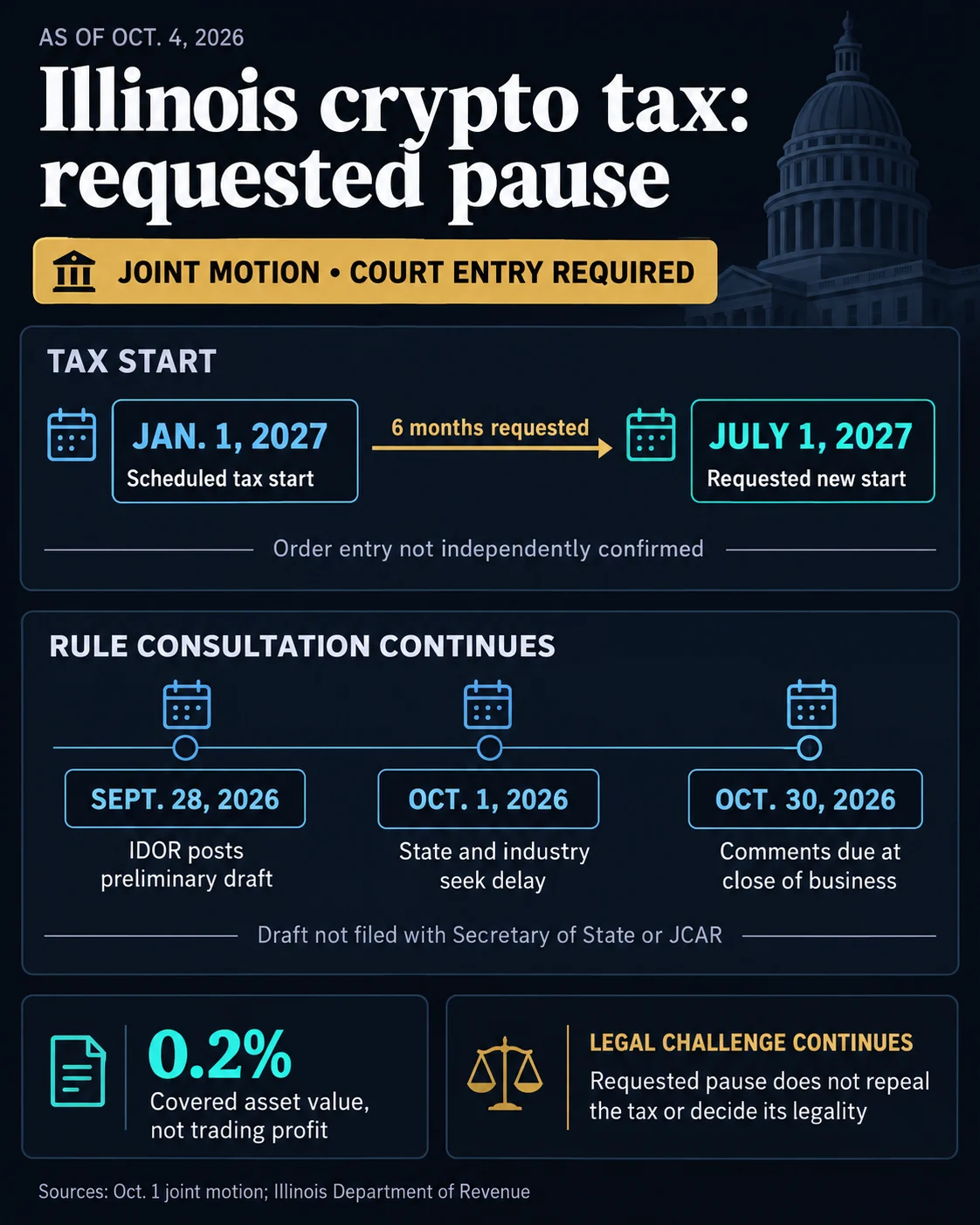
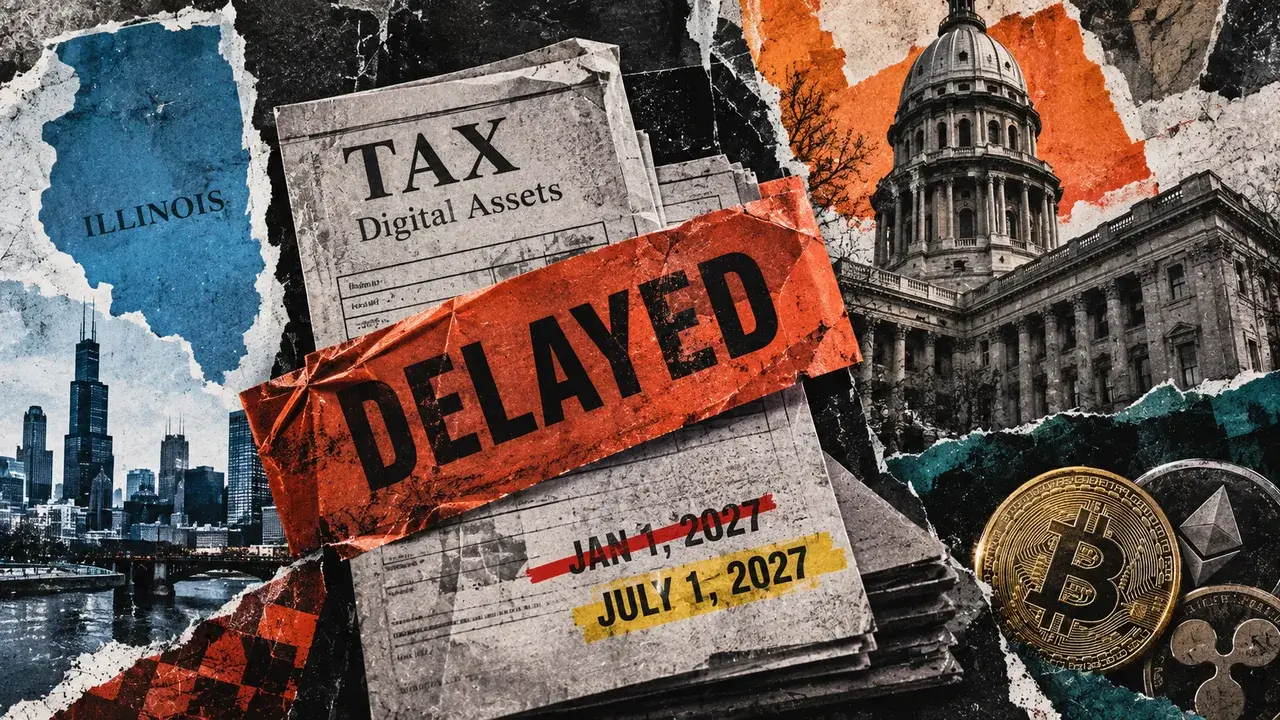
In a significant development for the digital asset landscape in the Midwest, Illinois state officials have joined forces with cryptocurrency industry advocates to request a six-month postponement of a controversial new tax on digital assets. The joint motion, filed on October 1 in Sangamon County, seeks to move the implementation date of the levy from January 1, 2027, to July 1, 2027. This move comes as the state grapples with intense legal challenges and an ongoing rulemaking process that has left many market participants uncertain about their future compliance obligations.
The agreement involves high-ranking state officials, including Revenue Director David Harris and Attorney General Kwame Raoul, who have consented to the delay despite the state’s continued defense of the underlying law. The request for a consent injunction is part of a broader legal battle initiated by The Digital Chamber and the Illinois Blockchain Association. These organizations have challenged the constitutionality of the tax, arguing that it creates an undue burden on a specific class of assets and lacks the clarity required for businesses to operate within the state.
The Mechanics of the Illinois Digital Asset Tax
The legislation in question, enacted in June, introduces a unique fiscal approach to the cryptocurrency sector. Unlike federal taxes, which generally focus on capital gains or income realized at the time of a sale, the Illinois Digital Asset Tax imposes a 0.2% levy on the gross value of digital assets involved in "covered transactions." This distinction is critical; the tax is triggered by the movement or transfer of assets rather than the profit generated by the holder.
According to draft rules released by the Illinois Department of Revenue, the scope of the tax is remarkably broad. A "covered transaction" can include fee-paid withdrawals from a centralized exchange to a self-custody wallet, provided certain statutory conditions are met. Conversely, direct peer-to-peer transfers that do not involve a "covered broker" may currently fall outside the immediate reach of the levy, though industry experts warn that the definitions remain fluid as rulemaking continues.
Under the proposed framework, brokers are designated as the primary collection agents. They are responsible for calculating, collecting, and remitting the 0.2% tax to the state. If a broker fails to fulfill this duty, they remain liable for the unpaid amounts. Perhaps more controversially, the law includes a "fallback obligation" for individual customers. If a broker does not charge the tax, the customer is legally required to calculate the amount owed and remit payment to the state by the 20th day of the month following the transaction.
Chronology of the Dispute and Legislative Timeline
The path to the current request for a delay has been marked by legislative speed followed by immediate industry pushback.
- June 2026: Illinois enacts the Digital Asset Tax as part of a broader revenue-seeking package. The law is scheduled to take effect at the start of the following year.
- Summer 2026: Industry groups, led by The Digital Chamber and the Illinois Blockchain Association, begin a public campaign highlighting the technical difficulties of implementing a value-based transaction tax.
- August 2026: A formal constitutional challenge is filed in Sangamon County, alleging that the tax violates both state and federal commerce clauses and creates an unequal playing field between digital assets and traditional securities.
- September 2026: The Illinois Department of Revenue releases draft rules for public comment. The draft receives heavy criticism for its complexity regarding asset valuation in a volatile market.
- October 1, 2026: State officials and industry plaintiffs file a joint motion for a consent injunction to delay the tax by six months.
- October 30, 2026: The deadline for public comments on the Department of Revenue’s draft rules.
- November 13, 2026: The revised deadline for the state to formally respond to the industry’s lawsuit.
- January 1, 2027: The original effective date, now pending a court-approved postponement.
- July 1, 2027: The proposed new start date for the levy.
Administrative and Technical Implementation Challenges
The decision to seek a delay is rooted in the immense technical hurdles associated with the tax. In the traditional financial world, a 0.2% tax on the value of a transaction is relatively straightforward because the value is denominated in fiat currency. In the cryptocurrency world, however, asset prices can fluctuate significantly within seconds.
Brokers have expressed concerns over which price index should be used to determine the "value" of an asset at the exact moment of a transfer. Furthermore, the integration of tax collection software into automated blockchain protocols presents a logistical nightmare. For many decentralized or hybrid platforms, the requirement to withhold a portion of a digital asset transfer to cover a state tax is functionally incompatible with existing smart contract architectures.
The Illinois Department of Revenue is still in the "consultation" phase. The draft rules have not yet been submitted to the Joint Committee on Administrative Rules (JCAR) or filed with the Secretary of State. This procedural gap means that even if the tax were to go live in January, the specific "how-to" of compliance would not be finalized, leaving businesses at risk of inadvertent non-compliance.
Reactions from Industry Stakeholders
The Digital Chamber has characterized the joint motion as a necessary reprieve for a sector that is vital to the state’s technological future. Representatives from the group have argued that the tax, as currently structured, would effectively drive crypto-native businesses out of Illinois and into more "tax-friendly" jurisdictions like Wyoming, Texas, or Florida.
"This delay is a recognition of the complexity and the potential for unintended economic consequences," stated a spokesperson for the Illinois Blockchain Association. "While we continue to believe the law is fundamentally flawed and unconstitutional, this six-month window provides a critical buffer for firms to engage with the Department of Revenue and for the court to weigh the merits of our challenge."
On the state’s side, the willingness of Revenue Director David Harris and Attorney General Kwame Raoul to join the motion suggests a pragmatic approach. While they maintain that the law is a valid exercise of state taxing authority, the prospect of implementing an unworkable system while a major lawsuit is pending appears to have motivated the compromise. The state’s primary goal remains the generation of revenue, but officials seem to realize that a botched rollout could lead to prolonged litigation and a loss of tax base if companies flee the state.
Broader Implications for State-Level Crypto Taxation
The situation in Illinois is being closely watched by legislators across the United States. While the federal government, through the IRS, has focused on capital gains and the "broker rule" for information reporting (1099-DA), Illinois is one of the first states to attempt a direct transaction-based levy on digital asset value.

If the Illinois tax eventually survives the legal challenge and is implemented, it could serve as a blueprint—or a cautionary tale—for other states looking to plug budget deficits. Critics argue that such taxes represent a form of "double taxation" or a "wealth tax" that traditional assets like stocks and bonds do not face, as those are typically only taxed upon sale or as part of an estate.
The six-month delay, if granted by the court, shifts the focus to the spring of 2027. During this time, the state must address several critical questions:
- Valuation Standards: Will the state mandate a specific exchange’s price or an average of several indices?
- Exemptions: Will small transactions or transfers between a single user’s wallets be clearly exempted to avoid "taxing the movement" rather than the "economic gain"?
- Privacy Concerns: How will the state handle the data collection requirements inherent in tracking individual transfers to and from self-custody wallets?
Conclusion and Next Steps
The filing of the joint motion does not signal the end of the legal battle, but rather a strategic pause. The Illinois state government has not conceded that the law is unconstitutional, nor has it indicated an intent to repeal the levy. Instead, both parties have agreed that rushing into a January 1 implementation would be detrimental to all involved.
For crypto companies operating in Illinois, the immediate pressure has lessened, but the long-term compliance requirement remains a looming reality. Firms are encouraged to continue participating in the public comment period ending October 30 to shape the final rules.
As the legal proceedings continue toward the new November 13 response deadline, the court in Sangamon County will ultimately decide whether to enter the consent injunction. If approved, the "crypto tax holiday" will extend through the first half of 2027, giving the industry more time to lobby for legislative changes or prepare for a new era of state-level digital asset taxation. The outcome will likely define Illinois’ reputation as either a hub for blockchain innovation or a jurisdiction with one of the most aggressive and complex tax regimes in the country.