Dwi Wanna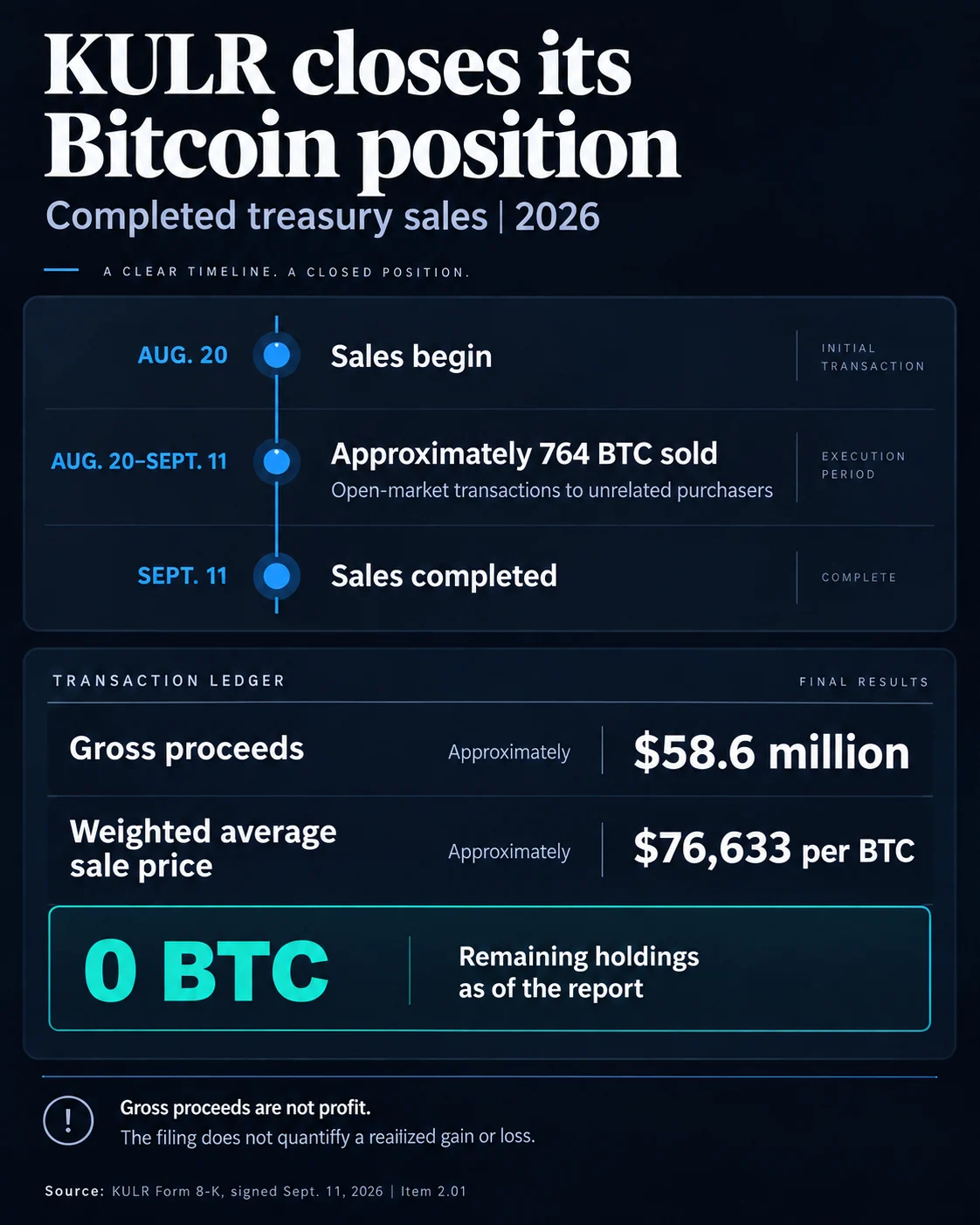
KULR Technology Group, a prominent developer of next-generation lithium-ion battery safety and thermal management technologies, has officially concluded its experimental foray into cryptocurrency. In a recent regulatory filing with the Securities and Exchange Commission (SEC), the company disclosed that it has liquidated its remaining Bitcoin holdings, marking a total retreat from a treasury strategy that had once aimed to diversify its balance sheet through digital assets. Between August 20 and September 11, 2026, the company sold approximately 764 BTC, generating gross proceeds of $58.6 million. This final divestment brings KULR’s Bitcoin balance to zero, effectively ending a chapter characterized by high volatility and a significant shift in corporate capital allocation.
The transactions were executed through a series of open-market sales to unrelated third parties at a weighted average price of approximately $76,633 per Bitcoin. This move follows an earlier, substantial reduction in the company’s crypto exposure during the summer of 2026. By offloading its remaining digital assets, KULR joins a growing list of mid-cap public companies that have reassessed the feasibility of holding large amounts of Bitcoin amid fluctuating market conditions and the pressing need to fund core industrial operations.
Strategic Realignment and the Pivot to Energy Storage
The decision to exit the Bitcoin market is not an isolated event but rather the culmination of a strategic pivot that began in the second quarter of 2026. KULR Technology Group has faced increasing pressure to streamline its operations and focus resources on its primary business: providing thermal management solutions for the aerospace, defense, and electric vehicle (EV) sectors. As the demand for high-performance battery safety increases—driven by global electrification trends and rigorous safety standards—KULR’s management determined that the capital tied up in cryptocurrency would be better utilized in research, development, and scaling its manufacturing capabilities.
The company’s initial venture into Bitcoin included not only treasury holdings but also the operation of proprietary mining infrastructure. However, the high energy costs and capital expenditure required to maintain a competitive mining edge often conflicted with the company’s broader sustainability and energy-efficiency goals. By shutting down its mining operations earlier this year and now clearing its treasury of the underlying asset, KULR is signaling to investors a renewed commitment to its "core energy platform."
A Detailed Timeline of the Liquidation Process
The unwinding of KULR’s Bitcoin position occurred in two distinct phases, reflecting a cautious but deliberate exit strategy. The first major sign of a retreat appeared in August 2026, when the company revealed it had sold 333 Bitcoin following the close of the second quarter on June 30. That initial sale generated approximately $21.5 million.
Of those initial proceeds, KULR directed roughly $20 million toward the repayment of principal debt owed to Coinbase. This debt had been a lingering obligation on the balance sheet, linked to the financing of its digital asset acquisitions. By settling this liability, KULR reduced its interest expenses and mitigated the risks associated with margin calls or collateral depreciation during periods of Bitcoin price volatility.
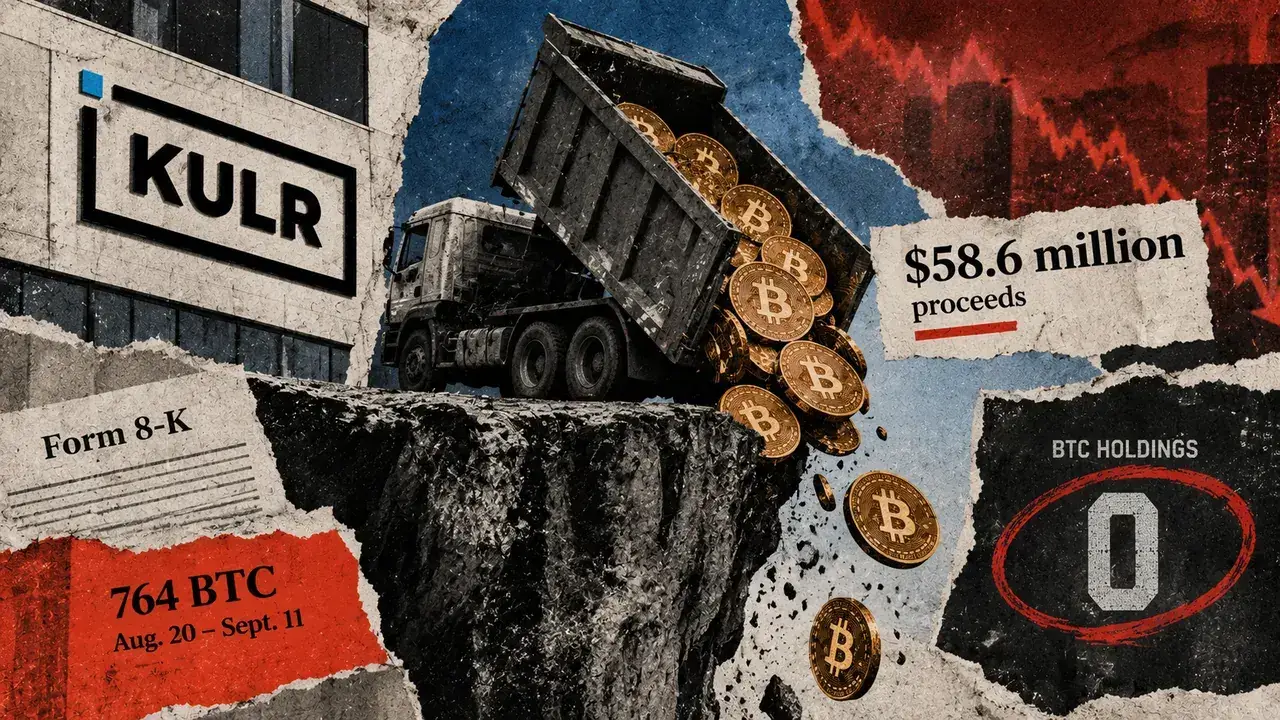
The second and final phase took place over a three-week window ending on September 11, 2026. During this period, the company liquidated the remaining 764 BTC. The timing of these sales coincided with a period of relative strength in the Bitcoin market, allowing KULR to exit at a weighted average price of $76,633. While the SEC filing did not specify the original cost basis for these specific coins, the gross proceeds of $58.6 million represent a significant liquidity injection for a company of KULR’s size.
Financial Analysis: Addressing Volatility and Debt
The "Bitcoin Playbook," popularized by firms like MicroStrategy, suggests that Bitcoin can serve as a superior reserve asset compared to cash. However, for KULR, the reality was more complex. Earlier reports indicated that treasury volatility had previously wiped out certain paper profits, at one point triggering a reported $22 million loss. For a technology company focused on hardware and industrial engineering, such swings in "other comprehensive income" can complicate earnings reports and deter risk-averse institutional investors.
By converting its Bitcoin into $58.6 million in cash, KULR has significantly strengthened its current ratio and general liquidity. Analysts suggest this move was necessary to fund the company’s transition into more capital-intensive projects, such as its KULR VIBE vibration reduction technology and its automated battery testing suites. The move also eliminates the "crypto discount" sometimes applied by traditional analysts who struggle to value companies with large, volatile digital asset holdings.
The $20 million repayment to Coinbase remains a focal point for financial observers. It illustrates the dangers of using leverage to build a corporate Bitcoin treasury. When the asset’s price fluctuates, the debt-to-equity ratio can become strained, forcing companies to sell at times they might not otherwise choose. KULR’s decision to prioritize debt reduction over "HODLing" suggests a conservative shift in its fiscal policy.
The Broader Impact on Corporate Bitcoin Adoption
KULR’s exit serves as a cautionary tale for other public companies considering a similar treasury path. While Bitcoin has gained legitimacy as an institutional asset class, its role on the balance sheets of non-crypto-native companies remains a subject of intense debate.
For large-cap companies with billions in excess cash, such as Tesla or Block, a small percentage of Bitcoin exposure may be manageable. For mid-sized technology firms like KULR, however, the opportunity cost of holding a non-productive asset can be high. The $58.6 million recovered from the final sale represents capital that can now be deployed into high-yield industrial contracts, intellectual property acquisitions, or the expansion of production facilities in North America.
Furthermore, the regulatory environment for corporate crypto holdings has become more rigorous. Changes in accounting standards, such as those proposed by the Financial Accounting Standards Board (FASB) regarding fair-value accounting for digital assets, mean that companies must be more transparent—and perhaps more vulnerable—to the immediate market pricing of their holdings. KULR’s management likely viewed the total disposal of the asset as a way to simplify its financial reporting and return the focus to its operational metrics: revenue growth, gross margins, and contract wins.

Official Responses and Market Reaction
While KULR has not issued a separate press release specifically "celebrating" the exit, the language in the 8-K filing was strictly procedural. The company stated the sales were part of its "treasury management operations." This neutral tone is common among companies looking to move past a failed or concluded strategic experiment without drawing undue negative attention to previous losses.
Market reactions have been mixed. Some crypto-focused investors view the exit as a missed opportunity to benefit from future Bitcoin appreciation. Conversely, industrial and energy sector analysts have largely praised the move. "KULR is a battery safety company, not a hedge fund," noted one analyst following the energy storage sector. "Seeing them return to a cash-heavy balance sheet that supports their R&D pipeline is a net positive for long-term stability."
The company has stopped short of issuing a permanent ban on future cryptocurrency transactions. The filing records the disposal of current holdings but leaves the door ajar for future "treasury management" decisions. However, given the recent closure of its mining division and the total liquidation of its reserves, a return to the crypto market seems unlikely in the near to medium term.
Future Outlook: Reinvesting in Thermal Management
With $58.6 million in new gross proceeds and a cleaner balance sheet, KULR Technology Group is well-positioned to capitalize on the "Green Energy" boom. The company’s specialized thermal runaway shield (TRS) technology is currently used by NASA to protect astronauts and sensitive equipment on the International Space Station. Bringing this level of safety to consumer electronics and large-scale energy storage systems (BESS) is the company’s stated priority.
The liquidation of the Bitcoin treasury provides the "dry powder" necessary to compete for large-scale government and private sector contracts. As the world moves toward 2030 sustainability goals, the demand for KULR’s core products—safe, efficient, and high-capacity battery solutions—is expected to grow. By shedding its Bitcoin holdings, KULR has effectively chosen to bet on its own engineering prowess rather than the price of a digital currency.
In conclusion, KULR’s exit from the Bitcoin market marks the end of an era of corporate speculation for the firm. The $58.6 million sale completes a retreat that prioritizes financial stability, debt reduction, and a focus on the energy technology sector. As the company moves forward, its performance will be judged not by the price of Bitcoin, but by its ability to innovate in the critical field of battery safety and energy management.