Dwi Wanna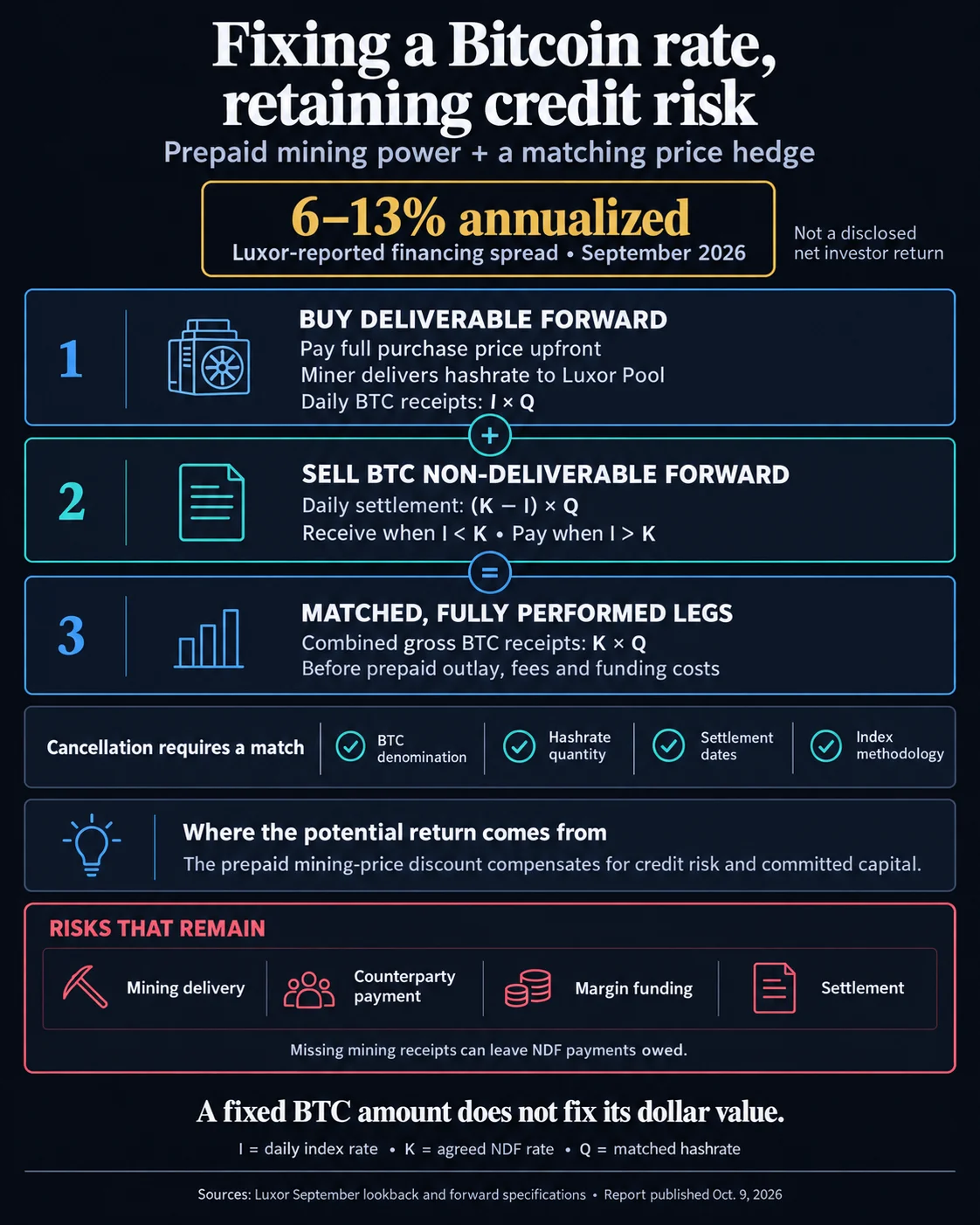
Luxor, a prominent provider of Bitcoin mining derivatives and hashrate services, released its September lookback report on October 9, revealing that the annualized Bitcoin financing spread within its ecosystem ranged between 6% and 13%. This performance metric highlights a sophisticated financial maneuver where institutional lenders and Bitcoin treasury companies acquire prepaid mining power, pairing the purchase with a price hedge to lock in returns, while Bitcoin miners utilize the reverse of this trade to secure essential upfront financing for their operations. The report underscores a significant shift in the cryptocurrency landscape, as mining evolves from a purely speculative activity into a structured asset class characterized by complex yield-generating strategies and rigorous risk management protocols.
The Mechanics of the Bitcoin Financing Spread
The annualized return identified by Luxor is fundamentally derived from the discount a miner accepts in exchange for receiving capital upfront. In the volatile world of Bitcoin mining, liquidity is often the primary constraint for scaling operations. By selling future hashrate—the computational power used to secure the Bitcoin network—at a discount, miners can bypass traditional banking hurdles and access immediate funds for hardware procurement or energy costs.
The "spread" refers to the difference between the cost of the prepaid hashrate and the fixed revenue generated through a hedged position. To understand this, one must look at "hashprice," a metric Luxor uses to quantify the daily revenue potential of a unit of computing power, expressed in either Bitcoin or U.S. dollars. When an investor buys future hashrate via a deliverable forward (DF) contract, they are essentially purchasing a claim on the income that power will generate over a specified duration.
In a deliverable forward contract, the buyer pays the full purchase price at the outset. The seller, typically a mining entity, is then obligated to direct their hashrate to Luxor’s Bitcoin Mining Pool. The buyer’s daily Bitcoin settlement is tied directly to the hashprice index and the contracted volume of mining power. Luxor notes that these deliverable forwards typically trade at a lower price than non-deliverable forwards (NDFs) to compensate the buyer for the inherent credit risk and the opportunity cost of committing capital upfront.
The Role of the Hedged Trade
The 6% to 13% spread reported for September is not a passive yield; it is the result of a "paired trade." Without a hedge, a buyer of hashrate remains fully exposed to the fluctuations of mining difficulty and the market price of Bitcoin. To mitigate this, institutional investors often sell a non-deliverable forward (NDF) alongside their physical hashrate purchase.
The NDF is a cash-settled contract that does not require the physical delivery of mining power. In this arrangement, the daily settlement is calculated as the difference between the agreed-upon fixed hashprice and the actual index rate for that day, multiplied by the contracted hashrate. If the actual index rate falls below the fixed price, the NDF seller (the investor) receives the difference. Conversely, if the index rate rises, the seller owes the difference.
When these two legs—the physical hashrate purchase and the NDF sale—are perfectly matched in terms of Bitcoin denomination, quantity, and settlement dates, the price exposures effectively cancel each other out. The result is a fixed rate of return that depends on the initial discount of the prepaid purchase relative to the fixed NDF rate. However, Luxor cautions that this "locked-in" return is contingent upon the performance of the entire repayment chain, including the physical delivery of hashrate by the miner.
Chronology of the September Market Performance
The data released on October 9 follows a month of relative stability in the Bitcoin network’s hashprice, though the broader mining industry continues to grapple with the aftermath of the April 2024 halving event, which slashed block rewards by 50%.
Throughout September, Luxor observed a steady demand for financing as miners sought to upgrade to more efficient hardware, such as the Bitmain Antminer S21 series, to maintain profitability. The 6% to 13% annualized spread recorded during this period reflects a market where lenders demanded a premium for credit risk while miners were willing to pay for liquidity to avoid selling their BTC holdings at perceived local bottoms.
The report also indicates that the reported range does not represent a guaranteed quote for today’s market but rather a historical lookback of executed or available spreads during the September window. Luxor’s product suite currently supports monthly contracts extending up to 18 months, allowing for a variety of tenors that contribute to the aggregate annualized figures.

Risk Management and the Repayment Chain
The primary risk in this financing model is "delivery failure." If a miner fails to provide the promised hashrate—due to equipment malfunction, power outages, or financial insolvency—the investor’s hedge remains active. In a scenario where the settlement hashprice exceeds the NDF’s fixed rate, the investor would owe a cash payment on the hedge without receiving the corresponding mining revenue to cover it.
To address these risks, Luxor acts as the central counterparty for both the buyer and the seller in its order-book ecosystem. This makes Luxor’s own operational and financial stability a critical link in the repayment chain. The company employs a rigorous credit profiling process for sellers before any funds are advanced. This includes:
- Technical Verification: Reviewing mining-site documentation, power purchase agreements (PPAs), and pool performance history.
- Financial Scrutiny: Analyzing financial statements, insurance coverage, and existing future obligations.
- Performance Bonds: Requiring guarantors or performance bonds in certain high-risk scenarios.
- Margin Requirements: Implementing collateral policies to protect against market volatility.
Luxor’s margin policy requires Bitcoin collateral for BTC-denominated contracts. The company’s public documentation specifies an initial margin of approximately 17.5% to 18%, though these rates can be adjusted based on the creditworthiness of the participants. These "variation margins" are collected when realized or unrealized balances fall below maintenance requirements, ensuring that the hedge remains adequately capitalized.
Institutional Participation and Market Access
The 6% to 13% spread is largely an institutional phenomenon. Luxor’s derivatives products are restricted to "Eligible Contract Participants" (ECPs). Under U.S. regulatory standards, an ECP generally includes entities with more than $10 million in assets or entities with a net worth of at least $1 million that are hedging a specific commercial risk.
A notable example of this institutional adoption is Steelhead Capital Management. In a case study cited by Luxor, Steelhead utilized the hashrate forward market to "lend with confidence." By purchasing physical hashrate upfront and adding an NDF to fix the hashprice, Steelhead was able to generate a predictable return while providing necessary capital to the mining sector. This structure allows traditional credit funds to gain exposure to Bitcoin mining yields without the operational burden of running hardware.
Analysis of Broader Implications
The existence of a 6% to 13% annualized Bitcoin financing spread has several long-term implications for the cryptocurrency ecosystem:
1. Stabilization of Mining Revenue: By allowing miners to lock in prices and receive upfront capital, these derivatives reduce the "boom and bust" cycle associated with mining. This stability can lead to more sustainable growth and better long-term planning for infrastructure projects.
2. Maturation of Bitcoin as a Treasury Asset: For companies holding Bitcoin on their balance sheets, the ability to earn a 6-13% return on their BTC through hashrate financing—rather than just holding the asset—presents a compelling alternative to traditional corporate treasury strategies.
3. Integration with Traditional Finance: The use of NDFs, margin policies, and credit profiling brings Bitcoin mining closer to the standards of global commodities trading. As these markets become more liquid and transparent, they are likely to attract a wider array of institutional capital from hedge funds and private equity firms.
4. Pressure on Retail Miners: As institutional players utilize sophisticated hedging to secure lower-cost capital and guaranteed returns, retail miners who operate without these financial tools may find themselves at a competitive disadvantage, further driving the industrialization of the sector.
Conclusion
Luxor’s September lookback provides a rare glimpse into the "engine room" of Bitcoin mining finance. The reported 6% to 13% annualized spread serves as a benchmark for the cost of capital in a sector that is increasingly defined by financial engineering rather than just raw computational power. While the risks of delivery failure and counterparty default remain significant, the development of robust margin policies and credit checks suggests a maturing market. For institutional investors, the ability to capture a "mining yield" through a hedged, delta-neutral strategy represents a new frontier in digital asset management, bridging the gap between the physical reality of Bitcoin production and the requirements of modern finance.