admin
admin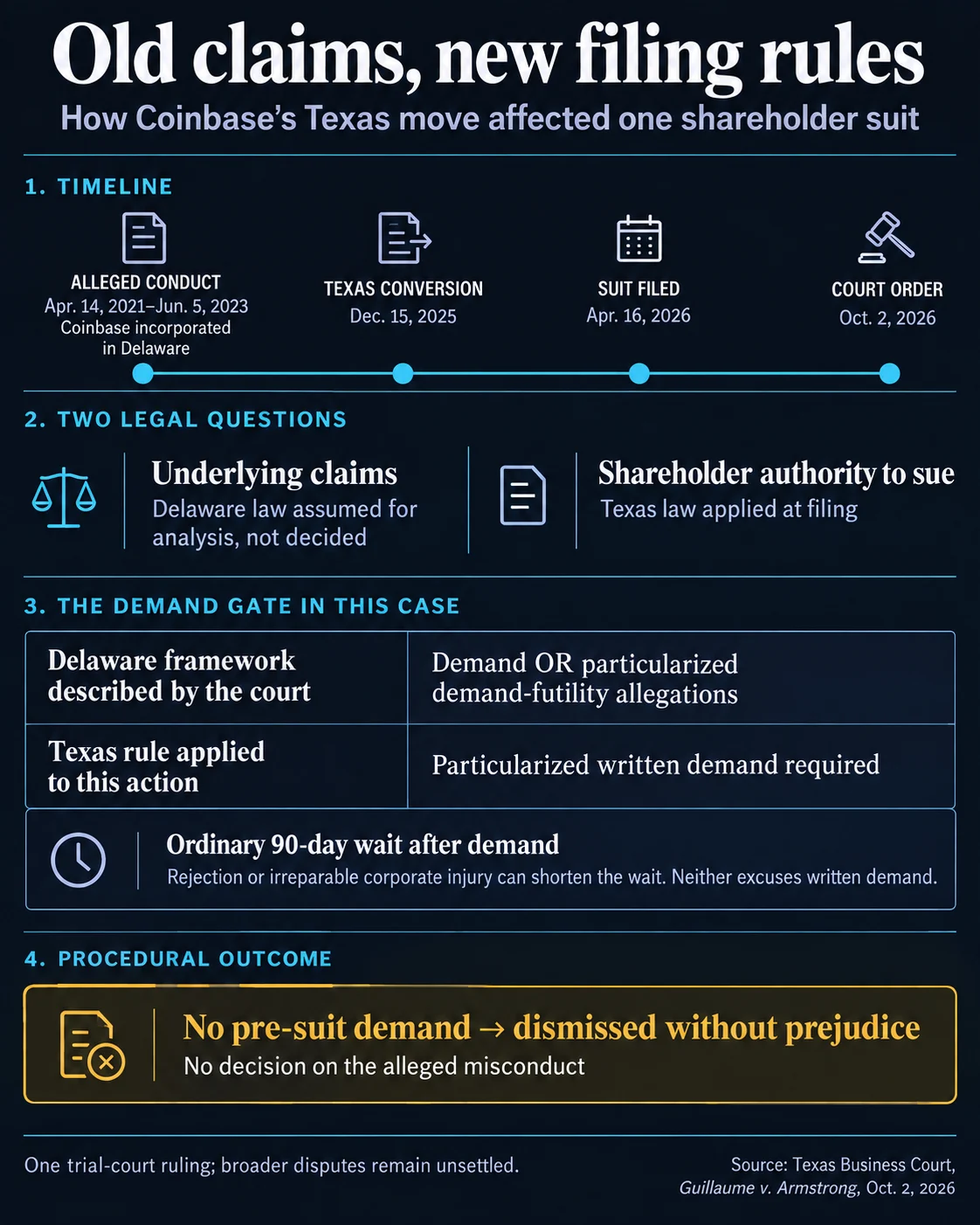
The recent relocation of cryptocurrency exchange Coinbase from Delaware to Texas has introduced a significant legal hurdle for shareholders seeking to pursue derivative lawsuits against the company’s directors concerning actions taken during its Delaware tenure. In a landmark October 2 ruling, the Texas Business Court dismissed a derivative action brought by shareholder Gary Guillaume, citing his failure to first formally demand that Coinbase itself take action on the alleged grievances. This decision, while not delving into the merits of the accusations, has profound implications for corporate governance and shareholder rights, particularly in instances of reincorporation.
The core of the dispute lies in the differing procedural requirements for initiating derivative lawsuits in Delaware and Texas. A derivative action is a legal tool that empowers a shareholder to sue on behalf of a corporation, effectively stepping into the shoes of the board of directors when the board is unwilling or unable to pursue claims belonging to the company. This mechanism is designed to hold corporate leadership accountable when internal remedies have failed.
Guillaume’s lawsuit, filed on April 16, 2026, targeted alleged misconduct by Coinbase directors spanning from April 14, 2021, to June 5, 2023. During this period, Coinbase was incorporated in Delaware. The company’s official conversion to a Texas entity became effective on December 15, 2025, several months prior to Guillaume filing his suit.
Under Delaware law, a shareholder initiating a derivative suit generally has two options: either make a formal demand on the board of directors to address the alleged wrongdoing, or plead that such a demand would be futile. The futility exception is a critical safeguard, allowing shareholders to bypass the demand requirement if they can demonstrate with particularized allegations that the directors are personally conflicted, face a substantial likelihood of liability, or lack independence from those who benefited from or were involved in the alleged misconduct. Typically, at least half of the relevant board members must meet this futility threshold.
Gary Guillaume opted for the latter route, attempting to plead futility rather than making a pre-suit demand. However, the Texas Business Court, presided over by Judge Andrea K. Bouressa, found this approach insufficient under Texas law. The court stipulated that for public companies, Texas mandates a specific, written demand that clearly identifies the disputed conduct and requests appropriate corporate action. This demand is followed by a standard 90-day waiting period, during which the corporation is expected to investigate and respond. Derivative proceedings are generally permitted only after this period has elapsed, though exceptions exist if the corporation rejects the demand or if irreparable harm to the corporation is evident. Crucially, even these exceptions do not negate the initial written demand requirement.
Guillaume’s allegations of futility, while potentially valid under Delaware law, could not substitute for the explicit written request mandated by Texas statutes. Consequently, the court dismissed his action without prejudice, meaning he can refile the suit if he complies with the Texas demand requirement. The dismissal was solely based on this procedural deficiency, and the court explicitly stated that it did not adjudicate the validity of the underlying claims or whether the alleged misconduct actually occurred.
The Jurisdictional Disconnect: Delaware Claims, Texas Procedure
A key point of contention in the case was the applicable law. Guillaume argued that Delaware law should govern the lawsuit, as the alleged misconduct took place during Coinbase’s incorporation in that state. Judge Bouressa, for the purpose of her analysis, accepted this premise regarding the underlying claims. However, she then confronted a separate, pivotal question: which state’s law dictated the shareholder’s authority to initiate a derivative action at the time of filing?
The court’s reasoning centered on the company’s state of incorporation at the moment the shareholder sought to exercise their right to sue derivatively. The opinion clarified that while a corporate claim might arise under one state’s laws, the procedural framework for pursuing that claim derivatively could be governed by the laws of the state where the company is incorporated at the time of the lawsuit. The court reasoned that a shareholder does not possess a vested right to pursue a corporate claim personally at a later date, simply because the claim originated during a different period of incorporation.
This interpretation imbues the act of reincorporation with substantial consequences, extending beyond future corporate decisions to the very avenue through which past alleged wrongdoing can be challenged. Coinbase’s conversion to a Texas entity in December 2025, therefore, retroactively altered the procedural landscape for shareholders seeking to litigate conduct that occurred as far back as 2021.
Coinbase’s disclosures related to its conversion also became a focal point. Guillaume pointed to language within these disclosures that he believed preserved shareholders’ standing and ability to bring derivative claims concerning prior conduct, provided they maintained continuous ownership. However, the court’s interpretation of this language was more restrictive. Judge Bouressa noted that the disclosures did not guarantee that Delaware law would continue to govern shareholder authority post-conversion. Furthermore, the documents explicitly stated that Texas law would govern Coinbase’s affairs following the move.

The court also found that Guillaume failed to present any argument or evidence demonstrating that complying with the Texas demand requirement would cause him irreparable harm, be impossible, or otherwise prejudice his ability to pursue the claims. He had not established that the ability to plead futility under Delaware law provided him with a unique or indispensable advantage that would be lost. The court also found no evidence that Coinbase had contractually circumvented the Texas demand requirement.
A Shift in Corporate Governance and Shareholder Accountability
The implications of this ruling are far-reaching, particularly for companies considering or having undergone reincorporation. The decision underscores the principle that a company’s domicile at the time a legal action is initiated dictates the procedural rules governing that action, even if the alleged underlying misconduct predates the move.
Coinbase’s decision to relocate to Texas was motivated by several factors, as outlined in its regulatory filings. The company cited a desire for greater litigation predictability, potential cost savings in defense, indemnification, and insurance, and Texas’s burgeoning reputation as a crypto-friendly jurisdiction. This strategic move, seemingly aimed at optimizing its legal and regulatory environment, has now demonstrably impacted the avenues available for shareholder oversight and accountability.
The governance structure of Coinbase further contextualizes this ruling. In November 2025, a significant majority of the company’s voting power, approximately 78.40%, was held by a group associated with CEO Brian Armstrong and co-founder Fred Ehrsam. This group approved the conversion to Texas by written consent. The company stated that a committee of independent directors evaluated various jurisdictions before recommending Texas, citing benefits such as enhanced litigation predictability.
However, the concentration of voting power also suggests a robust internal control mechanism. While Coinbase’s information statements and proxy filings reveal varying percentages of voting power held by Armstrong and Ehrsam over time, they consistently indicate that key individuals and associated entities collectively possess the ability to exercise majority voting rights. This concentrated ownership structure can influence the board’s responsiveness to shareholder concerns and, in turn, the necessity and effectiveness of derivative litigation.
The ruling in Guillaume v. Armstrong sets a significant precedent for companies contemplating or executing reincorporations. It highlights a critical distinction between the substantive law governing alleged corporate malfeasance and the procedural law governing a shareholder’s ability to challenge that malfeasance. For shareholders, this means that the legal framework for asserting their rights can shift not only based on where a company is incorporated but also on when that incorporation change occurs relative to their decision to pursue legal action.
The Broader Impact on Shareholder Rights and Corporate Mobility
The Texas Business Court’s decision in Guillaume v. Armstrong serves as a potent reminder that corporate mobility, while offering potential benefits, can introduce complex jurisdictional dynamics for shareholders. Companies that reincorporate may find that their chosen new domicile’s procedural rules, such as Texas’s mandatory written demand requirement for derivative suits, can significantly alter the landscape of shareholder litigation.
This ruling could incentivize other companies to consider reincorporation in jurisdictions with procedural rules that may be perceived as more favorable to corporate management, particularly in managing shareholder-initiated legal challenges. Conversely, it may prompt shareholders and their legal counsel to be more attuned to the procedural requirements of a company’s current state of incorporation when contemplating derivative actions, especially in the context of recent reincorporations.
The endorsement of the ruling by Coinbase CEO Brian Armstrong, who praised it as potentially encouraging more companies to incorporate in Texas, underscores the strategic significance of this legal development. This statement, made shortly after the court’s order, suggests that the company views this decision as validation of its move and a positive signal for future corporate migration to Texas.
In conclusion, the Coinbase reincorporation case has illuminated a critical intersection of corporate law and procedural justice. While the allegations of misconduct remain unadjudicated, the Texas Business Court’s ruling has definitively established that a company’s domicile at the time a shareholder attempts to initiate a derivative lawsuit dictates the procedural pathway, even when the alleged wrongdoing occurred under a previous jurisdiction. This decision carries substantial weight for the future of corporate governance, shareholder rights, and the strategic considerations surrounding corporate relocation in an increasingly mobile global economy. Shareholders must now navigate a more intricate legal terrain, where the timing and location of a company’s incorporation can significantly influence their ability to hold corporate directors accountable.