admin
admin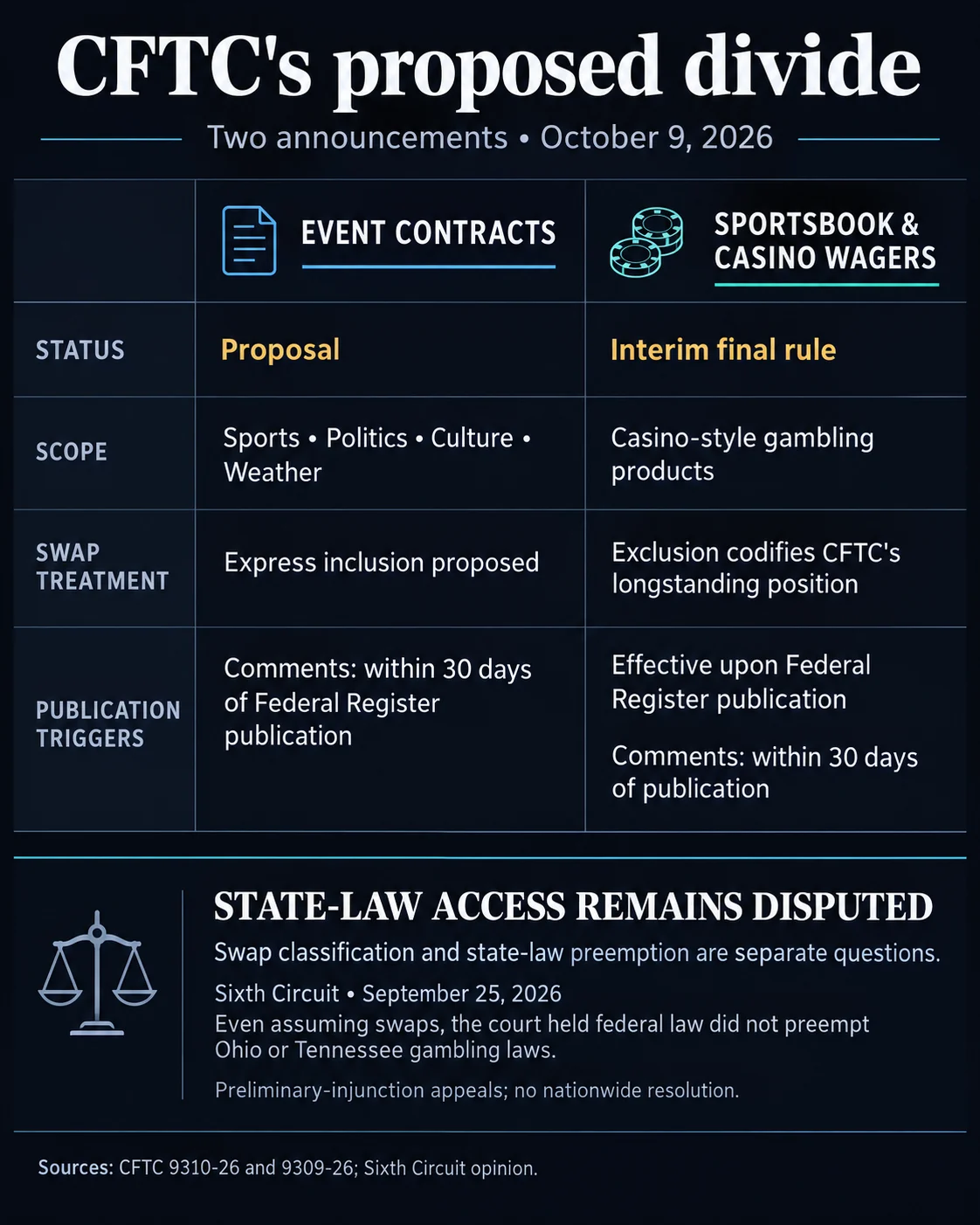
The Commodity Futures Trading Commission (CFTC) has taken a significant step towards clarifying the regulatory landscape for event-based financial instruments, proposing to explicitly define prediction market contracts as swaps while simultaneously solidifying the exclusion of traditional sportsbook and casino wagers. Announced on October 9th, these two distinct actions aim to draw a clearer federal boundary, though they leave in their wake ongoing disputes regarding state-level access and the interpretation of existing gambling laws.
The proposed rule, specifically targeting event contracts that encompass outcomes from sports, political elections, cultural events, and even weather phenomena, seeks to bring these products squarely under the CFTC’s exclusive jurisdiction as defined by the Commodity Exchange Act (CEA). CFTC Chairman Michael S. Selig articulated that these instruments, by their nature, fall within the purview of financial derivatives that the agency is mandated to oversee. This classification is crucial because, while these contracts may bear a superficial resemblance to wagers, their underlying mechanics and regulatory framework differ significantly.
Prediction market contracts typically allow participants to acquire binary positions—essentially "yes" or "no" options—on the likelihood of a future event occurring, with a predetermined fixed payout, often standardized at $1. The value of these contracts fluctuates based on the perceived probability of the event’s outcome, offering avenues for both hedging against financial risk and engaging in speculative investment. This distinction is vital for understanding the regulatory approach. For instance, platforms like Polymarket, which facilitate the trading of these outcome-based contracts, operate within a different legal and operational paradigm compared to sportsbooks like Cloudbet, which focus on odds-based wagering.
The proposed inclusion of event contracts as swaps is not yet a final determination. The CFTC has opened a 30-day public comment period, inviting written submissions through Regulations.gov, following the proposal’s publication in the Federal Register. This period allows stakeholders, industry participants, and the public to voice their perspectives and provide crucial feedback on the proposed regulatory framework.
Concurrently, the CFTC has also issued an interim final rule to formally codify its long-standing position that casino-style gambling products, including those offered by sportsbooks and traditional casinos, are explicitly excluded from the definition of a swap. This action aims to provide greater regulatory certainty by formally documenting a stance that has been implicitly applied for some time. The interim final rule is slated to take effect immediately upon its publication in the Federal Register, also subject to a 30-day comment window. While the announcements were made on October 9th, the precise Federal Register publication dates are yet to be confirmed, meaning the effective dates and comment deadlines have not yet been firmly established.
The regulatory divide being drawn by the CFTC highlights a fundamental difference in how these financial instruments are perceived and governed. Swaps, as financial derivatives, are subject to the robust regulatory oversight designed to ensure market integrity, transparency, and stability. Gambling, on the other hand, is primarily regulated at the state level, with a focus on consumer protection, preventing fraud, and managing social impacts. By proposing to classify event contracts as swaps, the CFTC asserts its authority to regulate them as financial products, distinct from the state-controlled domain of gambling.
However, the implications of these federal actions are far from straightforward, particularly when it comes to the intersection of federal jurisdiction and state law. A recent ruling by the Sixth Circuit Court of Appeals on September 25th shed significant light on this complex interplay. In preliminary injunction appeals involving Kalshi, a prediction market operator, the court determined that the company had not sufficiently demonstrated that its sports-event contracts met the statutory definition of a swap. More consequentially, the court also held, in the alternative, that even if the contracts were deemed swaps, the CEA did not expressly or implicitly preempt the gambling laws of Ohio or Tennessee.
This alternative holding from the Sixth Circuit underscores a critical challenge for operators seeking to offer their products nationwide. Successfully arguing for a product’s classification as a regulated financial instrument does not automatically grant immunity from existing state gambling statutes. This means that platforms dealing in event contracts, even if recognized as swaps by the CFTC, may still face legal hurdles and potential conflicts with state-level prohibitions on gambling. The dual regulatory environment creates a complex and potentially fragmented market access scenario.
The distinction drawn by the CFTC has also drawn scrutiny from advocacy groups concerned with market regulation and consumer protection. Benjamin Schiffrin, securities-policy director at Better Markets, issued a statement on October 9th, criticizing the CFTC’s approach. He argued that sports event contracts effectively function as a form of sports betting and, therefore, should remain subject to the purview of state gambling laws, not be reclassified as financial derivatives. This perspective highlights a fundamental disagreement on the core nature and appropriate regulatory oversight of these increasingly popular financial instruments.
The broader context for these regulatory moves involves the burgeoning growth of both prediction markets and the online gambling industry. As technology advances and consumer interest in these sectors expands, regulatory bodies are compelled to adapt and clarify their roles. The CFTC’s actions can be seen as an attempt to proactively address potential regulatory gaps and ambiguities before they escalate into widespread market disruptions or consumer protection issues. The agency’s move is also likely influenced by increasing interest from institutional investors and financial firms in participating in markets that offer exposure to real-world event outcomes.
Furthermore, the evolution of prediction markets has seen them move beyond simple yes/no outcomes to more complex contract structures, mirroring some of the sophistication found in traditional financial markets. This increasing complexity necessitates a clear regulatory framework to ensure fair trading practices and to prevent potential market manipulation. The CFTC’s proposed inclusion of these contracts as swaps aligns with its mandate to regulate derivatives markets, which are designed to manage risk and facilitate price discovery for a wide range of underlying assets, including events.

The timeline leading up to these proposals has been marked by ongoing debate and legal challenges. For years, the distinction between regulated financial instruments and gambling has been a grey area, exploited by some platforms seeking to operate with less stringent oversight. The Sixth Circuit’s ruling, in particular, serves as a significant judicial precedent that the CFTC’s current actions aim to navigate. By proposing to define event contracts as swaps, the CFTC is attempting to assert federal regulatory authority, but the Sixth Circuit’s preemption ruling suggests that state laws may still hold considerable sway.
The implications of these CFTC actions are multifaceted. For prediction market operators, clarity on their regulatory status is paramount. If classified as swaps, they will likely need to comply with CFTC regulations, which can involve registration, reporting, and capital requirements. This could lead to increased operational costs and a more rigorous compliance environment. However, it could also lend legitimacy to their operations and potentially attract a wider range of sophisticated investors.
For the traditional gambling industry, the interim final rule offers a clear confirmation that their operations remain outside the CFTC’s direct regulatory ambit. This provides a degree of stability and reinforces the existing state-based regulatory structure for sportsbooks and casinos. However, it does not resolve the underlying tension regarding the increasing overlap in functionality and consumer interest between prediction markets and sports betting.
The broader economic impact could be significant. A well-regulated prediction market could become a valuable tool for hedging and price discovery across various sectors. For example, businesses could use event contracts to hedge against weather-related risks impacting supply chains, or political campaigns could use them to gauge public sentiment. Conversely, if the regulatory landscape remains fragmented or overly restrictive, the potential for these markets to develop and serve these economic functions could be hampered.
The CFTC’s dual approach—proposing inclusion for event contracts and confirming exclusion for casino wagers—reflects a deliberate effort to distinguish between financial derivatives and pure gambling. The agency is essentially drawing a line in the sand, asserting that contracts whose value is derived from future events and which can be traded on exchanges with fixed payouts, fit the definition of a swap. This classification is intended to bring them under the robust regulatory framework of the CEA, aimed at ensuring market integrity and investor protection.
In conclusion, the CFTC’s recent proposals mark a pivotal moment in the regulation of event-based financial products. By seeking to classify prediction market contracts as swaps and explicitly excluding traditional gambling, the agency is attempting to impose order on a rapidly evolving market. However, the legal battles and ongoing debates, particularly concerning the extent to which federal regulations preempt state gambling laws, indicate that the journey towards a fully resolved regulatory landscape is far from over. The forthcoming public comments and potential further legal challenges will undoubtedly shape the future of how these instruments are regulated and accessed across the United States. The balance between fostering innovation in financial markets and protecting consumers from the risks associated with gambling remains a delicate act for regulators.