admin
admin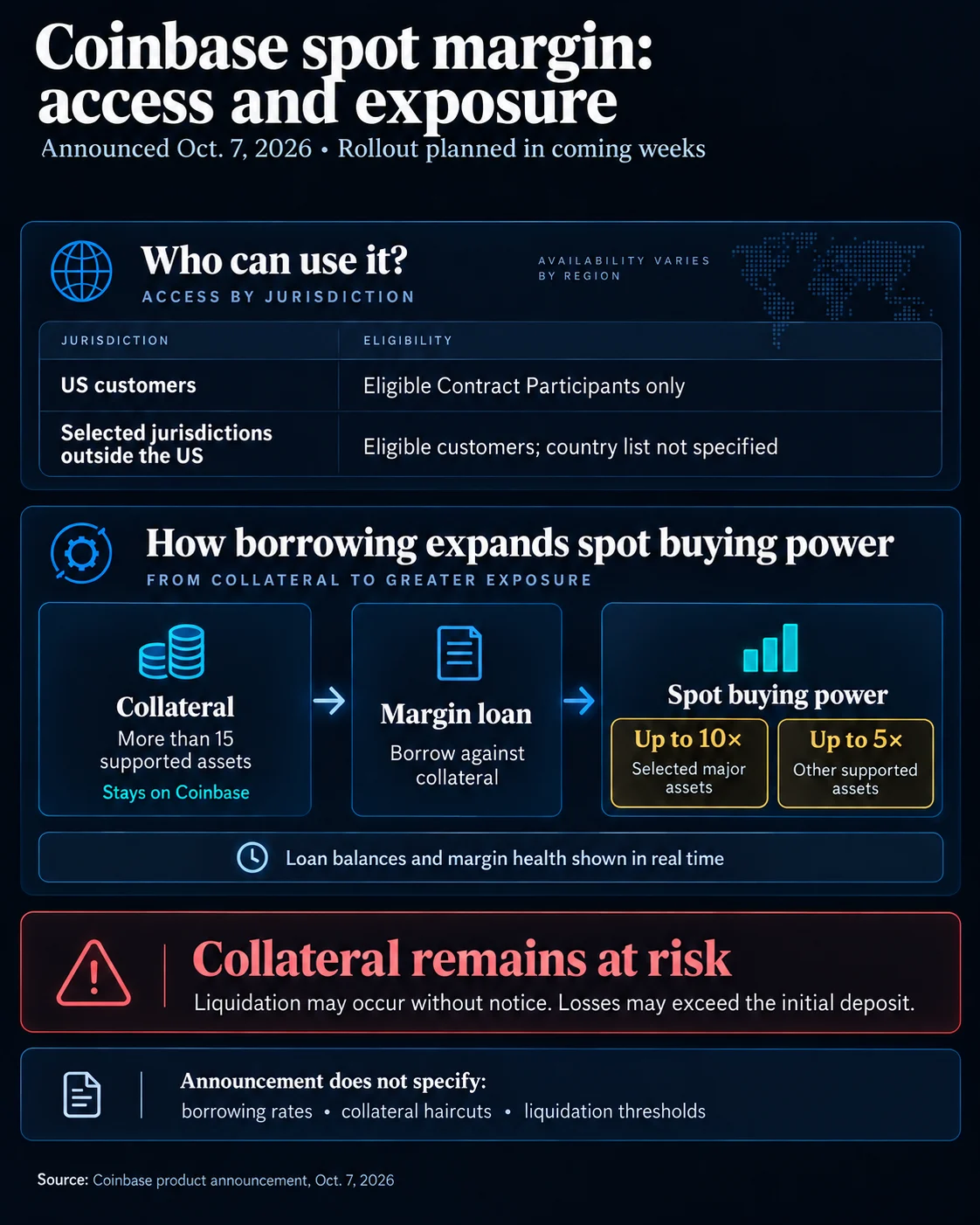
Coinbase is set to roll out a new spot borrowing feature allowing eligible traders to leverage their positions up to 10 times, a move that significantly expands trading capabilities for a select group of its users. However, the exchange has confirmed that the vast majority of U.S. retail customers will be excluded from this offering due to regulatory restrictions. The introduction of higher leverage amplifies both potential gains and losses, placing collateral at risk of forced liquidation, a stark reminder of the inherent volatility within leveraged cryptocurrency trading.
The announcement, made on October 7th, positions this new service as a key development in Coinbase’s strategy to build a more comprehensive trading platform. The spot borrowing feature will permit qualified traders to borrow against their existing crypto collateral, enabling them to increase their exposure in spot market trades. This effectively allows traders to magnify their buying power, potentially capitalizing on market movements with a smaller initial capital outlay. The rollout is slated to occur in the coming weeks, with availability contingent on customer eligibility and specific jurisdictions. Coinbase has not yet provided a definitive list of these eligible countries, leaving potential users in a state of uncertainty regarding their access.
For individuals within the United States, the eligibility criteria are stringent. The U.S. Commodity Futures Trading Commission (CFTC), the nation’s derivatives regulator, has previously outlined definitions for "Eligible Contract Participants" (ECPs). As described in a 2021 statement by a CFTC commissioner, this typically includes entities or individuals with discretionary investments exceeding $10 million in aggregate, or $5 million if the transaction is for risk management purposes. This high threshold effectively places the planned 10x leverage service beyond the reach of ordinary U.S. retail investors, who are more likely to operate with smaller capital allocations.
This restriction specifically pertains to the spot borrowing product. Coinbase has clarified that this service is being offered through its international affiliates, such as Coinbase Custody International Limited or Coinbase Credit, Inc., and is distinct from Coinbase Financial Markets, which handles derivatives trading for U.S. customers. While traders will manage both spot borrowing and derivatives exposure within a unified margin portfolio, the underlying lending entities are positioned to navigate different regulatory frameworks.
The timing of this announcement follows closely on the heels of Coinbase’s successful migration of Deribit, a major derivatives exchange, which was completed on October 2nd. This strategic acquisition and integration signaled Coinbase’s intent to broaden its international exchange trading offerings. The introduction of spot margin alongside these developments underscores a dual approach to market expansion: bolstering its international derivatives presence while simultaneously introducing advanced trading tools for sophisticated traders globally.

The Mechanics of Leveraged Trading on Coinbase
The new spot borrowing feature will offer eligible customers leverage of up to 10 times on select major cryptocurrency assets. For other supported assets, the maximum leverage will be capped at 5 times. This tiered approach acknowledges the varying volatility profiles of different cryptocurrencies. Traders will be able to pledge a wide array of supported cryptocurrencies as collateral, with Coinbase listing more than 15 different assets eligible for this purpose. Crucially, these collateral holdings will remain within Coinbase’s custody.
Coinbase has stated that real-time monitoring of loan balances, collateral levels, and overall margin health will be accessible to traders. This transparency aims to empower users to manage their positions actively. However, the fundamental risk associated with leveraged trading remains. The exchange explicitly warns that amplified trading magnifies losses as well as gains. Furthermore, it emphasizes that collateral can be liquidated automatically and without prior notice if margin levels fall below predefined thresholds. The potential for losses to exceed the initial deposit is a significant concern for any participant engaging in leveraged trading.
Details regarding critical parameters such as borrowing rates, collateral valuation haircuts (the percentage discount applied to pledged assets to account for volatility), and specific liquidation thresholds have not yet been disclosed. These factors are pivotal in determining the overall cost of utilizing the service and the precise point at which a trader’s collateral becomes vulnerable to liquidation. The absence of this information leaves a significant knowledge gap for potential users assessing the viability and risks of the new offering.
Regulatory Landscape and Market Implications
The exclusion of U.S. retail traders from Coinbase’s 10x spot leverage offering highlights the complex and often fragmented regulatory environment for digital asset exchanges in the United States. While U.S. regulators have been working to establish a clear framework for cryptocurrencies, the pace of innovation in the sector often outstrips regulatory development. The CFTC’s stance on defining ECPs for leveraged products reflects a broader concern for retail investor protection, aiming to shield less experienced traders from the amplified risks associated with high-leverage instruments.
This move by Coinbase could be interpreted in several ways. On one hand, it demonstrates the company’s commitment to providing advanced trading tools to its more sophisticated clientele, a segment that often demands higher leverage capabilities. By offering this service through international affiliates, Coinbase can potentially tap into a global market of traders seeking such features, while navigating the distinct regulatory landscapes of different jurisdictions.
On the other hand, the exclusion of U.S. retail investors underscores the ongoing challenges faced by crypto exchanges in serving the domestic market with complex financial products. This situation could lead to a divergence in product offerings between U.S. and international Coinbase users, potentially pushing U.S.-based traders seeking similar leverage to explore offshore platforms, which may carry their own set of risks and regulatory uncertainties.

The broader implication for the cryptocurrency market is the continued development of sophisticated trading infrastructure. As institutional adoption of digital assets grows, the demand for tools that facilitate more complex trading strategies, including leveraged positions, is likely to increase. Coinbase’s offering, albeit restricted, signals a trend towards the maturation of crypto trading platforms, bringing them closer to the functionality available in traditional financial markets.
However, the inherent risks associated with leverage cannot be overstated. The potential for rapid and substantial losses, especially in the highly volatile cryptocurrency market, remains a significant deterrent for many. The forced liquidation mechanism, designed to protect lenders, can lead to swift and often devastating losses for traders who experience adverse price movements. This underscores the importance of robust risk management strategies for anyone considering the use of leverage.
Historical Context and Future Outlook
The introduction of leveraged trading products by cryptocurrency exchanges is not a new phenomenon. Many platforms, particularly offshore entities, have offered various forms of margin and futures trading with high leverage for years. Coinbase, as one of the most established and regulated exchanges, has historically taken a more cautious approach, prioritizing compliance and security, especially concerning its U.S. operations.
The company’s recent strategic moves, including the Deribit acquisition and the introduction of spot leverage, suggest a calculated expansion into more complex financial instruments. This evolution aligns with the broader industry trend of crypto platforms seeking to offer a wider suite of services, moving beyond simple spot trading to encompass derivatives, lending, and other financial products.
Looking ahead, the regulatory environment for cryptocurrencies in the U.S. remains a critical factor. Any future clarity or changes in regulations could impact Coinbase’s ability to offer such products domestically. For now, the 10x spot leverage feature represents a significant, albeit geographically limited, step in Coinbase’s journey to become a more comprehensive financial services provider in the digital asset space. Traders who qualify for this new offering will need to exercise extreme caution, understanding the amplified risks that accompany magnified potential rewards. The exchange’s own disclosures serve as a stark warning: leverage is a double-edged sword, capable of enhancing both profits and losses, and potentially leading to the swift depletion of collateral.