admin
admin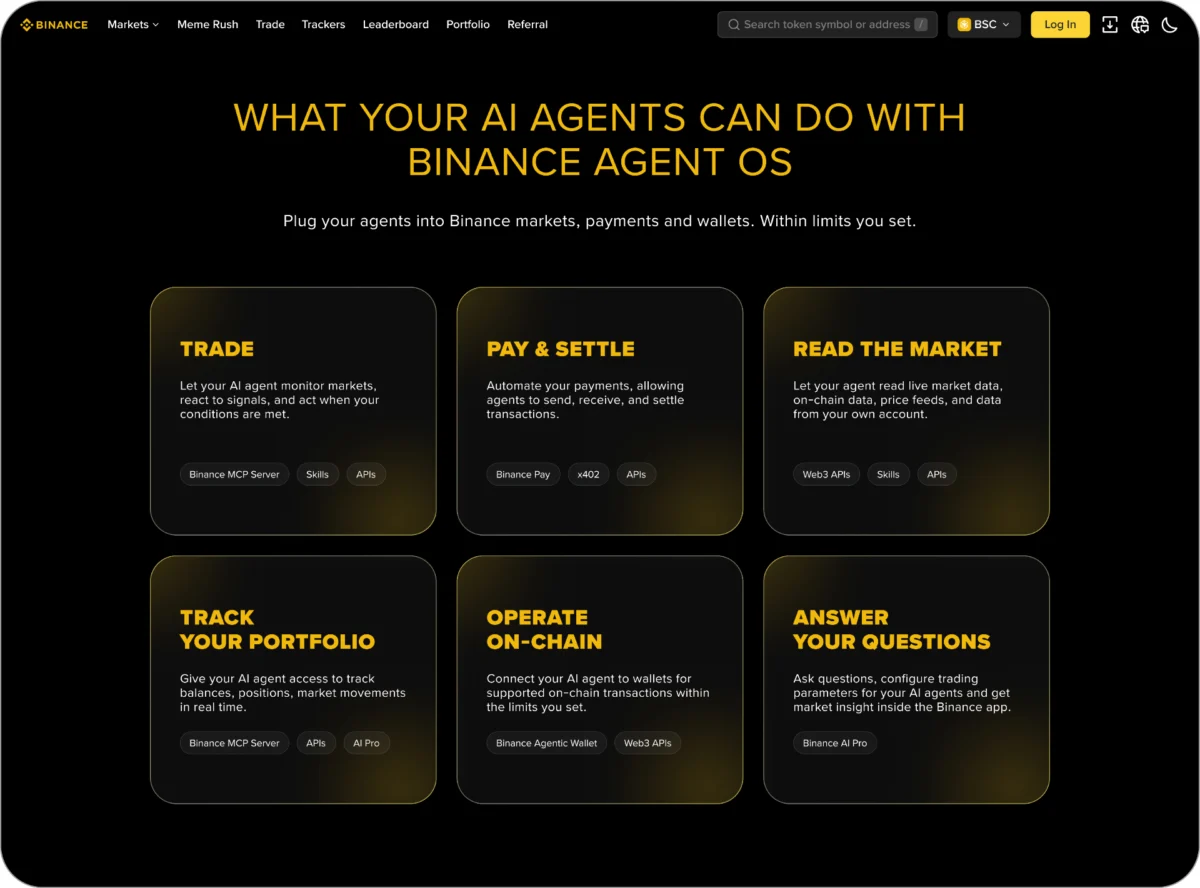
Binance, the world’s largest cryptocurrency exchange by trading volume and user base, has officially entered the era of autonomous finance with the launch of Agent OS. This new platform, announced on Thursday, is designed to bridge the gap between advanced artificial intelligence and complex financial ecosystems, allowing AI agents to analyze market trends, manage portfolios, and execute trades on behalf of users. By integrating these autonomous entities directly into its financial infrastructure, Binance aims to transform how its more than 300 million registered users interact with digital assets, moving beyond manual trading toward a model defined by algorithmic efficiency and machine-led decision-making.
The introduction of Agent OS marks a significant pivot in the broader technology landscape. While the previous two years were dominated by generative AI chatbots like ChatGPT and Claude—tools primarily designed to process information and generate text—the industry is now shifting toward "agentic" AI. These are systems capable of taking independent actions within software environments to achieve specific goals. For Binance, this means providing the plumbing necessary for an AI agent to not just "suggest" a trade based on sentiment analysis, but to actually log into a secure environment, verify the liquidity, and execute the transaction in real-time.
The Technical Framework of Agent OS
Agent OS functions as a comprehensive developer suite that aggregates Binance’s existing technical tools while introducing new protocols to facilitate AI-driven workflows. At the heart of the platform is the integration of the Model Context Protocol (MCP), an open standard recently championed by AI industry leaders like Anthropic. MCP allows AI models to seamlessly connect to external data sources and tools, reducing the friction typically associated with building custom integrations for different LLMs (Large Language Models).
By supporting MCP, Agent OS enables developers to link a variety of popular AI tools to the Binance ecosystem. This includes OpenAI’s ChatGPT and Codex, Anthropic’s Claude Code, and the AI-powered code editor Cursor. The platform also leverages several core Binance services:
- Binance APIs: The foundational layer for market data and execution.
- Binance Wallet Agentic Hub: A specialized interface for managing digital wallets through automated scripts.
- Binance x402: A transaction verification and payment facilitator API designed for machine-to-machine payments.
- Binance Skill Hub: A repository where developers can create and share specific "skills" or capabilities that agents can learn, such as technical indicator analysis or cross-exchange arbitrage.
Through these integrations, a user can authorize an AI agent to access real-time market data, view account balances, and execute complex trading strategies without human intervention for every individual step.
Security Architecture and the "Sandbox" Approach
Entrusting autonomous software with real capital introduces significant risks, ranging from software bugs and "hallucinations" to malicious prompt-injection attacks. To mitigate these dangers, Binance has implemented a security model centered on "subaccounts." Jeff Li, Vice President of Product at Binance, emphasized in a recent interview that the platform is designed to give users granular control rather than total autonomy.
When a user deploys an agent via Agent OS, the activity is confined to a dedicated subaccount. This subaccount acts as a sandbox, isolating the agent’s access from the user’s primary funds. By default, withdrawals from these subaccounts are blocked, ensuring that even if an agent is compromised or malfunctions, it cannot drain a user’s entire portfolio to an external address.
Furthermore, users retain the ability to set specific permissions. An agent can be restricted to "view-only" mode, "approval-required" mode—where the user must manually greenlight every trade—or "fully autonomous" mode. While Binance does not impose a universal cap on trading losses within these subaccounts, the amount of capital a user chooses to transfer into the subaccount serves as a de facto "circuit breaker." If an agent exhausts the funds in its designated subaccount, its ability to trade is effectively halted.
Addressing the "Black Box" Problem
One of the most complex challenges in AI-driven finance is the "reasoning" behind a trade. Traditional algorithmic trading follows strict, "if-then" logic that is easily auditable. AI agents, however, utilize neural networks that can be opaque. Jeff Li noted that Binance does not have visibility into the internal logic or "thought process" of an agent, as that reasoning occurs on the user’s local machine or within the third-party AI application’s servers.
"We really cannot see the reasoning of what the user’s action is," Li stated. This admission highlights a critical boundary: Binance acts as the execution layer and the gatekeeper of the funds, but the intellectual "brain" of the operation remains decentralized. While this protects user privacy and proprietary strategies, it also means Binance has limited ability to intervene if an agent makes a decision based on faulty data or a manipulated prompt. To counter this, the exchange relies on its existing suite of risk-control and anti-money laundering (AML) policies, which are applied to all API-driven activity on the platform.
Transactional Limits and the Agentic Wallet
Beyond the trading of spot and futures contracts, Agent OS is built to facilitate the "Agent Economy," where AI agents pay each other for services or interact with decentralized finance (DeFi) protocols. This is facilitated through the Agentic Wallet and the x402 integration.
Unlike the exchange trading environment, where limits are largely determined by subaccount balances, Binance has set specific daily ceilings for on-chain and payment activities to prevent systemic abuse:
- Standard Token Swaps: Capped at $50,000 per day.
- DeFi Protocol Interactions: Capped at $100,000 per day.
- x402 Micro-payments: Capped at $20 per day (intended for API fees and small service payments).
These limits suggest that while Binance is eager to foster innovation, it is taking a cautious approach toward high-velocity, automated on-chain movements that could be exploited by bad actors or destabilize smaller liquidity pools.

A Competitive Timeline: The Race for AI Supremacy in Crypto
Binance’s entry into the AI agent space follows a series of similar moves by its primary competitors, indicating a coordinated industry-wide shift toward "Agentic Web3."
- March 2024: Kraken launched an open-source command-line tool equipped with an MCP server, allowing developers to script trades directly through AI interfaces.
- June 2024: Coinbase introduced "Coinbase for Agents," a set of tools designed to give AI agents a "bank account" (in the form of a crypto wallet) to perform financial tasks autonomously.
- Mid-2024: OKX released its "Agent Trade Kit," which similarly utilized the Model Context Protocol to bridge LLMs with its exchange liquidity.
The convergence of these major players around the Model Context Protocol suggests that the industry is moving toward a standardized "operating system" for financial AI. By launching Agent OS, Binance is leveraging its massive user base and deep liquidity to position itself as the primary hub for this emerging ecosystem.
Broader Implications and Future Outlook
The launch of Agent OS could have profound implications for market dynamics. As AI agents become more prevalent, the speed and efficiency of price discovery are likely to increase. However, this also raises the specter of "flash crashes" or high-frequency volatility if multiple agents react simultaneously to the same news event or data signal.
From a regulatory perspective, the rise of AI agents complicates the concept of "know your customer" (KYC). While the human owner of the account is verified, the entity performing the actual transactions is a piece of software. Regulators in the United States, Europe, and Asia are already grappling with how to assign liability when an autonomous system violates securities laws or market manipulation rules.
For Binance, Agent OS is described as a "first step." The long-term vision involves a world where AI agents do more than just trade; they could manage complex tax strategies, participate in DAO (Decentralized Autonomous Organization) governance, and even negotiate service contracts on behalf of their human owners.
As the crypto industry continues to mature, the integration of AI represents a move away from the "speculative" era of retail trading toward a more "automated" era of institutional-grade management accessible to everyone. By providing the infrastructure for these agents, Binance is betting that the future of finance will not be managed by humans clicking buttons, but by intelligent systems working 24/7 to optimize wealth in a digital-first economy.