admin
admin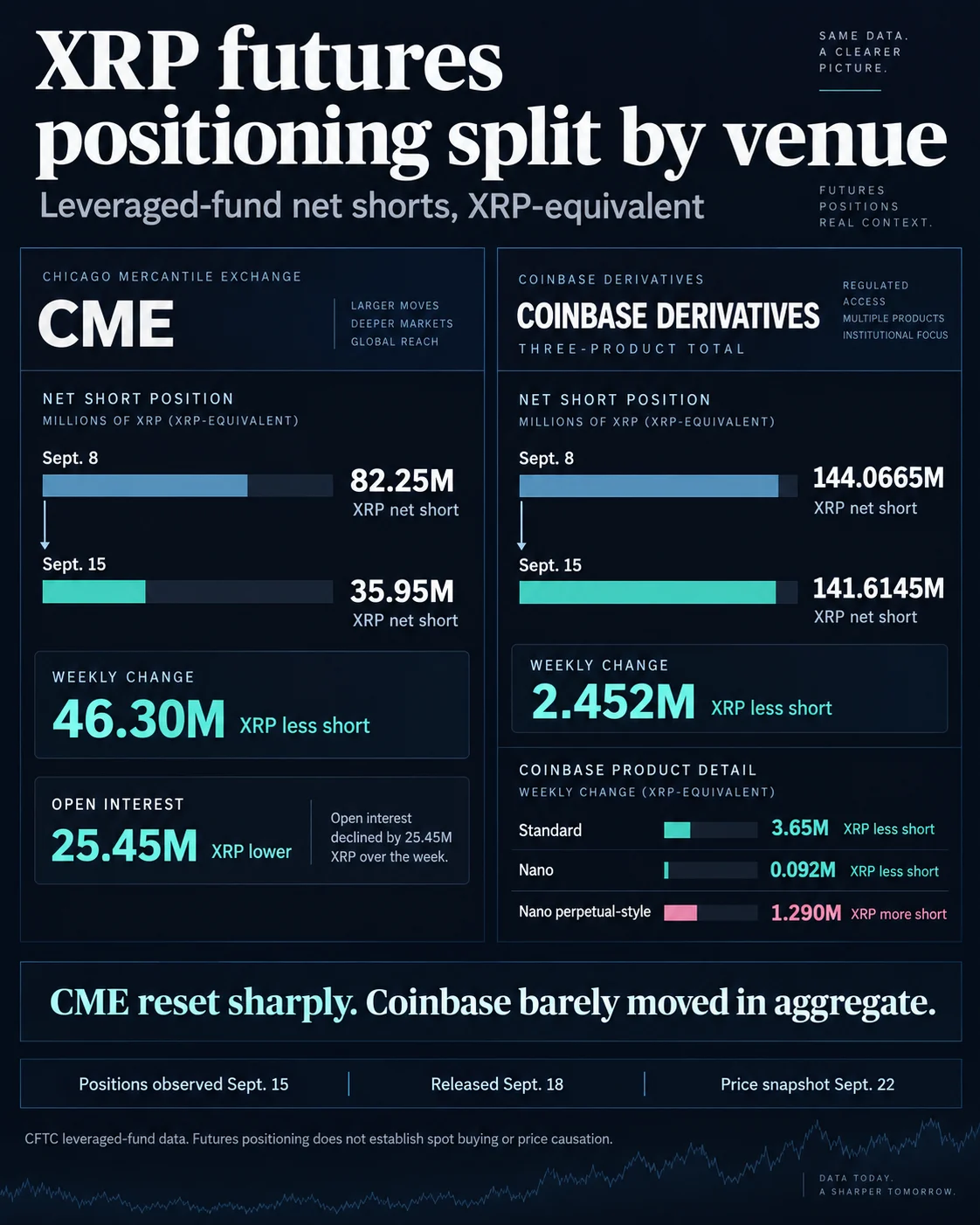
XRP experienced a notable surge on September 22nd, reaching an intraday high of $1.60 on significant trading volume estimated at $7.4 billion. While this price action indicated strong upward momentum, a deeper examination of regulated futures market data from the Commodity Futures Trading Commission (CFTC) reveals a more nuanced picture of trader positioning, particularly highlighting a striking divergence between CME Group and Coinbase Derivatives. The latest public data, reflecting positions as of September 15th, shows leveraged funds significantly reducing their net short exposure on CME, while their adjustments on Coinbase platforms were considerably more modest, suggesting a concentrated and venue-specific repositioning rather than a broad market sentiment shift.
Unpacking the Futures Data: A Tale of Two Markets
The CFTC’s September 15th snapshot of regulated futures markets offers a critical lens through which to understand the underlying sentiment among sophisticated traders. For CME futures, which represent 50,000 XRP per contract, leveraged funds saw their net short position shrink by the equivalent of 46.3 million XRP in the week leading up to the report. This substantial reduction was driven by both an increase in long contracts and a significant decrease in short contracts. Specifically, longs rose by 305 contracts, while shorts plummeted by 621 contracts. This aggressive unwinding of short positions on CME suggests a notable recalibration by these traders, potentially anticipating or reacting to market movements.
In contrast, the data for Coinbase Derivatives presented a different narrative. Across its three reported products – the standard Coinbase future (10,000 XRP per contract), the NANO XRP contract (500 XRP per contract), and the NANO XRP PERP STYLE contract (500 XRP per contract) – the same category of leveraged funds reduced their combined net short by a mere 2.452 million XRP. This implies that while there were some minor adjustments, the overall bearish exposure on Coinbase remained substantial, standing at approximately 141.6 million XRP by September 15th.
The stark contrast in the magnitude of these shifts is a key takeaway. The CME reduction dwarfed the aggregate change across Coinbase products, indicating that the significant deleveraging of short positions was largely concentrated on the CME platform. This divergence is particularly interesting given that the price action on September 22nd occurred after these positioning shifts were recorded. The reporting lag means that the September 15th data offers a look at the market before the observed price rally, making it difficult to establish a direct causal link. However, it does provide valuable insight into the sentiment leading up to that surge.
A Deeper Dive into CME’s Significant Shift
To fully appreciate the scale of the change on CME, it’s crucial to look at the weekly progression. On September 8th, leveraged funds held 1,280 long contracts against 2,925 short contracts, resulting in a net short position of 1,645 contracts, equivalent to 82.25 million XRP. By September 15th, this position had shifted to 1,585 long contracts and 2,304 short contracts, a net short of 719 contracts, or 35.95 million XRP. The reduction of 926 contracts, or 46.3 million XRP, in net short exposure signifies a substantial recalibration by these traders.
The improvement in the net short position was a result of both an increase in bullish bets and a decrease in bearish bets. The rise in longs by 305 contracts suggests some traders were initiating or increasing bullish positions. However, the more dramatic reduction in shorts by 621 contracts points to a more significant factor: a widespread closing of existing short positions. This could be driven by a variety of factors, including a reassessment of risk, a desire to lock in profits from previous short trades, or anticipation of upward price movement.
Furthermore, open interest on CME futures declined by 509 contracts, or 25.45 million XRP, during the same week. This decline in open interest, despite the increase in long positions, suggests that a significant portion of the net short reduction came from traders closing their existing short positions without necessarily initiating new long ones. This scenario is consistent with a deleveraging process where existing bearish bets are being unwound.
Coinbase’s Modest Adjustments and Divergent Trends
On Coinbase, the picture was far less dramatic. The standard Coinbase future, representing 10,000 XRP per contract, saw a reduction of 3.65 million XRP in leveraged funds’ net short position. The NANO XRP contract contributed a further 92,000 XRP reduction. However, the NANO XRP PERP STYLE contract, a regulated, five-year cash-settled future that utilizes funding adjustments, moved in the opposite direction. Leveraged funds increased their net short position in this product by 1.29 million XRP.
This increase in shorting on the perpetual-style contract offset some of the reductions seen in the other two Coinbase products. The net effect was a modest overall decrease in net short exposure across all three Coinbase products combined, totaling just 2.452 million XRP. This suggests that while some traders may have been adjusting their strategies, there wasn’t a broad-based unwinding of short positions comparable to what was observed on CME.
The fact that the perpetual-style contract saw increased shorting is noteworthy. This product’s structure, being a regulated, long-term instrument with funding adjustments, might attract a different set of participants or reflect different trading strategies compared to standard futures. The divergence in positioning across Coinbase’s own products further complicates any attempt to infer a unified market sentiment from its data alone.

The Significance of the Divergence and Reporting Lags
The discrepancy between CME and Coinbase positioning is the most compelling aspect of the September 15th data. While CME leveraged funds were significantly de-risking their short exposure, Coinbase traders remained largely entrenched in their net short positions, with only minor adjustments. This venue-specific recalibration raises several questions.
Firstly, it challenges the notion of a unified market sentiment driving trader behavior across all regulated platforms. It suggests that factors specific to each exchange, such as liquidity, participant base, or even regulatory nuances, might be influencing positioning decisions.
Secondly, the reporting lag of the CFTC data is crucial. The September 15th snapshot reflects positions before the September 22nd price surge. This means that the observed positioning changes on CME were likely a precursor or a parallel development to the price rally, rather than a direct consequence of it. It’s possible that traders were anticipating a price increase and reducing their short exposure accordingly, or that the price increase itself was already underway and reflected in subsequent trading activity not yet captured by the reported data.
The next CFTC report, scheduled to cover positions as of September 22nd and released on September 25th, will be critical. It will provide insight into whether the divergence persisted during the rally. If Coinbase’s net short also saw a material reduction alongside expanding open interest, it would lend more credence to a broader market-wide directional turn. However, if Coinbase’s positioning remains heavily short while CME continues to show reduced net short exposure, it would further support the narrative of a venue-specific reset.
What the Data Can and Cannot Tell Us
It is important to understand the limitations of the CFTC’s Commitment of Traders (COT) reports. The "leveraged funds" category encompasses traders whose primary business activity is classified as such. While this provides a valuable aggregate view, it does not reveal the motivations behind individual trades. A short position can serve multiple purposes: a bearish outlook, hedging existing spot holdings, offsetting other derivative positions, or participating in basis trades. Similarly, reducing a short position can signify a bullish shift, a strategic hedge adjustment, an unwind of relative value trades, or a general reduction in risk appetite.
The CME data, for instance, shows rising longs, falling shorts, and a decrease in total open interest. This clearly indicates that leveraged funds on CME significantly reduced their net short exposure. However, labeling this entire shift as fresh directional buying or directly attributing it as the cause of XRP’s subsequent price gain would be an overreach of the evidence. It’s a reduction in bearish sentiment, but the exact driver remains open to interpretation.
Furthermore, the analysis is confined to the four contract families included in the specific CFTC query. CME also offers Micro XRP futures, which are treated as a distinct product. The CFTC includes a market in its COT reports only if at least 20 traders hold positions at or above certain reporting thresholds. The absence of a specific product from these reports means its activity is unknown, and the reporting threshold is merely a potential explanation for such an omission.
Broader Implications and Future Outlook
The divergence in positioning between CME and Coinbase derivatives during XRP’s recent rally offers a compelling case study in market dynamics. It highlights that even within regulated futures markets, distinct trading behaviors can emerge across different platforms. This could be influenced by factors such as the composition of the user base on each exchange, the specific contract specifications, or even the perceived regulatory environment.
The implications of this divergence are multifaceted. For market participants, it underscores the importance of looking beyond headline price action and delving into the underlying futures positioning data. Understanding these nuances can provide a more informed perspective on market sentiment and potential future price movements. It suggests that a single narrative might not always capture the full picture of market activity.
The upcoming CFTC reports will be crucial in determining whether the observed trends are temporary or indicative of more persistent dynamics. If Coinbase’s net short position continues to decline significantly, it would suggest a broader shift in sentiment across major regulated venues. Conversely, if the divergence persists, it may point to ongoing differences in how traders interact with XRP futures on CME versus Coinbase.
Ultimately, the events of September 2026, marked by XRP’s price surge and the contrasting futures positioning data, offer valuable lessons. While XRP experienced a strong rally, the regulated futures markets reveal a complex interplay of trader sentiment, with significant repositioning occurring on CME while Coinbase saw more subdued adjustments. The divergence is the signal, but the precise reasons behind it remain a subject for further analysis as more data becomes available. The ability to connect price action with detailed, albeit lagged, futures data provides a critical, fact-based foundation for understanding market movements in the evolving cryptocurrency landscape.