Dwi Wanna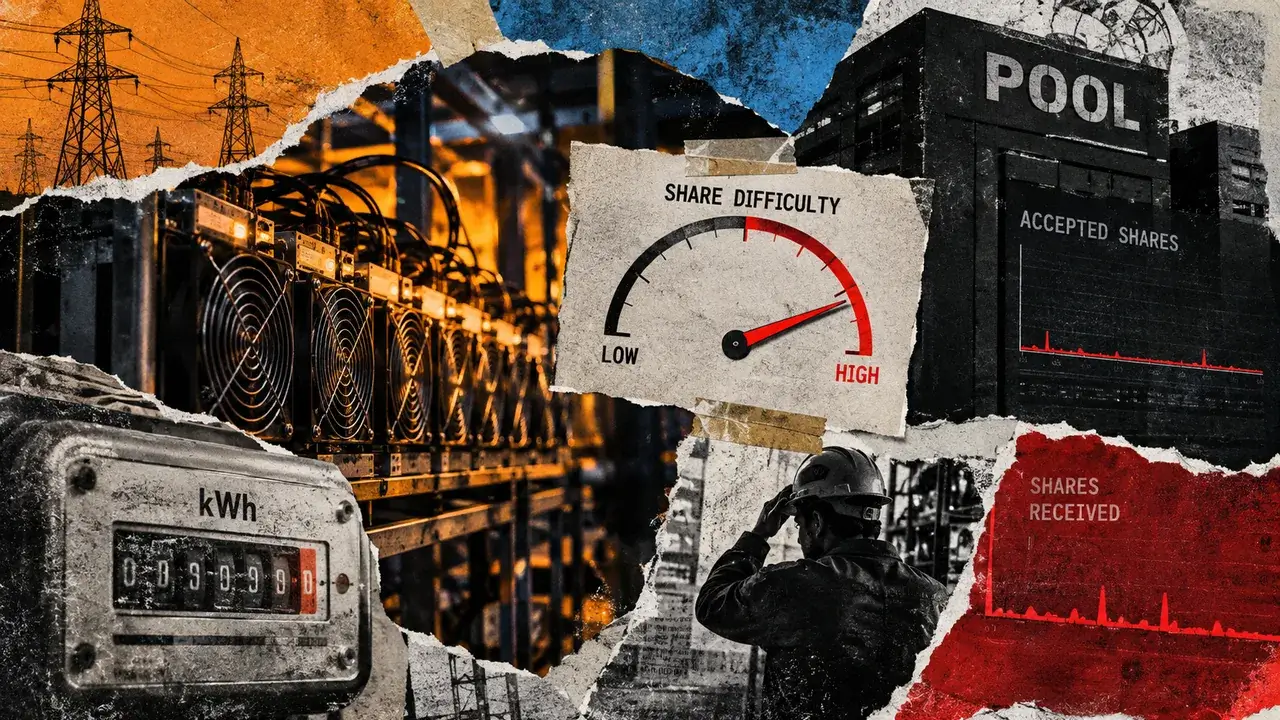
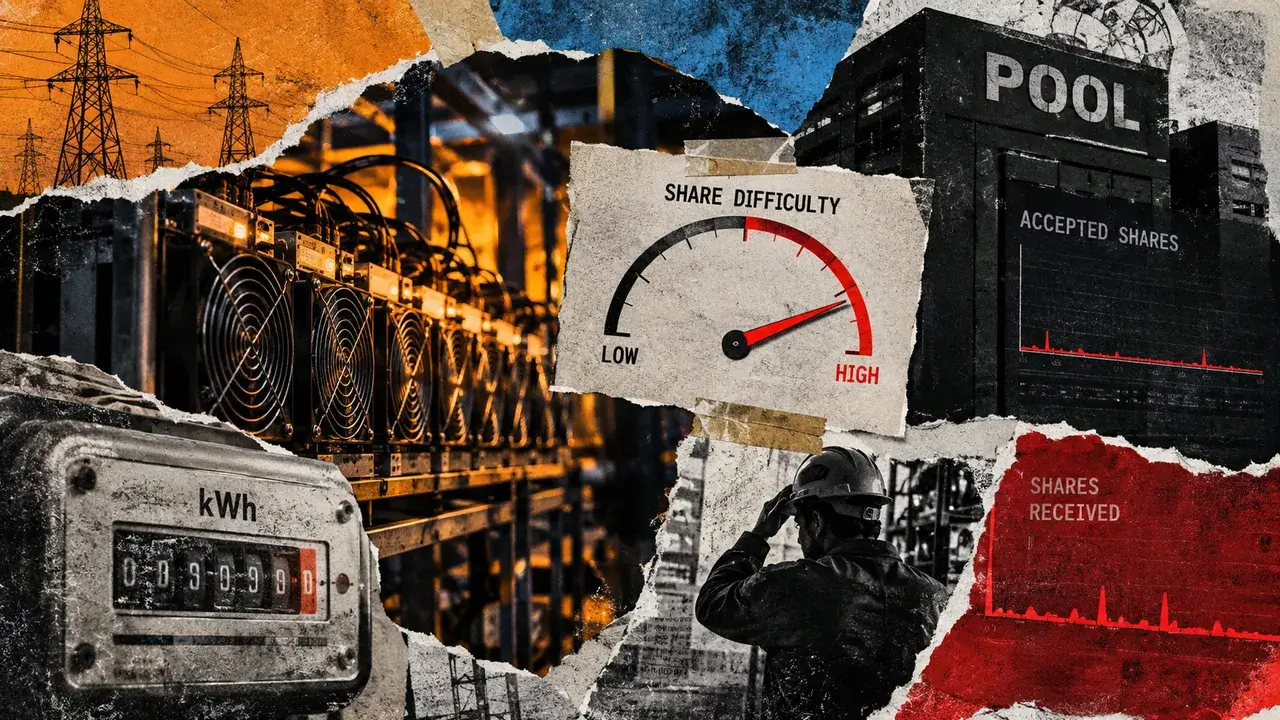
The technical infrastructure supporting the Bitcoin mining ecosystem has revealed a subtle but potentially costly vulnerability in how mining pools manage connection difficulties. A technical analysis recently brought to the forefront of the developer community indicates that certain variable difficulty (vardiff) controllers can inadvertently trap slowed mining rigs in a state of "share drought." In this state, a mining machine continues to consume electricity and perform computations, yet fails to produce the "shares" required to earn rewards from a mining pool. This phenomenon effectively causes the miner to burn energy without the possibility of financial compensation, undermining the very efficiency gains that power-down or curtailment strategies are intended to achieve.
The core of the issue lies in the communication protocols between individual mining rigs and the central pools they contribute to. To coordinate the work of thousands of machines, mining pools assign each connection a specific "share difficulty." This difficulty is significantly lower than the global Bitcoin network difficulty, allowing the pool to track the "hashrate" or computational power of the miner by observing how frequently they submit valid, though non-block-winning, solutions. A vardiff controller is the software mechanism responsible for adjusting this difficulty in real-time; if a miner is powerful, the difficulty is raised to prevent the pool from being overwhelmed with messages; if a miner is weak, the difficulty is lowered to ensure the pool receives enough data points to verify the miner’s work.
The Vardiff Trap: A Technical Breakdown
The vulnerability, identified by mining engineer Eric Price and later highlighted by the Bitcoin Optech newsletter on September 18, occurs when a controller’s logic is "share-triggered." Under this specific architecture, the controller only recalculates and updates a miner’s assigned difficulty upon the arrival of a new share. This creates a logical paradox if a miner’s hashrate suddenly drops—whether due to manual power curtailment, thermal throttling, or hardware degradation.
When a miner slows down abruptly, it continues to work against the high difficulty target assigned when it was running at full speed. Because the machine is now slower, the statistical probability of it finding a share at that high difficulty level drops precipitously. If the difficulty is set so high that the slowed miner cannot find a share within a reasonable timeframe, the share-triggered controller never receives the "trigger" it needs to lower the difficulty. Consequently, the miner remains "stranded" at a difficulty level it can no longer meet. During this period, the ASIC (Application-Specific Integrated Circuit) chips continue to cycle, drawing significant wattage, but because no shares are submitted to the pool, the miner is credited with zero hashrate and receives zero payout.
This failure mode is particularly relevant in the context of modern industrial mining, where "curtailment"—the practice of reducing power consumption to stabilize the electrical grid during peak demand—is a standard operational procedure. If a mining farm reduces its power by 50%, but the vardiff controllers do not adjust to the new, lower hashrate, the farm may find itself in a position where it is still paying for 50% of its usual electricity while earning 0% of its usual revenue.
Chronology of Discovery and Research
The identification of this "clockless" vardiff failure is the result of several months of technical scrutiny within the Bitcoin mining development community.
In July 2024, Eric Price published a detailed analysis on the Delving Bitcoin research forum titled "A clockless vardiff strands a slowing miner." Price’s research utilized mathematical modeling to demonstrate how a lack of timer-based updates in pool software could lead to permanent or semi-permanent stalls in share submission. He noted that while a high-difficulty share is technically worth more than a low-difficulty share, the "realized window"—the actual time spent mining—must result in at least one submission for the miner to be paid.
On September 18, 2024, Bitcoin Optech, a primary resource for technical developments in the Bitcoin space, brought wider attention to Price’s findings. The Optech report clarified that this is a pool-assigned share difficulty issue, not an issue with the Bitcoin network’s self-adjusting difficulty (which occurs every 2,016 blocks). This distinction is critical for investors and operators to understand: the Bitcoin network remains secure and functional, but individual mining businesses may be losing efficiency due to sub-optimal pool software.
The research also identified specific software implementations that utilize this share-triggered logic. One notable example cited is ckpool, a long-standing and respected mining pool implementation. While ckpool and similar architectures are highly efficient under stable conditions, the research suggests they may lack the necessary "timer-triggered" safeguards to handle the volatile power environments of the modern era.
Historical Context: The 2026 Winter Storm and Grid Stability
The practical implications of this research were underscored by real-world events earlier in 2026. During a severe winter storm in the United States in January 2026, Bitcoin’s global hashrate saw a significant, temporary slump. This was largely attributed to large-scale mining operations in Texas and other regions voluntarily powering down or "curtailing" their operations to ensure that the electrical grid had enough capacity to heat homes.
While the January 2026 event was not directly linked to vardiff losses in public reports, it provided a massive real-world test case for how mining hardware reacts to rapid power fluctuations. Industry analysts noted at the time that the ability to "ramp down" and "ramp up" is one of the primary value propositions of Bitcoin mining for energy grid operators. However, if the software controlling these transitions—the vardiff controllers—cannot keep up with the physical changes in power, the economic incentive for miners to participate in grid balancing programs could be diminished.
If a miner knows that dropping to 20% power might "break" their connection to the pool and result in a total loss of revenue for several hours, they may be less inclined to offer their load for curtailment, potentially leading to greater strain on public energy infrastructure.
Economic and Operational Impact on Miners
The financial impact of a vardiff stall depends heavily on the payout structure used by the mining pool. Most modern pools use one of two primary methods: Pay-Per-Share (PPS) or Proportional (PPLNS).
In a Pay-Per-Share model, the pool pays the miner for every valid share submitted, regardless of whether the pool actually finds a block. If a miner is trapped by high difficulty and submits zero shares, they receive zero payment. The energy costs, however, remain fixed based on the machine’s current power draw. This creates a direct "negative spread" where the cost of production remains while the output vanishes.
In Proportional or PPLNS models, the reward is distributed based on shares submitted within a specific "window" or since the last block was found. If a miner fails to submit shares during a window because their difficulty was too high, their portion of the reward is effectively redistributed to other miners in the pool who were able to maintain a steady stream of shares.

The risk is not merely theoretical. As Bitcoin’s market capitalization sits at approximately $1.74 trillion and the network hashrate continues to hit all-time highs, the margins for mining operations have become increasingly thin. With Bitcoin currently trading with a 24-hour volume of over $57 billion, even a 1% loss in efficiency due to software lag can translate into millions of dollars in lost opportunity costs for large-scale industrial miners.
Mitigation Strategies and the Role of Stratum V2
The mining industry is not without solutions to this problem. The analysis by Price and the subsequent highlight by Bitcoin Optech point toward the Stratum V2 protocol as a primary defense against vardiff stalls.
Stratum V2 is the next-generation communication protocol for Bitcoin mining. Unlike its predecessor, the reference implementation of Stratum V2 avoids permanent freezes by incorporating a timer-based recalculation. Even if no shares are arriving, the controller will check the status of the connection at regular intervals and proactively lower the difficulty if it detects a "share drought." This ensures that the miner can always "find its way back" to a difficulty level appropriate for its current speed.
However, the researchers cautioned that recovery can still be slow on long-lived connections. Furthermore, because Stratum V2 is a protocol and not a single piece of software, not every deployment of the protocol necessarily includes these timer-triggered safeguards. It remains incumbent upon pool operators to ensure their specific implementation is robust against hashrate volatility.
To assist in this effort, the MARA Foundation—the non-profit arm of Marathon Digital Holdings—has released an open-source tool called shape-proxy. This tool allows mining operators to simulate hashrate drops without actually changing the physical output of their machines. By using "step, ramp, and stall" profiles, operators can test how their chosen mining pool reacts to sudden changes. If the pool’s assigned difficulty remains "pinned" at a high level despite an apparent drop in hashrate, the operator has empirical evidence that their pool is susceptible to the vardiff trap.
Broader Implications for the Industry
The discovery of the vardiff vulnerability serves as a reminder of the "invisible" complexities involved in the Bitcoin ecosystem. While much of the public focus remains on Bitcoin’s price or its total energy consumption, the underlying software protocols that bridge the gap between hardware and the blockchain are equally vital.
As the mining industry continues to mature and integrate with global energy markets, the robustness of these protocols will become a matter of both financial and public interest. The ability of miners to act as "flexible loads" for power grids depends on software that can handle the transition between full-power and low-power states without penalizing the operator.
The findings by Eric Price and the promotion of testing tools like shape-proxy signal a move toward greater transparency and technical rigor in the mining sector. By addressing these "edge cases" in vardiff logic, the industry can ensure that when miners cut power to help the grid, they aren’t inadvertently burning money in the process. This technical refinement is a necessary step in the evolution of Bitcoin mining from a niche hobby into a sophisticated, grid-integrated industrial powerhouse.