admin
admin
Global asset manager VanEck has issued a strong rebuke regarding Metaplanet’s executive compensation framework, contending that despite recent amendments aimed at mitigating shareholder dilution, the Japanese Bitcoin treasury company’s approach still falls critically short of adequately aligning management incentives with investor interests. The critique, detailed in a comprehensive report, positions Metaplanet as an outlier among its peers in the burgeoning digital asset treasury sector, raising significant questions about corporate governance in this rapidly evolving industry.
VanEck’s Scathing Assessment: Metaplanet Rated ‘Bad’
In a recent Friday report meticulously analyzing executive compensation structures across the ten largest digital asset treasury companies, VanEck assigned Metaplanet’s compensation structure the lowest possible rating: "Bad." This designation makes Metaplanet the sole firm to receive such a negative assessment, highlighting a stark divergence from industry norms and best practices identified by the asset manager. The core of VanEck’s concern lies in Metaplanet’s disproportionately large equity plan and officer exposure.
According to VanEck’s findings, Metaplanet’s overall equity plan accounts for a substantial 14.7% of fully diluted shares. Even more critically, the officer exposure, representing the portion of equity allocated directly to company executives, stands at an alarming 8.2%. To contextualize these figures, VanEck emphasized that Metaplanet’s officer exposure is approximately ten times the average of 0.8% observed among the other nine companies scrutinized in the analysis. Similarly, the company’s total equity plan is nearly four times the peer average, underscoring the extent of the potential dilution faced by existing shareholders.
This detailed examination by VanEck signals a growing emphasis by institutional investors on robust corporate governance within companies that have embraced Bitcoin as a primary treasury asset. As these firms mature and attract broader investment, the transparency and fairness of executive compensation become paramount indicators of long-term shareholder value commitment.
A Stark Contrast: MicroStrategy as the Gold Standard
To illustrate what it considers a well-aligned compensation structure, VanEck drew a direct comparison with MicroStrategy, the undisputed leader and largest corporate Bitcoin (BTC) holder globally. MicroStrategy, often seen as the pioneer in the corporate Bitcoin adoption strategy, received a "Good" rating from VanEck for its executive compensation framework.
MicroStrategy’s equity plan is modest by comparison, equating to just 2% of its fully diluted shares, with officer exposure at an even lower 0.5%. Crucially, VanEck highlighted key features of MicroStrategy’s plan that contribute to its favorable rating: its equity reserve is fixed, meaning it does not automatically expand with new share issuances, and any proposed increases to the plan necessitate a direct shareholder vote. This mechanism ensures that shareholders retain control over potential dilution and that executive incentives are closely tied to the company’s long-term performance and the interests of its broader investor base. The contrast between MicroStrategy’s proactive shareholder protection measures and Metaplanet’s structure underscores the concerns raised by VanEck.
Metaplanet’s Profile: A Rising Force in Bitcoin Treasuries
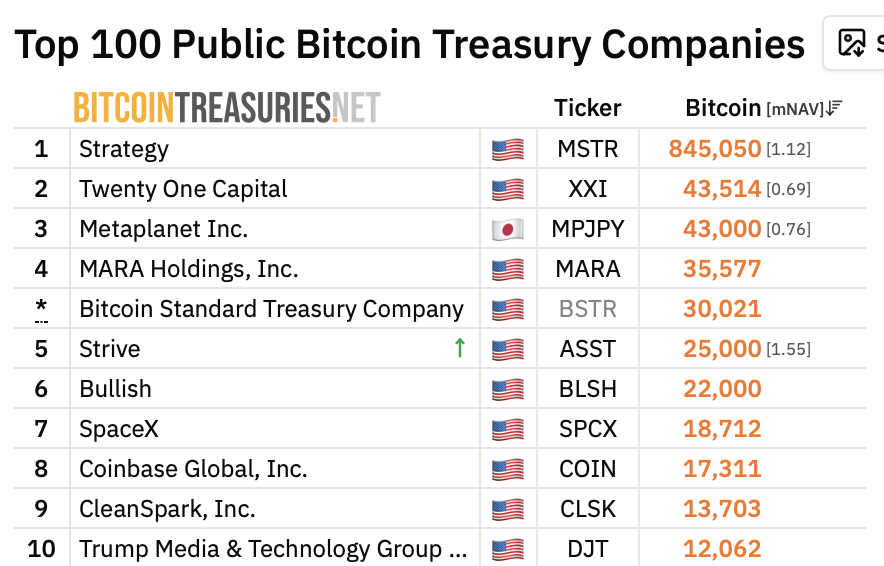
Metaplanet, a publicly traded Japanese company, has rapidly emerged as a significant player in the corporate Bitcoin treasury landscape. The firm currently ranks as the third-largest publicly traded corporate Bitcoin holder worldwide, boasting an impressive treasury of 43,000 BTC, as verified by data from BitcoinTreasuries.net. This substantial holding places Metaplanet squarely alongside other major corporate adopters of Bitcoin, such as MicroStrategy and Marathon Digital Holdings, in terms of sheer asset accumulation.

Metaplanet’s strategic pivot to Bitcoin as a treasury asset has been lauded by many in the digital asset community, particularly given Japan’s traditionally cautious regulatory environment. The company’s aggressive accumulation strategy, aimed at hedging against yen depreciation and capitalizing on Bitcoin’s long-term value proposition, has attracted considerable investor attention. However, VanEck’s recent critique suggests that while the company’s asset strategy may be forward-thinking, its internal governance mechanisms have not kept pace with the expectations of sophisticated institutional investors.
The Genesis of Disparity: Automatic Option Pool Expansion
VanEck’s analysis meticulously traces the roots of Metaplanet’s current compensation disparity to its former executive compensation structure. Historically, Metaplanet had an automatic adjustment mechanism embedded within its equity plan. This mechanism allowed the company’s executive option pool to expand automatically whenever the company issued new shares, particularly those issued to fund its substantial Bitcoin purchases.
This automatic expansion proved to be a critical point of contention. The mechanism caused the executive option pool to balloon dramatically, growing from an initial 46 million shares to an astounding 319.5 million shares. This represents an addition of approximately 273 million potential shares that could be granted to executives, significantly increasing the potential for shareholder dilution without explicit, real-time shareholder approval. This historical context is vital for understanding the magnitude of VanEck’s current concerns, as it highlights a systemic issue that allowed for substantial growth in potential executive compensation without proportionate checks and balances.
Shareholder Backlash and Metaplanet’s Partial Response
The exponential growth of the executive option pool did not go unnoticed by Metaplanet’s investor base. Earlier, the expansion drew considerable criticism from some Metaplanet shareholders, who voiced their disapproval and called upon the company to retract or cancel the additional potential shares that had been created by the automatic adjustment mechanism. This public and private shareholder pressure underscored a fundamental disagreement over the fairness and appropriateness of the compensation structure.
In response to this mounting criticism, Metaplanet undertook measures to address the concerns. In August, the company announced the termination of the problematic automatic adjustment mechanism, a crucial step towards preventing future unchecked expansion of the option pool. Following this, in September, Metaplanet further reduced the overall size of the executive option pool by a significant 41%, bringing the total from 319.5 million down to 188.2 million shares. These actions were presented as a commitment to better align with shareholder interests and mitigate future dilution.
However, VanEck’s recent report indicates that these changes, while a step in the right direction, are insufficient to fully rectify the underlying issues. The asset manager stated unequivocally that Metaplanet’s adjustments "fall well short of the mark." This assessment suggests that the magnitude of the previous expansion was so significant that even a substantial reduction still leaves the company’s executive compensation structure out of sync with industry best practices and shareholder expectations.
VanEck’s Explicit Demands for Remediation
To truly address the concerns and realign executive incentives with shareholder value, VanEck has put forth a series of clear and actionable recommendations for Metaplanet. These demands are designed to not only prevent future excessive dilution but also to claw back some of the dilution that may have already occurred.
Firstly, VanEck explicitly called for Metaplanet to reverse the approximately 273 million-share expansion that was generated by the now-defunct automatic adjustment clause. This recommendation targets the core of the historical issue, aiming to nullify the disproportionate increase in potential executive grants. Secondly, the asset manager urged Metaplanet to replace any remaining rights stemming from the old structure with a new, shareholder-approved compensation plan. This would ensure that any future executive grants are transparent, subject to investor scrutiny, and aligned with agreed-upon metrics.
A critical caveat in VanEck’s report highlighted the urgency of these actions: "unless past grants are clawed back, much of the dilution has already occurred." This emphasizes that the potential impact on shareholder value is not merely prospective but may have already manifested, making swift and decisive action from Metaplanet imperative.
Beyond these structural changes, VanEck also recommended tying executive compensation to a performance metric directly linked to shareholder value in a Bitcoin treasury company context, such as "Bitcoin per fully diluted share." This metric would incentivize management to optimize not just the absolute Bitcoin holdings but also the efficiency of those holdings relative to the company’s equity structure, directly benefiting shareholders. Finally, VanEck advised the adoption of a formal, written grant-timing policy, which would enhance transparency and prevent any potential abuse related to the timing of executive stock option grants.
Broader Implications for Corporate Governance in Digital Assets
The VanEck report on Metaplanet transcends a mere critique of a single company’s compensation structure; it serves as a critical barometer for corporate governance standards within the burgeoning digital asset industry. As more traditional institutional investors enter the cryptocurrency space, whether directly or through companies like Metaplanet and MicroStrategy that hold significant Bitcoin treasuries, the scrutiny on conventional corporate governance principles will intensify.
The Imperative of Shareholder Alignment: The core issue at stake is the alignment of interests between management and shareholders. Excessive executive compensation, particularly through dilutive equity plans, can create a wedge between these parties. When management’s incentives are perceived as self-serving rather than value-creating for shareholders, investor confidence can erode rapidly. In a sector as volatile and nascent as digital assets, where companies are often valued on their long-term vision and asset accumulation strategy, robust governance becomes a bedrock for sustainable growth and investor trust.
The Role of Institutional Activism: VanEck’s public criticism underscores the growing role of institutional investors in advocating for stronger governance. As significant capital allocators, firms like VanEck possess the leverage to demand accountability and influence corporate behavior. This kind of "activist" stance, common in traditional markets, is increasingly being applied to digital asset-focused companies, signaling a maturation of the investment landscape surrounding cryptocurrencies. It highlights that even innovative business models cannot circumvent fundamental expectations of sound financial stewardship.
Impact on Market Perception and Valuation: While Metaplanet’s Bitcoin accumulation strategy has drawn praise, concerns over executive compensation can cast a shadow over its market perception and potentially impact its valuation. Investors typically apply a "governance discount" to companies perceived to have weak controls or misaligned incentives, regardless of their underlying assets. For Metaplanet, which operates in a competitive and often speculative market, addressing these governance gaps is crucial for attracting and retaining long-term, stable capital. The comparison with MicroStrategy, a firm that has managed to maintain investor confidence despite its aggressive Bitcoin strategy, reinforces this point. MicroStrategy’s "Good" rating for compensation implies that it has successfully navigated the balance between ambitious strategy and responsible governance.
Setting Industry Standards: The digital asset treasury company model is still relatively new. As such, best practices for executive compensation, capital allocation, and shareholder protection are still being established. VanEck’s report contributes significantly to this process by openly identifying problematic structures and highlighting exemplary ones. This kind of analysis can serve as a guide for other companies considering similar Bitcoin treasury strategies, encouraging them to embed robust governance from the outset. The recommendation to tie compensation to "Bitcoin per fully diluted share," for instance, offers a tangible, crypto-native metric for performance alignment.
The Path Forward for Metaplanet: For Metaplanet, the path forward involves a critical re-evaluation of its executive compensation strategy. Ignoring VanEck’s recommendations could lead to continued investor skepticism, potential divestment from governance-focused funds, and a higher cost of capital in the long run. Conversely, a proactive and comprehensive response, fully embracing the spirit of shareholder alignment and transparency, could restore investor confidence and solidify its position as a leading, responsibly governed Bitcoin treasury company. This situation serves as a powerful reminder that while the underlying assets may be revolutionary, the principles of sound corporate governance remain timeless and indispensable.