Dwi Wanna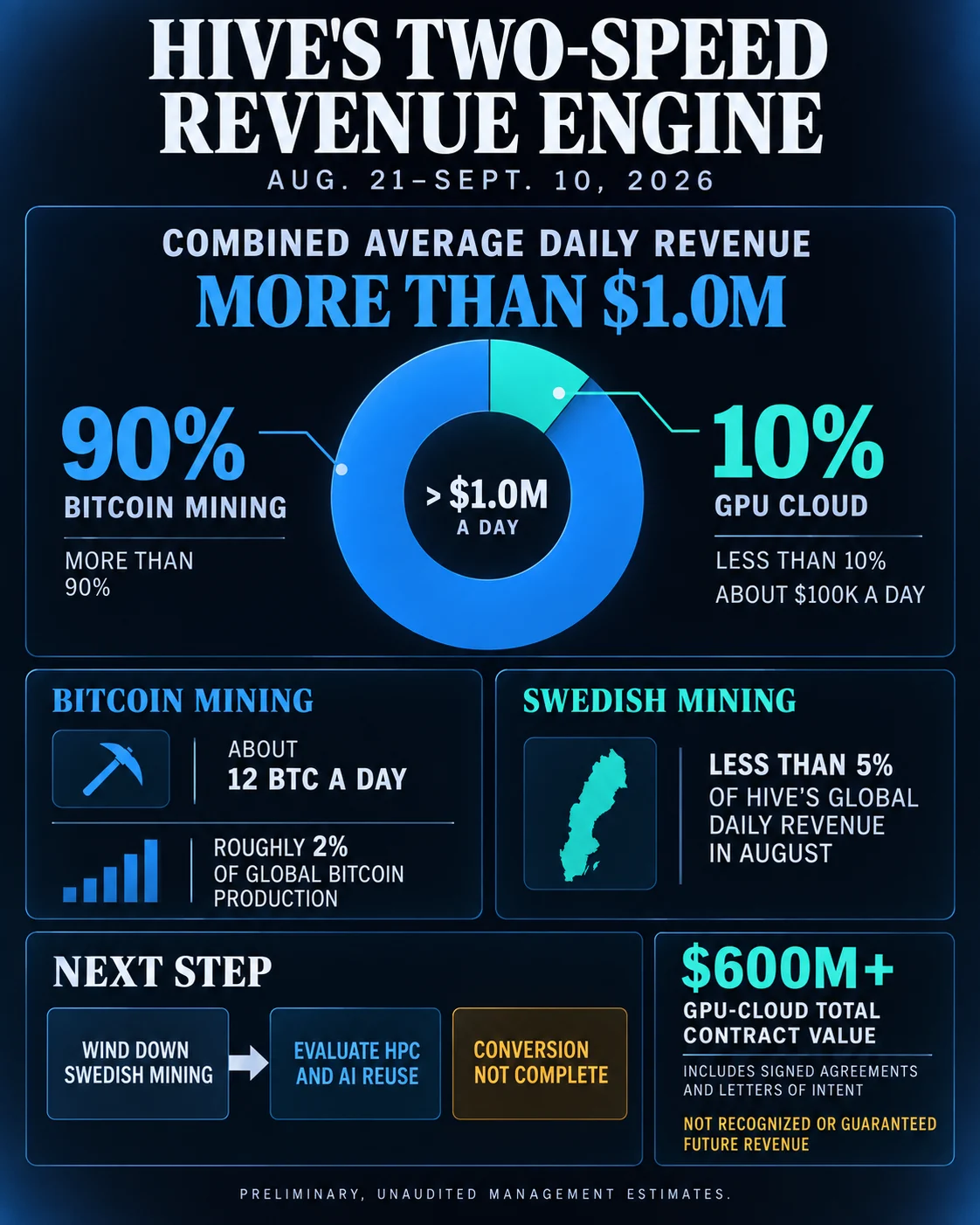
HIVE Digital Technologies, a leading player in the diversified digital asset and blockchain infrastructure sector, has released preliminary financial figures for the period spanning August 21 through September 10, 2024. The data reveals a significant milestone for the company, with combined average daily revenue from its Bitcoin mining and GPU-based cloud operations exceeding $1 million. However, the report also underscores a stark disparity between the company’s legacy operations and its much-touted expansion into artificial intelligence (AI) infrastructure. Despite the strategic pivot toward high-performance computing (HPC) and AI, Bitcoin mining continues to serve as the primary economic engine, providing more than 90% of the company’s daily revenue.
During this 21-day window, HIVE’s GPU cloud services generated approximately $100,000 in daily revenue. While this confirms that the AI-focused segment of the business is operational and contributing to the bottom line, it currently represents less than 10% of the total revenue mix. In contrast, the company’s Bitcoin mining division remains the dominant force, accounting for more than $900,000 per day. This financial snapshot provides a clear quantification of HIVE’s "two-speed transition," where the established mining business provides the necessary cash flow to fuel the capital-intensive buildout of its emerging AI cloud platform.
The Mining Engine: Sustaining Operations Amid Volatility
HIVE’s mining performance remains robust despite the increased difficulty of the Bitcoin network following the April 2024 halving event. According to the company’s September 10 update, HIVE mined an average of 12 Bitcoin per day during the reported period. This output represents roughly 2% of the total global Bitcoin network production, a significant share for a single publicly traded entity.
The company attributed these results to its fleet of high-efficiency Application-Specific Integrated Circuits (ASICs) and favorable operating conditions across its data centers in Canada, Sweden, and Iceland. However, management was careful to note that these figures are preliminary and unaudited. The dollar value of this mining output is inherently tied to the prevailing market price of Bitcoin and the fluctuating network difficulty. During the period in question, Bitcoin prices experienced localized volatility, yet HIVE managed to maintain a steady production rate, leveraging its proprietary software and energy-management strategies to optimize uptime.
The reliance on Bitcoin mining is not unique to HIVE; many former "pure-play" miners are currently navigating a similar transition. However, HIVE’s ability to generate $1 million in daily revenue places it in an elite tier of miners that have managed to scale operations to a level that can withstand the cyclical nature of the crypto markets. The revenue from mining acts as a hedge and a funding mechanism, allowing the company to avoid dilutive financing while investing in the expensive hardware required for AI applications.
The AI Pivot: Analyzing the $600 Million Pipeline
While the current revenue contribution from AI is modest, HIVE’s long-term strategy is heavily weighted toward the GPU cloud market. The company reported that it has closed more than $600 million in "total contract value" (TCV) year-to-date. This figure is a combination of signed customer agreements and formal letters of intent (LOIs).

It is crucial to distinguish between TCV and recognized revenue. As HIVE cautioned in its disclosure, TCV represents the potential value of contracts over their entire lifespan and does not guarantee immediate or future cash flow. The conversion of these contracts into recognized revenue depends on the successful deployment of hardware and the consistent delivery of computing power to clients.
This disclosure follows a major announcement in August regarding a $350 million AI cloud agreement. To fulfill the requirements of that deal and others in its pipeline, HIVE is currently undertaking a massive infrastructure buildout. This includes an estimated $185 million investment in high-end NVIDIA GPUs and the specialized data center environments required to house them. The challenge for HIVE lies in the "execution gap"—the time and capital required to transform signed LOIs into the $100,000-a-day revenue streams that the company hopes will eventually rival its mining income.
The Swedish Transition and Facility Repurposing
A key component of HIVE’s strategy involves the repurposing of existing infrastructure. The company is currently evaluating its facilities in Sweden to determine their suitability for high-performance computing. Historically, these sites were utilized for Ethereum mining before the network’s transition to Proof-of-Stake in 2022. Since then, HIVE has been one of the few miners to successfully pivot its GPU fleet toward cloud computing rather than simply liquidating the hardware.
In Sweden, HIVE is exploring ways to utilize the "waste heat" generated by its servers to support local industry or district heating systems, a move that aligns with its ESG (Environmental, Social, and Governance) goals. However, the transition is not without hurdles. HIVE noted that it intends to wind down traditional Bitcoin mining at certain facilities to make room for AI-focused hardware. The company warned that this wind-down and the subsequent repurposing are complex processes that may not proceed exactly as planned. Converting a facility designed for Bitcoin mining into one capable of hosting AI workloads requires significant upgrades to cooling systems, power density, and physical security.
Chronology of HIVE’s Strategic Shift
The journey from a pure Bitcoin miner to a diversified "Digital Technologies" firm has been several years in the making.
- September 2022 (The Ethereum Merge): HIVE, which was one of the largest industrial-scale miners of Ethereum, faced a pivotal moment when Ethereum moved to Proof-of-Stake. The company opted to retain its massive fleet of GPUs, experimenting with various altcoins and eventually settling on high-performance computing as the most viable long-term use for the hardware.
- July 2023 (The Rebrand): HIVE Blockchain Technologies officially changed its name to HIVE Digital Technologies. The rebranding was intended to reflect the company’s broader focus on the "green" energy-powered data center industry and the growing demand for AI compute.
- Early 2024 (Hardware Acquisition): The company began aggressively acquiring NVIDIA H100 GPUs, the industry standard for training large language models (LLMs).
- August 2024 ($350M Deal): HIVE announced a landmark agreement with a major client, signaling its arrival as a serious contender in the AI cloud space.
- September 2024 (Revenue Disclosure): The current update provides the first granular look at how the revenue split is manifesting during this transition phase.
Comparative Analysis: The Competitive Landscape
HIVE is not alone in its pursuit of the AI "gold rush." Other major miners, such as Core Scientific, Hut 8, and Iris Energy, have all announced plans to diversify into HPC and AI.
Core Scientific recently signed a series of multi-billion dollar deals with CoreWeave to provide infrastructure for AI workloads. Hut 8 has also secured significant investment to build out its GPU capabilities. What sets HIVE apart is its early start in the GPU space due to its Ethereum mining history. While many Bitcoin-only miners are having to build AI facilities from scratch, HIVE already has years of experience managing GPU clusters at scale.

However, the data shows that HIVE is currently in a more nascent stage of revenue realization compared to the massive scale of its mining operations. The 90/10 revenue split highlights the "gravity" of Bitcoin mining; it is an incredibly efficient way to monetize electricity, whereas AI cloud services require more intensive sales cycles, customer support, and sophisticated software stacks.
Broader Implications and Future Outlook
The financial data released by HIVE suggests a company in a state of profound transformation. The $1 million per day in revenue provides a solid foundation, but the market will likely judge HIVE based on its ability to shift that 90/10 ratio toward a more balanced mix.
For investors, the primary risk remains the capital intensity of the AI pivot. Spending $185 million on hardware is a significant bet, especially in a market where GPU technology evolves rapidly. If HIVE can successfully convert its $600 million TCV into recognized revenue, it could see a dramatic re-rating of its stock, moving from being valued as a cyclical commodity producer (Bitcoin) to a high-growth technology infrastructure provider (AI).
Furthermore, the "two-speed transition" provides a blueprint for the survival of the mining industry in a post-halving world. By using mining as a "baseload" revenue generator, companies can subsidize the entry into higher-margin, more stable industries like AI cloud computing.
As HIVE moves into the final quarter of 2024, the focus will remain on the Swedish facility evaluations and the progress of its GPU deployments. The company’s ability to maintain its 12 BTC-per-day mining pace while simultaneously scaling its AI cloud revenue from $100,000 to $200,000 and beyond will be the key metric for success. For now, Bitcoin remains the king of HIVE’s balance sheet, providing the financial "engine" that keeps the company’s AI ambitions moving forward.