admin
admin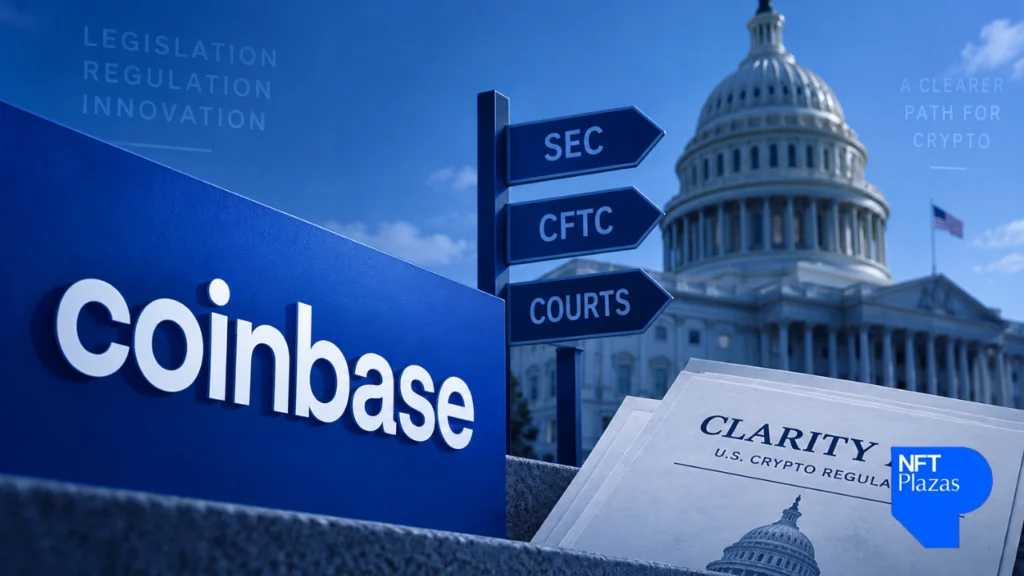
Coinbase, a leading cryptocurrency exchange, is strategically preparing for the potential failure of the long-anticipated U.S. crypto market-structure bill, known as the CLARITY Act, to clear Congress, while simultaneously affirming its unwavering commitment to accelerating the launch of new products and services. This proactive stance underscores the company’s deep-seated belief in the digital asset ecosystem’s future, irrespective of immediate legislative outcomes.
Alesia Haas, Coinbase’s Chief Financial Officer, articulated the company’s comprehensive approach during an interview with Yahoo Finance at the Goldman Sachs Communacopia & Technology Conference. Haas identified three distinct pathways to achieving the much-needed regulatory clarity: through congressional legislation, via federal agencies such as the Securities and Exchange Commission (SEC) and the Commodity Futures Trading Commission (CFTC), and ultimately, through the courts. This multi-faceted strategy signals a robust preparedness for various political and regulatory scenarios that could unfold in Washington.
“There was always three paths to getting Clarity,” Haas stated, emphasizing that even if the CLARITY Act stalls in Congress, Coinbase sees viable alternative routes. She specifically highlighted what she described as recent efforts by SEC Chair Paul Atkins and CFTC Chair Michael Selig to advance crypto regulation through agency rulemaking. While the current SEC Chair is Gary Gensler and CFTC Chair is Rostin Behnam, Haas’s reference points to a broader recognition within Coinbase of regulatory bodies’ capacity and willingness to develop frameworks, potentially reflecting engagement with commissioners or previous leadership or internal discussions. This adaptability is crucial for an industry grappling with a fragmented and often ambiguous regulatory landscape.
The timing of these comments is particularly poignant, coming just days before a critical Senate vote that holds significant sway over the CLARITY Act’s immediate future. The outcome of this procedural vote on September 15th could either pave the way for landmark legislation or relegate comprehensive crypto reform to an uncertain future, potentially years away.
The CLARITY Act: A Legislative Cornerstone for Digital Assets
The CLARITY Act represents a monumental effort to establish a federal framework for the burgeoning digital-asset market in the United States. At its core, the proposed legislation aims to delineate clearer boundaries between the SEC and the CFTC, two powerful financial regulators whose overlapping jurisdictions have long been a source of contention and confusion for crypto companies. Crucially, it seeks to provide definitive rules for classifying digital assets, determining whether they fall under securities regulation (typically overseen by the SEC) or commodities regulation (under the CFTC’s purview). This distinction is fundamental, as it dictates the compliance obligations, operational requirements, and even the market structures that digital asset firms must adhere to.
For years, the U.S. crypto industry has vociferously advocated for such clarity, arguing that the prevailing regulatory ambiguity has stifled innovation, limited investment, and pushed promising blockchain projects and talent overseas. Many industry leaders point to the European Union’s Markets in Crypto-Assets (MiCA) regulation, which provides a comprehensive and harmonized framework across member states, as an example of how clear rules can foster growth and confidence. The U.S., by contrast, has largely relied on a patchwork of state-level regulations and enforcement actions, creating a complex and often contradictory environment.
The upcoming Senate cloture vote on September 15th is a procedural hurdle, not a final vote on the bill itself, but it carries immense weight. To advance the legislation, 60 votes are required, a significant threshold in a politically divided Congress. Securing such bipartisan support for complex financial legislation is notoriously challenging, even for bills with broad industry backing. A failure to clear this procedural hurdle would likely mean the CLARITY Act, and possibly any comprehensive crypto legislation, would not move forward during the current congressional session, pushing the timeline for reform potentially years into the future.
Senator Cynthia Lummis (R-WY), a vocal proponent of digital assets and a key architect of the bill, has repeatedly warned of the severe consequences of legislative inaction. Her concerns echo those across the industry: without a clear federal framework, the U.S. risks falling behind other nations in the global race for blockchain innovation and market leadership, ultimately ceding its competitive edge.

Coinbase’s Unwavering Ambition: Beyond Congressional Delays
Despite the high stakes of the upcoming vote, Coinbase remains steadfast in its long-term vision and product development trajectory. Emilie Choi, Coinbase’s President and Chief Operating Officer, echoed Haas’s sentiment during the same interview, asserting, “We never have to roll back our ambitions.” This statement reflects a core tenet of Coinbase’s strategy: building its operations and product roadmap with regulation and compliance woven into its DNA. The company has demonstrated its capability to launch products and services within the existing, albeit imperfect, regulatory framework.
Choi clarified that the legislative outcome primarily affects the pace of market development and adoption, rather than the fundamental direction of Coinbase’s growth. “I think it’s more about the acceleration of adoption and how quickly money comes off the sidelines for Clarity,” she explained. This perspective suggests that while comprehensive legislation would undoubtedly provide a significant boost, its absence would necessitate a more gradual, perhaps more arduous, but ultimately achievable path to mainstream adoption and institutional engagement. The estimated global cryptocurrency market capitalization, which often fluctuates between $1 trillion and $3 trillion, stands to benefit immensely from increased institutional participation, much of which is currently held back by regulatory uncertainty.
The Alternative Routes: Agency Rulemaking and Judicial Precedent
Coinbase’s proposed fallback plan relies heavily on the regulatory initiatives undertaken by federal agencies, particularly the SEC and CFTC. Haas specifically lauded the efforts attributed to Paul Atkins and Michael Selig in pursuing rulemaking that could furnish greater clarity without waiting for congressional action. This approach acknowledges that agencies possess significant authority to interpret existing laws and issue new regulations, even in the absence of explicit legislative mandates.
The CFTC, for instance, has publicly indicated its exploration of how its existing authority under the Commodity Exchange Act could be leveraged to establish a clearer framework for crypto markets, particularly for digital assets deemed commodities, should the CLARITY Act remain stalled. This includes potential guidance on derivatives, spot markets, and registration requirements for platforms trading these assets. Similarly, the SEC has been actively working on developing a broader crypto regulatory framework, primarily through enforcement actions and guidance documents that articulate its view on which digital assets constitute securities. While these actions have often been met with criticism from the industry for being "regulation by enforcement," they nonetheless contribute to a developing, albeit litigious, body of regulatory understanding.
The advantage of agency rules lies in their potential for faster implementation compared to the protracted legislative process. Regulatory bodies can issue guidance, propose rules, and finalize them within months or a few years, whereas congressional bills can take years to negotiate and pass, often facing political gridlock. However, this speed comes with a trade-off: agency rules are inherently less durable than statutes passed by Congress. They can be revised, rescinded, or reinterpreted by future administrations or different agency leadership, introducing a degree of long-term uncertainty that comprehensive legislation would ideally mitigate. This dynamic creates a "two steps forward, one step back" scenario that can be challenging for long-term business planning.
Beyond agency rulemaking, Coinbase also acknowledges litigation as a third, albeit less preferred, path to clarity. Haas cited the company’s own history of legal battles with the SEC as an example of how court decisions can force regulatory definitions and precedents. Coinbase has notably engaged in public disputes with the SEC, including receiving a Wells Notice from the agency and challenging its approach to regulating digital assets. While costly and time-consuming, litigation can, in some instances, compel courts to interpret existing laws in the context of novel technologies, thereby establishing legal clarity that might otherwise be absent. This judicial route, though adversarial, has historically played a role in shaping regulatory landscapes across various industries.
Coinbase’s Vision: An "Everything Exchange" for the Digital Age
Coinbase’s determination to continue expanding its offerings is intrinsically linked to its ambitious strategy of evolving beyond a conventional cryptocurrency exchange. The company is actively pursuing an “Everything Exchange” model, envisioning a comprehensive platform that encompasses a wide array of financial products and services. This includes traditional crypto trading, but also delves into payments, tokenized assets, lending, and potentially other decentralized finance (DeFi) applications.

Clearer U.S. regulation is seen as a critical catalyst for bringing these sophisticated offerings to American customers and, more significantly, for encouraging institutional investors to deploy substantial capital into digital assets. Institutional adoption is widely considered the next major growth driver for the crypto market. Large financial institutions, hedge funds, and corporate treasuries, which collectively manage trillions of dollars, are often constrained by strict compliance requirements and risk aversion, making them hesitant to enter markets without robust regulatory frameworks. A study by Fidelity Digital Assets, for instance, showed that a significant percentage of institutional investors globally already hold digital assets, but many more are waiting for greater regulatory clarity before increasing their exposure.
Coinbase CEO Brian Armstrong has consistently maintained an optimistic outlook on the prospects of the CLARITY Act. In recent interviews, he expressed confidence in the bill’s eventual passage, arguing that definitive rules would unlock a floodgate of institutional investment. Armstrong has also publicly articulated a bullish long-term view for the crypto market, famously describing $400,000 Bitcoin by 2030 as a reasonable target, underscoring his conviction in the transformative potential of digital assets.
He frequently points to the GENIUS Act, a stablecoin legislation passed in the previous year, as a compelling precedent for how regulatory clarity can dramatically accelerate corporate adoption. Armstrong highlighted that within three months of the GENIUS Act’s passage, over 150 large companies integrated stablecoins into their operations, demonstrating a clear demand for regulated digital financial instruments. He anticipates a similar ripple effect from the CLARITY Act, especially for innovative products such as tokenized equities, which could revolutionize traditional capital markets by offering greater liquidity, transparency, and fractional ownership. Tokenized assets, representing real-world assets on a blockchain, hold the promise of democratizing access to various investment opportunities, from real estate to fine art.
The Crucial September Vote and its Broader Implications
Despite Coinbase’s well-articulated backup plans, the company and the broader crypto industry still have a profound incentive for Congress to act decisively. Legislation offers a more comprehensive, uniform, and durable framework than a collection of agency rules or fragmented court decisions. A federal law would establish unequivocal jurisdiction between regulators, thereby mitigating the regulatory arbitrage and uncertainty that have historically complicated the launch and scaling of crypto products in the U.S. It would also provide a level playing field for all market participants, fostering fair competition and robust market integrity.
The Senate’s September 15th cloture vote therefore stands as a pivotal moment for the industry’s ongoing quest for regulatory certainty. As the vote approaches, the CLARITY Act has reportedly undergone continuous revisions, with Senate Republicans releasing updated language to address complex issues such as decentralized finance (DeFi) protocols and nuanced compliance requirements for various digital asset businesses. These revisions reflect the inherent complexities of regulating a rapidly evolving technological and financial landscape.
For Coinbase, a failure of the CLARITY Act to advance would be a significant setback in terms of market acceleration, but decidedly not a stop sign. The exchange is effectively preparing for two primary outcomes: successful congressional legislation if lawmakers can muster the requisite votes, or a sustained, multi-front push through the SEC, CFTC, and the courts if the legislative path remains obstructed.
Coinbase’s overarching message to its investors, customers, and the market at large is becoming increasingly transparent: the company’s ambitious U.S. expansion plans and its vision for an "Everything Exchange" are not solely contingent upon a single piece of legislation. While the CLARITY Act holds the potential to dramatically accelerate these plans, Coinbase is signaling its unwillingness to wait indefinitely for Washington to provide the regulatory certainty it has long sought. This resilient and adaptive strategy reflects a mature understanding of the political and regulatory realities, positioning Coinbase to navigate the complex landscape and continue its growth trajectory, regardless of the immediate legislative winds. The digital asset industry’s future in the U.S. remains a dynamic interplay of innovation, regulation, and strategic adaptation.