Dwi Wanna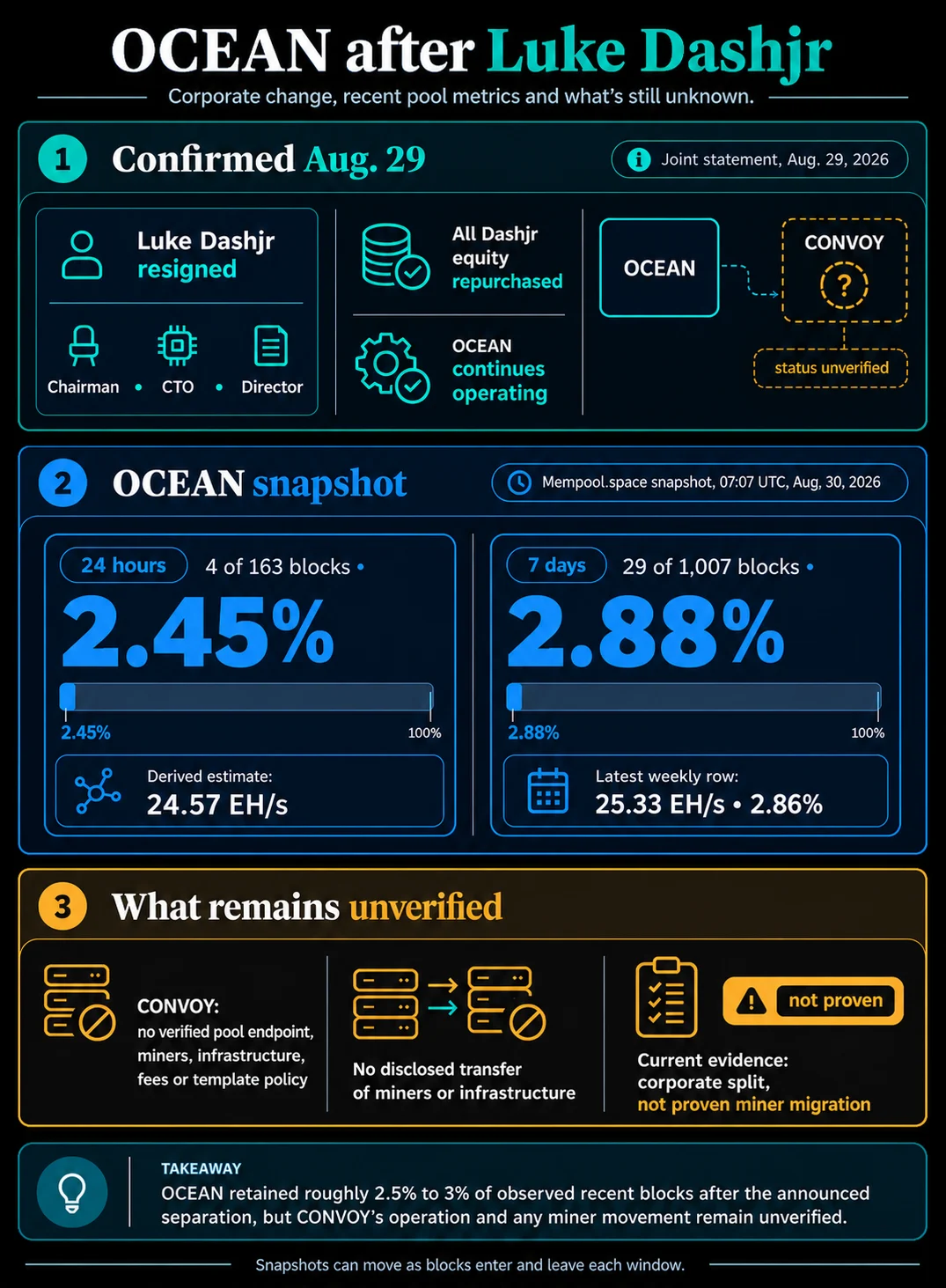
The landscape of Bitcoin mining infrastructure underwent a significant shift on August 29, as OCEAN Mining announced the completion of a full equity buyout of its co-founder and long-time Bitcoin Core contributor, Luke Dashjr. The move marks the end of a high-profile partnership that sought to decentralize the mining process but ultimately succumbed to diverging technical visions for the future of the network. Dashjr, a 16-year veteran of Bitcoin development, has officially resigned from his roles as Chairman, Chief Technology Officer, and Director, liquidating his entire ownership stake in the private firm.
The separation, finalized through a joint statement, removes one of Bitcoin’s most influential and often polarizing technical figures from the leadership of a pool that was specifically designed to embody his philosophy of decentralization. While the financial terms of the buyout remain confidential, the corporate restructuring signals a pivot for OCEAN as it attempts to maintain its market share without its primary technical architect. Simultaneously, Dashjr has signaled his intention to launch a competing venture named CONVOY, raising questions about whether the hash power currently pointed at OCEAN will remain loyal to the platform or follow the developer to his new project.
A Chronology of the OCEAN-Dashjr Partnership
To understand the weight of this departure, one must look at the genesis of OCEAN. Launched in late 2023 with significant backing—including a $6.2 million seed round led by Block Inc. co-founder Jack Dorsey—OCEAN was marketed as a "non-custodial" and "transparent" alternative to the dominant mining pools like Foundry USA and AntPool. The project was built on the foundation of the old Eligius pool, which Dashjr had operated years prior.
The core value proposition of OCEAN was the implementation of TIDES (Transparent Index of Decentralized Equity Shares), a payout scheme designed to improve upon traditional PPLNS (Pay Per Last N Shares) by ensuring miners received rewards directly from the Bitcoin block coinbase transaction, rather than waiting for a pool operator to distribute funds. This removed the custodial risk that has historically plagued the mining industry.
Throughout early 2024, OCEAN positioned itself as a defender of Bitcoin’s "purity," often reflecting Dashjr’s own technical stances. This included a controversial decision to filter certain types of transactions, specifically those related to Ordinals and BRC-20 tokens, which Dashjr characterized as "spam" exploiting vulnerabilities in the Bitcoin Core software. This stance created a rift in the mining community, with some praising the pool’s commitment to network health and others criticizing it for censorship and potential loss of fee revenue for miners.
The tension reached a boiling point in mid-2024 following the emergence of new protocol developments, including BIP-110 and disagreements over block template construction. By July, OCEAN began offering dedicated endpoints to accommodate different miner preferences, a move that hinted at internal friction regarding how much control the pool should exert over the blocks its miners produced. The August 29 announcement was the culmination of these escalating differences in "vision."
Quantitative Analysis: OCEAN’s Current Market Position
At the time of the buyout, OCEAN occupied a modest but strategically important niche in the global Bitcoin hashrate. According to data from Mempool.space captured on August 30, OCEAN accounted for approximately 2.45% of the blocks mined over the preceding 24-hour window. This share was derived from the pool successfully mining four out of 163 blocks.

When extrapolated against the total network hashrate, OCEAN’s contribution is estimated at roughly 24.57 exahashes per second (EH/s). A broader look at the trailing seven-day window provides a more stable picture of the pool’s standing; it captured 29 out of 1,007 blocks, representing a 2.88% market share and a weekly average hashrate of 25.33 EH/s.
While these figures are small compared to industry leaders—Foundry USA often commands upwards of 25% to 30% of the network—OCEAN’s share is significant enough that any mass migration of miners would be immediately visible on-chain. The pool has consistently fluctuated within the 2.5% to 3% range, making it a viable "mid-tier" player that caters to ideologically driven miners and those seeking non-custodial payout structures.
The Technical Schism: BIP-110 and Block Templates
The joint statement issued by OCEAN and Dashjr alluded to "different visions following recent protocol developments." While the statement avoided naming specific technologies, industry analysts point to the friction surrounding BIP-110 and the DATUM (Decentralized Alternative Template User Management) system.
In July, OCEAN introduced dedicated BIP-110 and "no-signal" endpoints. This was a response to a growing demand among miners for more autonomy in block construction. Traditionally, the pool operator decides which transactions go into a block. Dashjr’s philosophy, often implemented via his "Bitcoin Knots" software, favored strict filtering of what he deemed non-financial data. However, many miners, motivated by profit maximization, preferred to include high-fee transactions regardless of their content (such as Ordinals).
OCEAN’s DATUM system was intended to bridge this gap by allowing miners to gain more control over block templates. However, the implementation of these features appeared to create a divide between those who wanted a "curated" Bitcoin ledger and those who favored a "market-driven" approach. The buyout suggests that OCEAN intends to move toward a more flexible model that may prioritize miner choice and fee optimization to remain competitive, while Dashjr seeks to double down on his specific technical standards through CONVOY.
CONVOY: The Uncertain Successor
The announcement of CONVOY has introduced a new variable into the mining ecosystem, though the project remains shrouded in mystery. As of late August, CONVOY has not released a public codebase, infrastructure specifications, or an endpoint for miners to connect to. Its public profile on social media platforms and the joint press release offered no details regarding fees, block-template policies, or participating mining farms.
The critical question facing the industry is whether the hashrate currently at OCEAN is tied to the brand and its TIDES payout system, or to Luke Dashjr’s personal reputation. Historically, hash power has proven to be highly mercenary, moving toward pools that offer the highest "luck-adjusted" returns and the lowest fees. However, OCEAN’s user base is unique; many of its miners joined specifically because of the decentralization and "spam-filtering" ethos championed by Dashjr.
If CONVOY launches with a similar non-custodial structure but offers a more refined version of Dashjr’s Bitcoin Knots integration, it could potentially siphon off a significant portion of OCEAN’s 25 EH/s. Conversely, if OCEAN manages to retain its TIDES system and improves its fee competitiveness by being less restrictive with transaction filtering, it may actually see a growth in hashrate from miners who were previously deterred by Dashjr’s controversial stances.

Broader Implications for Bitcoin Decentralization
The departure of Luke Dashjr from OCEAN is more than a simple corporate divorce; it is a case study in the challenges of decentralizing Bitcoin mining at the institutional level. The primary goal of OCEAN was to prevent the "centralization of block construction," where a handful of pool operators decide the contents of the Bitcoin blockchain.
By separating, the two entities may inadvertently contribute to further fragmentation of the hashrate. While fragmentation is generally viewed as a positive for decentralization (as it prevents any single entity from reaching a 51% threshold), it also creates challenges for the economic viability of smaller pools. Smaller pools face higher "variance," meaning they may go long periods without finding a block, which can lead to inconsistent payouts for miners.
Furthermore, this split highlights the ongoing debate within the Bitcoin community regarding the "social contract" of the network. Dashjr’s exit suggests that the "maximalist" approach to block filtering—treating the blockchain as a purely financial ledger—is finding it difficult to coexist with the commercial realities of a multi-billion dollar mining industry.
Official Responses and Future Outlook
In the wake of the announcement, OCEAN has reaffirmed its commitment to its roadmap, stating it will continue to operate its transparent, non-custodial pool. The company has yet to name a successor for the CTO or Chairman roles, leading to speculation that a new technical lead may be brought in to modernize the pool’s stack and perhaps move away from the Bitcoin Knots-centric architecture.
For his part, Dashjr’s move to CONVOY is seen by his supporters as a necessary step to maintain technical integrity without the compromises required by a venture-backed corporate board. As one of the few developers with the seniority to influence the Bitcoin Core roadmap, his future technical decisions will be closely watched by miners and developers alike.
As the industry monitors the mining charts in the coming weeks, the stability of OCEAN’s 2.88% market share will serve as the primary metric for the success of this transition. If the share remains steady, it will prove that the infrastructure and payout model built by OCEAN have independent value. If it drops significantly, it will confirm that in the world of Bitcoin mining, the influence of a single veteran developer can still outweigh the institutional weight of a well-funded corporation.
For now, the Bitcoin network continues to produce blocks every ten minutes, indifferent to the corporate restructuring of the entities that secure it. However, the "Crossroads" depicted in the project’s recent imagery is real: one path leads toward a more commercial, miner-centric OCEAN, and the other toward a technically rigorous, developer-led CONVOY. Where the hash power eventually settles will define the next chapter of Bitcoin’s decentralized mining evolution.