Dwi Wanna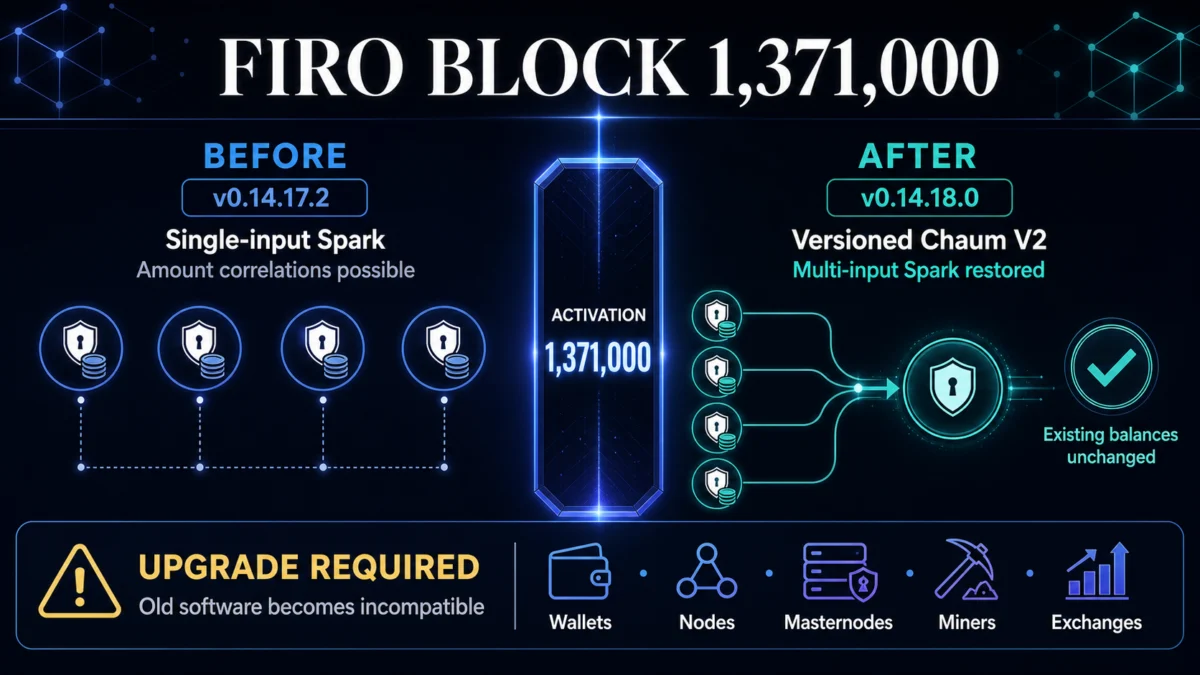
This high-stakes technical event follows weeks of emergency mitigation efforts. Early Friday, the Firo blockchain was fewer than 160 blocks away from the activation threshold. With block times averaging several minutes, the window for miners, masternode operators, and exchanges to update their software was reduced to a matter of hours. Failure to adopt the new software before the activation height results in immediate incompatibility with the main network, effectively stranding any node running legacy code on a deprecated and insecure chain.
The Spark Vulnerability: A Threat to Monetary Integrity
The core of the issue lies within "Spark," Firo’s flagship privacy protocol. Spark was designed to provide robust anonymity by obfuscating the origins, amounts, and destinations of transactions. However, on August 13, 2026, the Firo development team disclosed a critical discovery: a flaw in the multi-input Spark spending process. Under specific conditions, this flaw allowed for the creation of forged proofs, which could be used to generate new FIRO tokens out of thin air.
In a controlled environment, a security researcher demonstrated the severity of the flaw by successfully generating approximately 200 FIRO on the mainnet. While the development team noted that there was no evidence of this exploit being used by malicious actors prior to the disclosure, the potential for "endless token creation" posed an existential threat to the project. In the world of decentralized finance, supply integrity is the bedrock of value; if a privacy coin’s total supply cannot be verified due to hidden inflation, investor confidence typically collapses.
Crucially, the Firo team clarified that the vulnerability did not compromise the security of individual wallets or private keys. At no point were an attacker’s funds at risk of being stolen from their addresses. The risk was purely systemic, targeting the protocol’s ability to validate the total number of coins in circulation.
The Interim Stopgap: Sacrificing Privacy for Security
Immediately following the discovery in mid-August, Firo released an interim software version (v0.14.17.2). This version acted as a "stopgap" by placing a restrictive rule on the Spark protocol: it limited Spark transactions to a single input.
In practical terms, this meant that if a user wanted to send a large amount of FIRO that was composed of several smaller "notes" or "coins" in their private balance, they could no longer combine them into a single transaction. Instead, the user would have to send multiple separate transactions. While this effectively neutralized the inflation bug—as the exploit required multiple inputs to function—it introduced a significant privacy trade-off.
When a user is forced to split a payment into several smaller, separate transactions, those amounts can potentially be correlated by outside observers or sophisticated chain analysis tools. This "correlation risk" weakened the very anonymity that Firo users seek. Consequently, the community has been operating under a regime of "reduced privacy" for several weeks, awaiting the permanent fix that would restore full multi-input functionality without the risk of forgery.
Technical Specifications of the v0.14.18.0 Hard Fork
The current hard fork to version 0.14.18.0 is the definitive solution to this crisis. According to the official release notes provided by the Firo development team, the update introduces a new versioned Chaum V2 proof and an updated transaction format.
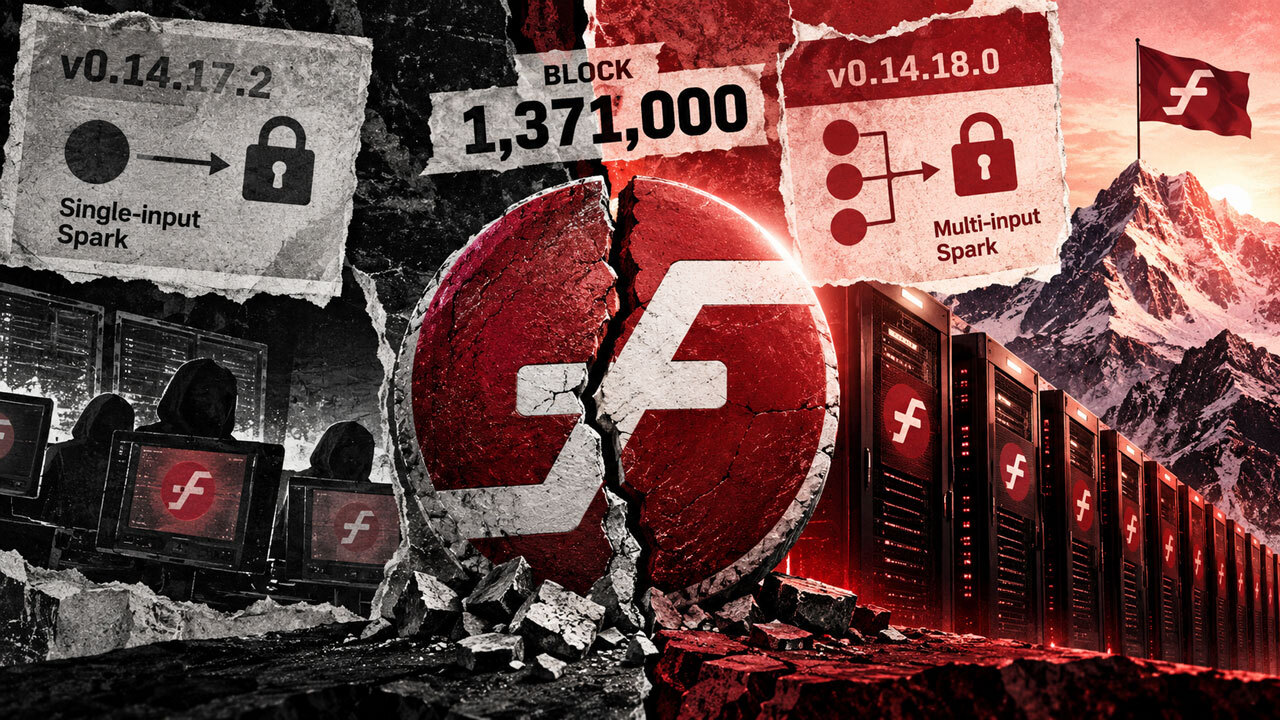
Chaumian blinding and proofs are central to many privacy protocols, allowing a system to verify that a transaction is valid without revealing the underlying data. The move to Chaum V2 represents a significant cryptographic upgrade, specifically designed to close the loopholes identified in the previous multi-input logic. Once the network reaches block 1,371,000, the updated software will automatically:
- Restore the ability to combine multiple Spark inputs into a single transaction.
- Maintain the validation of all historical Spark transactions to ensure chain continuity.
- Enforce the new proof standards, rendering any attempt at the old forgery method impossible.
For the average user holding FIRO in a private wallet, no direct action is required regarding their funds. Existing Spark coins, balances, and addresses remain valid and do not need to be migrated or "reminted." The "mandatory" nature of the update applies specifically to the infrastructure providers—the "plumbing" of the network.
A Chronology of the Firo Security Response
The path to this hard fork has been a sprint for the development team. The timeline of events highlights the rapid response required to secure a multi-million dollar digital asset:
- August 13, 2026: Firo publicly discloses the Spark vulnerability after a researcher reports the flaw. The team announces that an emergency mitigation strategy is already in development.
- August 14-15, 2026: Version 0.14.17.2 is deployed as an interim defense. This version restricts Spark to single-input spends, successfully halting the potential for inflation but limiting privacy features.
- August 27, 2026: The Firo team announces the completion of the permanent fix in version 0.14.18.0. They set the activation height at block 1,371,000 and urge all operators to prepare for a hard fork.
- September 4, 2026 (Early Morning): The network nears the activation block. At 1:45:47 a.m. UTC, the chain reaches block 1,370,847, leaving only 153 blocks until the transition.
- September 4, 2026 (Estimated 10:00 a.m. UTC): The hard fork is scheduled to go live.
This timeline illustrates the "responsible disclosure" process in action. By coordinating with the researcher and moving quickly to a stopgap before finalizing a complex cryptographic fix, the Firo team managed to prevent a market panic while ensuring the long-term viability of the protocol.
Network Roles and the Deadline for Compliance
As the deadline approached, the Firo team issued urgent reminders to various stakeholders within the ecosystem. Each group plays a vital role in ensuring a smooth transition:
Masternode Operators: Firo utilizes a hybrid system involving Long-Living Masternode Quorums (LLMQs). Masternodes provide services like InstantSend and participate in the network’s security layers. If a significant percentage of masternodes fail to upgrade, the network’s specialized features could experience instability.
Miners: Since Firo uses a Proof-of-Work (PoW) consensus mechanism, miners must use the new software to ensure they are mining on the correct chain. If a miner remains on the old software after block 1,371,000, they will be mining blocks that the rest of the updated network rejects, leading to a loss of mining rewards.
Exchanges and Service Providers: Platforms like Binance, Huobi, and others that list FIRO must update their wallet infrastructure. Most exchanges typically suspend deposits and withdrawals during a hard fork to prevent "replay attacks" or the accidental loss of funds on a split chain.
Full-Node Users: Users who run their own nodes to verify their own transactions must upgrade to stay synced with the network.

Market Reaction and Economic Data
Despite the technical turbulence, the market has reacted with surprising optimism. In the 24 hours leading up to the hard fork, FIRO’s price saw a significant uptick of 6.50%, reaching a market capitalization of approximately $13.4 million. Trading volume also saw a slight increase, rising by 0.95% to $236,940.
Currently ranked #817 by market capitalization, Firo remains a niche but respected project in the privacy sector. The positive price movement suggests that investors are confident in the development team’s ability to execute the hard fork successfully. Over a 30-day period, the coin is up 9.17%, indicating that the initial disclosure of the vulnerability in mid-August did not cause a lasting sell-off, likely due to the swift implementation of the stopgap measures.
The circulating supply of FIRO stands at approximately 19 million tokens, with a Fully Diluted Valuation (FDV) of $15.09 million. Maintaining the integrity of this supply is the primary objective of the current software deployment.
Broader Implications for the Privacy Coin Sector
The Firo incident highlights a recurring challenge for privacy coins: the "Invisible Inflation" paradox. In a transparent blockchain like Bitcoin, anyone can run a script to sum up all the outputs and verify that the total supply matches the issuance schedule. In a privacy coin, where outputs are shielded, verifying the total supply requires complex mathematical proofs.
If those proofs have a flaw—as was the case with Spark—inflation can occur without anyone noticing for an extended period. This happened famously with Zcash in 2018, where a "counterfeiting flaw" was discovered and fixed in secret before being disclosed months later. Firo’s decision to be transparent about the flaw shortly after discovery represents a shift toward more open security communications in the privacy space.
Furthermore, the Firo hard fork arrives at a time when privacy coins are under intense regulatory scrutiny. Global regulators have expressed concerns that anonymous transactions facilitate money laundering. By demonstrating a high level of technical rigor and a commitment to supply integrity, Firo is attempting to prove that privacy-preserving technology can be both secure and responsibly managed.
Looking Ahead: Post-Fork Disclosure
The Firo development team has committed to publishing a full technical disclosure and a post-mortem analysis once the fork is successfully activated and the network has stabilized. This document is expected to provide deeper insights into how the flaw was discovered, the specific mathematics of the Chaum V2 fix, and the lessons learned for future protocol development.
For now, the focus remains on the immediate transition. As block 1,371,000 approaches, the crypto community is watching closely. A successful upgrade will solidify Firo’s reputation for technical resilience, while any hiccups in the fork could provide a cautionary tale for other projects managing complex cryptographic protocols. The coming hours will determine the next chapter for this long-standing privacy-focused network.