admin
admin
Ethereum, the world’s second-largest blockchain by market capitalization, is approaching a pivotal moment in its history as it prepares to transition from a Proof-of-Work (PoW) consensus mechanism to a Proof-of-Stake (PoS) system. This transition, widely known as "The Merge," represents one of the most significant technical undertakings in the history of decentralized finance, involving the protection of hundreds of billions of dollars in assets. Industry experts and developers often compare this procedure to "changing the engine of an airplane while it is mid-flight," highlighting the absolute necessity that the network continues to produce valid blocks without interruption. While the technical shift promises to reduce Ethereum’s energy consumption by more than 99.9%, it also introduces a critical governance and security challenge: the concentration of validator nodes within a single software client.

The Architecture of the Post-Merge Network
To understand the risks associated with client concentration, one must first understand the architectural shift occurring within the Ethereum ecosystem. Unlike the current Proof-of-Work model, where miners perform both transaction execution and block validation, the post-Merge environment will separate these duties into two distinct layers. This separation is intended to enhance the robustness and modularity of the network.
Post-Merge, the network will consist of two types of nodes: execution nodes and consensus nodes. The execution nodes will continue to run the Ethereum Virtual Machine (EVM), handling the processing of smart contracts and transaction data. This is the layer that users and developers interact with directly. However, these nodes will no longer be responsible for the security of the chain through mining. Instead, they will pass executed transactions to validator nodes residing on the consensus chain, also known as the Beacon Chain.
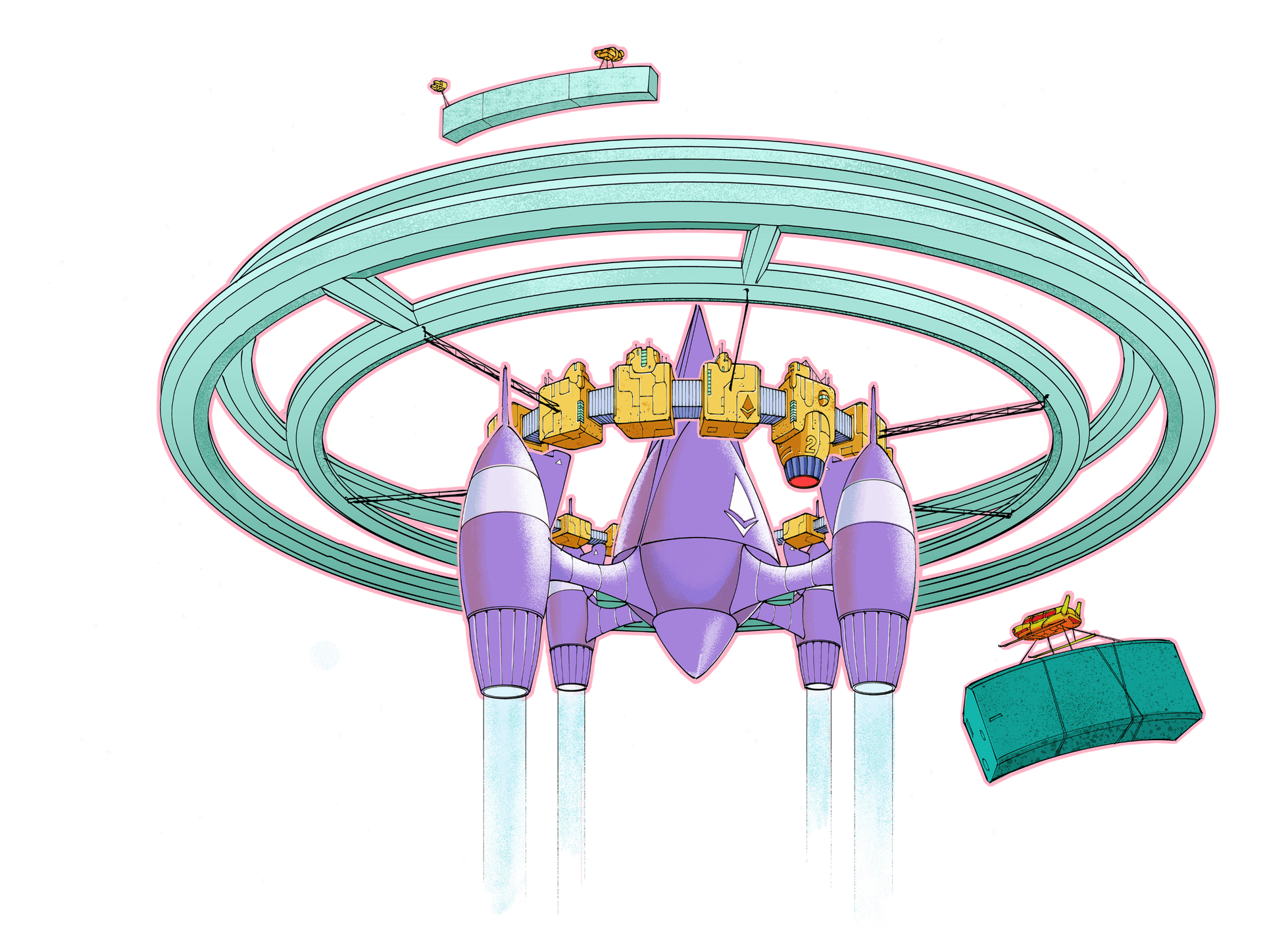
The Beacon Chain has been running in parallel with the main Ethereum network since December 2020, serving as a live testing ground for the PoS logic. The Merge is the moment these two layers become inextricably linked. At a specific block height, the PoW mechanism will be retired, and the Beacon Chain’s validators will take over the responsibility of finalizing blocks. While the transition is seamless from a user perspective, the underlying software distribution among these validators determines the ultimate security and "liveness" of the network.
The Mathematical Risks of Client Supermajorities
The Ethereum Foundation (EF) and the broader developer community have intentionally encouraged the development of multiple client implementations—software versions of the protocol written in different programming languages by independent teams. This "multi-client" philosophy is a departure from the model used by Bitcoin, which relies primarily on a single dominant client, Bitcoin Core. The rationale is that if a critical bug is discovered in one software version, the entire network will not fail as long as other versions are available to maintain the correct state of the ledger.
However, the efficacy of this safety net depends entirely on the distribution of these clients. In a Proof-of-Stake system, the network relies on certain mathematical thresholds to reach "finality," the point at which a block cannot be changed without a massive loss of staked capital. The risks are tiered based on the percentage of the network controlled by a single client:
- Below 33%: If a client with less than one-third of the staking power experiences a bug or goes offline, the network continues to function normally. The faulty nodes are penalized, but the blockchain remains stable.
- Between 33% and 50%: A bug in a client of this size can prevent the network from reaching finality. While the chain continues to grow, transactions are not "final," leading to potential disruptions in exchanges and high-value transfers.
- Above 50%: A majority client with a bug could cause a temporary split in the network, leading to significant complications in mending the state of the blockchain.
- Above 66% (The Supermajority): This is the "game over" scenario. If a client used by more than two-thirds of the validators contains a consensus-breaking bug, that bug will be written into the finalized history of the blockchain. Because the buggy client has the power to finalize blocks, the non-buggy clients are left with two choices: follow the buggy chain (and accept its flaws) or initiate a permanent chain split, effectively creating two versions of Ethereum.
Current Market Share and the Prysm Dominance
As the Merge approaches, data indicates that the Ethereum network is dangerously close to a supermajority situation. The Prysm client, developed by Prysmatic Labs, currently commands approximately two-thirds of the network’s staking power. While Prysm is a highly regarded and stable implementation, its sheer dominance undermines the security benefits of a multi-client ecosystem.
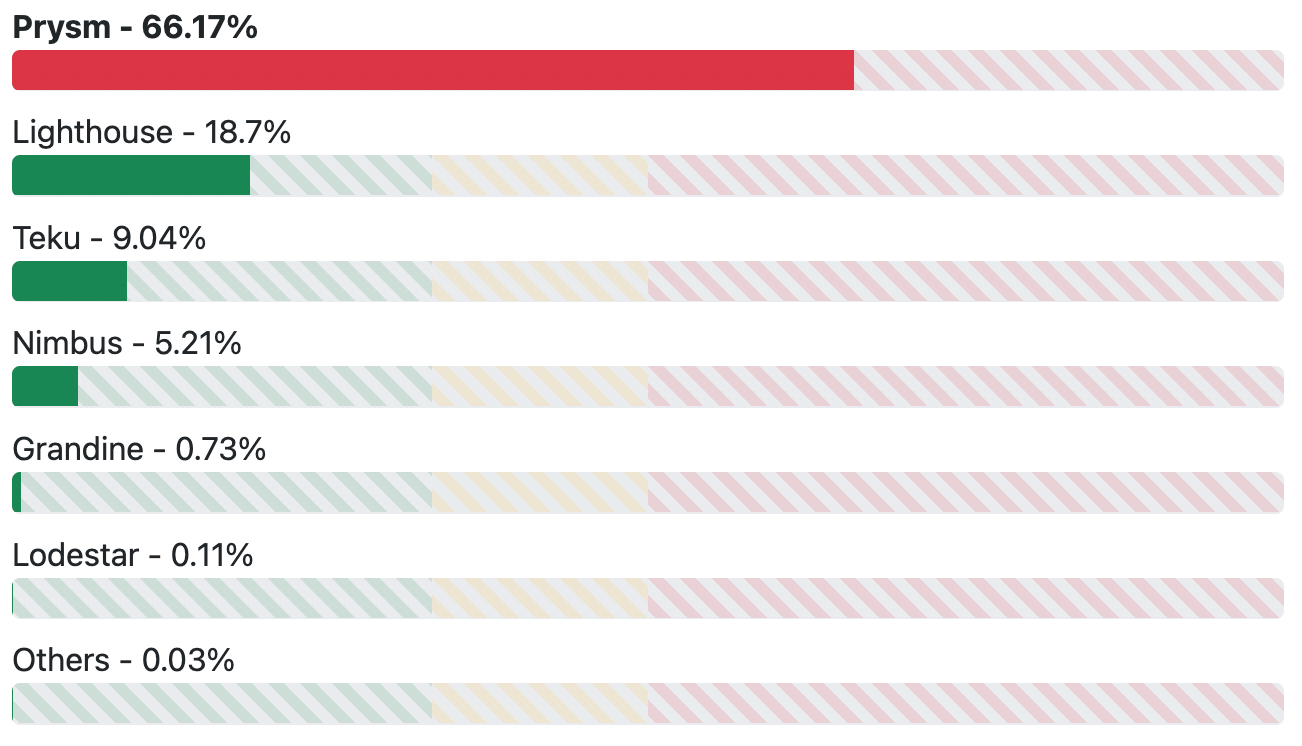
Other available consensus clients include Lighthouse (Sigma Prime), Teku (ConsenSys), Nimbus (Status), and newer entries like Grandine and Lodestar. Despite the availability of these alternatives, Prysm has maintained a "first-mover advantage." It was the first prototype implementation available for the Beacon Chain, allowing its developers to build comprehensive documentation, a robust user interface, and a suite of tools that made it the default choice for early adopters.
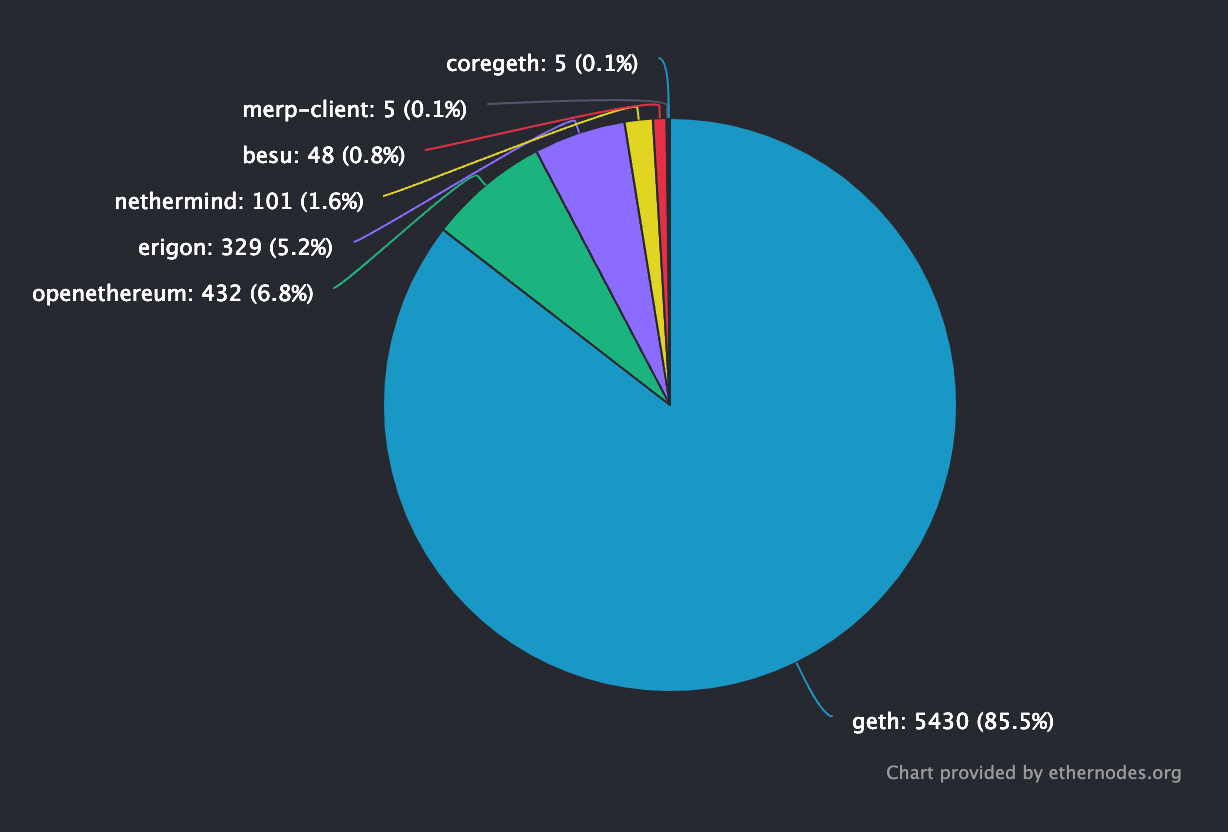
Furthermore, Prysm is written in Go (Golang), a programming language that is both performant and widely understood by the existing developer base. Since Geth (Go-Ethereum), the dominant execution client, is also written in Go, many node operators felt more comfortable auditing and running a consensus client in a familiar language. Currently, Geth holds an 85% market share on the execution layer, though this is considered less of a systemic threat than consensus layer dominance because execution clients do not dictate the finality of the chain in the same way.
The Role of Institutional Staking Services
The concentration of client software is largely driven by the behavior of major staking providers and cryptocurrency exchanges. Because individual users often lack the 32 ETH required to run a validator node, they turn to services like Coinbase, Kraken, Binance, and Lido. These entities manage thousands of validators on behalf of their customers, and their choice of software has a disproportionate impact on network health.
Data reveals the following contributions to the Prysm dominance:
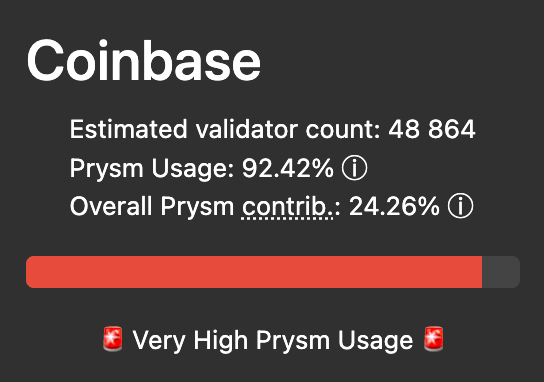
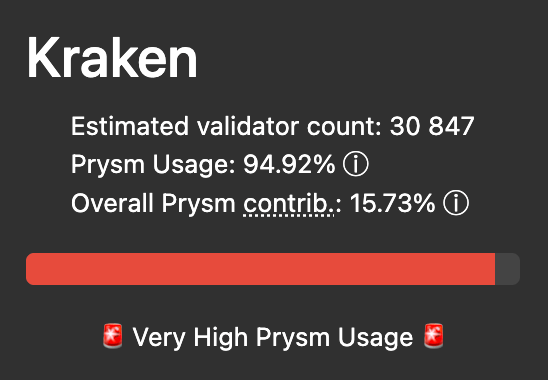
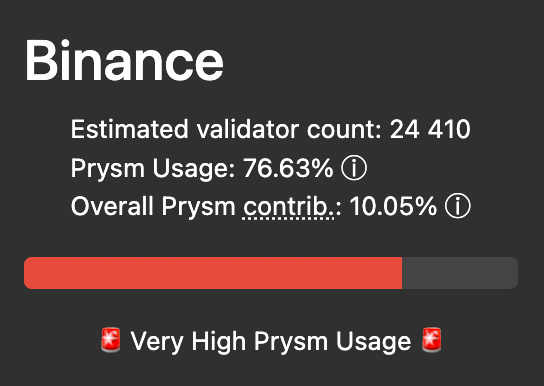
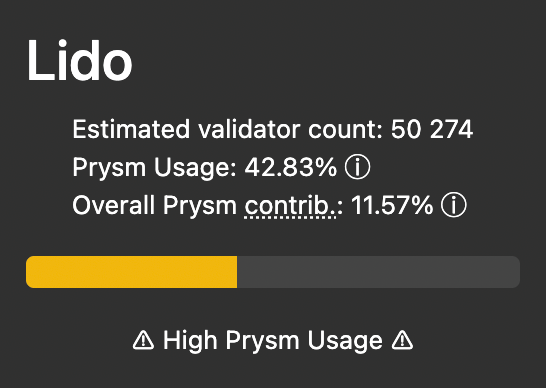
- Coinbase: Manages approximately 17.5% of all validators, with over 92% of those running Prysm.
- Kraken: Controls 11% of the validator set, with nearly 95% running Prysm.
- Binance: Holds an 8.7% share, with 76.6% on Prysm.
- Lido: As a decentralized autonomous organization (DAO), Lido is more diversified, with roughly 42.8% of its 18% market share running on Prysm.
In response to inquiries regarding these choices, Coinbase pointed to security as the primary driver. Early in the Beacon Chain’s lifecycle, Prysm was the only client that supported "remote signers." This feature allows validators to store their private keys in isolated, highly secure environments rather than on the validator server itself, which is a critical requirement for institutional-grade security.
Kraken’s Senior Product Manager, Brian Hoffman, noted that Prysm was selected for its maturity and stability during the initial rollout. However, Kraken has since engaged in discussions with the Ethereum Foundation and has begun migrating some of its infrastructure to the Teku client to improve diversity.
Chronology of the Transition
The path to the Merge has been a multi-year effort, marked by several key milestones:
- December 2020: Launch of the Beacon Chain, introducing the PoS consensus layer.
- April 2021: The Berlin Upgrade, optimizing gas costs and security.
- August 2021: The London Upgrade, introducing EIP-1559 and the fee-burning mechanism.
- Late 2021/Early 2022: Successful shadow forks and testnet merges (Kintsugi and Kiln) to identify bugs in the transition logic.
- Mid-2022: The projected window for the Mainnet Merge.
Throughout this timeline, the "client diversity" warning has grown louder. Developers have utilized various community calls and social media campaigns to urge "home validators" and small-scale operators to switch away from Prysm. Unlike large exchanges, which must update complex monitoring APIs to switch clients, individual operators can often switch implementations in less than ten minutes.
Analysis of Implications and Systemic Resilience
The Ethereum community has taken a hardline stance on the issue of client diversity. Core developers, including Marius van der Wijden, have emphasized that there will be no "bailouts" for stakers if a majority client fails. If a supermajority client experiences a consensus bug that leads to "slashing" (the permanent loss of staked ETH), the network’s protocols will function as designed, even if it results in the loss of billions of dollars for those running the faulty software. This "anti-correlation" penalty is built into Ethereum’s code to incentivize diversity; the more people who fail at the same time, the harsher the financial penalty.
Despite the risks, the developer community remains confident in proceeding with the Merge. The rationale is that the current testing infrastructure, which includes constant "fuzzing" (submitting random data to find differences in client behavior), is sufficient to catch most catastrophic bugs before they reach the mainnet. Furthermore, the transition to PoS is seen as an essential step for Ethereum’s long-term scalability and its narrative as a sustainable, "green" blockchain.
The broader impact of the Merge extends beyond Ethereum itself. As the foundational layer for thousands of decentralized applications (dApps), any instability in Ethereum would reverberate across the entire crypto ecosystem. The success or failure of this transition will likely dictate the future of decentralized governance. If Ethereum can successfully navigate the Merge while eventually diversifying its client base, it will set a precedent for how decentralized networks can undergo massive upgrades without centralized control.
In the coming months, the focus will remain on the major staking pools. Their ability to migrate to clients like Lighthouse and Teku will be the deciding factor in whether Ethereum enters its new era as a truly resilient, multi-client network or one that remains vulnerable to the "game over" scenario of a software monopoly. For now, the "airplane" continues its flight, with the world watching to see if the engine swap will be completed in time and with the necessary safety margins.