admin
admin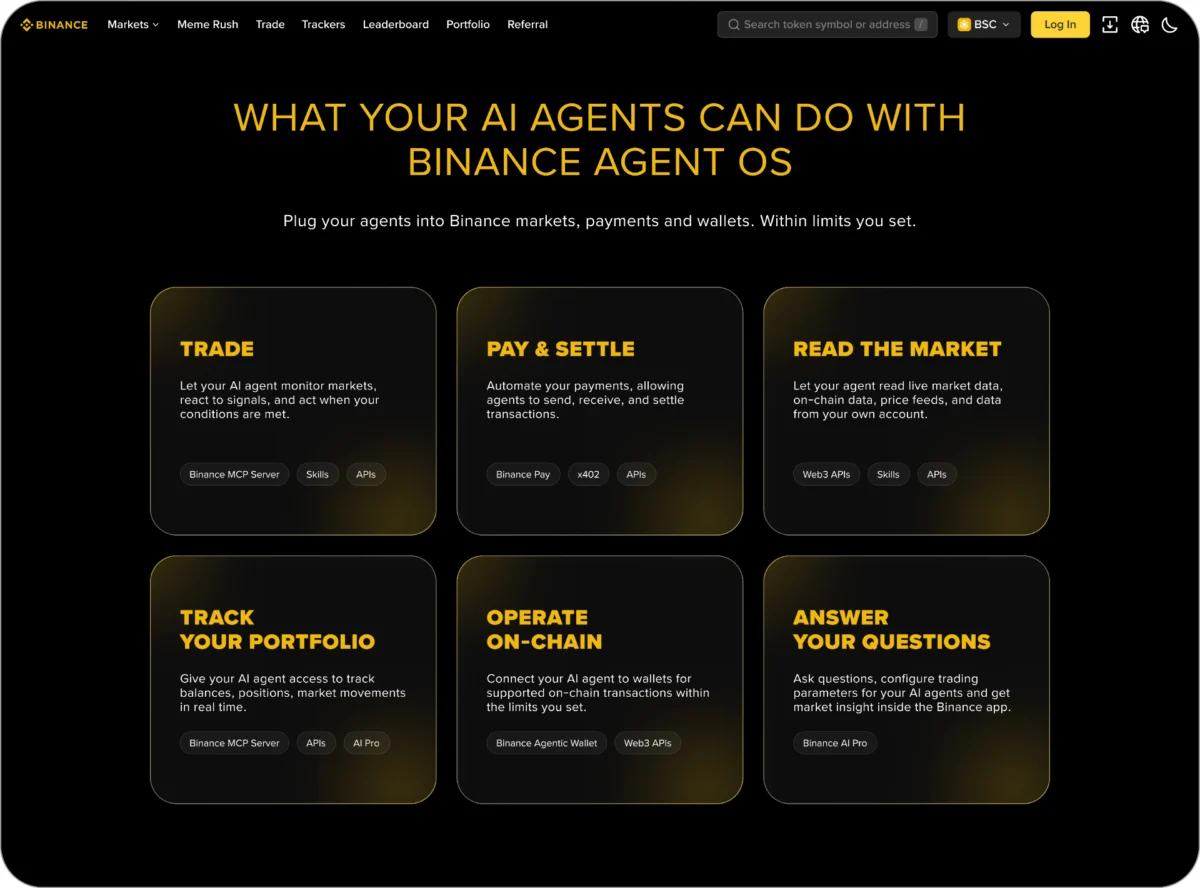
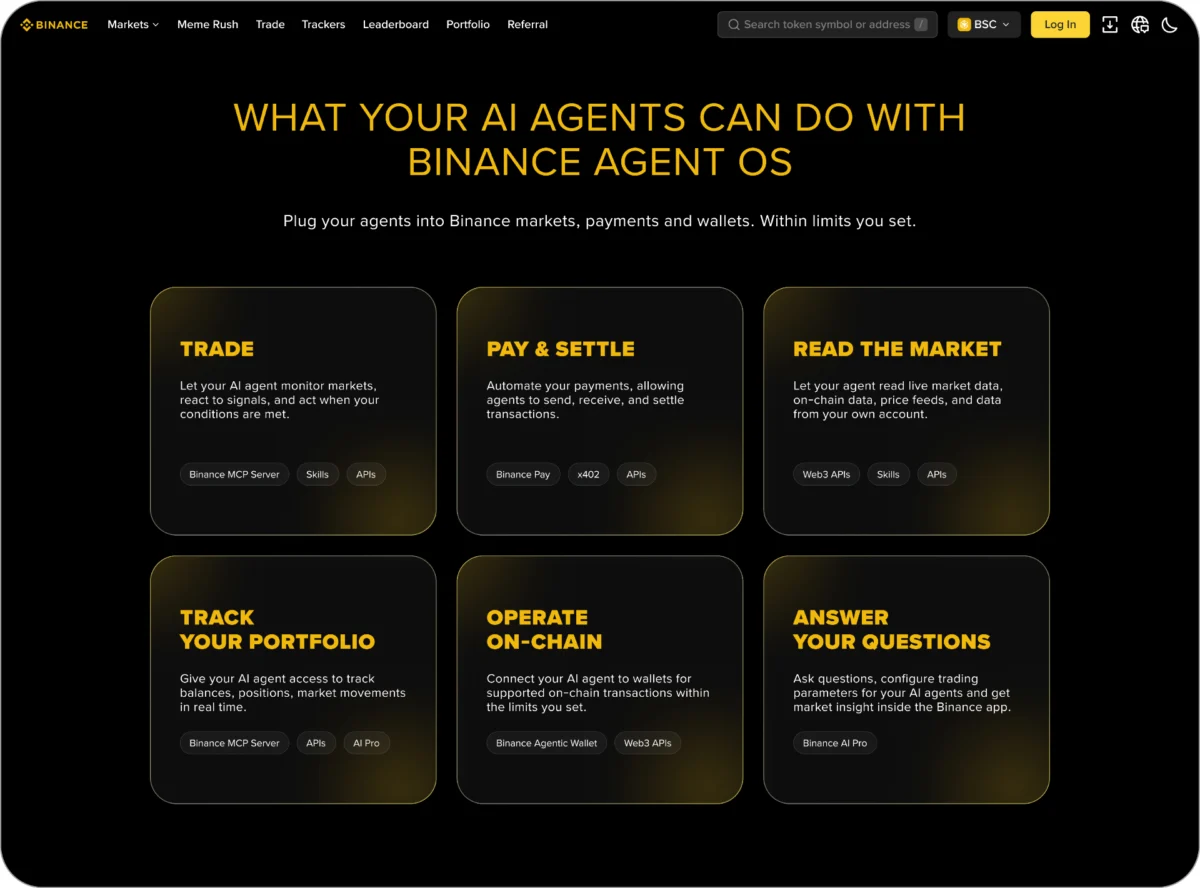
The global financial landscape reached a significant milestone on Thursday as Binance, the world’s largest cryptocurrency exchange by trading volume and user base, officially unveiled Agent OS. This new platform is designed to bridge the gap between advanced artificial intelligence and real-world financial execution, allowing AI agents to analyze complex market data and execute trades autonomously on behalf of users. With a registered user base exceeding 300 million, Binance’s entry into the "agentic AI" space signals a fundamental shift in how retail and institutional investors may interact with digital assets moving forward, transitioning from manual interface navigation to delegating authority to autonomous software entities.
The Technical Framework of Agent OS
Agent OS is not merely a single tool but a comprehensive infrastructure layer that allows developers to link sophisticated AI models directly to Binance’s deep liquidity and financial services. The platform integrates several of the exchange’s core technological components into a unified environment. Key among these are the Binance APIs, the Binance Wallet Agentic Hub, and the Binance x402 transaction verification and payment facilitator API.
Furthermore, the platform introduces the Binance Skill Hub and robust support for the Model Context Protocol (MCP). MCP is an emerging industry standard that allows AI models to maintain a consistent "context" when interacting with external data sources and tools. By adopting MCP, Binance ensures that Agent OS is compatible with the world’s leading AI ecosystems. At launch, the platform supports integration with OpenAI’s ChatGPT and Codex, Anthropic’s Claude Code, and the AI-powered code editor Cursor. This interoperability allows developers to build agents that can read real-time market feeds, check account balances, and execute buy or sell orders based on natural language instructions or complex algorithmic logic.
Security and the "Sandbox" Philosophy
The delegation of financial authority to AI agents introduces unprecedented risks, ranging from technical glitches to "hallucinations" where an AI might misinterpret market data. To mitigate these concerns, Binance has implemented a governance model that places the burden of risk management on the user while providing the technical tools to enforce strict boundaries.
Jeff Li, Vice President of Product at Binance, emphasized that the platform is built on the principle of granular access control. Rather than granting an AI agent full access to a user’s primary account, Agent OS utilizes a "subaccount" structure. This creates a virtual sandbox where the agent operates. By default, withdrawals from these subaccounts are blocked, ensuring that even if an agent were to malfunction or be compromised, the user’s primary capital remains secure.
Within these subaccounts, users can define specific permissions. An agent might be restricted to spot trading only, or it might be permitted to engage in futures and derivatives. Users also have the option to require manual approval for every trade the AI proposes, or they can toggle "autonomous mode," allowing the agent to execute trades instantly when certain market conditions are met. Notably, Binance does not impose a universal cap on trading losses within these subaccounts; instead, the total amount of capital a user transfers into the subaccount serves as the effective "hard limit" on the agent’s potential exposure.
Addressing the "Black Box" of AI Decision-Making
One of the most complex challenges in AI-driven finance is the "reasoning" behind a trade. When a human trader makes a move, there is usually a discernible strategy or emotional catalyst. With LLM-based (Large Language Model) agents, the decision-making process happens within the neural network of the AI provider, such as OpenAI or Anthropic.
Binance has clarified that it does not have visibility into the internal logic or "thought process" of the agents using Agent OS. The reasoning occurs either on the user’s local machine or within the third-party AI application. This creates a significant transparency gap; while Binance can monitor the resulting trades for signs of market manipulation or money laundering, it cannot determine if a trade was triggered by a "prompt injection" attack—a type of cyberattack where malicious instructions are hidden in data to trick an AI—or simply by faulty logic.
To counter this, Binance relies on its existing suite of security protocols. The company stated that all Agent OS activities are subject to the same rigorous risk-control and anti-money-laundering (AML) policies that govern its standard API and institutional services.
The Competitive Landscape: A 2024 Timeline
Binance’s launch of Agent OS is the latest move in a rapidly accelerating arms race among crypto exchanges to capture the AI developer market. Throughout 2024, the industry has seen a clear trend toward "agentic" capabilities.
- March 2024: Kraken initiated the trend by launching an open-source command-line tool equipped with a built-in MCP server. This allowed developers to command AI agents to perform spot and futures trades directly from a terminal.
- June 2024: Coinbase introduced "Coinbase for Agents," a platform that focused on giving AI agents the ability to not only trade but also handle payments and financial workflows, effectively giving AI a "bank account."
- Late 2024: OKX released its "Agent Trade Kit," also leveraging the open-source MCP toolkit to enable agentic trading for its global user base.
Binance’s entry is significant due to its sheer scale. With over 300 million users, the integration of Agent OS could democratize high-frequency and algorithmic trading strategies that were previously the exclusive domain of sophisticated quantitative hedge funds.
Beyond Trading: Payments and On-Chain Activity
While the primary focus of Agent OS at launch is market analysis and execution, the platform’s scope extends into the broader decentralized finance (DeFi) ecosystem. Through the Binance x402 integration, AI agents can handle micro-payments and settle transactions autonomously. The Binance Agentic Wallet further allows these agents to interact with on-chain protocols, enabling them to participate in yield farming, staking, or liquidity provision without human intervention.
To manage the systemic risk of automated on-chain activity, Binance has established specific daily transaction limits:

- Regular Token Swaps: Capped at $50,000 per day.
- DeFi Transactions: Subject to a default $100,000 daily limit.
- x402 Payments: Strictly limited to $20 per day to prevent mass-automated fraud or spam.
These limits represent a cautious approach to "on-chain agents," where the irreversibility of blockchain transactions makes the cost of AI errors significantly higher than in centralized trading environments.
Market Implications and the Future of AI-Finance
The launch of Agent OS carries profound implications for market dynamics. As more trades are executed by AI agents rather than humans, market volatility could see new patterns. AI agents can process vast amounts of sentiment data from social media, news feeds, and on-chain metrics simultaneously, potentially leading to faster price discovery but also increasing the risk of "flash crashes" if multiple agents react to the same signal in a synchronized manner.
From a regulatory perspective, Agent OS sits at a complex intersection. Financial regulators worldwide are currently grappling with how to oversee AI in finance. The "subaccount" and "sandbox" approach used by Binance may serve as a template for how other institutions manage the risks of autonomous software. However, the lack of visibility into AI reasoning remains a point of contention for regulators concerned about market integrity and the potential for AI-driven collusion.
For Binance, Agent OS is framed as a "first step." The company envisions a future where AI-powered applications act seamlessly across both cryptocurrency and traditional financial markets. By providing the "OS" or operating system for these agents, Binance aims to position itself as the foundational infrastructure for the next generation of automated wealth management.
As the industry moves away from simple chatbots that merely answer questions toward agents capable of taking complex financial actions, the success of Agent OS will likely depend on the community’s ability to build safe, reliable, and profitable agents. For now, the "power is in the users’ hands," but the responsibility for the outcomes—whether they result in unprecedented gains or total loss—remains firmly with the human behind the machine.