Dwi Wanna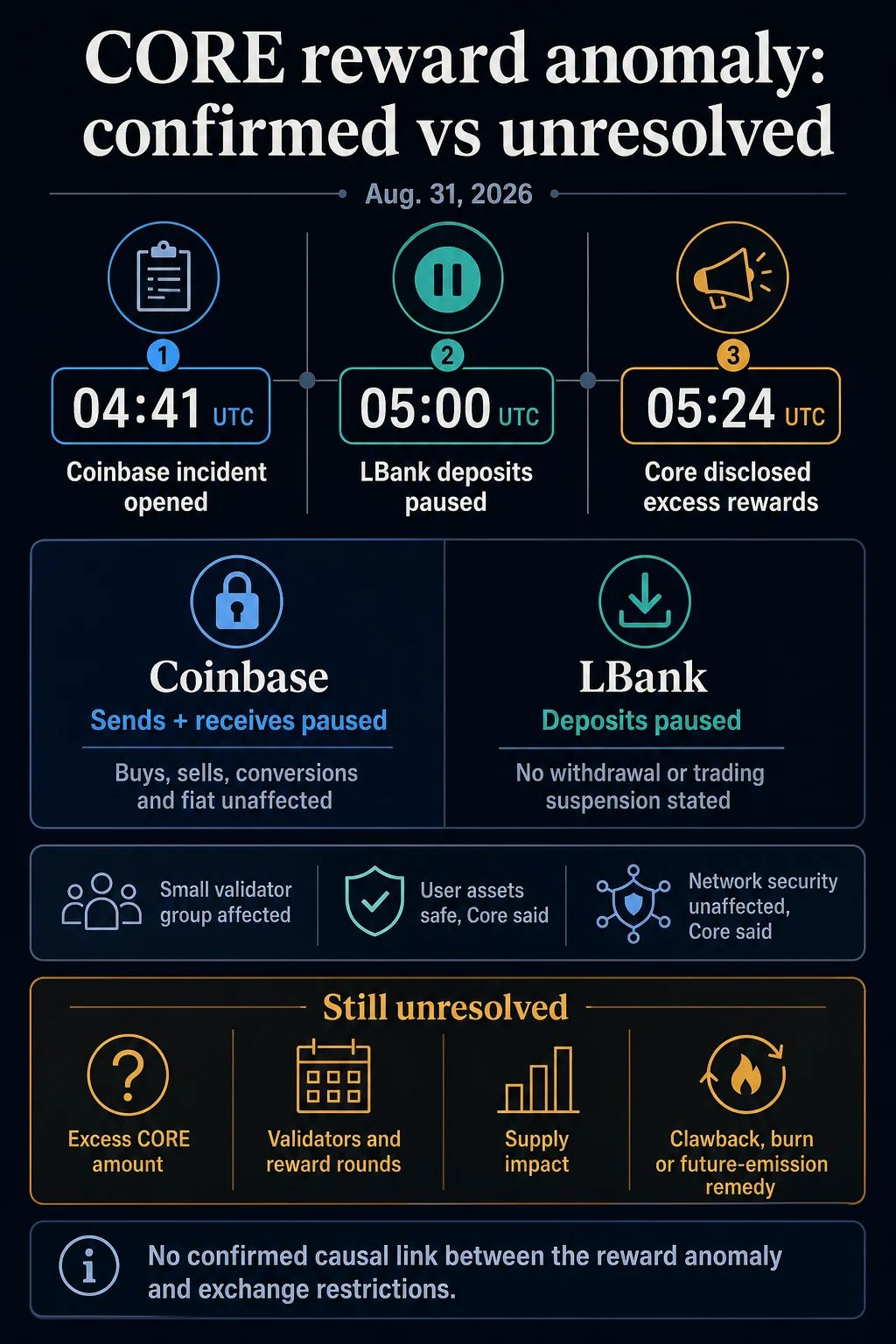
The Core DAO ecosystem, a decentralized organization developing a blockchain that bridges the security of Bitcoin with the scalability of Ethereum, is currently navigating a significant technical disruption involving its validator reward mechanism. This anomaly, which resulted in the issuance of rewards exceeding intended protocol levels for a specific group of validators, has prompted immediate protective measures from major centralized exchanges and raised critical questions regarding the long-term supply integrity of the CORE token. While the project’s leadership has moved to reassure the community that user assets remain secure, the lack of a quantified assessment regarding the excess tokens has created a period of uncertainty for investors and network participants.
The Nature of the Reward Anomaly
Core DAO officially disclosed the incident after identifying that a subset of network validators received compensation significantly higher than the parameters defined by the protocol’s consensus rules. According to a public statement released by the project, the root cause of the reward overflow has been identified, and technical teams are currently implementing mitigations to prevent further deviations. Despite this, the project has not yet released a specific figure regarding the volume of excess CORE tokens minted or the exact number of validators affected by the glitch.
The incident is localized to the reward issuance module of the blockchain. In a blockchain environment, reward issuance is the process by which the network compensates validators for proposing and verifying blocks. Core DAO emphasized that this failure did not compromise the underlying security of the network, nor did it affect the custody of user funds or the integrity of existing balances. However, the "excess" nature of the rewards is a primary concern for the token’s economic model. Because Core DAO validator rewards typically include newly minted tokens, any issuance beyond the scheduled parameters effectively represents an unplanned expansion of the circulating supply, unless corrective measures such as token burns or clawbacks are implemented.
Exchange Reactions and Operational Restrictions
The technical failure on the Core DAO network triggered a rapid response from major cryptocurrency trading platforms, reflecting the high sensitivity of exchanges to potential inflationary events or network instabilities. Coinbase, one of the world’s largest regulated exchanges, was among the first to react. The platform opened an incident report at 04:41 UTC on August 31, notably prior to Core DAO’s own public disclosure. Coinbase moved to pause all CORE sends and receives, effectively locking the token within its ecosystem to prevent potential arbitrage of "tainted" or excess tokens or to shield users from network volatility.
While Coinbase restricted transfers, it maintained that trading activities—including buys, sells, and conversions—remained functional. This suggests that the exchange’s primary concern was the movement of tokens on-chain rather than the internal ledger transactions between its users. As of the latest updates from the Coinbase status feed, the incident remains under investigation, and no definitive timeline has been provided for the restoration of full transfer functionality.
Simultaneously, LBank, another prominent exchange, announced a suspension of CORE deposits starting at 05:00 UTC. LBank’s notice explicitly cited "project requirements" as the reason for the suspension, indicating a direct line of communication between Core DAO developers and exchange operators. Unlike Coinbase, LBank’s public notice focused specifically on deposits, leaving the status of withdrawals and internal trading less clear in its initial English-language communication. These divergent approaches by major exchanges highlight the fragmented nature of incident response in the digital asset space, though both aimed to mitigate the impact of the reward overflow on their respective liquidity pools.
Technical Background: The Satoshi Plus Consensus
To understand the implications of this failure, one must examine the unique architecture of the Core DAO network. Core operates on a proprietary consensus mechanism known as "Satoshi Plus." This system is designed to combine the strengths of Bitcoin’s Proof of Work (PoW) with Delegated Proof of Stake (DPoS). In this model, Bitcoin miners can delegate their hashing power to Core validators without sacrificing their BTC rewards, while CORE token holders can stake their assets to elect validators.
The reward structure is the cornerstone of this hybrid model. Validators are compensated through a combination of newly minted CORE tokens (block rewards) and transaction fees collected from users. According to Core DAO’s official documentation, 90% of these rewards are distributed to the validators and their respective delegators, while the remaining 10% is directed to a "System Reward Contract" designed to ensure the long-term sustainability of the ecosystem.
The current anomaly occurred within this calculation and distribution phase. Because the Satoshi Plus consensus calculates rewards at the end of each "round"—a specific set of blocks—the failure likely manifested during the execution of the reward distribution smart contracts. This distinction is vital: the error was not in the ledger of user transactions, but in the minting logic that generates new supply to pay the network’s guardians.
Chronology of the Incident
The timeline of the event illustrates the speed at which technical failures can impact global market access:
- August 31, 04:41 UTC: Coinbase identifies an issue with the Core DAO network and initiates an incident report, pausing CORE sends and receives.
- August 31, 05:00 UTC: LBank suspends CORE deposits, citing requirements from the Core DAO project team.
- August 31, 05:24 UTC: Core DAO issues its first public statement via social media, acknowledging the reward issuance anomaly and stating that mitigations are underway.
- August 31, Late Morning UTC: Core DAO confirms that the root cause is understood and reassures the community regarding the safety of user assets.
- August 31, 17:38 UTC: Coinbase continues to list the incident as "investigating," maintaining the pause on transfers while the broader market waits for a technical postmortem.
Tokenomics and Supply Implications
The central question remaining for the Core DAO community is the impact of this event on the CORE tokenomics. Core has a strictly defined maximum supply of 2.1 billion tokens. Of this total, 839.9 million CORE (approximately 40%) is allocated to node mining rewards, to be distributed over an 81-year period. This long-term emission schedule is modeled after Bitcoin’s scarcity principle, with rewards gradually decreasing over time to incentivize early adoption while ensuring long-term security.
If the excess rewards issued during this incident were substantial, they could potentially disrupt this 81-year decay function. There are three primary scenarios for resolution:
- Acceleration: The excess tokens are treated as a "pre-payment" of future rewards, and subsequent reward rounds are reduced until the supply returns to the intended schedule.
- Inflation: The excess tokens remain in circulation, permanently increasing the circulating supply beyond the intended curve, though still capped by the 2.1 billion hard limit.
- Correction: The project implements a "clawback" via a hard fork or encourages validators to voluntarily burn the excess tokens to maintain the economic equilibrium.
Core DAO has not yet specified which path it will take, stating only that a full postmortem will be provided once the issue is fully contained. The "transferability" of the affected rewards is also a point of contention; if the validators moved the excess tokens to exchanges before the blocks were implemented, the possibility of a clean reversal becomes significantly more complex.

Broader Market Impact and Analysis
The incident on Core DAO serves as a reminder of the "smart contract risk" inherent in even the most robustly designed decentralized systems. While the Satoshi Plus consensus is innovative in its attempt to leverage Bitcoin’s security, the complexity of managing multi-source reward distributions (PoW delegation + DPoS) introduces more surface area for logic errors.
For the broader blockchain industry, this event underscores the importance of real-time monitoring by centralized exchanges. The fact that Coinbase flagged the incident nearly an hour before the project’s public announcement suggests that exchange monitoring tools are becoming increasingly sophisticated at detecting on-chain anomalies, such as unusual minting patterns or sudden spikes in validator balances.
Furthermore, the lack of transparency regarding the "quantified" impact in the immediate aftermath of such events often leads to market volatility. While Core DAO has been proactive in stating that user funds are safe, the "supply question" is a fundamental valuation metric. In the absence of data, the market tends to price in the worst-case scenario, which explains the bearish sentiment surrounding the token during the transfer freeze.
Conclusion and Future Outlook
As Core DAO works toward a resolution, the focus will shift to the promised postmortem report. This document will be essential for restoring investor confidence, as it must detail not only the technical flaw that allowed the reward overflow but also the exact volume of CORE tokens affected. The project’s ability to remediate the supply deviation—whether through protocol-level adjustments or community-led burns—will be a litmus test for its governance and the resilience of the Satoshi Plus model.
For now, the network remains operational, but the restricted access on Coinbase and LBank serves as a bottleneck for liquidity. Participants are advised to monitor official status pages and wait for the technical audit of the reward distribution mechanism. The long-term health of Core DAO depends on its ability to prove that its 2.1 billion token cap is an immutable law, even in the face of unforeseen technical hurdles. In the evolving landscape of DeFi and hybrid consensus blockchains, the resolution of this reward failure will likely serve as a precedent for how decentralized protocols handle unplanned inflationary events.