Dwi Wanna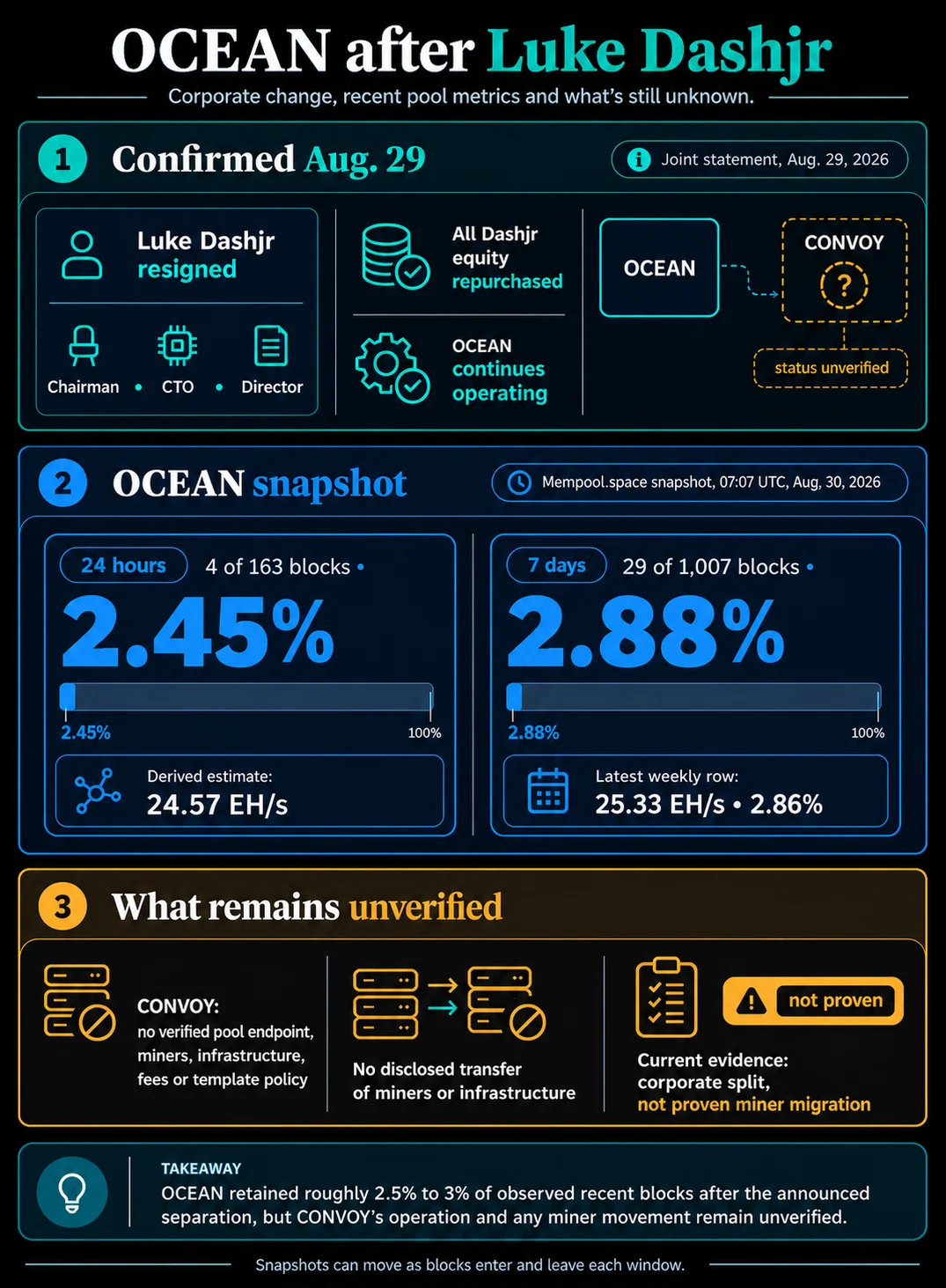
The landscape of Bitcoin mining governance underwent a significant shift this week as OCEAN Mining, a prominent player in the decentralized mining sector, announced the departure of its co-founder and technical lead, Luke Dashjr. The move, characterized as a full equity buyout, marks the end of Dashjr’s tenure as Chairman, Chief Technology Officer, and Director of the organization. Dashjr, a 16-year veteran of Bitcoin Core development and one of the most recognizable figures in the protocol’s history, is now pivoting to launch a competing venture named CONVOY.
The transition comes at a critical juncture for Bitcoin mining, as the industry grapples with internal debates regarding block construction, transaction filtering, and the centralization of hash power. While OCEAN has established a measurable foothold in the network’s total hashrate, the sudden exit of its chief architect raises questions about the future stability of its mining community and whether the specialized hash power currently directed toward OCEAN will migrate to Dashjr’s new project.
The Terms of the Separation
According to a joint statement released on August 29, the separation was finalized through a private agreement in which OCEAN repurchased all of Dashjr’s equity. While the financial specifics of the buyout remain undisclosed, the move effectively severs Dashjr’s executive and technical influence over the pool’s operations.
Dashjr’s roles as Chairman and CTO were not merely ceremonial. Since OCEAN’s inception, he has been the primary architect of the pool’s technical philosophy, which emphasized transparency and non-custodial payouts. His departure represents a clean break from the board and the executive suite, leaving OCEAN to navigate its next phase of growth under a yet-to-be-announced leadership structure.
The company stated that it will continue its mission of providing a transparent, decentralized mining alternative. However, the loss of a developer with Dashjr’s pedigree—having been involved in Bitcoin since its earliest years—is a notable transition for a firm that marketed itself heavily on his technical oversight and "Bitcoin-native" principles.
A History of Technical Friction: The Context of the Split
While the official statement cited "different visions following recent protocol developments," the broader Bitcoin community has observed growing tensions regarding how mining pools should handle certain types of network data. Dashjr has been a vocal critic of "inscriptions" and "ordinals," which he characterizes as an exploit of the Bitcoin protocol that clogs the blockchain with non-financial data.
As the maintainer of Bitcoin Knots—an alternative implementation of the Bitcoin Core software—Dashjr has advocated for more stringent filtering of what he deems "spam" transactions. This stance has often put him at odds with the economic incentives of miners, who generally prefer to include any transaction that pays a high fee, regardless of its content.

In late 2023 and early 2024, OCEAN implemented policies that reflected some of Dashjr’s philosophies, including the ability for miners to choose their own block templates via the DATUM system. However, the balance between technical "purism" and the competitive reality of mining profitability appears to have created an ideological rift. The recent discussions surrounding BIP-110 and various proof-of-work proposals likely served as the catalyst for the final separation, as OCEAN sought to balance its commitment to decentralization with the need to remain a viable, profitable choice for large-scale mining operations.
Analyzing OCEAN’s Current Market Position
Despite the high-profile departure, OCEAN continues to command a small but significant portion of the global Bitcoin hashrate. According to real-time data from Mempool.space, OCEAN was attributed with approximately 2.45% of the blocks discovered over a trailing 24-hour period as of August 30. This translates to an estimated 24.57 exahashes per second (EH/s) of computing power.
Over a longer seven-day window, the pool’s performance remained consistent, capturing 2.88% of the total blocks (29 out of 1,007). This puts OCEAN’s weekly hashrate at approximately 25.33 EH/s. These figures suggest that, as of the time of the announcement, there has not been an immediate, mass exodus of miners following Dashjr’s exit.
It is important to distinguish between the hash power owned by a company and the hash power directed to a pool by independent miners. OCEAN’s model relies on attracting external participants who value its non-custodial approach—where rewards are sent directly from the block coinbase to the miner’s wallet. The stability of OCEAN’s 2.5% to 3% market share in the coming weeks will serve as a primary indicator of whether miners are loyal to the platform’s infrastructure or to Dashjr’s specific technical vision.
CONVOY: The Mystery of the New Venture
As Dashjr transitions to his new project, CONVOY, the industry is watching for signs of operational readiness. Thus far, CONVOY remains largely an enigma. Public disclosures and social media profiles for the new venture have yet to provide a technical roadmap, an endpoint for miners to connect to, or a public codebase.
At the time of reporting, there is no evidence of a functioning mining pool under the CONVOY banner. No participating miners or infrastructure transfers from OCEAN have been confirmed. Furthermore, the new venture has not yet disclosed its fee structure or its policy regarding block templates—a point of significant interest given Dashjr’s history with transaction filtering.
The success of CONVOY will likely depend on whether Dashjr can attract a "purist" subset of the mining community that prioritizes his vision of Bitcoin’s long-term health over immediate fee maximization. If CONVOY implements the strict filtering policies Dashjr has championed in the past, it will represent a unique experiment in the mining world: a pool that potentially sacrifices some fee revenue in exchange for a specific vision of block space management.
The Evolution of Block Construction: DATUM and Stratum V2
One of Dashjr’s lasting contributions to OCEAN was the development and promotion of the DATUM (Decentralized Alternative Template User Management) system. This system was designed to combat the centralization of mining by allowing individual miners, rather than the pool operator, to decide which transactions are included in a block.

Traditionally, large pools like Foundry USA or Antpool control the block templates for all their participating miners. This creates a "choke point" where a single entity could theoretically censor transactions. OCEAN’s implementation of DATUM, and its support for the emerging Stratum V2 protocol, aimed to return this power to the individual.
With Dashjr’s exit, the technical community is closely monitoring whether OCEAN will maintain its aggressive push for decentralized block construction or if it will shift toward a more traditional, centralized template model to simplify operations. For its part, OCEAN has reiterated its commitment to transparency and the DATUM system, suggesting that the "non-custodial" and "miner-controlled" aspects of the pool are core to its identity, regardless of Dashjr’s presence.
Broader Implications for the Bitcoin Network
The split between Dashjr and OCEAN is more than a corporate dispute; it is a reflection of the ongoing "civil war" within the Bitcoin ecosystem regarding the use of the blockchain. On one side are the "maximalists" and technical purists who believe Bitcoin should be used strictly for financial transactions and that the chain must be kept "clean" to ensure long-term decentralization. On the other side are the "pragmatists" and miners who argue that a permissionless network should allow any valid transaction, and that the fee revenue from inscriptions is vital for network security, especially as block subsidies continue to halve every four years.
If Dashjr’s CONVOY becomes a viable entity, it will formalize these two schools of thought into competing market products. Miners will effectively be able to "vote" with their hashrate:
- Support OCEAN or other traditional pools for a balance of decentralization and maximum fee collection.
- Support CONVOY to align with a specific technical philosophy regarding the nature of Bitcoin transactions.
This competition is healthy for the network’s decentralization. The more options miners have to direct their power, the less likely it is that any single entity can exert undue influence over the protocol. However, the fragmentation of hashrate also carries risks. Smaller pools have higher "variance," meaning they may go longer periods without finding a block, which can lead to inconsistent payouts for miners—a factor that often drives hash power back toward the largest, most centralized pools.
Chronology of Recent Events
- Late 2023: OCEAN Mining launches with backing from Jack Dorsey’s TBD and technical leadership from Luke Dashjr.
- Early 2024: OCEAN faces criticism and praise for its "spam filtering" policies, which excluded certain Ordinal-related transactions from its default block templates.
- July 2024: OCEAN introduces dedicated BIP-110 and no-signal endpoints to give miners more choice in the face of protocol disputes.
- August 9, 2024: OCEAN reverts its default endpoint to the non-BIP-110 chain while maintaining multiple options for its users.
- August 29, 2024: A joint statement announces the full buyout of Luke Dashjr’s equity and his resignation from all leadership roles at OCEAN.
- August 30, 2024: Market data shows OCEAN maintaining a steady 2.45% share of the Bitcoin hashrate, while Dashjr’s CONVOY remains in the pre-operational phase.
Conclusion: The Road Ahead
The departure of Luke Dashjr from OCEAN Mining marks the end of a notable chapter in the effort to decentralize Bitcoin mining. OCEAN now faces the challenge of proving it can innovate and maintain its market share without its founding technical visionary. Meanwhile, Dashjr faces the daunting task of building a mining infrastructure from the ground up in a highly competitive and capital-intensive industry.
The "measurable evidence" of this split’s impact will not be found in press releases, but on the blockchain itself. If OCEAN’s hashrate remains stable or grows, it will demonstrate that the pool’s brand and its DATUM infrastructure have value independent of its founders. Conversely, if a significant percentage of that 25 EH/s migrates to CONVOY once it goes live, it will confirm that a meaningful segment of the mining community is deeply aligned with Dashjr’s specific vision for the future of Bitcoin.
For the broader industry, this separation serves as a reminder that Bitcoin’s governance is a messy, market-driven process. The tension between developer philosophy and miner economics remains one of the most important dynamics to watch as Bitcoin continues to mature as a global financial layer. For now, OCEAN remains a functional and significant player in the mining ecosystem, while the industry waits to see if CONVOY can turn a technical vision into a functional reality.