Dwi Wanna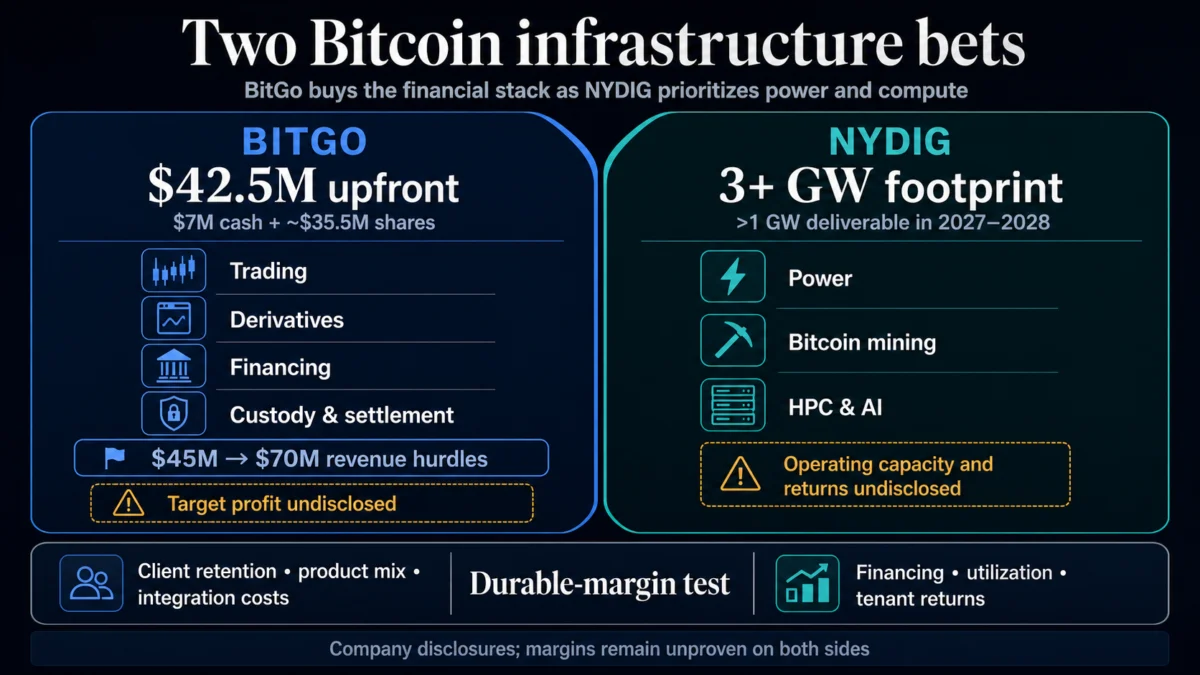
The digital asset landscape underwent a significant structural shift as BitGo, a leading provider of digital asset custody and infrastructure, finalized its acquisition of NYDIG’s institutional trading business. This transaction, disclosed through recent regulatory filings with the Securities and Exchange Commission (SEC), represents a strategic divergence between two of the industry’s most prominent players. While BitGo is doubling down on its mission to become a full-service financial prime broker for institutions, NYDIG is pivoting its resources toward the burgeoning intersection of energy production, Bitcoin mining, and high-performance computing (HPC) data centers.
The deal involves the transfer of NYDIG’s spot and derivatives trading, virtual currency asset management, borrowing and lending, and loan servicing operations to BitGo. Crucially, the agreement explicitly excludes NYDIG’s Bitcoin mining and custody businesses, allowing NYDIG to sharpen its focus on its massive power-and-compute footprint, which the company claims exceeds 3 gigawatts (GW). For BitGo, the acquisition brings in an experienced institutional team of approximately 30 professionals, a robust book of client relationships, and a suite of sophisticated financial products designed to complement its existing custody and settlement platform.
Financial Architecture and Deal Terms
The financial structure of the acquisition reflects a performance-oriented approach, balancing upfront compensation with long-term growth incentives. According to the disclosed merger agreement, BitGo provided an upfront consideration of approximately $42.5 million. This was comprised of $7 million in cash—subject to standard adjustments and holdbacks—and 5,933,577 shares of BitGo stock. Based on a reference price of $5.9829 per share established in the agreement, the equity portion of the deal is valued at roughly $35.5 million.
Beyond the initial payment, the deal includes a tiered earn-out structure designed to reward the successful integration and scaling of the acquired business units. The first earn-out milestone offers $10 million in cash, while a second tier provides an additional $5 million in cash and 835,715 BitGo shares, valued at approximately $5 million. These payments are contingent upon the acquired business meeting specific trailing-12-month revenue hurdles of $45 million and $70 million, respectively, with a window extending through February 2028.
Furthermore, separate awards totaling $10 million have been earmarked for the transferred employees. These incentives are intended to ensure talent retention and align the interests of the incoming NYDIG team with BitGo’s broader corporate objectives. By structuring the deal with significant revenue-based milestones, BitGo has established a clear "growth test" for the new division, though the specific operating costs required to reach these revenue targets remain undisclosed.
Strategic Pivot: BitGo’s Drive for Margin and Stickiness
The acquisition comes at a critical juncture for BitGo. The company’s second-quarter filings for 2026 provide essential context for why it is seeking to expand its product suite beyond simple asset sales. During the three months ending June 30, BitGo reported "Digital Asset Sales" revenue of $4.197 billion. However, the direct costs associated with these sales were $4.190 billion, leaving a gross spread of only $7.082 million—a margin of approximately 16.9 basis points.
This thin margin is a byproduct of BitGo’s role as a principal in these transactions. Under standard accounting practices, acting as a principal requires the company to report the full value of the asset sale as revenue and the purchase price as a direct cost. While this results in impressive top-line figures in the billions, it highlights the vulnerability of a business model reliant solely on high-volume, low-margin spot trading. BitGo also reported a consolidated net loss of $19.025 million for the same quarter, underscoring the need for more capital-efficient revenue streams.
By integrating NYDIG’s derivatives, structured products, and lending capabilities, BitGo aims to increase "asset stickiness." Institutional clients who utilize a broader range of services—such as hedging via derivatives or leveraging assets through lending—are less likely to move their holdings to competitors. These sophisticated financial products typically carry higher margins than spot trading and allow BitGo to capture a larger share of the institutional value chain. The strategic thesis is that by becoming a one-stop shop for custody, settlement, and advanced trading, BitGo can transform its massive transaction volume into sustainable profitability.
NYDIG’s Infrastructure Ambition: The 3 GW Frontier
While BitGo expands its financial services, NYDIG is executing a radical transformation into an infrastructure powerhouse. The company has moved away from the competitive and often commoditized world of institutional trading to focus on what it views as a "scarcity play" in power and compute capacity. NYDIG’s current portfolio includes energy generation assets, grid positions, and data center halls capable of supporting high-performance computing, artificial intelligence (AI) training, and Bitcoin mining.
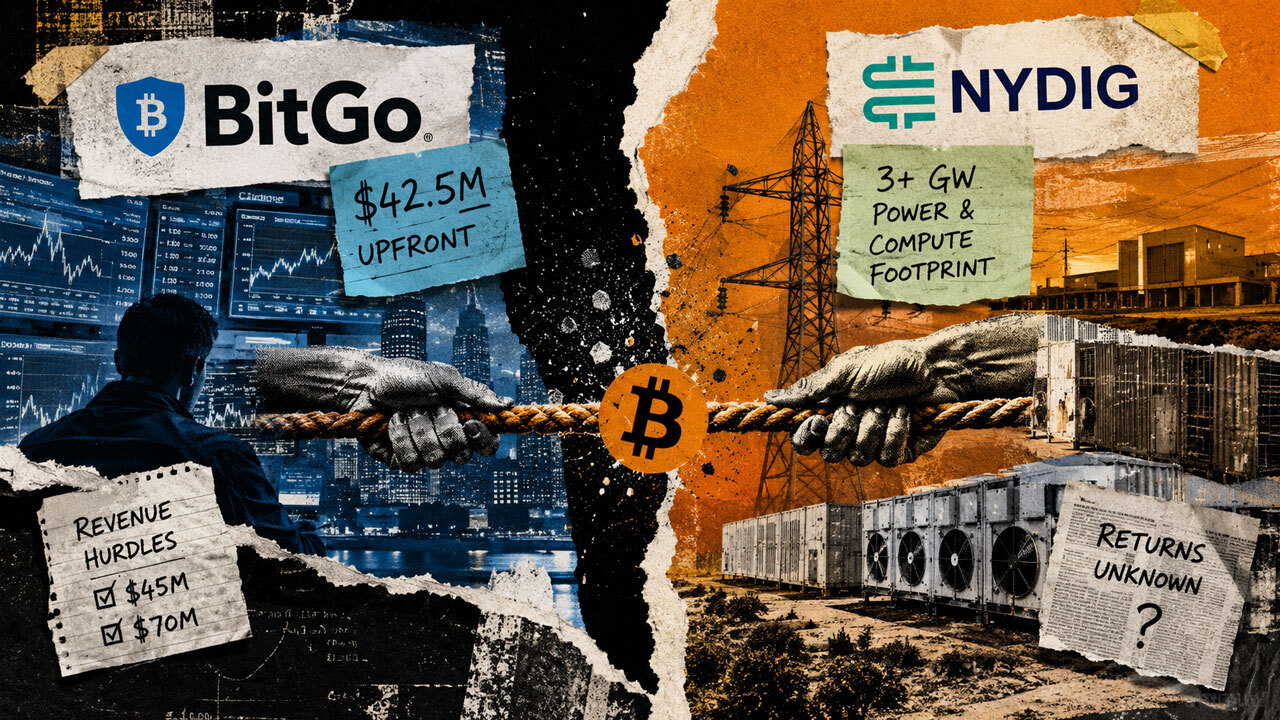
The company has claimed a North American footprint exceeding 3 GW, with more than 1 GW expected to be deliverable between 2027 and 2028. This shift began in earnest in March 2025, when NYDIG announced the acquisition of Crusoe’s Bitcoin mining business. Crusoe was a pioneer in utilizing stranded energy—specifically flared natural gas—to power modular data centers. By integrating these capabilities, NYDIG has positioned itself as a bridge between the energy sector and the digital economy.
The rationale behind NYDIG’s pivot is rooted in the soaring demand for data center capacity driven by the AI boom. Large-scale language models and inference engines require immense amounts of electricity and specialized cooling infrastructure—assets that overlap significantly with the requirements of industrial-scale Bitcoin mining. By controlling the underlying power assets and the physical data centers, NYDIG moves up the supply chain, potentially securing more stable, long-term returns than those found in the volatile crypto trading markets. However, the success of this strategy remains to be seen, as the company has not yet disclosed the specific utilization rates, construction costs, or project returns associated with its massive 3 GW pipeline.
Chronology of the Deal and Market Context
The acquisition of NYDIG’s trading unit is the culmination of several months of realignment within the digital asset sector. The timeline of events highlights a broader trend of consolidation as the industry matures:
- March 2025: NYDIG acquires Crusoe’s Bitcoin mining business, signaling a major shift toward energy-intensive infrastructure and "green" mining solutions.
- June 2026: BitGo’s Q2 financial results reveal the challenges of a high-volume, low-margin trading environment, reinforcing the need for higher-value financial products.
- August 27, 2026: BitGo and NYDIG officially announce the completion of the deal. Approximately 30 employees transition to BitGo, and the transfer of institutional client relationships begins.
- Late 2026: Regulatory filings disclose the specific $42.5 million upfront consideration and the $45M/$70M revenue earn-out hurdles.
- 2027–2028: The window for NYDIG to deliver its promised 1 GW of new power capacity and for BitGo to meet its revenue-based performance targets.
This deal reflects a "maturation phase" for the industry. In the early years of the digital asset boom, firms often attempted to be vertically integrated, offering everything from mining to retail wallets to institutional prime brokerage. As the market has evolved, the most successful players are now specializing. BitGo is specializing in the "Financial Layer," while NYDIG is specializing in the "Physical Layer."
Broader Implications for the Institutional Market
The separation of these business units carries significant implications for institutional investors. For those seeking a pure-play financial counterparty, BitGo’s expanded platform offers a more comprehensive suite of tools for risk management and capital efficiency. The addition of derivatives and financing means that institutions can now manage complex portfolios without leaving the BitGo ecosystem, potentially reducing counterparty risk and streamlining operations.
On the other hand, NYDIG’s evolution provides a template for how Bitcoin-native firms can pivot into the broader AI and HPC sectors. As the difficulty of Bitcoin mining increases and block rewards diminish, the ability to repurpose energy assets for AI compute represents a vital hedge. This convergence of Bitcoin mining and AI infrastructure is likely to attract a new class of investors—infrastructure funds and energy companies—who view these facilities as essential utility-like assets for the 21st century.
Conclusion: Two Divergent Scorecards
The BitGo-NYDIG transaction leaves the industry with two distinct scorecards to watch over the coming years. BitGo’s success will be measured by its income statement. Investors will be looking for evidence that the $42.5 million investment has successfully shifted the company’s revenue mix toward higher-margin products. The $45 million and $70 million revenue hurdles provide a transparent benchmark for this growth, but the ultimate test will be whether BitGo can achieve consolidated profitability while managing the integration and compliance costs of its new derivatives and lending arms.
NYDIG’s scorecard is more capital-intensive and focused on the balance sheet. The company must prove that it can convert its 3 GW of "claimed footprint" into operational, revenue-generating capacity. Turning a gigawatt of power into profit requires navigating complex grid interconnections, securing long-term tenants for AI compute, and managing the cyclicality of the Bitcoin mining market.
Ultimately, the deal underscores a fundamental truth about the current state of the digital asset industry: the "middle ground" is disappearing. Success now requires either the scale and sophistication of a global financial institution or the physical and energetic infrastructure of a major utility provider. By trading assets for focus, both BitGo and NYDIG have placed their bets on which side of that divide they intend to dominate.