admin
admin
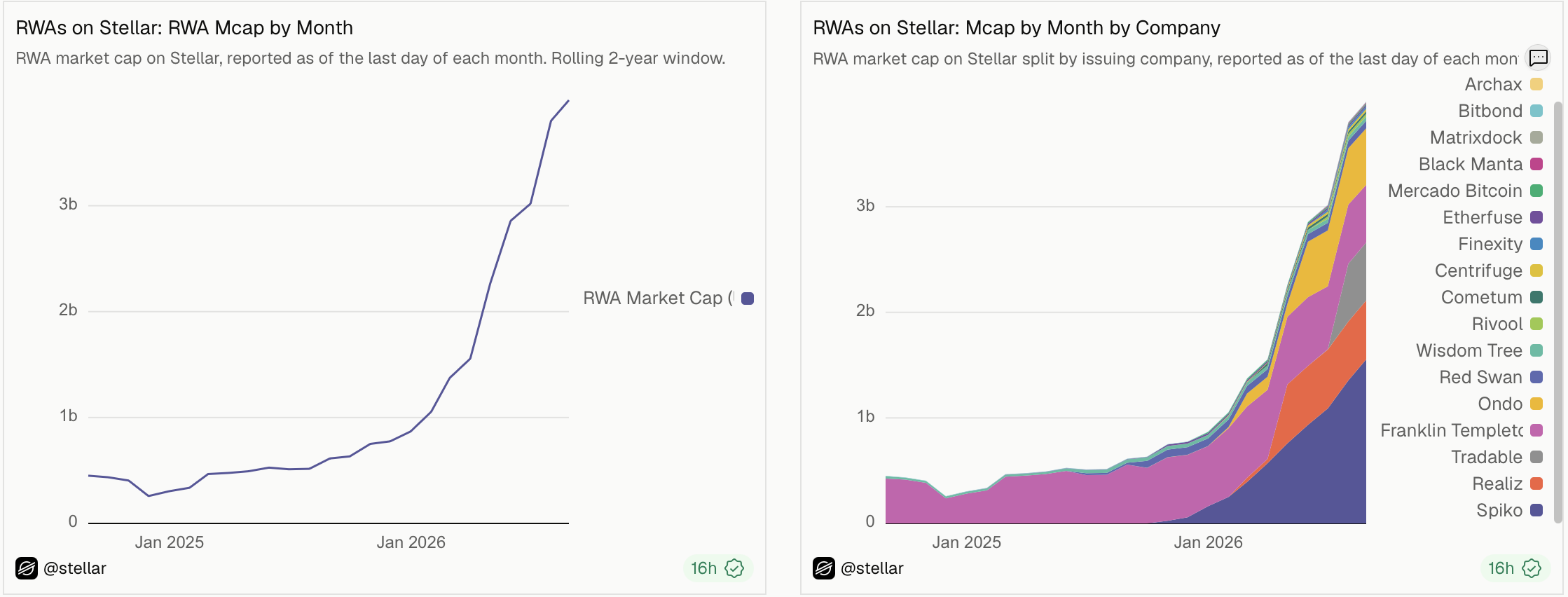
The value of tokenized real-world assets (RWAs) on the Stellar blockchain network has experienced an extraordinary surge in 2026, climbing approximately 360% to reach nearly $4 billion. This significant increase from $868.8 million at the close of last year underscores a rapidly maturing landscape for digital asset integration into traditional finance. As of August 29, the network’s RWA market capitalization stood at $3.996 billion, distributed across a diverse portfolio including US Treasurys, various forms of private and public credit, non-US government debt, and other tokenized asset classes, according to data from a Dune Analytics dashboard maintained by Stellar.
This dramatic expansion positions Stellar as a frontrunner in the burgeoning RWA sector, highlighting the increasing confidence and active participation of major financial institutions and specialized tokenization platforms. The transformation reflects a broader industry trend towards leveraging blockchain technology for enhanced efficiency, liquidity, and accessibility of traditional financial instruments.
Understanding the Evolution of Tokenized Real-World Assets (RWAs)
Tokenized Real-World Assets represent a pivotal shift in how tangible and intangible assets are managed and traded. Essentially, tokenization is the process of issuing a blockchain-based token that digitally represents ownership or a fractional interest in an underlying physical or financial asset. These assets can range from real estate and commodities to equities, bonds, and even intellectual property. The fundamental appeal of RWAs lies in their ability to bridge the gap between traditional finance (TradFi) and decentralized finance (DeFi), unlocking several key benefits.
Firstly, tokenization enhances liquidity. Assets that were traditionally illiquid, such as private credit or real estate, can be fractionalized into smaller, more manageable tokens, making them accessible to a wider pool of investors and facilitating easier trading on secondary markets. Secondly, it introduces greater transparency and auditability. All transactions involving tokenized assets are recorded on an immutable public ledger, providing a clear and verifiable history of ownership and transfers. Thirdly, it can reduce transaction costs and settlement times by streamlining intermediary processes. Finally, fractionalization allows for broader participation, enabling smaller investors to access high-value assets that were previously reserved for institutional players.
Stellar, with its emphasis on speed, low transaction costs, and interoperability, has proven to be a particularly suitable blockchain for the issuance and management of these tokenized assets. Its architecture is designed to facilitate efficient value transfer, making it an attractive platform for financial entities looking to innovate in the RWA space.
Stellar’s Explosive Growth in the RWA Ecosystem
The 360% growth witnessed in 2026 is not merely a statistical anomaly but a testament to Stellar’s strategic focus and successful execution in attracting significant capital and institutional partners. The nearly $4 billion valuation on August 29 underscores the platform’s burgeoning role as a vital infrastructure for digital asset innovation. The breakdown of asset classes within this market cap illustrates the breadth of Stellar’s application:
- US Treasurys: A cornerstone of global finance, the tokenization of US Treasurys offers a secure, yield-bearing asset class to blockchain users, providing a stable foundation for the RWA market.
- Private and Public Credit: This segment involves the tokenization of various debt instruments, from corporate loans to securitized debt. The ability to fractionalize and trade these credits on-chain introduces new avenues for capital formation and investment.
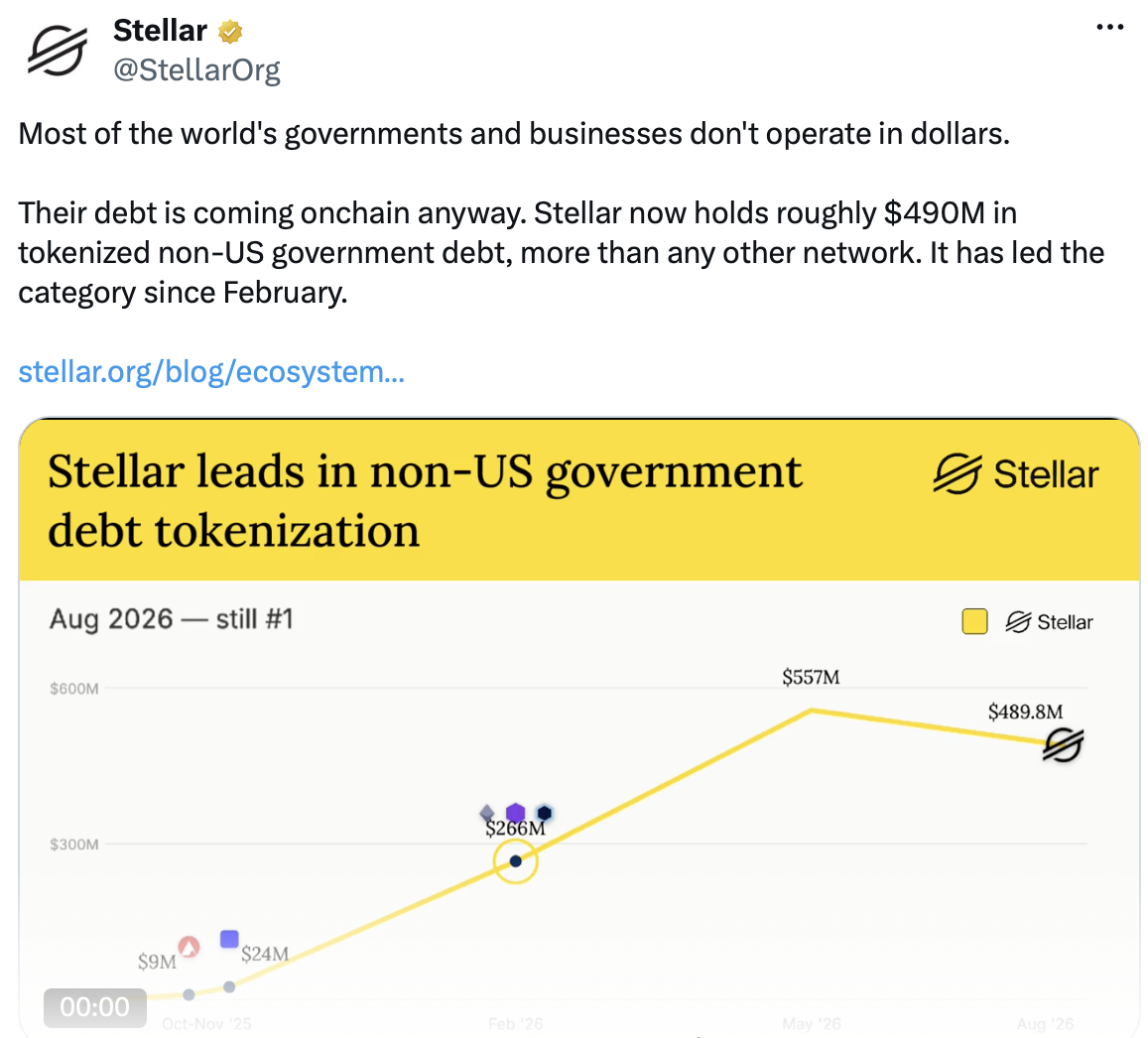
- Non-US Government Debt: A notable area of expansion for Stellar, this includes sovereign bonds from various nations. The Stellar Development Foundation (SDF) highlighted, citing RWA.xyz data, that the network held approximately $490 million in this asset class as of August 20. This includes tokenized Mexican CETES (Certificados de la Tesorería de la Federación) and Brazilian government bonds, primarily issued through platforms like Etherfuse. This diversification into international sovereign debt signals Stellar’s growing global footprint and its capacity to cater to a diverse range of national financial instruments.
The transparency provided by the Dune Analytics dashboard maintained by Stellar has been crucial in monitoring and validating this rapid growth, offering real-time insights into the network’s RWA market dynamics.
Leading Issuers Dominating Stellar’s RWA Landscape
The concentration of Stellar’s RWA market among a handful of key issuers signifies the strategic partnerships and significant capital deployment by these entities. As of August 27, the top five issuers accounted for a substantial portion of the network’s tokenized asset value:
- Spiko: Leading the pack with $1.55 billion, Spiko’s substantial contribution indicates its prominent role in originating or facilitating the tokenization of a wide range of assets on Stellar. While specific asset classes under Spiko were not detailed, their dominance suggests a broad engagement across various RWA categories.
- Realiz: Following with $559 million, Realiz demonstrates a strong presence, likely specializing in particular asset types or catering to a specific investor base within the Stellar ecosystem.
- Tradable: With $548 million, Tradable’s significant volume is particularly noteworthy given its recent announcements regarding private credit, as detailed below. This figure represents their active contribution to the network’s RWA growth.
- Franklin Templeton: A globally recognized asset management firm, Franklin Templeton’s $546 million underscores the increasing embrace of blockchain technology by established financial giants. Their involvement often centers on regulated investment products, bringing a high degree of credibility and institutional liquidity to the Stellar network.
- Ondo: Contributing $535 million, Ondo’s presence reflects its focus on offering institutional-grade, blockchain-native investment products, often involving tokenized securities and yield-bearing assets.
The participation of these diverse entities, from dedicated blockchain firms to traditional asset managers, paints a picture of a robust and multifaceted ecosystem driving Stellar’s RWA expansion.
Chronology of Institutional Milestones in 2026
The impressive growth in Stellar’s RWA market capitalization is not accidental; it is the culmination of strategic partnerships and significant institutional integrations throughout 2026, cementing Stellar’s position as a preferred network for the tokenization of real-world assets.
May 2026: DTCC’s Landmark Integration Plans
A pivotal moment arrived in May 2026 when the Depository Trust & Clearing Corporation (DTCC), a cornerstone of post-trade market infrastructure for the global financial services industry, announced its plans to connect its tokenization service to the Stellar network. The DTCC is renowned for providing clearing, settlement, and information services for equities, corporate and municipal bonds, unit investment trusts, government and mortgage-backed securities, money market instruments, and over-the-counter derivatives. Its move to integrate with Stellar is a profound endorsement of the blockchain’s capabilities.
This integration is anticipated to go live in the first half of 2027, with the potential to support the tokenization of a wide array of high-value assets. These include US Treasurys, major index Exchange Traded Funds (ETFs), and even stocks listed in the Russell 1000 index. The implications of this partnership are far-reaching. It signals a critical step towards bridging traditional securities markets with blockchain technology, promising to enhance efficiency, reduce operational costs, and potentially unlock new liquidity pools for these assets. For Stellar, it represents a direct pipeline to some of the largest and most liquid financial markets globally, dramatically expanding the scope and scale of assets that can be tokenized on its network. Industry analysts widely view this as a significant validation of Stellar’s enterprise-grade readiness and its ability to meet the stringent requirements of traditional financial institutions.
July 2026: Tradable’s $1 Billion Private Credit Initiative
Further strengthening Stellar’s institutional footprint, July 2026 saw tokenization platform Tradable unveil ambitious plans to bring up to $1 billion in private credit assets onto the Stellar blockchain. Private credit, which involves direct lending from non-bank lenders to companies, has traditionally been an opaque and illiquid market. Tradable’s initiative aims to revolutionize this sector by leveraging tokenization.
Tradable already boasts a track record of tokenizing $1.7 billion in private credit across nearly 30 positions, demonstrating their expertise in this specialized domain. The integration with Stellar is designed to enhance compliance, streamline investor onboarding processes, and provide robust asset lifecycle management for these tokenized private credit instruments. By bringing these assets on-chain, Tradable seeks to improve transparency, reduce administrative burdens, and potentially open up private credit markets to a broader investor base through fractionalization, all while maintaining rigorous regulatory standards. This move solidifies Stellar’s role in democratizing access to complex financial products and enhancing the efficiency of an often-siloed market.
June 2026: MoneyGram’s MGUSD Stablecoin Launch
Beyond RWAs, Stellar’s fundamental strength in digital payments continued to expand in June 2026 with MoneyGram’s launch of its MGUSD dollar stablecoin on the network. MoneyGram, a global leader in cross-border peer-to-peer payments and money transfers, chose Stellar for its stablecoin due to its proven capabilities in fast, low-cost international transactions.
The MGUSD stablecoin allows users to hold dollar-denominated balances directly on the Stellar network and leverage MoneyGram’s extensive global payments network for seamless fund transfers. This initiative represents a significant step in making digital dollars more accessible and usable for everyday remittances and international payments, aligning perfectly with Stellar’s core mission of financial inclusion. MGUSD joins an existing ecosystem of roughly $438 million in reserve-verified stablecoins already issued on Stellar, according to the Dune dashboard, further cementing the network’s position as a robust platform for digital currency circulation and cross-border value exchange. The integration underscores Stellar’s dual utility: serving as an infrastructure for both complex tokenized assets and ubiquitous digital payments.
The Broader Context: Stellar’s Strategic Positioning
Stellar’s original mission, conceived by co-founder Jed McCaleb, was to connect people to low-cost financial services and facilitate fast, cheap cross-border payments, particularly for the unbanked and underbanked populations. While its roots are deeply embedded in payments, the network’s evolution into a major player in the RWA space is a natural extension of its underlying architecture and philosophy. The ability to issue, manage, and transfer various asset types, including stablecoins and now a growing portfolio of tokenized real-world assets, aligns perfectly with its goal of creating a more inclusive and efficient global financial system.
Compared to other blockchain networks, Stellar offers distinct advantages for RWA tokenization. Its consensus mechanism, the Stellar Consensus Protocol (SCP), provides high transaction throughput and near-instant finality at minimal cost, crucial for handling high-frequency financial operations. Furthermore, Stellar’s built-in decentralized exchange (DEX) allows for seamless trading of any tokenized asset on the network, fostering liquidity. Its emphasis on regulatory compliance and strong partnerships with established financial entities has also made it an attractive choice for institutions wary of the regulatory uncertainties often associated with other blockchain platforms.
Market Reactions and Future Outlook
Despite the spectacular growth in the RWA sector on Stellar, the network’s native XLM token has not mirrored this immediate success in terms of price performance. Year-to-date, XLM is down approximately 11%, trading near $0.18, according to CoinGecko data. This divergence between network utility and token price is not uncommon in nascent and developing blockchain ecosystems, where fundamental value accrual can often precede speculative market appreciation. The value of the network’s underlying technology and its growing adoption by institutions may take time to fully reflect in the market capitalization of its native token. Factors such as broader cryptocurrency market sentiment, regulatory developments, and the specific utility models for XLM within these new RWA applications will influence its future trajectory.
The implications of Stellar’s RWA growth for traditional finance are profound. It represents a tangible step towards the "internet of value," where assets can be moved and exchanged with the same ease as information. This convergence of TradFi and DeFi, facilitated by platforms like Stellar, promises to unlock unprecedented levels of efficiency, reduce systemic risks by increasing transparency, and democratize access to investment opportunities globally. The integration with entities like DTCC signifies that blockchain is no longer a fringe technology but is becoming an integral part of the future financial infrastructure.
However, challenges remain. Regulatory clarity across different jurisdictions is still evolving, and the legal frameworks surrounding tokenized assets need further standardization. Scalability solutions, while robust on Stellar, will need to continually adapt to ever-increasing transaction volumes. Interoperability with other blockchain networks and traditional financial systems will also be critical for seamless global adoption. Despite these hurdles, the momentum is undeniable.
Expert Perspectives and Concluding Thoughts
Representatives from the Stellar Development Foundation (SDF) have consistently articulated a vision where Stellar serves as a foundational layer for a more equitable and efficient global financial system. The exponential growth in tokenized RWAs on the network is a clear validation of this vision. "Our focus has always been on creating a network that can handle the complexities of real-world finance," an SDF spokesperson might infer, "and the rapid uptake of RWAs, particularly by institutional players, demonstrates that Stellar is uniquely positioned to bridge the gap between traditional assets and blockchain technology. This is just the beginning of a transformative era for global finance."
Market analysts echo this sentiment, pointing to the significance of major financial institutions choosing Stellar. "The DTCC integration is a game-changer," commented a leading blockchain research analyst. "It’s not just about tokenizing more assets; it’s about legitimizing the entire RWA space within the highly regulated world of traditional finance. Stellar’s robust infrastructure and focus on compliance are clearly resonating with these established players."
The dramatic surge in tokenized real-world assets on the Stellar network to nearly $4 billion in 2026 marks a watershed moment in the evolution of digital finance. Driven by strategic institutional partnerships with entities like DTCC, Tradable, and MoneyGram, Stellar is rapidly transforming into a crucial nexus where traditional financial instruments meet the innovation of blockchain technology. This expansion not only validates the potential of tokenization to enhance liquidity, transparency, and accessibility across diverse asset classes but also firmly establishes Stellar as a formidable platform poised to redefine the future landscape of global finance. While the journey ahead involves navigating regulatory complexities and ensuring continuous technological advancement, the foundation laid in 2026 signals a robust and promising future for Stellar and the broader RWA ecosystem.