admin
admin
The proposed CLARITY Act, a landmark piece of legislation aimed at providing a comprehensive regulatory framework for the burgeoning cryptocurrency market in the United States, appears poised to miss a critical August 5th deadline for Senate advancement, effectively relegating it to a "walking dead" status. This assessment comes from Matt Hougan, Chief Investment Officer at Bitwise, who, in a recent blog post, acknowledged the widespread sentiment that this week was "make or break" for the bill. However, Hougan maintains that despite legislative gridlock, the digital asset industry has garnered too much momentum to be contained, asserting that "Washington is always late to major technology shifts, and it has rarely mattered as much as people feared." This perspective offers a nuanced view on a situation that many market participants and lawmakers had hoped would finally bring much-needed legal certainty to a complex and rapidly evolving sector.
The CLARITY Act: A Quest for Regulatory Certainty
The CLARITY Act (short for "Certainty for Digital Assets Regulation and Investment Transparency") represents one of the most significant bipartisan efforts to establish a clear regulatory pathway for cryptocurrencies and digital assets within the United States. Introduced with the primary goal of delineating the jurisdictions of the Securities and Exchange Commission (SEC) and the Commodity Futures Trading Commission (CFTC) over various digital assets, the bill sought to resolve the long-standing ambiguity that has plagued the industry. Currently, many digital assets exist in a gray area, often subject to overlapping or conflicting interpretations from these two powerful federal agencies.
At its core, the CLARITY Act aimed to categorize digital assets, distinguishing between those that function as securities (and thus fall under SEC purview) and those that behave as commodities (governed by the CFTC). Such clarity is crucial for innovators, investors, and consumers alike. Without it, companies face immense legal uncertainty, stifling innovation, pushing businesses offshore, and potentially exposing investors to risks due to inconsistent oversight. The bill also intended to address other critical aspects of the digital asset market, including stablecoins, decentralized finance (DeFi), and illicit finance concerns, seeking to foster innovation while simultaneously protecting consumers and maintaining financial stability. Its passage was widely anticipated to unlock significant institutional investment and solidify the U.S.’s position as a leader in the global digital economy.
Fading Hopes on Capitol Hill
The immediate challenge for the CLARITY Act is the looming August 5th deadline, marking the Senate’s departure for its summer recess. With November’s midterm elections drawing closer, a failure to advance the bill before recess would likely push any further consideration into the next year, or even beyond, as legislative priorities shift dramatically towards election-focused agendas. This tight timeline has amplified concerns among proponents of the bill, leading to a palpable sense of pessimism across market observers and analysts.
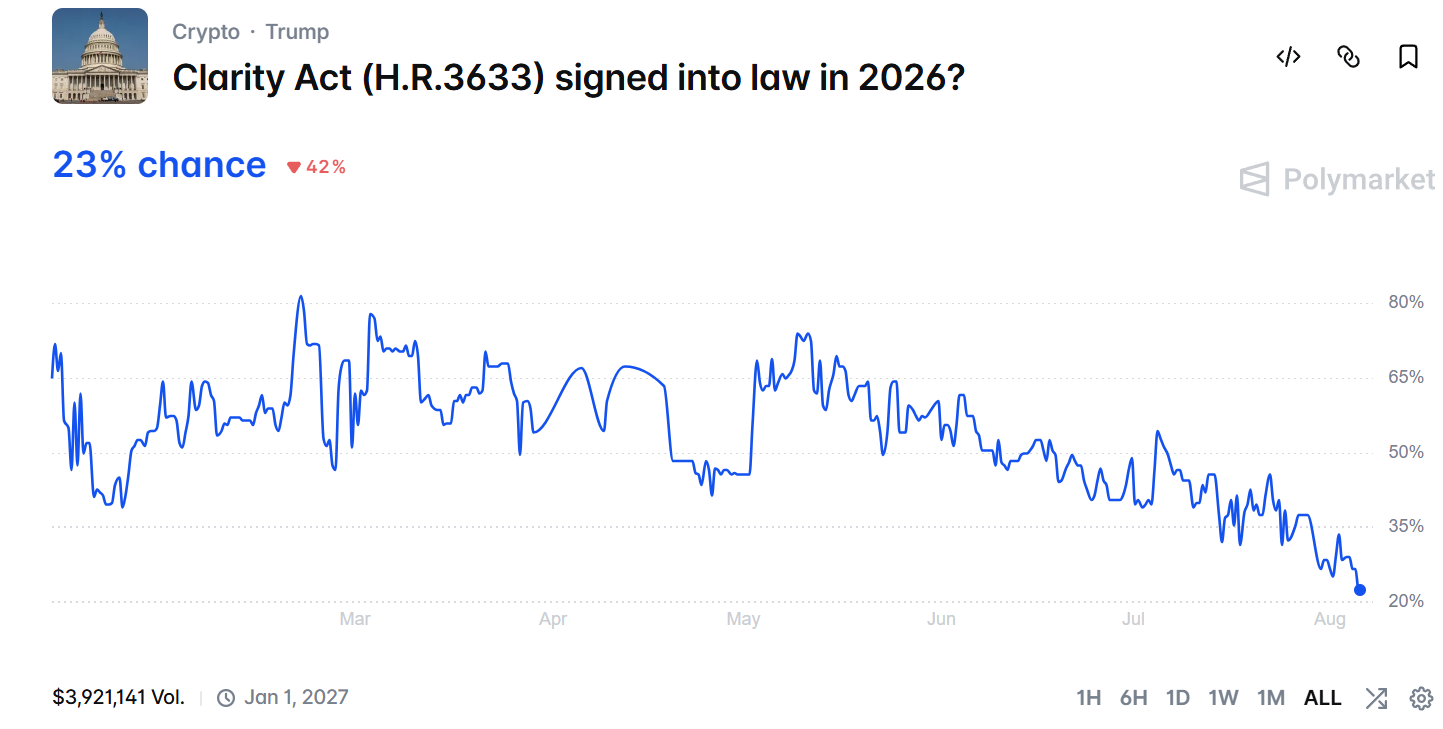
Recent data underscores this declining confidence. Galaxy Research, a prominent financial services and investment management firm specializing in digital assets, notably lowered its probability estimate for the CLARITY Act passing in 2026 to a mere 30% in July. This represents a significant drop, reflecting growing skepticism about the legislative process. Even more starkly, Polymarket, a decentralized prediction market platform, currently shows only a 23% chance of the bill being signed into law this year. This figure is a precipitous decline from the 82% probability recorded in February, illustrating how quickly optimism has waned as the political realities of Washington D.C. have set in.
Behind the Legislative Stalemate
The reasons for the CLARITY Act’s stalled progress are multifaceted, rooted in the complex interplay of partisan politics, competing interests, and the inherently challenging nature of regulating a novel technology. While the bill garnered initial bipartisan support, the latest draft, despite being more complete according to experts like Greg Cipolaro, Global Head of Research at NYDIG, still "lacked sufficient bipartisan support" for passage. Cipolaro highlighted the core issue, stating, "The central investor takeaway is that Republicans have produced a substantially more complete bill, but not yet one with a credible path to 60 votes," referring to the supermajority often required to overcome filibusters in the Senate.

Sources familiar with the legislative discussions, speaking to Punchbowl News, have indicated that Senate Democrats are prepared to deny cloture—a procedural vote to end debate and force a vote on a bill—for the crypto legislation. This move is reportedly contingent on a lack of progress from the White House regarding a broader bipartisan ethics deal. Furthermore, unresolved issues surrounding illicit finance controls and the regulation of stablecoin yield mechanisms remain significant sticking points. These broader legislative priorities and political maneuvering highlight how even a bill with a clear need and initial cross-party appeal can become entangled in the intricate web of congressional negotiations, especially in an election year. The absence of a unified approach from key stakeholders, coupled with the inherent complexities of digital asset regulation, has created a formidable barrier to legislative consensus.
Industry Voices on the Path Forward
Despite the dimming prospects for immediate legislative action, industry leaders are processing the implications and charting a course forward. Matt Hougan’s "walking dead" characterization suggests that while the bill is not permanently defeated, it is effectively in a state of indefinite suspension, unlikely to move forward in its current form or timeframe. He does, however, hold out some hope for future revival, noting that "Congress often bundles multiple bills into a year-end ‘omnibus’ package, forcing legislators to vote on a single bill that includes things they like and things they hate. Maybe the Clarity Act can pass that way." This "lame duck" session, occurring after the November elections but before the new Congress convenes, could present a narrow window for the bill to be attached to a larger legislative vehicle, a common tactic for passing contentious or stalled legislation.
Other industry experts echo the sentiment that legislative clarity is paramount. Ryan Louvar, Chief Legal Officer at WisdomTree, a prominent asset manager, has consistently argued that the absence of clear legislation continues to impede market development. At a July congressional hearing, Louvar articulated the fundamental problem: "A market cannot function well when its participants cannot tell in advance which agency’s rules apply to them." This lack of predictability creates a chilling effect on innovation and investment, as companies struggle to navigate an ambiguous regulatory landscape. The current piecemeal approach, characterized by enforcement actions and regulatory pronouncements rather than comprehensive law, fosters an environment of uncertainty that ultimately harms both businesses and consumers.
The Impermanence of Regulatory Interpretations
In the absence of comprehensive legislation, the crypto industry will largely fall back on existing regulatory guidance, most notably the joint interpretation issued by the SEC and CFTC in March. This interpretation, which classifies Bitcoin and other select digital assets as digital commodities, sought to provide some interim clarity, replacing the SEC’s 2019 staff guidance. While this framework offers a degree of operational understanding, its inherent limitations are widely recognized.
As former SEC Commissioner Paul Atkins, a respected voice in financial regulation, once emphasized in remarks quoted by Senator Cynthia Lummis, "Only Congress can ensure that regulation in this area is future-proofed through comprehensive market structure legislation." The crucial distinction lies in the durability and authority of law versus regulatory interpretation. Agency interpretations, while providing current guidance, are inherently less stable than congressional legislation. They can be challenged in court, revised by future administrations, or even superseded by a change in leadership within the agencies themselves. This impermanence creates a fragile foundation for an industry that requires long-term planning and significant capital investment. The lack of a clear legislative mandate means that the crypto market remains vulnerable to shifts in political tides and evolving regulatory philosophies, perpetuating a cycle of uncertainty rather than establishing a stable foundation for growth.
Crypto’s Unstoppable Momentum?
Despite the legislative hurdles and the inherent instability of reliance on agency interpretations, Bitwise’s Matt Hougan remains remarkably optimistic about the long-term trajectory of the crypto industry. His assertion that "crypto will be fine" stems from a belief in the industry’s intrinsic momentum and its ability to adapt, even in the face of a dysfunctional Washington. Hougan suggests that even with the current regulatory framework, the industry would still have "two and a half years to accelerate before a new administration could potentially install a new SEC" with different priorities. This timeframe, he argues, is sufficient for the industry to continue its march forward, building out infrastructure and attracting further adoption.
Hougan’s perspective reflects a broader sentiment within the crypto community: that technological innovation, driven by decentralized principles and global adoption, will ultimately outpace and transcend traditional governmental attempts at control. "Washington is dysfunctional," Hougan lamented, "It seems crazy to me that we can’t get our act together to pass legislation that would improve investor protections and spark new innovation." However, he quickly pivoted to the larger picture: "But it’s not a referendum on crypto’s validity as a pillar of the global financial infrastructure. That ship has long since sailed. At this point, crypto has enough momentum that it will reshape finance for decades, regardless of what happens in the next few days." This conviction highlights the belief that the fundamental value proposition of digital assets—efficiency, transparency, and decentralization—is strong enough to overcome even significant regulatory friction.
Broader Implications for the Digital Asset Landscape
The failure of the CLARITY Act to advance this year carries significant implications for the broader digital asset landscape in the United States and potentially globally. For investors, continued regulatory ambiguity translates to heightened risk and uncertainty. Institutional players, in particular, often require clear legal frameworks before committing substantial capital, meaning that the lack of comprehensive legislation could deter further mainstream adoption and slow the influx of traditional finance into the crypto space. This could manifest as depressed valuations for certain digital assets or a slower pace of innovation within the U.S. compared to jurisdictions with more progressive regulatory stances.
For innovators and entrepreneurs, the U.S. risks falling behind other nations that are actively developing clear, forward-thinking regulatory regimes for digital assets. Countries like the European Union, the UK, and several Asian nations are moving more decisively to create bespoke frameworks for crypto, potentially drawing talent and capital away from American shores. The U.S. has historically been a leader in technological innovation, but a protracted period of regulatory uncertainty could erode this competitive edge in the rapidly expanding digital economy. Businesses might choose to domicile in jurisdictions with greater legal clarity, impacting job creation and economic growth within the U.S.
Moreover, the ongoing reliance on enforcement actions rather than proactive legislation fosters a reactive rather than a strategic approach to regulation. This can lead to a climate of fear and unpredictability, where companies operate under the constant threat of legal action, rather than with clear guidelines for compliance. While regulatory bodies like the SEC and CFTC are working within their existing mandates, these mandates were largely established prior to the advent of digital assets and are often ill-suited to the unique characteristics of this new asset class.
Looking Ahead: The Lame-Duck Session and Beyond
As the August 5th deadline passes, the immediate focus will shift to the slim possibility of the CLARITY Act being revived during the "lame-duck" session of Congress later this year. This post-election period, often characterized by a final flurry of legislative activity before new members take office, could offer a chance for the bill to be attached to an omnibus spending package or other must-pass legislation. However, even this scenario is far from guaranteed, requiring significant political will and compromise.
Should the bill fail to pass in 2026, the legislative effort would likely need to be re-initiated in the next Congress, facing a fresh set of political dynamics, new committee leadership, and potentially different White House priorities. This would mean restarting the arduous process of drafting, negotiating, and building bipartisan consensus, pushing the timeline for comprehensive crypto regulation further into the future. The enduring challenge for lawmakers will be to bridge the partisan divide and address the complex policy issues surrounding digital assets in a manner that fosters innovation, protects investors, and safeguards financial stability, all while navigating the ever-present political landscape of Washington D.C. In the interim, the crypto industry, as Hougan suggests, will continue its march, adapting to the regulatory patchwork and pushing the boundaries of financial technology, perhaps with or without the clear legislative guidance it so desperately seeks.