Dwi Wanna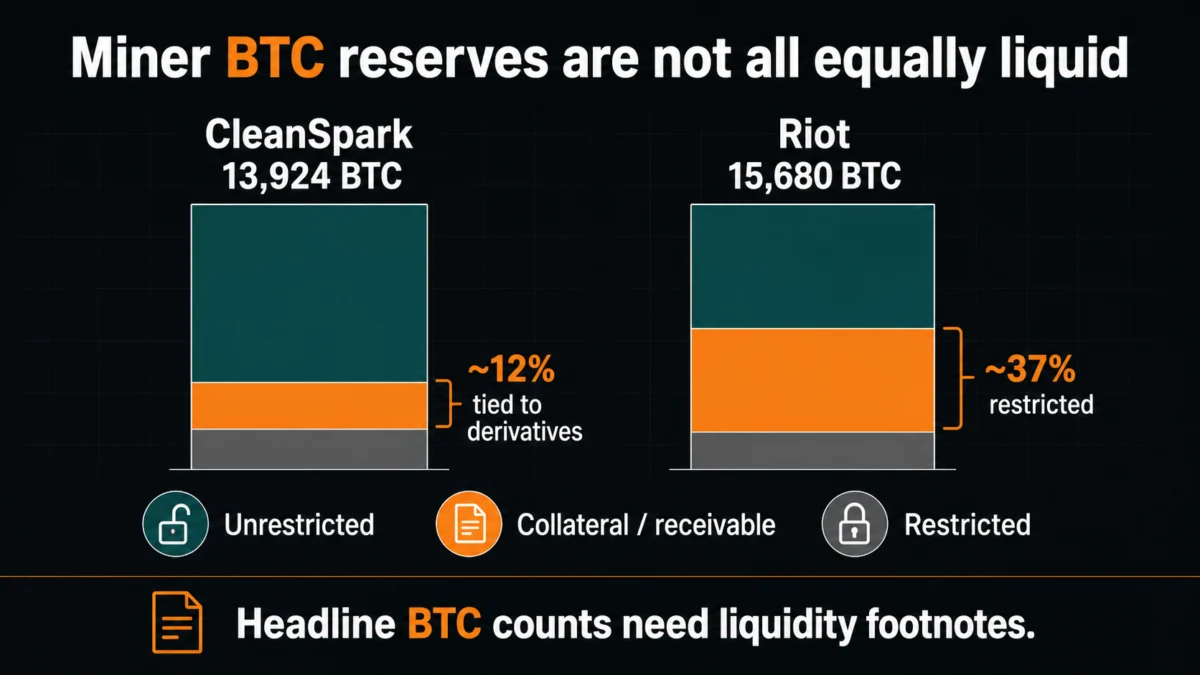
The landscape of public Bitcoin mining has undergone a fundamental shift in how assets are managed, reported, and perceived by the global investment community. For years, the primary metric for evaluating a mining company’s strength was its total Bitcoin (BTC) holdings—a strategy often referred to as "HODLing." However, recent operational updates from industry leaders CleanSpark and Riot Platforms suggest that the headline treasury figure is no longer a sufficient indicator of financial health. Instead, a new era of transparency has emerged, where the liquidity and availability of those assets are becoming more critical than the raw total.
As of June 30, 2026, CleanSpark, one of the top-tier public Bitcoin miners, reported a total treasury of 13,924 BTC. While this figure secures its position as the owner of the 11th-largest public Bitcoin treasury among operating companies, a crucial footnote in its latest disclosure revealed a more complex reality. Of that total, 1,719 BTC—approximately 12% of the balance—was posted as collateral or recorded as a receivable tied to derivative transactions. This disclosure highlights a growing trend among miners to utilize their digital assets in financing and risk-management mechanisms, effectively moving them out of the category of readily available reserves.
The Dissection of a Modern Miner’s Balance Sheet
The shift toward complex financial instruments marks a departure from the traditional "mine and hold" philosophy. In the current market, miners are increasingly acting as sophisticated financial entities, using their Bitcoin stacks to navigate volatile price swings and high operational costs. The CleanSpark disclosure is not an indication of financial distress, but rather a reflection of modern treasury management. By pledging BTC as collateral or engaging in derivative contracts, companies can hedge against price drops or secure the capital necessary for expansion without the immediate need to sell their core assets at spot prices.
However, this complexity creates a challenge for investors. When a significant portion of a company’s treasury is tied up in restricted accounts or pledged as collateral, its "liquidity buffer" is diminished. In a scenario where cash is needed urgently—to cover power bills, debt service, or capital expenditures for new hardware—restricted BTC cannot be easily liquidated. This distinction transforms the treasury report from a simple inventory count into a nuanced liquidity signal.
Comparative Analysis: CleanSpark vs. Riot Platforms
To understand the scale of this trend, it is necessary to look at Riot Platforms, another titan in the sector. In its Q1 2026 operations update, Riot reported holding 15,680 BTC. However, the report also specified that 5,802 BTC of that total was "restricted." This means approximately 37% of Riot’s reported holdings were not immediately accessible for general corporate use.
The comparison between CleanSpark’s 12% restricted/collateralized balance and Riot’s 37% provides a window into the varying strategies employed by major players. While both companies maintain massive headline numbers, their operational flexibility differs. A miner with a higher percentage of unrestricted BTC possesses a larger "stress buffer," allowing them to weather prolonged market downturns or sudden spikes in hashprice volatility without needing to restructure debt or issue new equity.
A Chronology of Financial Evolution in the Mining Sector
The transition to these complex reporting standards did not happen in a vacuum. It is the result of several years of mounting pressure on the mining industry:
- The 2024 Halving and Post-Halving Era: Following the 2024 Bitcoin halving, block rewards were cut in half, forcing miners to become more efficient. Those who could not lower their power costs or upgrade to more efficient machines began looking for ways to monetize their existing BTC holdings through lending and derivatives.
- The Rise of Institutional Participation: As institutional investors entered the crypto space, they demanded more traditional financial reporting. This led miners to adopt GAAP-compliant disclosures that clearly distinguish between unrestricted cash equivalents and restricted collateral.
- The 2025 All-Time High and Subsequent Correction: Bitcoin reached a historic peak in October 2025, but by July 2026, the price had retraced to approximately $62,000—a 50% decline. This volatility forced miners to use "delta-neutral" strategies and "basis trades" to lock in value and protect their balance sheets from further downside.
- The AI and HPC Pivot: Throughout late 2025 and early 2026, several miners announced massive deals to colocate GPUs for Artificial Intelligence (AI) and High-Performance Computing (HPC). These projects require immense upfront capital, leading miners to pledge their BTC as collateral to secure the necessary financing for data center buildouts.
Deciphering the June Operational Updates
The specific movements within CleanSpark’s June update illustrate how active these treasuries have become. During the month, the company produced 614 BTC, yet its final treasury balance was influenced by several non-production factors:
- Spot Sales: 179 BTC were sold directly for cash.
- Call Exercises: 250 BTC were sold pursuant to the exercise of call options.
- Put Exercises: 25 BTC were acquired through the exercise of put options.
- Delta-Neutral Basis Trades: 244 BTC were acquired in connection with sophisticated hedging strategies designed to profit from the price difference between spot and futures markets while minimizing directional risk.
These maneuvers show that the treasury is no longer a static vault; it is an active portfolio. The acquisition of BTC through delta-neutral trades, for instance, suggests that miners are looking for ways to grow their stacks through market inefficiencies rather than just through the energy-intensive process of mining.

The Economic Reality: Rising Costs and Underwater Fleets
The move toward derivatives is also a defensive necessity. According to CoinShares’ Q1 2026 mining report, the weighted-average cash cost for listed miners to produce a single Bitcoin rose to approximately $79,995 by the end of 2025. With Bitcoin trading near $62,000 in mid-2026, many miners are operating at a functional loss on a per-coin basis when accounting for all overheads.
Furthermore, the "hashprice"—a measure of the expected value of 1 petahash of hashing power per day—has hovered near $30. At this level, industry analysts estimate that 15% to 20% of the global mining fleet is "underwater," meaning the cost of electricity to run the machines exceeds the value of the Bitcoin they produce. In such a high-pressure environment, the ability to use Bitcoin as a financial tool to bridge the gap between production costs and market price is a survival mechanism.
The Strategic Shift Toward Artificial Intelligence
One of the most significant transformations in the industry is the diversification into AI and cloud services. CoinShares projects that listed miners could derive as much as 70% of their revenue from AI by the end of 2026, a massive leap from the 30% seen in previous years. This shift follows more than $70 billion in announced deals involving GPU colocation and partnerships with hyperscale data center providers.
This pivot requires a different type of financial strength. Building AI-ready data centers is significantly more expensive than building traditional mining farms. Consequently, the "new balance-sheet question" for miners is not who holds the most Bitcoin, but who holds the most deployable Bitcoin. If a company’s treasury is heavily collateralized to support its mining operations, it may lack the liquid capital needed to pivot into the lucrative AI sector.
Market Implications and Investor Sentiment
For investors, these disclosures represent a double-edged sword. On one hand, the use of derivatives and collateralized financing shows that mining management teams are becoming more sophisticated and are utilizing all available tools to manage risk. On the other hand, it introduces "counterparty risk" and "liquidity risk" that were not present when miners simply held coins in cold storage.
If Bitcoin prices remain stagnant or decline further, the footnotes in these financial reports will become more important than the headline totals. A "liquidity stress test" may soon be applied to the sector, where analysts discount restricted or collateralized BTC when calculating a company’s "dry powder."
Industry analysts suggest that the next round of quarterly updates (Q2 2026) will be a watershed moment for the sector. If more miners follow CleanSpark’s lead in providing detailed breakdowns of collateral and receivables, it will signal a new standard for transparency. Conversely, companies that continue to report a single, monolithic treasury number may face skepticism from a market that is increasingly wary of hidden liquidity constraints.
Conclusion: The New Standard for Transparency
The era of judging a Bitcoin miner solely by the size of its "HODL" stack is coming to an end. As the industry matures and integrates with the broader worlds of AI and high-finance, the internal composition of those treasuries matters more than ever. CleanSpark’s disclosure of its 1,719 BTC in collateralized assets is a preview of a future where liquidity is the ultimate arbiter of success.
The network itself remains robust, but the corporate entities that secure it are entering a period of intense financial scrutiny. Investors will be watching closely to see how many "reported" coins are actually available to fund the next generation of computing infrastructure. In a market where the cost of production exceeds the spot price, the difference between a restricted coin and an unrestricted one is the difference between a company that can innovate and one that is simply holding on.