Dwi Wanna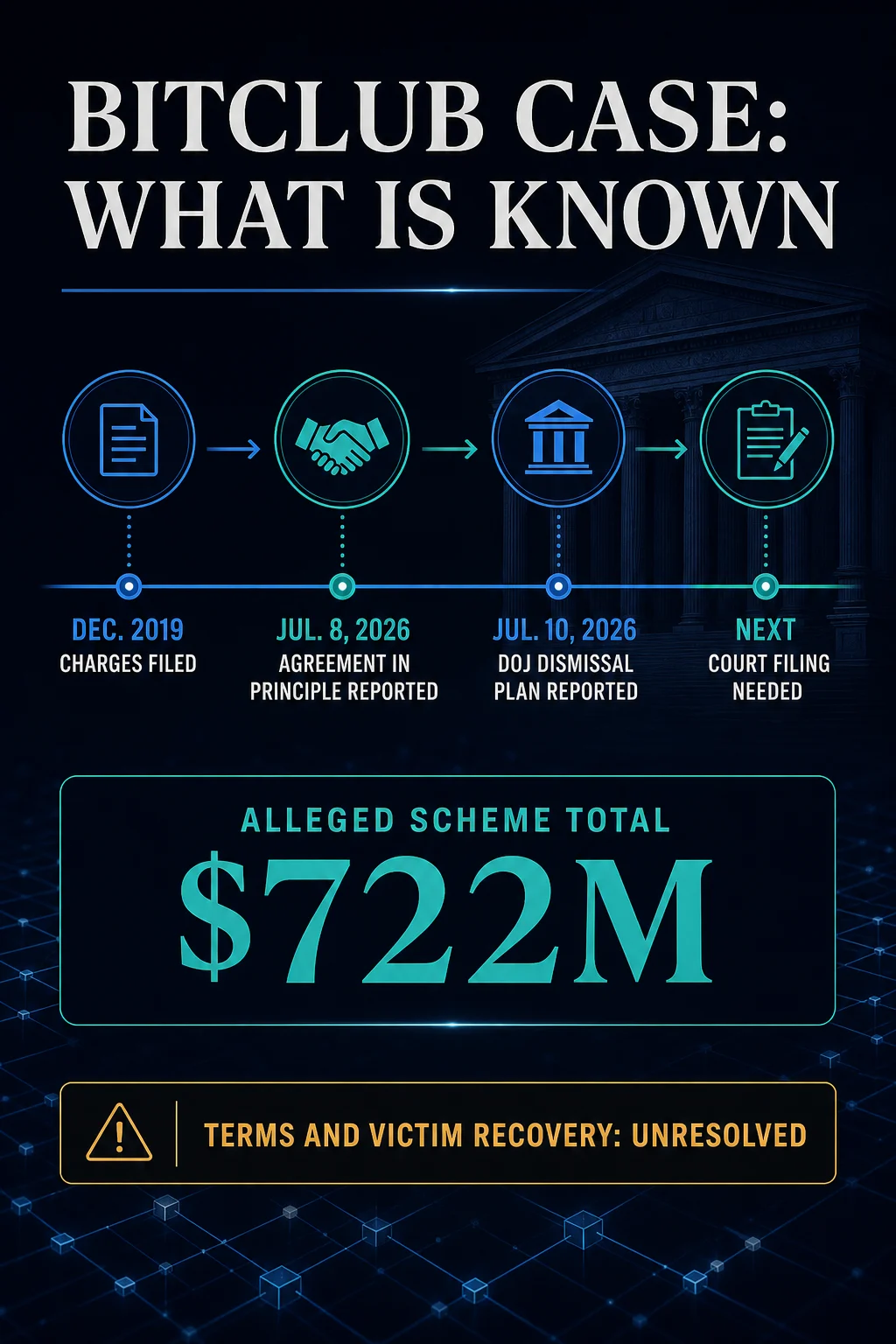
The United States Department of Justice (DOJ) has signaled a significant pivot in one of the most high-profile cryptocurrency fraud cases in recent years, moving to dismiss criminal charges against Matthew Goettsche, the alleged mastermind behind the BitClub Network. This development, occurring just months before a scheduled October 2024 trial, marks a potential end to a legal saga that has spanned more than six years and involved an alleged global Ponzi scheme totaling at least $722 million. While the prosecution prepares to step back, thousands of investors who lost funds between 2014 and 2019 remain in a state of uncertainty regarding the status of their potential recoveries and the final terms of the resolution.
According to reports from Bloomberg Law, which cited sources familiar with the internal deliberations, the Deputy Attorney General’s office has instructed federal prosecutors in New Jersey to seek a dismissal of the case with prejudice. A dismissal "with prejudice" is a definitive legal action that prevents the government from refiling the same charges against the defendant in the future. On July 8, 2026, defense counsel for Goettsche informed the court that the parties had reached an "agreement in principle" to resolve the pending charges, requesting additional time to finalize the specific terms of the settlement. As of mid-July, the formal dismissal motion has yet to be entered into the public court record, leaving the specific conditions of the deal—including any financial penalties or restitution requirements—shrouded in secrecy.
The Rise and Fall of the BitClub Network
The BitClub Network emerged in 2014, positioning itself as a premier destination for investors looking to capitalize on the burgeoning cryptocurrency mining industry. At the time, Bitcoin was beginning to gain mainstream attention, and the technical barriers to entry for mining—the process of using specialized hardware to secure the network and earn rewards—were becoming increasingly high for individual enthusiasts. BitClub offered a solution: a cloud-mining service where investors could purchase "shares" in purported mining pools.
The government’s original indictment, filed in December 2019, painted a starkly different picture of the operation. Prosecutors alleged that BitClub was a "transparent-to-the-founders" fraud scheme that functioned as a classic Ponzi operation. According to court documents, Goettsche and his co-defendants allegedly referred to their target demographic as "dumb" and "sheep," specifically aiming to exploit investors who lacked technical knowledge of blockchain technology.
The scheme’s mechanics were reportedly two-fold. First, BitClub allegedly provided investors with fabricated or manipulated mining earnings data, showing profitable returns that did not reflect the actual output of the network’s hardware. Second, the operation utilized a complex multi-level marketing (MLM) structure, incentivizing existing members to recruit new victims. Rewards were paid out for bringing in fresh capital, ensuring a steady stream of liquidity to pay off earlier investors and fund the lavish lifestyles of the organizers. By the time federal authorities intervened in late 2019, the DOJ estimated the scheme had defrauded investors of at least $722 million in Bitcoin and other digital assets.
Chronology of Legal Proceedings and Policy Shifts
The legal trajectory of the BitClub case has been marked by several critical milestones, leading to the current move toward dismissal:

- 2014–2019: The BitClub Network operates globally, soliciting hundreds of millions of dollars from investors.
- December 2019: Federal authorities arrest Matthew Goettsche and several co-conspirators. The DOJ charges them with conspiracy to commit wire fraud and conspiracy to offer and sell unregistered securities.
- 2020–2024: The case experiences numerous delays, compounded by the complexity of tracing digital assets across international jurisdictions and the disruptions caused by the global pandemic. Several co-defendants, including Silviu Balaci and Joseph Abel, enter guilty pleas, cooperating with the government.
- January 2025: The DOJ issues a pivotal internal memorandum regarding the prosecution of digital asset cases. The memo states that the department will move away from using criminal litigation to impose regulatory frameworks on the crypto industry, focusing instead on cases of clear criminal intent and victimization.
- July 8, 2026: Goettsche’s legal team informs the court of an agreement in principle.
- July 10, 2026: Reports emerge that the Deputy Attorney General has ordered the dismissal of the case.
- October 2026: The original date for the commencement of the criminal trial, now unlikely to proceed.
The 2025 DOJ Policy Shift: A Catalyst for Dismissal?
The sudden move to drop the charges against Goettsche appears to be linked to a broader strategic shift within the Department of Justice. In early 2025, a DOJ memorandum clarified the department’s stance on digital asset enforcement. The directive advised prosecutors to review ongoing matters to ensure they were consistent with a policy of avoiding "regulation by enforcement." Specifically, the memo suggested that the department should stop using criminal cases to establish new legal precedents for how digital assets are categorized under existing securities laws.
While the memo also emphasized that prosecutors should prioritize cases involving the direct victimization of investors, the BitClub case presents a unique challenge. Because the scheme was built on a foundation of mining shares—a product that sits at the intersection of technology services and financial securities—the DOJ may have determined that pursuing the case to trial risked setting a legal precedent that contradicted its new policy. Without a public statement from the DOJ, it remains unclear whether the dismissal is a result of a lack of evidence, a change in legal philosophy, or a negotiated settlement that includes significant civil forfeitures.
The Question of Victim Recovery
For the thousands of individuals who lost money in the BitClub Network, the primary concern is the recovery of their assets. The $722 million figure cited by the DOJ represents the total alleged intake of the scheme, but it does not necessarily reflect the amount currently available for restitution.
The DOJ has maintained a "BitClub Case" portal, directing potential victims to an FBI questionnaire to document their losses. However, the status of these funds remains opaque. In typical fraud cases, the government seeks "forfeiture"—the seizure of assets derived from criminal activity—and "restitution," which is the court-ordered repayment of victims.
A spokesperson for the DOJ recently told Bloomberg Law that the government has been successful in recovering a "substantial amount" of money intended for investors. However, the specific mechanisms for distribution have not been disclosed. If the criminal case is dismissed with prejudice, the legal path to restitution may shift to civil asset forfeiture proceedings. In such a scenario, the government would continue to pursue the assets themselves rather than the individual defendants, though this process can often be lengthy and result in victims receiving only a fraction of their original investment.
Analysis of Implications for the Crypto Industry
The decision to drop the BitClub case carries significant implications for the future of cryptocurrency regulation and enforcement in the United States.
First, it signals a potential "thaw" in the aggressive pursuit of early-era crypto projects. By moving away from a trial that would have scrutinized activities from over a decade ago, the DOJ may be signaling that it is more interested in policing current and future market actors rather than litigating the "Wild West" era of 2014–2017.

Second, the dismissal highlights the difficulty of prosecuting complex crypto-MLM schemes. These cases often involve thousands of victims across dozens of countries, making the collection of testimony and the verification of financial records a logistical nightmare for prosecutors. The decision to settle or dismiss may reflect a pragmatic realization that the costs and risks of a multi-month trial outweigh the benefits, provided that some form of asset recovery is achieved.
Third, the lack of transparency regarding the "agreement in principle" may lead to criticism from victim advocacy groups. Without a public trial, the full details of how the scheme operated and where the money went may never be fully exposed. This lack of closure can be a significant blow to those seeking accountability for financial crimes.
Next Steps in the Judicial Process
The legal community is now awaiting the formal filing of the dismissal motion. This document is expected to provide at least some clarity on the rationale behind the DOJ’s decision and the future of the recovered funds. If the court accepts the dismissal with prejudice, Matthew Goettsche will be cleared of the criminal charges that have loomed over him since 2019.
However, the conclusion of the criminal case does not necessarily mean the end of legal trouble for the BitClub founders. Civil litigation from private investors and regulatory actions from the Securities and Exchange Commission (SEC) or the Commodity Futures Trading Commission (CFTC) could still proceed. Historically, when the DOJ steps back from a criminal prosecution, civil regulators often step in to seek permanent injunctions and civil monetary penalties.
As the October trial date approaches, the focus will remain on the DOJ’s ability to fulfill its promise of recovering funds for the victims. Whether through a negotiated settlement or continued civil forfeiture, the resolution of the BitClub Network saga will serve as a landmark case in the history of digital asset law, illustrating the evolving boundaries between criminal fraud, financial innovation, and federal policy.