admin
adminThe era of experimental cross-chain interoperability is definitively over. With hundreds of public and private blockchains now operational and more launching regularly, the imperative for robust inter-chain connectivity has emerged as a foundational requirement for the global financial system. The movement of hundreds of trillions in assets onto blockchain networks, enabling maximized liquidity and global distribution for digital assets, hinges entirely on the security and efficiency of these cross-chain solutions. However, the operational landscape reveals a stark reality: not all cross-chain infrastructure is created equal, and critical security vulnerabilities have posed an existential threat to the burgeoning on-chain finance sector.
The Imperative of Interoperability: Bridging Digital Finance
The distributed ledger technology (DLT) ecosystem has evolved rapidly, giving rise to diverse blockchain networks, each with unique strengths, functionalities, and user bases. This fragmentation, while fostering innovation, inherently creates silos. For the global financial system, accustomed to seamless, albeit complex, interbank and inter-market operations, this fragmentation presents a significant hurdle. The vision of tokenizing real-world assets, from equities and bonds to real estate and commodities, relies on the ability to move these digital representations fluidly across different blockchain environments. Without secure and reliable cross-chain interoperability, liquidity remains fragmented, distribution is hindered, and the true potential of on-chain finance—including enhanced transparency, reduced settlement times, and lower costs—cannot be fully realized. The goal is to create a unified digital economy where assets and data can flow securely, mirroring the interconnectedness of traditional finance but with the added benefits of blockchain technology.
A Troubled Landscape: The Cost of Insecurity
The urgency for secure interoperability is underscored by a sobering statistic: nearly $3 billion has been stolen in cross-chain bridge hacks to date, according to data from DeFiLlama. These incidents, which include high-profile exploits like the Ronin Bridge attack ($625 million), the Wormhole exploit ($325 million), and the BNB Chain Bridge hack ($100 million), are not merely isolated events. They represent a systemic vulnerability rooted in fundamental infrastructure security design flaws. Many cross-chain solutions, despite being presented as decentralized, often compromise on critical security tenets. Common weaknesses include insecure or unsafe defaults, centralized node deployments and dependencies, insufficient risk controls and monitoring, and operationally complex architectures that burden developers and asset issuers with the task of becoming cross-chain infrastructure security experts.
These vulnerabilities are not inherent to cross-chain technology itself but are, instead, direct consequences of poor design choices and cost-saving development shortcuts. Such compromises present an insurmountable barrier to institutional capital. Financial institutions, operating within highly regulated frameworks and managing vast sums, demand infrastructure that meets the highest security standards, often exceeding those of existing traditional systems. Without such assurances, institutional migration onto blockchain networks will remain largely symbolic, limited to pilot projects rather than transformative adoption at scale. The industry has increasingly recognized that "decentralized in name only" solutions are insufficient, necessitating a shift towards truly decentralized, robustly secured networks underpinned by defense-in-depth architectures.
The Foundation of Trust: Chainlink’s Seven-Year Legacy in Decentralized Security
Addressing these critical security gaps, Chainlink has positioned its Cross-Chain Interoperability Protocol (CCIP) as a leading solution, designed from the ground up to deliver the strongest cross-chain security guarantees in the blockchain industry. This security-first foundation is deemed critical for attracting institutional capital on-chain at scale, a principle articulated by Chainlink co-founder Sergey Nazarov: "You’re not building the systems for the 363 days when everything is smooth. You’re building the system for the 2 days when everything goes crazy." This philosophy encapsulates the necessity of designing for worst-case scenarios, a non-negotiable requirement for managing the quadrillions in value processed annually by the global financial system.
Chainlink’s commitment to security and reliability spans over seven years. Its journey began in 2017 with the invention of the "Decentralized Oracle Network" (DON), a paradigm-shifting innovation that extended the principles of decentralization and cryptographic verification from blockchains to a broader spectrum of data and interoperability functionalities. Since its mainnet launch in 2019, Chainlink DON infrastructure has become the industry standard for connecting off-chain systems to on-chain applications, having securely enabled over $29 trillion in transaction value across more than 80 public and private blockchains. This infrastructure has been instrumental in powering the explosive growth of the decentralized finance (DeFi) economy, securing over 70% of global DeFi markets through reliable market data feeds.
The development and maintenance of this robust infrastructure are supported by a dedicated team of over 600 engineers, researchers, security experts, data scientists, and DevOps professionals. This rigorous and principled approach to infrastructure security and decentralization, honed over years of securing high-value on-chain transactions, forms the bedrock of Chainlink CCIP. The same design philosophy that underpins the reliability of Chainlink DONs—a secure-by-default, defense-in-depth architecture—has been meticulously applied to CCIP, setting a new benchmark for cross-chain interoperability security.
Chainlink CCIP: Engineering for Resilience and Security-by-Default
Chainlink CCIP is engineered with the conviction that robust cross-chain security and decentralization must be intrinsic properties of the interoperability protocol itself, rather than an afterthought or an optional layer. This "secure-by-default" model provides strong security guarantees out-of-the-box, alleviating the immense burden on application developers and asset issuers who may not possess deep expertise in cross-chain infrastructure security. CCIP addresses cross-chain risk at the protocol level, offering safe defaults while also providing developers with the flexibility to integrate additional layers of security controls, such as issuer attestations, rate limits, circuit breakers, and comprehensive permissioning and compliance tooling.
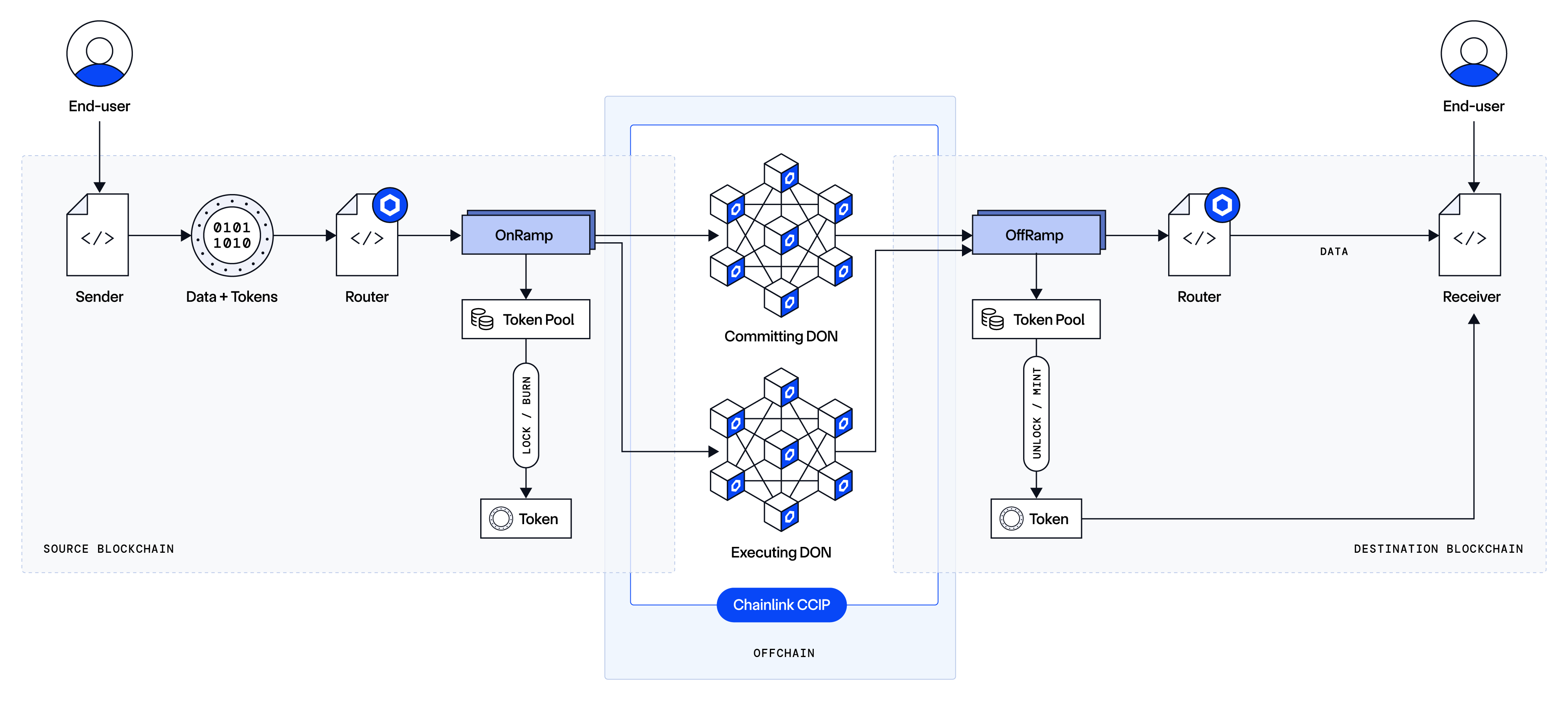
The architecture of CCIP leverages distinct committing and executing DONs, creating an additional layer of separation and security. This multi-layered approach ensures that the integrity of cross-chain transactions is maintained even under adverse conditions, a stark contrast to monolithic or less decentralized solutions.
Decentralized Observation and Validation: Beyond "Decentralization Theater"
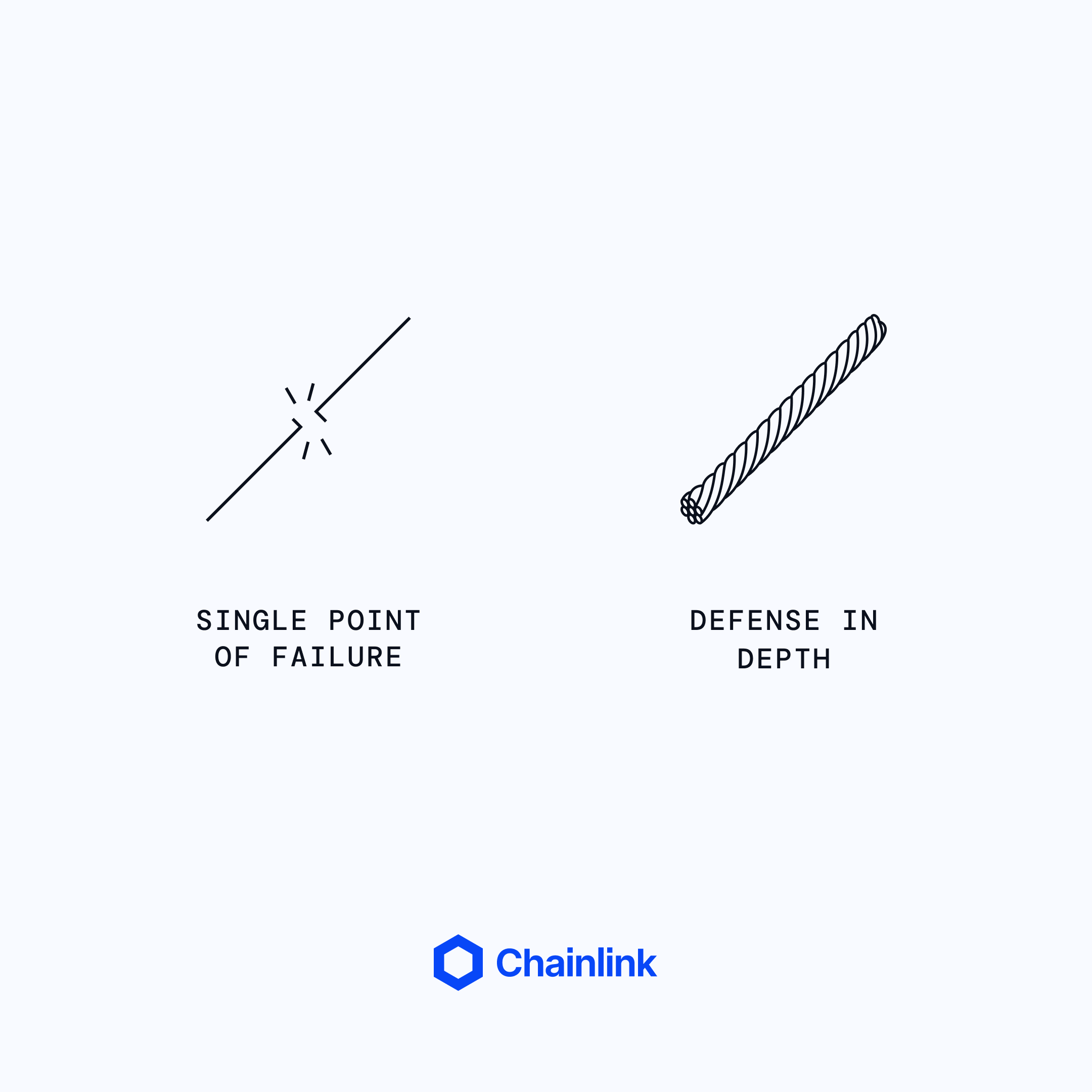
A cornerstone of CCIP’s secure-by-default model is its defense-in-depth DON architecture, specifically implemented through decentralized observation and validation. Unlike solutions that might rely on a single verifier, machine, or infrastructure provider, the Chainlink DONs securing CCIP comprise 16 independent, professional node operators. These operators validate cross-chain transactions through a process of decentralized consensus, significantly mitigating single points of failure. The node operators are geographically distributed, Sybil-resistant, and have undergone rigorous security reviews, possessing extensive experience in running mission-critical infrastructure across diverse sectors including telecommunications, cloud computing, and Web3.
Infrastructure diversity is a key operational principle for these node operators, who utilize a mix of on-premise bare-metal and multi-region cloud deployments. They also operate robust RPC infrastructure with multiple layers of redundancies and verification checks. This strategic diversity proved critical during the October 2025 AWS outage, which impacted numerous major web services and other cross-chain providers. Thanks to its distributed infrastructure, CCIP experienced no downtime and remained fully operational, demonstrating its resilience in the face of widespread service disruptions.
Crucially, the security of any cross-chain system begins with the quality of its observation. Observation determines what transpired on the source chain, while verification confirms whether those observed events are sufficient to authorize an action on the destination chain. If the observation layer is weak or centralized, invalid state can contaminate the entire system—a classic "garbage in, garbage out" scenario. Many bridges may appear decentralized at the verifier layer but still depend on opaque, correlated, or shortcut-heavy observation mechanisms. Merely adding more verifiers atop a single point of observation failure does not confer meaningful security; it merely creates a false impression of a distributed network, often referred to as "decentralization theater." CCIP explicitly counters this by decentralizing both the observation and validation layers across multiple independent operators and infrastructure. Chainlink DONs observe source-chain state, reach off-chain consensus on committed messages, and then execute only after robust proof verification on the destination chain, thus eliminating reliance on any single observer, endpoint, or infrastructure provider.
Proactive Risk Management: Built-In Controls and Safeguards
Beyond decentralized validation, CCIP’s architecture integrates robust risk monitoring and control features, mirroring the sophisticated safeguards employed in traditional financial markets. These include configurable rate limits, which can function as automated circuit breakers during abnormal conditions such as extreme market volatility or geopolitical instability, effectively mitigating the impact of incidents and providing critical time for response.
Asset issuers are also empowered to directly participate in the verification process through Token Developer Attestations. This feature allows issuers to provide attestation proofs that are verified on-chain before any cross-chain transactions involving their tokens are processed, adding an extra layer of security and control. Furthermore, developers and asset issuers can incorporate additional, optional compliance and permissioning logic via Chainlink’s Automated Compliance Engine (ACE). ACE enables pre-transaction checks and policy enforcement, fulfilling fundamental requirements for regulated digital assets and ensuring that transactions adhere to necessary legal and regulatory frameworks. This combination of decentralized validation and protocol-level risk controls establishes a powerful and resilient foundation for secure interoperability.
Empowering Issuers: Eliminating Vendor Lock-In with CCTs
Security, in the context of CCIP, also extends to providing issuers with complete flexibility and control over their digital assets and smart contracts. CCIP underpins the Cross-Chain Token (CCT) standard, a significant advancement that enables any new or existing ERC20-compatible token to become securely cross-chain-enabled. CCTs offer self-serve deployments, full control and ownership for developers, enhanced programmability, and zero-slippage transfers—all backed by CCIP’s industry-standard defense-in-depth security.
CCTs are designed to be token logic agnostic, meaning asset issuers and developers can deploy pre-audited token pool contracts to transform any ERC20-compatible token into a CCT, or they can deploy their own custom token pool contracts for more specialized use cases. Critically, the CCT standard does not necessitate token developers inheriting any CCIP-specific code within their token’s smart contract. This innovative design eliminates vendor lock-in, granting token issuers autonomy and ownership over their token contracts without inheriting or relying on specific CCIP libraries or functions. This empowers teams to evolve their cross-chain design over time without the risk of underlying code changes unexpectedly impacting their token’s functionality or security. The CCT standard represents a commitment to open, flexible, and secure token design within the cross-chain ecosystem.
Meeting Institutional Demands: Certifications and Real-World Adoption
Chainlink’s security-first approach and substantial investment in decentralization have solidified its position as the market-leading oracle platform, encompassing data, interoperability, compliance, privacy, and orchestration. Notably, Chainlink is the sole data and interoperability oracle platform to have achieved key institutional security certifications: SOC 2 Type 2, SOC 2 Type 1, and ISO/IEC 27001:2022. These certifications, validated by a "Big Four" accounting firm, Deloitte & Touche LLP, are crucial for the world’s largest institutions and enterprises, providing independent assurance that Chainlink consistently adheres to the highest security and operational controls. Such attestations are paramount for traditional finance players considering substantial engagement with blockchain technology.
The efficacy and security of CCIP are already evident in its adoption across various institutional environments where security, compliance, and reliability are paramount. Major financial entities are integrating CCIP to facilitate secure cross-chain transactions and data flows. For instance, the DTCC (Depository Trust & Clearing Corporation) utilized CCIP in its recent Project Guardian pilot with JPMorgan and Apollo to explore tokenized fund distribution, highlighting its suitability for complex capital markets operations. Similarly, Swift, the global interbank messaging network, partnered with Chainlink to demonstrate how its existing financial infrastructure could securely connect to blockchain networks using CCIP, showcasing a clear pathway for traditional finance to engage with digital assets. Furthermore, BNP Paribas, T-Systems MMS, Citi, B.Metzler, and Australia and New Zealand Banking Group (ANZ) are among the numerous institutions exploring or actively using CCIP for various initiatives, from tokenized asset experiments to secure inter-blockchain communication.
Beyond institutional adoption, CCIP has also seen widespread integration within the largest DeFi and tokenized asset protocols. Leading DeFi protocols like Aave, Synthetix, WEMIX, GMX, and Pendle Finance have adopted CCIP for secure cross-chain messaging and asset transfers, leveraging its robust security guarantees to enhance their multi-chain strategies. The trust placed in CCIP by these diverse entities—from established financial giants to innovative DeFi leaders—underscores its proven capability to meet the stringent demands of both traditional and decentralized finance.
The Path Forward: Securing the Future of On-Chain Finance
The digital asset industry stands at a critical inflection point, witnessing an accelerating convergence of tokenized assets and traditional financial instruments moving onto blockchain networks. The success of this monumental transition is entirely dependent on the underlying infrastructure being demonstrably secure, reliable, and scalable to support global adoption.
Chainlink has dedicated over seven years to meticulously building secure and reliable oracle infrastructure, forming the bedrock of the modern blockchain economy. With CCIP, this same security-first philosophy is extended to cross-chain interoperability, enabling the seamless and secure movement of value and data across disparate blockchain environments. The robust security guarantees inherent in CCIP are not merely desirable features; they are fundamental prerequisites for realizing the vision of on-chain finance at a global scale. As the industry matures, the distinction between genuinely secure and merely superficially decentralized solutions will become increasingly critical. Protocols like CCIP, with their deep-rooted commitment to defense-in-depth architecture and rigorous security standards, are paving the way for a more integrated, resilient, and trustworthy future for digital assets and the global financial system. Developers interested in building highly secure and reliable cross-chain applications can explore the comprehensive CCIP developer documentation to begin their journey into this new era of interoperability.