Dwi Wanna
The BlackRock Investment Institute, in its 2026 Global Outlook, has issued a stark directive to institutional investors: cease viewing artificial intelligence as merely a software revolution and begin treating it as a massive, physical energy play. The report argues that the global buildout of AI infrastructure is rapidly approaching physical limits, identifying electricity as the critical constraint that the market continues to underprice. According to BlackRock’s projections, AI-driven data centers could consume as much as 24% of the total electricity in the United States by 2030. This scale of consumption would necessitate a fundamental reordering of utility capital expenditures, industrial siting strategies, and national energy policy.
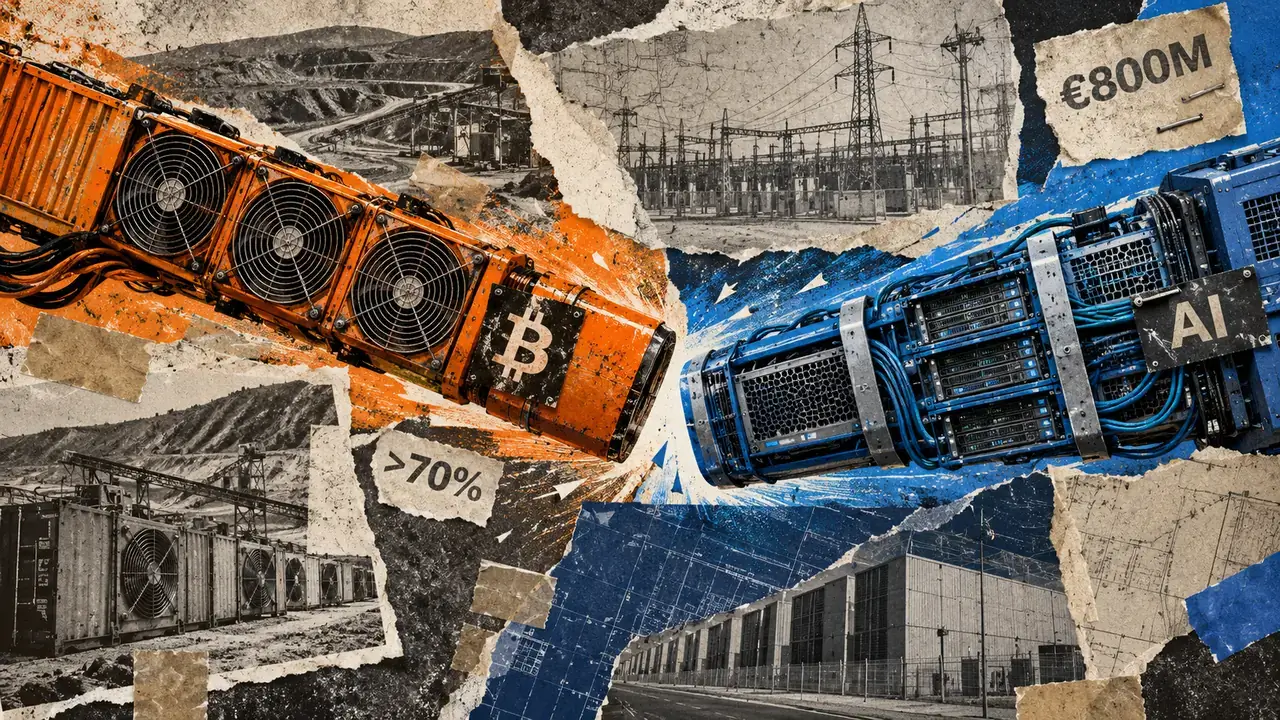
This shift in perspective arrives at a pivotal moment for the technology and energy sectors. What began as a race for high-performance semiconductors has evolved into a high-stakes competition for megawatts. As hyperscalers like Microsoft, Google, and Amazon scramble to secure power for their next generation of data centers, the existing occupants of the energy grid—most notably Bitcoin miners—are finding themselves in the crosshairs of a tightening market.
The Transformation of AI from Software to Physical Infrastructure
The core premise of the BlackRock report is that the AI boom is uniquely capital-intensive compared to previous technological cycles. The firm estimates that total capital spending intentions for the AI buildout could range between $5 trillion and $8 trillion through 2030. This expenditure is not merely earmarked for software development or chip procurement but is increasingly directed toward the physical "stack": compute clusters, massive data center campuses, and the underlying energy infrastructure required to keep them operational.
Historically, data centers were viewed as high-tech warehouses. However, the generative AI era requires a different class of facility. Training Large Language Models (LLMs) and serving real-time inference requires constant, high-density power. This demand is colliding with a US electrical grid that was largely designed for a different era—one characterized by centralized power plants and predictable, slow-growing demand. The BlackRock Investment Institute suggests that the "megawatt race" will define the winners and losers of the next decade, as access to the grid becomes a scarcer asset than the chips themselves.
A Chronology of Increasing Energy Projections
The realization that AI would strain the electrical grid has developed rapidly over the last several years. In the early 2020s, data center energy use was relatively stable, as efficiency gains in hardware offset the growth in internet traffic. However, the debut of ChatGPT in late 2022 and the subsequent explosion of generative AI altered the trajectory.
- 2023: The Chip Scarcity Phase. The primary bottleneck was the availability of Nvidia H100 GPUs. Energy was a secondary concern as companies focused on securing hardware.
- 2024: The Power Realization. Reports from the Electric Power Research Institute (EPRI) and the Lawrence Berkeley National Laboratory began to signal a decoupling of efficiency and demand. EPRI modeling suggested data centers could reach up to 9.1% of US generation by 2030.
- 2025: The Infrastructure Pivot. Utilities began reporting record-long interconnection queues. Major tech firms started signing direct "behind-the-meter" deals with nuclear power plants, such as the agreement between Microsoft and Constellation Energy to restart the Three Mile Island reactor.
- 2026 and Beyond: BlackRock’s "aggressive" forecast of 24% consumption represents the logical conclusion of current growth trends if efficiency gains do not dramatically accelerate.
The Department of Energy (DOE) has noted that data center load growth in the US has already tripled over the past decade. Current projections suggest it will double or triple again by 2028. While various organizations offer different "ceilings" for this growth—ranging from the World Resources Institute’s 6.7% to 12% to BlackRock’s 24%—the consensus is that the upward pressure on power prices and grid stability is unprecedented.
The Friction Between AI and Bitcoin Mining
For the cryptocurrency industry, BlackRock’s forecast introduces a significant strategic challenge. Bitcoin mining has long operated on a business model of "energy arbitrage"—seeking out the cheapest, most isolated, or most interruptible power sources available. Miners have historically positioned themselves as "flexible loads" that can support grid reliability.
In Texas, the Electric Reliability Council of Texas (ERCOT) has formalized this relationship. During periods of extreme heat or cold, Bitcoin miners like Riot Platforms have demonstrated the ability to curtail their power usage by over 95% within seconds, effectively acting as a virtual power plant. In August 2023, Riot Platforms famously earned $31.7 million in energy credits by powering down during a heatwave, a sum that exceeded their potential mining revenue for that period.
However, the AI sector operates on an entirely different set of requirements. AI data centers demand "certainty" and "baseload" power. Training an AI model is a continuous process; an interruption can lead to significant data loss or hardware strain. Unlike Bitcoin miners, who can switch off when prices spike, AI hyperscalers are willing to pay a premium for guaranteed, 24/7 uptime.
As these two industries compete for the same interconnection points and substation capacity, the "flexible load" argument may lose its luster. If a utility has a choice between a Bitcoin miner that might turn off during peak demand and an AI facility that brings high-paying jobs and long-term, stable contracts, the political and economic preference is increasingly shifting toward the latter.
Grid Constraints and the Regulatory Bottleneck
The physical limitations of the US grid are becoming the primary friction point for AI expansion. Even in regions with abundant energy generation, the "wires"—the transmission and distribution infrastructure—are often insufficient. Interconnection queues, the waiting lists for new projects to plug into the grid, have swelled to thousands of gigawatts across the country.
The North American Electric Reliability Corporation (NERC) has issued warnings regarding the potential for reliability threats as rapid load growth from AI, data centers, and electric vehicles (EVs) coincides with the retirement of traditional coal and gas-fired power plants. This "supply-demand gap" is creating a regulatory contest.
In hotspots like Northern Virginia (the world’s largest data center hub) and Texas, grid operators are already adjusting rate structures. There is growing pressure to ensure that large-scale power users pay their "fair share" of grid upgrades, rather than passing those costs onto residential consumers. For Bitcoin miners, who operate on razor-thin margins, any increase in industrial power tariffs or "grid access fees" could render their operations unprofitable.
The Shifting Political Landscape
The political optics of energy consumption are also evolving. For years, Bitcoin mining has faced criticism for its perceived lack of "utility" relative to its energy use. In contrast, AI is being framed by both the public and private sectors as a matter of national competitiveness.
In the eyes of lawmakers, AI is the backbone of future breakthroughs in medicine, defense, and productivity. This creates a "policy asymmetry." It is politically easier to impose reporting requirements, environmental taxes, or curtailment mandates on a Bitcoin mining facility than on a data center that is viewed as essential to the national interest. If BlackRock’s prediction of a 24% power share comes to fruition, the pressure to prioritize "productive" loads over "speculative" ones will likely intensify.
Industry advocates argue that Bitcoin mining and AI can coexist. A report from Duke University suggests that the existing US grid has enough "headroom" to handle significant new loads if those loads are flexible. Since Bitcoin miners are the most flexible large-scale loads in existence, they could theoretically serve as the "shock absorbers" that allow the grid to accommodate the inflexible demands of AI. Whether this nuanced argument can survive the heat of local utility commission hearings remains to be seen.
The Barbell Outcome: Adaptation or Obsolescence
As the "easy era" of cheap power abundance ends, the Bitcoin mining industry appears to be splitting into two distinct paths—what some analysts call a "barbell" outcome.
On one side of the barbell are the "Grid Integrators." These are miners who have moved beyond simple hashing and have become sophisticated energy partners. They sign complex demand-response agreements, co-locate with renewable energy projects to soak up "stranded" power, and integrate themselves deeply into utility planning. For these firms, their value lies in their ability to be the most controllable load on the grid.
On the other side are the "Infrastructure Pivoters." Recognizing that their most valuable asset is no longer their fleet of ASICs (Application-Specific Integrated Circuits) but their access to megawatts, these firms are converting their sites into AI hosting facilities. Firms like Core Scientific and others have already begun signing multi-billion dollar deals to provide high-performance computing (HPC) infrastructure for AI developers.
This transition is not without difficulty. AI data centers require sophisticated liquid cooling systems, high-speed fiber connectivity, and redundant power supplies—infrastructure that a standard Bitcoin "mine" does not possess. The cost of retrofitting can be immense, and miners must compete with established data center giants like Equinix and Digital Realty.
Conclusion: The Physical Reality of the Digital Frontier
The BlackRock 2026 Global Outlook serves as a reminder that the digital frontier is ultimately constrained by the laws of physics. The transition from AI as "code" to AI as "energy" marks a new phase in the global economy. As the US moves toward a future where nearly a quarter of its electricity could be dedicated to silicon-based intelligence, the competition for power will become the defining macro risk for investors.
For Bitcoin miners, the "power war" with AI represents an existential challenge but also a unique opportunity. Those who can prove their worth as grid stabilizers may survive the tightening market, while those who cannot may find themselves liquidated in favor of the more politically and economically favored AI revolution. Ultimately, the next decade of technological progress will not be won by those with the best algorithms alone, but by those who can secure the wires, permits, and turbines necessary to power them.