admin
admin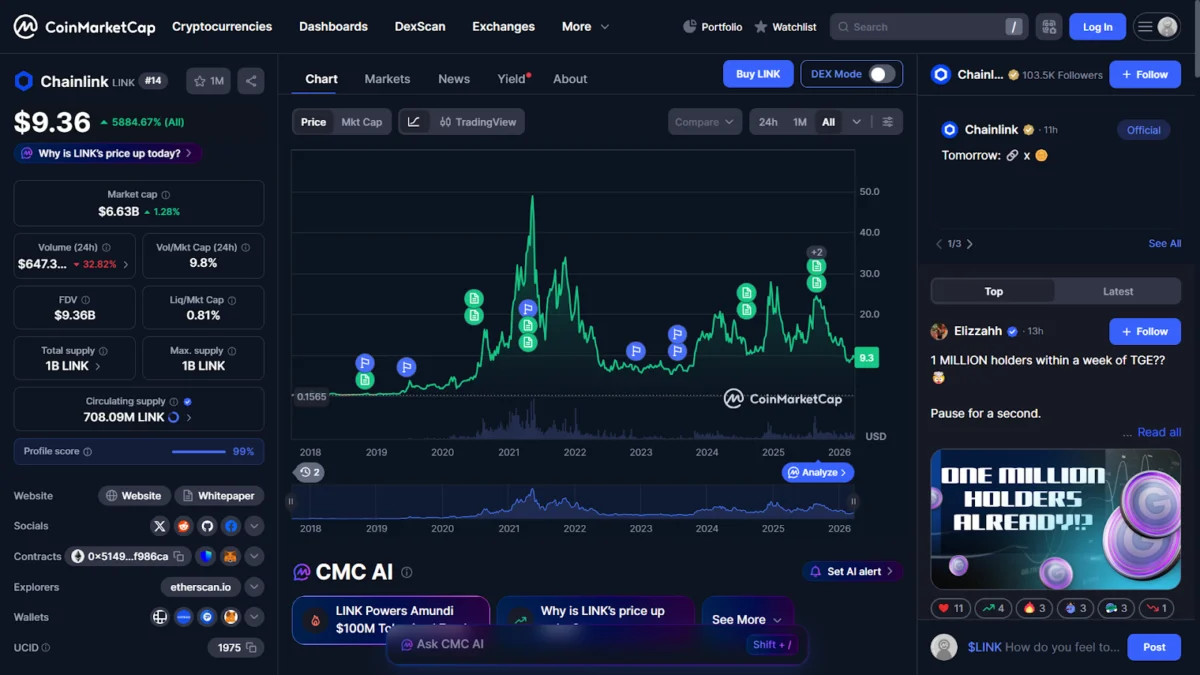
Chainlink, the decentralized oracle network, stands as a critical piece of infrastructure, seamlessly connecting blockchain smart contracts with the invaluable data and services residing in the real world. This fundamental capability has positioned Chainlink as a cornerstone of the burgeoning decentralized finance (DeFi) ecosystem and a vital component for the broader Web3 landscape. This comprehensive analysis delves into LINK’s current market performance, traces its significant historical milestones, and illuminates the advanced technology driving its increasing adoption across various industries.
Current Market Snapshot: LINK’s Steady Performance
As of the latest market assessment, Chainlink (LINK) is trading at $9.36. The token has exhibited a tight 24-hour trading range, fluctuating between $9.02 and $9.38, indicating a period of relatively stable price action. A modest increase of +0.55% over the past day reflects a degree of positive sentiment, albeit without significant volatility. With a circulating supply of approximately 708 million LINK tokens, Chainlink commands a substantial market capitalization of $6.44 billion, firmly placing it among the top cryptocurrencies by market value.
Trading activity for LINK remains robust, underscored by a 24-hour trading volume of $408 million. This healthy volume suggests sustained investor interest and liquidity within the market. A notable aspect of the recent trading dynamics is the pronounced dominance of buyers, who account for 74.8% of capital flow into the token, compared to 25.2% from sellers. This imbalance suggests underlying accumulation and potentially a positive outlook from both retail and institutional participants who recognize Chainlink’s foundational role in the evolving digital economy. Such steady activity, characterized by a higher buy-to-sell ratio, often points to a resilient asset holding its ground amidst broader market fluctuations and consolidating before potential future movements.
A Look Back: Chainlink’s Volatile Yet Resilient Price History
Understanding Chainlink’s historical price performance is crucial for contextualizing its current position and assessing future potential within the highly dynamic digital asset landscape. Like many cryptocurrencies, LINK has experienced significant volatility since its inception, yet it has also demonstrated clear patterns of adoption-driven growth and resilience through various market cycles.
Tracking the absolute highest and lowest price points offers invaluable insights into the token’s journey and helps investors identify long-term market support and resistance levels. Chainlink’s all-time high (ATH) was recorded at an impressive $52.70 on May 9, 2021. This peak occurred during the zenith of the 2021 crypto bull market, a period characterized by explosive growth in decentralized finance. During this era, DeFi protocols proliferated, and their increasing reliance on Chainlink’s secure and reliable oracle services for external data feeds—such as price information, lending rates, and event outcomes—catapulted LINK’s valuation. The token became an indispensable utility, directly benefiting from the surge in on-chain activity.
In stark contrast, Chainlink’s all-time low (ATL) was $0.09, registered on September 17, 2017. This price point reflects its early days, shortly after its initial token sale and before its mainnet launch. The astronomical difference from its ATL to its current price—a staggering +10,011.00%—highlights the immense long-term value appreciation for early investors and underscores Chainlink’s successful journey from a nascent project to a globally recognized blockchain infrastructure provider. Despite current prices being significantly below its ATH (-82.56%), LINK’s sustained growth from its initial offering demonstrates its enduring utility and the continued expansion of its network. This historical context suggests that while price fluctuations are inherent to the crypto market, Chainlink’s fundamental value proposition continues to attract and retain a strong user and investor base.
The Foundational Challenge: What Problems Does Chainlink Solve?
To truly grasp Chainlink’s profound value, one must first understand a fundamental limitation inherent to blockchain technology: the "oracle problem." Blockchains are, by design, closed and deterministic systems. They are engineered to execute smart contracts based solely on data that already exists on their own ledger. This isolation is critical for their security, immutability, and the deterministic nature of their consensus mechanisms. However, this hermetic seal prevents smart contracts from natively interacting with, or retrieving, data from the vast and ever-changing real world outside their network.
This creates a significant impediment for smart contracts, which are essentially self-executing agreements. Without a secure and reliable way to access external information—such as real-time asset prices, weather data, sports scores, or traditional financial market data—their utility is severely limited. For example, a smart contract for an insurance policy might need to know if a flight was delayed due to weather, or a DeFi lending protocol might need an accurate, up-to-the-second price feed for collateral. Directly feeding such external data into a blockchain through a single source would introduce a "single point of failure," compromising the very decentralization and security that blockchains are designed to uphold. This is the critical problem Chainlink was built to solve: how to bridge the data gap between the on-chain and off-chain worlds without sacrificing security or decentralization.
How Chainlink Works: A Decentralized Oracle Network in Action
Chainlink addresses the oracle problem through its ingenious architecture: a decentralized network of independent oracle nodes. When a smart contract requires external data, it initiates a "data request" to the Chainlink network. This request is then routed to multiple Chainlink nodes, which are individual operators running Chainlink software.
These nodes perform several critical functions:
- Data Fetching: Each node independently gathers the requested information from various trusted off-chain data sources (e.g., financial data providers, public APIs, enterprise systems).
- Data Aggregation: To ensure accuracy and tamper-resistance, the data from multiple nodes is aggregated and validated. Chainlink uses various aggregation methods, such as taking the median of all reported values, to filter out erroneous or malicious inputs.
- Cryptographic Proof: Before delivering the data on-chain, each node cryptographically signs its data, providing an undeniable proof of its origin and integrity.
- On-Chain Delivery: The aggregated, validated, and cryptographically signed data is then delivered back to the requesting smart contract on the blockchain.
This decentralized approach is paramount. By relying on numerous independent nodes rather than a single centralized entity, Chainlink eliminates single points of failure, mitigates the risk of data manipulation, and ensures the highest level of reliability and security for smart contract execution. Furthermore, Chainlink offers various specialized oracle services beyond simple price feeds, including:
- Chainlink Price Feeds: The most widely adopted service, providing real-time, tamper-proof price data for cryptocurrencies, commodities, and other assets, essential for DeFi applications like lending, borrowing, and derivatives.
- Chainlink Verifiable Random Function (VRF): A provably fair and verifiable source of randomness, crucial for NFTs, blockchain gaming, lotteries, and other applications requiring unpredictable outcomes.
- Chainlink Keepers: Decentralized smart contract automation that allows contracts to perform routine maintenance tasks (e.g., executing limit orders, rebalancing portfolios) without human intervention.
- Chainlink Cross-Chain Interoperability Protocol (CCIP): A groundbreaking protocol designed to enable secure and reliable cross-chain communication and asset transfers, aiming to create a truly interconnected multi-chain ecosystem.
These services collectively empower developers to build increasingly sophisticated and robust decentralized applications that can seamlessly interact with the real world, unlocking unprecedented use cases for blockchain technology.
LINK Tokenomics and Supply: Powering the Network
The LINK token is the native utility token that fuels the entire Chainlink network, serving multiple essential functions within its ecosystem. Its design ensures economic incentives align with network security and decentralization.

A breakdown of LINK’s tokenomics reveals its strategic allocation:
- Node Operators & Ecosystem (35% or 350 million LINK): This significant portion is dedicated to incentivizing Chainlink node operators for providing secure, reliable, and timely data to smart contracts. It also supports the broader ecosystem’s growth, development, and community initiatives, ensuring a robust and active network of data providers.
- Private Token Sale (32.3% or 323 million LINK): Distributed to early backers and strategic investors, this allocation provided initial capital for the project’s development, reflecting the early belief in Chainlink’s vision.
- Company Retained (30% or 300 million LINK): Held by the Chainlink Labs team, this portion is earmarked for ongoing research and development, operational costs, strategic partnerships, and ensuring the long-term sustainability and evolution of the Chainlink protocol.
- Public Token Sale (2.7% or 27 million LINK): This smaller percentage was sold to the wider community during Chainlink’s Initial Coin Offering (ICO), allowing broader participation in the network’s early stages.
The total maximum supply of LINK is hard-capped at 1 billion tokens, a deflationary mechanism that limits future inflation.
A crucial aspect of LINK’s utility is its role in staking. Network participants can stake their LINK tokens to help secure the network’s data feeds. Staking typically requires a minimum deposit of 1,000 LINK tokens. By locking up their assets, stakers provide economic security guarantees, as their staked LINK can be slashed if they act maliciously or fail to perform their duties. In return for contributing to network security and data integrity, stakers earn additional LINK rewards, creating a virtuous cycle that strengthens the network’s resilience.
The project team has adopted a gradual release schedule for the remaining uncirculated LINK tokens. Approximately 70 million LINK are released into the circulating supply each year, with the strategic goal of achieving full market circulation by the first quarter of 2030. This controlled release mechanism aims to manage market supply and demand dynamics, providing predictable liquidity while funding ongoing network development and incentives.
Chainlink Project Development: From Vision to Global Standard
Chainlink’s journey began in 2017, co-founded by Sergey Nazarov and Steve Ellis. Nazarov, a seasoned blockchain pioneer with experience dating back to 2011, envisioned a decentralized network that could securely connect smart contracts to real-world data, addressing the oracle problem head-on. Steve Ellis, the Chief Technology Officer, played a pivotal role in co-authoring the foundational Chainlink whitepaper and spearheading its technical development.
The project successfully raised $32 million through its initial token sale. Private investors acquired LINK tokens at $0.09, while public investors participated at $0.11, demonstrating early investor confidence in the project’s ambitious goals. Following rigorous development and extensive testing, the Chainlink mainnet officially launched on May 30, 2019. This milestone marked the beginning of Chainlink’s operational phase, allowing smart contracts on Ethereum to access external data feeds for the first time in a decentralized manner.
Since its mainnet launch, Chainlink has experienced exponential growth and adoption. The network has facilitated the secure execution of smart contracts accounting for tens of trillions of dollars in transaction value and currently secures billions of dollars in smart contract assets across various blockchain ecosystems. Its robust architecture and proven reliability have made it the industry standard for oracle services.
Chainlink’s development trajectory continues to accelerate, marked by a relentless pursuit of innovation and strategic expansion. The project is actively forging partnerships with traditional financial institutions and integrating with global enterprise systems. This involves initiatives aimed at bringing real-world assets (RWAs) on-chain, enabling tokenized securities, and providing secure data solutions for supply chain management, insurance, and other industries. The introduction of the Cross-Chain Interoperability Protocol (CCIP) further underscores Chainlink’s ambition to become the universal standard for secure cross-chain communication, facilitating a truly interconnected and composable blockchain ecosystem. Through these continuous advancements, Chainlink is not merely bridging a gap; it is constructing the fundamental infrastructure for a more integrated and data-rich decentralized future.
Broader Impact and Implications: Shaping the Future of Web3 and Beyond
Chainlink’s impact extends far beyond just providing price feeds to DeFi applications. Its decentralized oracle network is fundamentally reshaping the capabilities and potential of blockchain technology across numerous sectors, making it an indispensable layer for the future of Web3 and enterprise adoption.
- Empowering Decentralized Finance (DeFi): Chainlink is the bedrock of DeFi, enabling complex financial instruments such as derivatives, lending protocols, and algorithmic stablecoins. Without its reliable data feeds, these applications would be prone to manipulation or would simply be unable to function securely and efficiently. Its services ensure fair market prices and trigger automated executions, fostering trust and stability in a nascent financial system.
- Advancing Web3 and Gaming: Services like Chainlink VRF are critical for creating truly decentralized and provably fair experiences in blockchain gaming and NFTs. From generating rare NFT attributes to ensuring equitable matchmaking or lottery outcomes, VRF provides a tamper-proof source of randomness, enhancing user trust and engagement.
- Facilitating Enterprise Adoption: Chainlink is increasingly serving as the bridge between legacy enterprise systems and blockchain networks. It allows large corporations to leverage the benefits of blockchain for supply chain management, trade finance, insurance, and compliance, without having to rebuild their entire infrastructure. This integration is key to bringing real-world assets (RWAs) onto the blockchain, tokenizing everything from real estate to carbon credits.
- Enhancing Security and Reliability: By eliminating single points of failure and providing cryptographically secure, aggregated data, Chainlink significantly enhances the overall security and reliability of smart contracts. This robustness is paramount for applications dealing with high-value transactions and sensitive information, reducing the risk of exploits and ensuring deterministic outcomes.
- Driving Cross-Chain Interoperability: With the introduction of CCIP, Chainlink is pioneering secure cross-chain communication. This innovation addresses the fragmentation of the blockchain ecosystem, allowing assets and data to flow seamlessly and securely between different networks. This is crucial for building a truly scalable and interconnected Web3, fostering innovation and expanding the reach of decentralized applications.
In essence, Chainlink is not just a data provider; it is an enabler of trust, transparency, and expanded functionality for the entire blockchain space. Its continuous development and growing suite of services underscore its pivotal role in realizing the full potential of smart contracts and decentralized applications, making it a foundational layer for the digital economy of tomorrow.
Frequently Asked Questions (FAQs)
What is LINK used for within the Chainlink ecosystem?
LINK is the native utility token of the Chainlink network, playing a multifaceted role. Primarily, it is used to compensate Chainlink node operators for their essential service of fetching, validating, and delivering secure and reliable off-chain data to smart contracts. Furthermore, LINK can be staked by network participants to provide economic security for the network’s oracle services, ensuring data integrity. In return for their contribution, stakers earn additional LINK rewards, making the token vital for both network operation and security incentives.
Who are the co-founders of the Chainlink platform?
Chainlink was co-founded by Sergey Nazarov and Steve Ellis. Sergey Nazarov serves as the visionary CEO, driving the strategic direction and overall growth of the project, building on his extensive background as a blockchain pioneer since 2011. Steve Ellis is the Chief Technology Officer, who co-authored the original Chainlink whitepaper and has been instrumental in the technical architecture and development of the decentralized oracle network.
What factors could influence Chainlink’s value in the future, particularly by 2026 and beyond?
Chainlink’s future value is intricately linked to several key factors. Continued adoption of its oracle services across DeFi, Web3 gaming, NFTs, and enterprise applications will be a primary driver. Increased staking participation, which enhances network security and utility, also plays a significant role. Technological advancements, such as the full rollout and adoption of the Cross-Chain Interoperability Protocol (CCIP), could unlock new use cases and demand. Analysts often predict that LINK could reach an average market price of $16 by 2026, with potential for further growth if its foundational oracle services continue to expand their reach and deepen their integrations within the broader digital economy and traditional finance.
What is the recommended process for acquiring LINK tokens?
To purchase LINK tokens, the most common method is through a reputable cryptocurrency exchange. You would typically start by creating an account on a major exchange that supports LINK, such as Binance, Kraken, Coinbase, or Crypto.com. After completing the necessary identity verification (KYC), you can deposit funds using various methods like bank transfer, debit card, or other cryptocurrencies. Once your account is funded, navigate to the trading section, search for LINK, and place a buy order. It is always recommended to transfer your purchased LINK tokens from the exchange to a secure, self-custodial wallet for long-term storage and enhanced security.
What distinguishes Chainlink from other blockchain projects and competitors?
Chainlink stands out as the leading decentralized oracle network, a unique position that securely connects blockchain smart contracts with real-world data, services, and legacy systems. Its key differentiators include its robust decentralization, which eliminates single points of failure, and its comprehensive suite of services like Price Feeds, Verifiable Random Function (VRF), Keepers for automation, and the Cross-Chain Interoperability Protocol (CCIP). These features collectively make Chainlink a critical, foundational layer for decentralized finance, Web3, and the integration of existing financial infrastructure with blockchain technology, a scope and depth unmatched by most other projects.
What specific elements primarily affect the market price of Chainlink (LINK)?
Chainlink’s price is influenced by a dynamic interplay of factors. Core drivers include the rate of oracle adoption across various blockchain networks and applications, the level of staking participation which affects circulating supply and network security, and ongoing technological advancements and new feature releases from the Chainlink Labs team. Broader cryptocurrency market trends, including overall market sentiment and liquidity, significantly impact LINK’s valuation. Additionally, macroeconomic conditions, regulatory developments impacting the blockchain space, and the competitive landscape within the oracle sector also play a substantial role in determining LINK’s total market value.