Dwi Wanna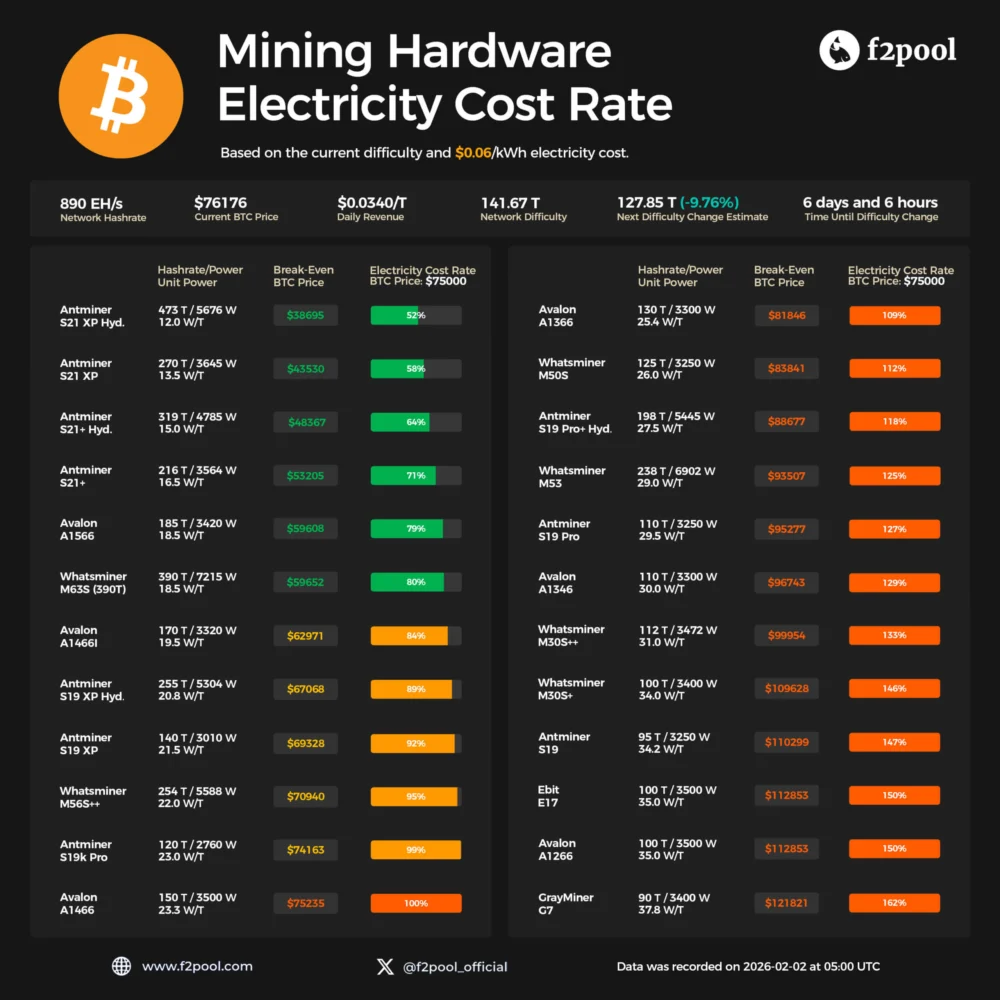
According to the latest market data, Bitcoin is trading in the vicinity of $78,000, a stark decline from its peak of $126,000 reached just four months prior. For the multi-billion dollar mining industry, this price action has transformed profitable operations into loss-making ventures almost overnight. The industry’s "hashprice"—a metric representing the expected value of 1 petahash per second (PH/s) of hashing power per day—has plummeted to approximately $35, a level that analysts describe as the historical floor for the network.
The Economic Mechanics of Miner Capitulation
The current crisis is defined by a "perfect storm" of diminishing returns. The Bitcoin security model relies on a competitive process where miners expend electricity to secure the ledger in exchange for a fixed block subsidy and transaction fees. However, the margin for error in this model has vanished. Analytics firm CryptoQuant recently designated miners as "extremely underpaid," noting that its profit-and-loss sustainability index has slumped to 21, the lowest reading observed since late 2024.
This financial strain is manifesting in the network’s hashrate—the total computational power dedicated to mining. Since November, the total hashrate has declined by approximately 12%, marking the steepest drawdown in three years. This reduction has brought the network’s total compute power to its lowest levels since September 2025, raising questions about the long-term robustness of the "security budget" that protects the $1.5 trillion asset.
Data from f2pool, a leading mining collective, illustrates the severity of the situation. As of early February, with Bitcoin priced near $76,176 and network hashrate hovering around 890 exahashes per second (EH/s), daily revenue has fallen to roughly $0.034 per terahash (TH) for operators paying a standard industrial electricity rate of $0.06 per kilowatt-hour (kWh). At these levels, only the most advanced hardware can maintain positive cash flow.
Hardware Efficiency and the Red Zone
The disparity between different generations of mining hardware has never been more pronounced. For an operator utilizing the Bitmain Antminer S21 XP Hydro—the current gold standard of efficiency—electricity costs account for roughly 52% of total revenue. While this remains profitable, it leaves a narrowing margin for debt service, facility maintenance, and labor.
However, for the vast majority of the global fleet, the math is unsustainable:
- Mid-generation rigs: Models such as the Antminer S19 XP or Avalon A1466i are seeing electricity cost rates between 92% and 100%. These machines are effectively "breaking even" on power alone, meaning they are operating at a net loss once overhead is included.
- Legacy hardware: Older models, including the Whatsminer M50S and the once-dominant S19 Pro series, now face electricity cost rates ranging from 109% to 162%.
In a traditional "crypto winter," these machines would be switched off and stored in warehouses, waiting for a price recovery to become viable again. The current cycle is different because the physical infrastructure—the warehouses, the transformers, and the high-voltage grid connections—is being permanently repurposed.
The AI Pivot: A Structural Exit Ramp
The emergence of generative AI has provided Bitcoin miners with a strategic alternative that did not exist in previous bear markets. High-performance computing (HPC) for AI workloads requires the same core components as large-scale Bitcoin mining: massive amounts of power and sophisticated cooling systems.
Unlike the volatile and currently depressed rewards of the Bitcoin network, AI compute providers are offering long-term, high-margin contracts. This has led to a "great migration" of infrastructure. CoreWeave, a firm that began as a Bitcoin mining operation, has become the poster child for this transformation. After pivoting to AI cloud services, the company recently secured a $2 billion equity investment from Nvidia to expand its data center footprint. CoreWeave’s aggressive attempt to acquire the publicly traded miner Core Scientific in a multi-billion dollar deal last year underscored the value AI giants place on existing mining sites.

Other major players are following suit. Canadian firm Hut 8 recently finalized a 15-year lease for a 245-megawatt AI data center at its River Bend campus. The deal is valued at approximately $7 billion over its lifetime, providing a level of revenue certainty that Bitcoin mining cannot match. For shareholders, this pivot is often viewed as a "de-risking" move, swapping the 30% to 50% volatility of crypto mining for the stable, contracted cash flows of the AI sector.
Timeline of the 2024-2025 Mining Crisis
The current state of the industry is the result of a sequence of events that began with the April 2024 halving:
- April 2024: The Bitcoin halving reduces the block subsidy from 6.25 BTC to 3.125 BTC, immediately doubling the production cost for miners.
- October 2024: Bitcoin hits a record high of $126,000. Despite the halving, high prices keep even inefficient miners profitable, and network hashrate surges to all-time highs.
- November 2024: A broader market correction begins. As prices dip, the network difficulty—which adjusts every two weeks—remains high, squeezing margins.
- December 2024 – January 2025: Several mid-sized mining firms announce "strategic reviews," with many signaling a shift toward HPC and AI hosting.
- February 2025: Bitcoin stabilizes near $78,000, but hashrate continues to drop as older machines are permanently retired or facilities are cleared to make room for AI GPUs.
Implications for Network Security and Decentralization
The permanent loss of hashrate to AI has sparked a debate among network security experts. Jeff Feng, co-founder of Sei Labs, characterized the current period as the most significant miner capitulation since the 2021 ban in China. The primary concern is that hashpower is not just "pausing" but is being reallocated to a different industry entirely.
Once a mining facility is re-racked with Nvidia H100 GPUs for AI training, that power capacity is effectively removed from the Bitcoin network’s future growth potential. This creates a "security ceiling." While Bitcoin remains the most secure decentralized network in existence, a sustained decline in hashrate lowers the theoretical cost of a 51% attack.
Furthermore, this trend threatens to centralize the network. If only the largest, most efficient, and most well-capitalized firms can survive the revenue squeeze, the production of new blocks becomes concentrated in fewer hands. This goes against the foundational ethos of Bitcoin as a distributed and permissionless system.
Future Outlook: The Evolution of the Security Budget
As the industry adjusts to this new reality, several potential paths for the Bitcoin network are emerging.
The first is an accelerated transition to a fee-based security model. As the block subsidy continues to diminish every four years, the network must eventually rely on transaction fees to incentivize miners. If the current revenue crisis persists, the ecosystem may be forced to prioritize high-value settlement and Layer-2 scaling solutions (such as the Lightning Network or Liquid) to generate the necessary fee volume to replace lost subsidies.
A second possibility is the institutionalization of mining support. Some analysts suggest that the large financial institutions now offering Bitcoin ETFs may eventually view network security as a systemic risk that requires active management. This could lead to industry-funded incentives or specialized financial products designed to subsidize "honest" hashpower during periods of extreme price depression.
Finally, the mining industry itself is likely to undergo a period of quiet consolidation. The "hobbyist" or "mid-tier" industrial miner is becoming an endangered species, replaced by "energy-first" companies that treat Bitcoin mining as just one of many ways to monetize electricity, alongside AI hosting and grid balancing.
At present, the f2pool dashboard serves as a real-time monitor of this economic struggle. With the network paying roughly 3.5 cents per terahash per day for its security, the market is in a state of tense negotiation. Whether the Bitcoin network can continue to attract the necessary energy and capital in a world increasingly hungry for AI compute will be the defining challenge for the asset’s second decade.