
 admin
admin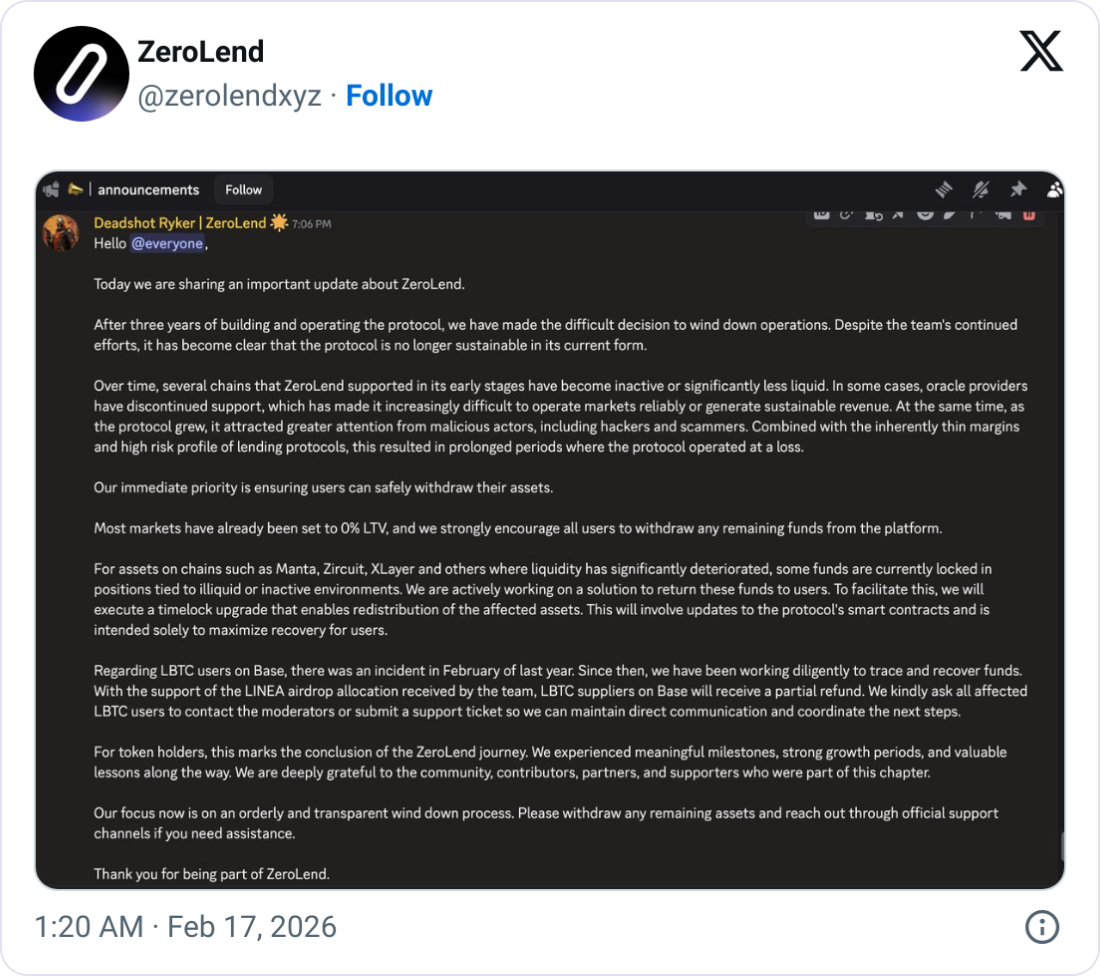
Decentralized lending protocol ZeroLend has announced its complete cessation of operations, attributing the difficult decision to persistently low user numbers and insufficient liquidity across the various blockchains it supported. The shutdown marks the end of a three-year journey for the protocol, which had positioned itself as a key player in the Ethereum Layer-2 ecosystem. This development underscores the inherent volatility and complex challenges facing decentralized finance (DeFi) projects, particularly those operating on nascent or less-established chains.
ZeroLend’s Journey and the Promise of Layer-2s
ZeroLend, founded by an individual known only as "Ryker," aimed to provide decentralized lending services primarily on Ethereum Layer-2 blockchains. These Layer-2 solutions were once widely championed by Ethereum co-founder Vitalik Buterin as an indispensable component of the network’s strategy to scale, enhance transaction throughput, and maintain its competitive edge in the burgeoning blockchain space. The vision was that Layer-2s would offload a significant portion of transaction processing from the main Ethereum chain, thereby reducing gas fees and increasing overall network capacity without compromising security, which would remain anchored to the robust Layer-1.
For protocols like ZeroLend, building on Layer-2s offered the promise of faster, cheaper transactions, theoretically attracting a broader user base and fostering greater capital efficiency within the DeFi ecosystem. These platforms sought to capitalize on the scalability narrative, offering users an alternative to the often-congested and expensive Ethereum mainnet. Decentralized lending, in particular, relies heavily on efficient and cost-effective transactions for actions such as borrowing, lending, collateral management, and liquidations. The ability to execute these operations without incurring prohibitive gas fees was a strong selling point for Layer-2 deployment. ZeroLend’s operations reflected this strategic choice, attempting to leverage the perceived advantages of these scaling solutions to carve out its niche in the competitive DeFi lending market.
The Official Announcement and Ryker’s Rationale
In a public statement shared on X (formerly Twitter) on Monday, ZeroLend’s founder, Ryker, articulated the gravity of the situation: "After three years of building and operating the protocol, we have made the difficult decision to wind down operations." He elaborated on the core challenges that ultimately led to the shutdown, stating, "Despite the team’s continued efforts, it has become clear that the protocol is no longer sustainable in its current form."
Ryker pointed to several critical factors contributing to the protocol’s demise. Foremost among these was the deteriorating state of the blockchains ZeroLend supported. He noted that "several blockchains the protocol supported have become inactive or significantly less liquid." This fragmentation of liquidity across various Layer-2s meant that despite the technical capabilities, there wasn’t enough capital or user activity to sustain robust lending markets. A lack of deep liquidity not only makes it harder for users to borrow or lend efficiently but also increases the risk of market manipulation and volatility, which is particularly detrimental to lending protocols that rely on stable asset prices for collateralization.
Furthermore, Ryker highlighted issues with essential infrastructure providers. He explained that in some instances, "oracle providers – services that fetch data and are often crucial to running protocols – have stopped support on some networks." Oracle providers are vital for DeFi protocols as they feed real-world data, such as asset prices, into smart contracts, enabling accurate collateral valuation and liquidation mechanisms. Without reliable oracle feeds, a lending protocol cannot function safely or effectively, making it "increasingly difficult to operate markets reliably or generate sustainable revenue." The withdrawal of such critical support effectively crippled ZeroLend’s ability to maintain secure and functional markets on these affected chains.
The Evolving Narrative Around Ethereum Layer-2s
Adding another layer of complexity to ZeroLend’s struggles is the recent shift in perspective from none other than Vitalik Buterin himself. Earlier this month, Buterin expressed a revised view on Ethereum’s scaling strategy, suggesting that his previous vision for scaling predominantly with Layer-2s "no longer makes sense." He highlighted concerns that many Layer-2s have "failed to properly adopt Ethereum’s security," implying potential vulnerabilities or a departure from the core security guarantees of the mainnet. Buterin’s updated stance suggests that future scaling efforts should increasingly originate from the Ethereum mainnet itself and through "native rollups," a more integrated approach to Layer-2s that maintains closer ties to Ethereum’s security model.
This pivot from a foundational figure like Buterin carries significant weight and could have profound implications for the broader Layer-2 ecosystem. For protocols like ZeroLend that built their entire operational model around the widespread adoption and viability of diverse Layer-2s, such a re-evaluation from the top can be disorienting and detrimental. It signals a potential re-prioritization within the Ethereum development community, possibly leading to less attention or support for certain Layer-2 initiatives that do not align with the updated vision. While Buterin’s comments do not directly cause a protocol to fail, they contribute to an environment of uncertainty and can influence investor and user confidence, especially for projects operating on the more experimental or less secure Layer-2 implementations.
Operational Losses and Security Threats
Beyond the issues of liquidity and infrastructure, ZeroLend also grappled with severe financial pressures and security challenges. Ryker candidly admitted that the protocol faced prolonged periods of operating at a loss. He stated, "At the same time, as the protocol grew, it attracted greater attention from malicious actors, including hackers and scammers." The inherent nature of decentralized lending, characterized by "inherently thin margins and high risk profile," exacerbated these financial strains.
DeFi protocols, by their very design, are attractive targets for exploits due to the large amounts of capital they manage and the immutable nature of smart contracts, which can be difficult to patch once deployed. The "thin margins" characteristic of many lending protocols mean that even small operational inefficiencies or security breaches can quickly push them into unprofitability. Maintaining robust security, conducting frequent audits, and responding to emerging threats require significant resources, which become increasingly difficult to justify when revenue streams are drying up due to low activity and liquidity. This vicious cycle of low revenue leading to underinvestment in security, which then exposes the protocol to further risks, can be a death knell for DeFi projects.
A Chronology of Challenges: The February 2023 Exploit
ZeroLend’s operational challenges were not theoretical; they manifested in tangible security incidents. A notable event occurred in February of the previous year when the protocol suffered an exploit. Attackers targeted a Bitcoin (BTC) product offered by ZeroLend on the Base blockchain, successfully draining lending pools. This incident served as a stark reminder of the ever-present security risks in the DeFi space and the vulnerability of protocols to sophisticated attacks.
Exploits can have devastating consequences, not only in terms of financial losses but also in eroding user trust and confidence. For ZeroLend, this incident undoubtedly contributed to its financial woes and reputation. Ryker confirmed that the team has been actively working to trace and recover the stolen funds. In an effort to mitigate the impact on affected users, ZeroLend plans to provide a partial refund to suppliers of the exploited product. This refund will be financed through an airdrop allocation that the ZeroLend team had received, demonstrating an attempt to fulfill their obligations despite the protocol’s impending closure. Such recovery efforts, while commendable, are often complex, time-consuming, and rarely result in full restitution for all victims, further highlighting the risks inherent in participating in DeFi.
Dramatic Decline in Metrics and Market Reaction
The financial and operational difficulties faced by ZeroLend are vividly reflected in its on-chain metrics. According to data from DefiLlama, a leading DeFi analytics platform, ZeroLend’s Total Value Locked (TVL) experienced a catastrophic decline. At its peak in November 2024, the protocol commanded a TVL of nearly $359 million, indicating significant user trust and capital allocation. However, this figure has since plummeted to a mere $6.6 million, representing a staggering loss of over 98% of its value. This dramatic contraction in TVL is a clear indicator of waning user engagement, capital flight, and a loss of confidence in the protocol’s future.
The market’s reaction to the shutdown announcement was swift and severe. The ZeroLend (ZERO) token, the protocol’s native cryptocurrency, experienced a sharp decline in value. CoinGecko data shows that the ZERO token fell by 34% within the 24 hours following the shutdown announcement. This immediate sell-off reflects investor panic and the rapid devaluation of assets associated with a defunct project. Furthermore, the token has lost nearly all its value since hitting a peak of one-tenth of a cent in May 2024, illustrating the complete collapse of its market capitalization and the permanent impairment of investor capital. Such drastic price movements are common in the highly speculative crypto market when projects fail, serving as a cautionary tale for investors.
Ensuring User Asset Recovery Amidst the Wind-Down
Despite the difficult decision to cease operations, ZeroLend has emphasized its commitment to ensuring users can withdraw their remaining assets. Ryker explicitly encouraged all users to "withdraw any remaining funds from the platform" as a matter of urgency. This directive is crucial for protecting user capital and mitigating further losses.
However, the process is not without its complications. Ryker acknowledged that some user funds might be "locked on blockchains that have seen significantly deteriorated liquidity." This scenario presents a challenge, as insufficient liquidity on these underlying chains could hinder or prevent users from easily converting their assets back into more liquid cryptocurrencies or stablecoins. To address this, ZeroLend plans to upgrade the protocol’s smart contracts. The aim of this upgrade is to facilitate the redistribution of these stuck assets, providing a mechanism for users to retrieve funds that might otherwise be trapped on illiquid or inactive networks. This commitment to an orderly wind-down, including technical solutions for asset recovery, is a critical step in responsible project closure, aiming to minimize the negative impact on its user base.
Broader Implications for the DeFi Ecosystem
ZeroLend’s shutdown is more than an isolated incident; it carries significant implications for the broader decentralized finance ecosystem, particularly for projects built on Layer-2 solutions.
- The Fragility of Niche Layer-2 DeFi: The protocol’s demise highlights the inherent risks of building on multiple, potentially less-established Layer-2 blockchains. While diversification might seem prudent, it can lead to fragmented liquidity and an over-reliance on the sustained health of each underlying chain. Projects need to carefully assess the long-term viability, user adoption, and developer support of the Layer-2s they choose to integrate with. The "build it and they will come" mentality is proving insufficient in a crowded and competitive landscape.
- Security Imperatives in DeFi: The February 2023 exploit serves as a stark reminder that security is paramount and a continuous battle in DeFi. The "increased attention from malicious actors" cited by Ryker is a universal truth in the space. Protocols must invest heavily in audits, bug bounties, and robust security practices from inception, recognizing that the immutable nature of smart contracts means vulnerabilities can be catastrophic. The thin margins in lending protocols make recovering from exploits even more challenging.
- The Critical Role of Oracle Providers: The withdrawal of oracle support from certain networks underscores the dependency of DeFi on third-party infrastructure. While decentralization is a core tenet, many protocols still rely on external data feeds. The reliability and continued support of oracle providers are non-negotiable for the safe and accurate functioning of lending, derivatives, and other complex DeFi applications. This incident may prompt a re-evaluation of oracle strategies, pushing for more robust, decentralized, and resilient solutions.
- Lessons for Decentralized Lending Models: The "inherently thin margins and high risk profile" of lending protocols, as articulated by Ryker, highlight the economic realities of this sector. Competition is fierce, and profitability can be elusive, especially when confronted with market volatility, security risks, and operational overheads. Future lending protocols must innovate not just in technology but also in sustainable economic models that can withstand prolonged bear markets and external pressures.
- The Evolving Ethereum Scaling Landscape: Vitalik Buterin’s recent comments signify a potential shift in Ethereum’s scaling narrative. While Layer-2s remain crucial, there may be a growing emphasis on more integrated, secure-by-design rollups directly tied to the mainnet. This evolution could impact the long-term viability of Layer-2s that do not meet stricter security and decentralization criteria, forcing protocols to adapt or face obsolescence. ZeroLend’s failure could be seen as an early indicator of this changing tide, where only the most robust and secure Layer-2 ecosystems will thrive.
ZeroLend’s closure is a sobering reminder of the challenging environment in decentralized finance. It underscores the confluence of technological, economic, and security hurdles that projects must navigate. As the DeFi landscape continues to mature, such events serve as critical learning experiences, emphasizing the need for robust infrastructure, stringent security, sustainable economic models, and adaptability to an ever-evolving technological frontier.