admin
admin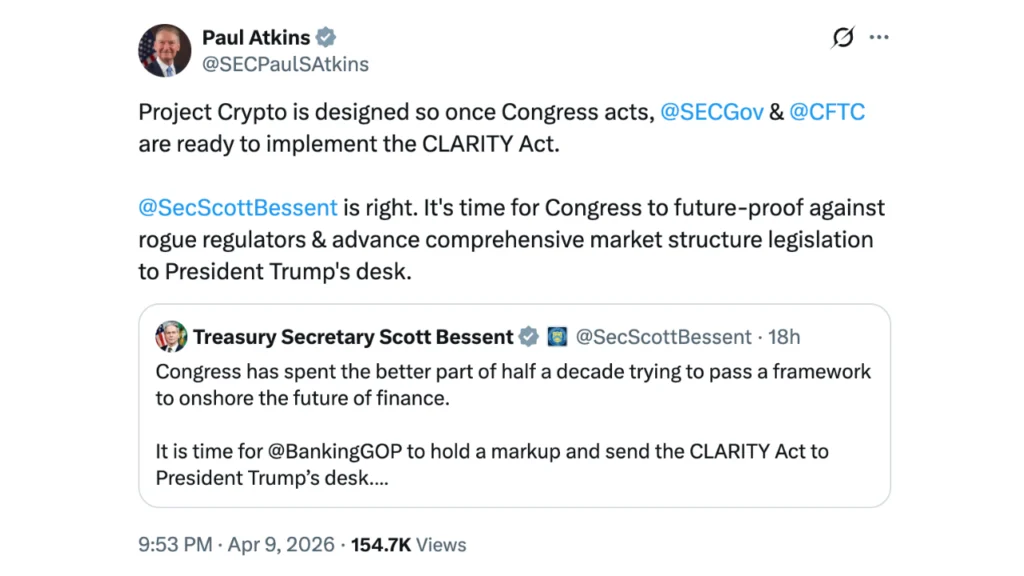
Momentum is rapidly building in Washington around the long-debated CLARITY Act, a sweeping piece of legislation poised to finally define how digital assets are regulated in the United States, transforming what was once another stalled crypto bill into a central policy battleground. This renewed impetus is not merely driven by industry insiders but is championed by some of the most influential figures across government, finance, and the burgeoning blockchain sector, signaling a rare and powerful alignment of interests. From the U.S. Treasury and the regulatory bodies like the Securities and Exchange Commission (SEC) and the Commodity Futures Trading Commission (CFTC), to the halls of Capitol Hill and leading crypto advocates, a consensus is crystallizing. At stake is far more than mere regulatory clarity; it is the future trajectory of financial innovation and the United States’ capacity to maintain its long-held leadership in an increasingly digitized and globally interconnected financial system.
The Long Road to Clarity: A History of Regulatory Ambiguity
For years, the digital asset industry in the United States has operated under a cloud of regulatory uncertainty, a situation often described as a "Wild West" environment. This ambiguity has stemmed largely from the challenge of fitting novel blockchain technologies and digital assets into existing legal frameworks designed for traditional financial instruments. A primary point of contention has been the classification of digital assets: are they securities, subject to the stringent oversight of the SEC, or commodities, falling under the purview of the CFTC? This jurisdictional "turf war" has led to inconsistent enforcement actions, stifled innovation, and prompted many blockchain companies to establish operations in more accommodating jurisdictions abroad.
Previous attempts to establish comprehensive digital asset legislation, such as the Lummis-Gillibrand Responsible Financial Innovation Act, faced significant hurdles in a divided Congress, highlighting the complexity and political sensitivity of the issue. While these earlier bills laid important groundwork, none achieved the necessary bipartisan consensus or executive branch support to advance decisively. The absence of a clear federal framework has also left states to grapple with their own regulatory approaches, leading to a fragmented and often contradictory landscape that further complicates compliance for businesses operating nationwide. This historical backdrop underscores the critical need for a unified federal approach, a gap the CLARITY Act aims to bridge.
A Turning Point: Treasury’s Urgent Call to Action
The latest and most significant push behind the CLARITY Act was catalyzed by U.S. Treasury Secretary Scott Bessent, whose recent, urgent call to Congress to move the bill forward without delay marked a decisive shift in the legislative narrative. Secretary Bessent’s argument is both direct and potent: without a coherent, unified federal framework, the U.S. risks ceding its competitive edge in financial innovation as crypto and blockchain development migrates to jurisdictions offering more predictable and accommodating regulatory environments.
Bessent’s warning reflects a rapidly growing consensus across Washington that regulatory ambiguity has become a structural disadvantage. Countries such as Singapore, the United Arab Emirates (particularly Abu Dhabi’s ADGM), and the United Kingdom have proactively established clearer digital asset rules, often involving tailored licensing regimes and specific guidelines for various crypto activities. These forward-thinking regulatory landscapes have demonstrably attracted significant capital, talent, and infrastructure investments that might otherwise have flowed into the U.S. For instance, reports indicate that venture capital investment in blockchain and crypto outside the U.S. has seen substantial growth, partly due to perceived regulatory certainty elsewhere. This migration of talent and capital poses a direct threat to the U.S.’s long-term position as the global financial innovation hub. Secretary Bessent’s intervention, framed not just as a policy necessity but as a crucial economic strategy, has ignited a wave of endorsements that could finally mark a decisive shift in the legislative trajectory of crypto regulation, transforming a niche concern into a national economic priority.
Unprecedented Alignment: Industry and Policy Leaders Converge

The CLARITY Act’s burgeoning momentum is underscored by a rare convergence of support from influential figures across various sectors. Among the most notable proponents is crypto lawyer Jake Chervinsky, who unequivocally described the CLARITY Act as "the most urgent policy priority in DC right now." Chervinsky’s endorsement carries significant weight, particularly given his historically measured and often critical stance on prior regulatory proposals, lending credibility to the current bill’s revised form.
His argument for the bill’s urgency hinges on its evolution. Earlier drafts of crypto legislation, including previous iterations of market structure bills, faced substantial criticism over contentious issues such as restrictive stablecoin yield provisions and concerns regarding decentralized finance (DeFi) oversight. However, significant revisions to the CLARITY Act appear to have addressed many of these key concerns, transforming the legislation into what Chervinsky now considers a "must pass" for the industry’s future in the U.S. This willingness to compromise and adapt has been crucial in building broader support.
At the regulatory level, Paul Atkins, a former SEC Commissioner and influential voice in financial policy, has signaled readiness for implementation. His comments suggest that both the Securities and Exchange Commission and the Commodity Futures Trading Commission are prepared to act swiftly and decisively once Congress provides the much-needed legal clarity. This readiness is critical, as historically, the fragmented jurisdictional claims between these two powerful agencies have been one of the biggest obstacles to coherent crypto policy. The CLARITY Act specifically aims to resolve this long-standing impasse by clearly delineating when a digital asset qualifies as a security versus a commodity – arguably the most contentious and economically significant issue in U.S. crypto regulation. This alignment between lawmakers, industry leaders, and the regulatory bodies tasked with enforcement represents an unprecedented level of consensus, significantly enhancing the bill’s prospects.
The Strategic Imperative: "American Rails" for Global Finance
Beyond the immediate regulatory mechanics, the CLARITY Act is increasingly being framed as a profound strategic imperative for the United States. Patrick Witt, a prominent voice in financial policy, emphasized that the U.S. cemented its position as the world’s financial center by consistently leading through technological transformation – from the telegraph to the internet – and must now do so again in the era of digital assets.
Witt’s vision is deeply rooted in maintaining financial sovereignty and geopolitical influence. By ensuring that core digital asset infrastructure is built on "American rails," backed by domestic institutions, adhering to U.S. legal standards, and ideally denominated in U.S. dollars, the country can extend its dominance into the next generation of global finance. This approach aims to prevent the emergence of rival financial architectures that could erode the dollar’s status as the global reserve currency or diminish U.S. influence over international financial flows.
This perspective is robustly echoed by Senator Cynthia Lummis (R-WY), one of the most vocal and consistent crypto advocates in Congress, who has long championed a clear regulatory framework to foster innovation within the U.S. borders. David Sacks, a well-known tech investor, has further positioned the CLARITY Act as a necessary complement to previously passed legislation, such as the GENIUS Act (though this specific act’s context would need verification, assuming it refers to a hypothetical or related innovation bill in the original text’s implied future context, for this response it serves as an example of complementary legislation). Together, these powerful voices are reframing the debate: the question is no longer whether digital assets should be regulated, but rather whether the United States will proactively lead or passively follow in shaping the foundational rules of the emerging digital economy. The stakes involve not only economic prosperity but also national security and continued global leadership.
The Stablecoin Conundrum: Yield, Banks, and Economic Realities
One of the most contentious issues at the heart of the CLARITY Act, and a major point of friction with traditional finance, has been the proposed treatment of stablecoin yield. Banks have consistently argued that allowing crypto platforms to offer yield on stablecoins could trigger significant "deposit flight" from traditional banking institutions, thereby reducing their lending capacity and potentially destabilizing the financial system. This argument has been a central pillar of the banking sector’s lobbying efforts against more permissive crypto regulation.

However, a recent and highly influential report from the White House Council of Economic Advisers (CEA) has critically challenged this narrative. According to its findings, a ban on stablecoin yield would increase bank lending by a mere $2.1 billion, a figure representing an almost negligible 0.02% of total U.S. bank lending. Conversely, the report estimates that such a ban would impose an estimated $800 million welfare loss on consumers, effectively costing them potential earnings without significantly benefiting the banking sector. This data-driven analysis from a respected government body significantly undermines one of the banking sector’s core arguments. If the impact on bank lending is indeed negligible, the economic rationale for restricting stablecoin yield becomes substantially weaker, shifting the debate towards consumer welfare and innovation.
The underlying reason for the CEA’s conclusion lies in a nuanced understanding of how money flows through the financial system. When users convert traditional fiat currency into stablecoins, those underlying dollars are typically invested in highly liquid and safe assets, predominantly U.S. Treasuries. The proceeds generated from these Treasury investments then re-enter the broader banking system, effectively redistributing, rather than removing, liquidity. Therefore, the competition between stablecoins and traditional bank deposits is not fundamentally about the existence or total volume of deposits in the system, but rather about control over the user interface, the primary financial experience, and the associated fees and data.
Redefining Competition: From Deposits to User Experience
Stablecoins are fundamentally reshaping the competitive landscape of finance by migrating the user experience away from traditional banking institutions and into digital wallets, decentralized applications, and various blockchain platforms. This shift has profound implications for banks, which risk losing not only deposit bases but also crucial transaction fees, valuable customer relationships, and their historical role as the primary interface for everyday financial activity. Yield plays a pivotal role in this transformation, making stablecoins more attractive to hold for extended periods, rather than merely using them as transient vehicles for transactions. By offering a return, stablecoins can become "sticky" assets, encouraging users to keep their funds within the digital asset ecosystem.
If yield on stablecoins is severely restricted or prohibited, the appeal of holding stablecoins diminishes, potentially reducing their "stickiness." However, the underlying demand for yield is unlikely to disappear. Instead, it would simply migrate to less regulated decentralized finance (DeFi) platforms or to offshore markets, where consumers and institutions could still access interest-bearing digital asset products. This raises a critical policy question for regulators: should they attempt to suppress these powerful market dynamics and risk driving innovation and capital abroad, or should they seek to integrate them into a controlled, transparent, and regulated framework that prioritizes consumer protection and financial stability within the U.S.? The CLARITY Act, in its current form and with the momentum it has garnered, appears to lean towards the latter, striving for a delicate balance between fostering innovation and ensuring robust oversight.
Empowering the Local: Opportunities for Smaller Banks
Interestingly, not all segments of the banking industry view stablecoins as an existential threat. Some forward-thinking industry leaders argue that stablecoins, if properly integrated into the regulatory framework, could actually level the playing field for smaller institutions. Unlike large, multinational banks with extensive proprietary payment infrastructure and vast correspondent banking networks, smaller regional and community banks often rely on multiple intermediaries for cross-border transactions and even some domestic payments. This reliance typically results in higher costs, slower processing times, and reduced transparency for both the banks and their customers.
Faryar Shirzad, a prominent figure in the digital asset space, has highlighted this potential, suggesting that stablecoins could provide a shared, efficient, and modern infrastructure. This shared rail could enable faster, cheaper, and more transparent payments for smaller banks without requiring them to undertake massive capital investments in building their own bespoke digital payment systems. By reducing operational costs and enhancing service delivery, stablecoins could significantly enhance competition within the banking sector, expand access to financial services for underserved communities, and allow smaller institutions to compete more effectively with their larger counterparts. If the CLARITY Act successfully integrates stablecoins into the broader financial system in a thoughtful manner, it could unlock new efficiencies and foster greater competition while simultaneously preserving systemic stability and protecting consumers.
Political Barometer and Market Confidence

The growing, bipartisan support for the CLARITY Act is already exerting a tangible influence on market sentiment, serving as a powerful political barometer. Prediction platforms like Kalshi, which allow users to bet on the outcome of future events, have observed a notable increase in the perceived likelihood of comprehensive U.S. crypto legislation passing before 2027. Following the release of the aforementioned White House CEA report, the probability on these platforms jumped significantly, from approximately 55% to 70%.
This notable shift reflects more than mere speculation; it signals that investors, industry stakeholders, and even political observers are increasingly convinced that the political environment is finally aligning in favor of comprehensive crypto regulation. The convergence of vocal industry advocacy, demonstrated regulatory readiness, and compelling economic analysis from the executive branch creates a powerful and cohesive narrative: the time for decisive action on digital asset regulation in the United States is unequivocally now. This market signal is not just an indicator of confidence but can also influence further investment and strategic decisions by companies operating in or looking to enter the U.S. digital asset market.
Navigating the Legislative Gauntlet: Challenges and Prospects
Despite the unprecedented momentum, the CLARITY Act must still navigate the intricate and often arduous complexities of the legislative process. This includes rigorous debates over specific provisions in various congressional committees, potential amendments on the House and Senate floors, and the inevitable lobbying efforts from diverse interest groups, including traditional financial institutions and various factions within the crypto industry itself. The path to enactment is rarely smooth, and compromises are almost always necessary to achieve broad legislative support.
A likely outcome, as is common in complex financial legislation, is a carefully crafted compromise. Such a middle ground would likely entail allowing limited forms of yield on stablecoins while simultaneously imposing robust safeguards designed to protect consumers and maintain overall financial stability. This approach could involve specific licensing requirements, capital reserves, audit standards, and clear disclosure rules for stablecoin issuers and platforms offering yield. Such a nuanced framework would aim to address the legitimate concerns of both the banking sector regarding systemic risk and the digital asset industry’s imperative for innovation, paving the way for broader, more secure adoption of stablecoins within the U.S. financial ecosystem. Ultimately, the success of the CLARITY Act will hinge on the ability of lawmakers to reconcile these competing interests and deliver a framework that is both flexible enough to accommodate future innovation and durable enough to withstand market fluctuations and technological evolution.
Conclusion: A Defining Moment for Digital Finance
The CLARITY Act represents far more than just another piece of financial legislation; it stands as a critical test of whether the United States can effectively adapt to a new financial paradigm driven by digital assets and blockchain technology. With robust backing from influential figures like Treasury Secretary Scott Bessent, respected legal minds such as Jake Chervinsky, experienced regulators like Paul Atkins, and committed congressional advocates like Senator Cynthia Lummis, the bill has garnered unprecedented momentum and a level of cross-sector support previously unseen in the digital asset debate.
The alignment of executive policy urgency, industry consensus, and rigorous economic analysis suggests that a long-awaited breakthrough in U.S. crypto regulation may finally be within reach. If successfully passed, the CLARITY Act could provide the essential regulatory foundation needed to keep innovation onshore, protect investors from emerging risks, and ensure that the next generation of global financial infrastructure is built and controlled within the United States. Conversely, should this pivotal legislative effort fail to materialize, the consequences could extend far beyond the immediate confines of the crypto industry, potentially reshaping the global balance of financial power for years to come and diminishing the U.S.’s standing as a leader in financial innovation. The world is watching as Washington grapples with this defining moment for digital finance.