
 admin
admin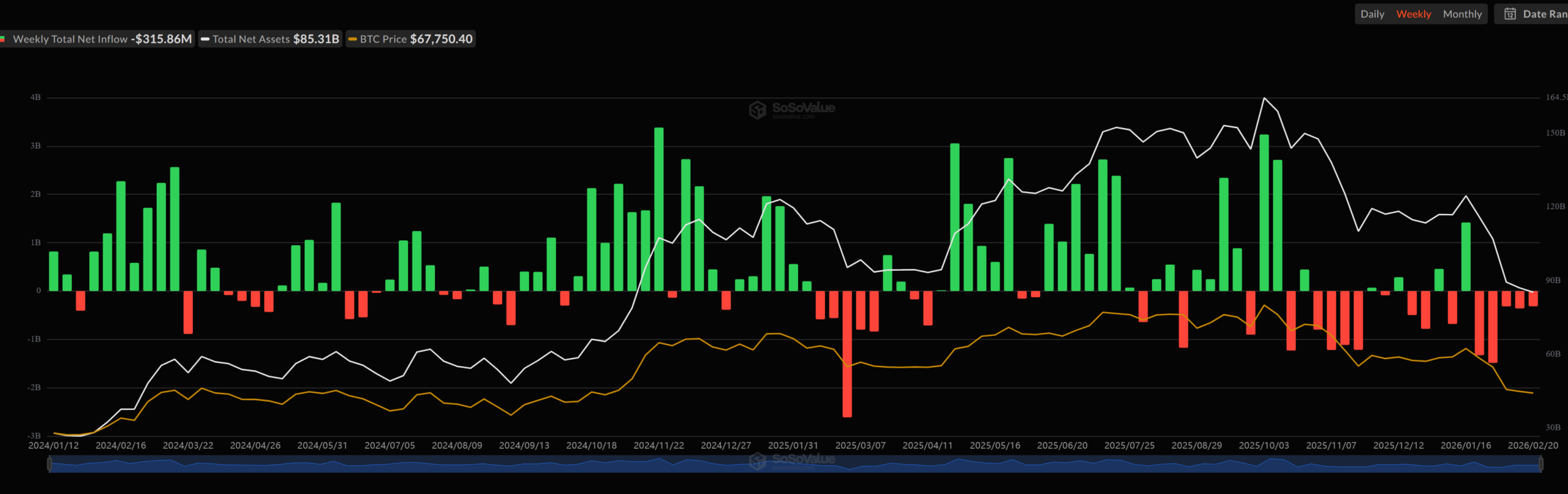
In a dramatic turn of events within global trade policy and the digital asset markets, former U.S. President Donald Trump, eyeing a potential return to the White House, unilaterally declared a 5% increase to the global tariff rate, raising it to 15%. This announcement, made on Friday, compounds existing duties and comes despite a recent U.S. Supreme Court ruling that deemed his previous sweeping tariffs under the International Emergency Economic Powers Act (IEEPA) illegal. Simultaneously, the burgeoning U.S. spot Bitcoin exchange-traded fund (ETF) market has recorded five consecutive weeks of net outflows, shedding approximately $3.8 billion, a stark contrast to the initial euphoria surrounding their launch. Amidst these significant developments, Bitcoin’s price has remarkably demonstrated resilience, maintaining its trading range around $68,000 and largely shrugging off the renewed trade uncertainty and institutional selling pressure in ETFs.
The Tariff Controversy Unfolds: A Legal Battle and Political Assertion
The latest escalation in trade policy stems from a contentious history of tariff implementation under Donald Trump’s previous administration. His initial use of the IEEPA to impose tariffs was ostensibly aimed at addressing national emergencies, but critics and legal scholars argued it overstepped the executive branch’s constitutional authority. This legal challenge culminated in a landmark decision by the U.S. Supreme Court, which concluded that the IEEPA did not grant the President the power to levy broad import duties, reaffirming Congress’s primary role in tariff policy.
The Supreme Court’s ruling, delivered in a 6-3 decision, struck down key portions of Trump’s earlier tariff regime. The court’s majority opinion emphasized that the IEEPA was intended for genuine national security emergencies, such as freezing assets of hostile nations, and not for general trade disputes or economic policy adjustments that typically fall under legislative purview. This judicial intervention underscored the principle of separation of powers, a cornerstone of American governance, and highlighted the limits of presidential authority in economic matters. The decision potentially opened the door for claims totaling billions of dollars in refunds for duties collected since 2025, a significant financial implication for importers and businesses.
Despite this clear legal setback, Donald Trump swiftly responded with a defiant announcement on Saturday, taking to his social media platform, Truth Social. He declared, "As President of the United States of America, I will be, effective immediately, raising the 10% worldwide tariff on countries, many of which have been ‘ripping’ the US off for decades, without retribution, until I came along, to the fully allowed, and legally tested, 15% level." This statement suggests an attempt to bypass the Supreme Court’s specific ruling on the IEEPA by asserting a different, albeit unspecified, legal basis or a direct challenge to the interpretation of presidential powers. The new 15% tariff is explicitly stated to be "added on top of already existing, legally valid tariffs," indicating a layered approach to trade protectionism.
Economic Implications of Escalating Tariffs
The imposition of tariffs is a double-edged sword, carrying significant economic ramifications for both domestic and international markets. Historically, tariffs are taxes on imported goods, intended to make foreign products more expensive and thus encourage domestic production. However, they often lead to higher costs for consumers, as importers pass on the added expenses. They can also trigger retaliatory tariffs from other nations, sparking trade wars that disrupt global supply chains, reduce international trade volumes, and dampen economic growth.

Previous rounds of tariffs under the Trump administration, particularly those levied against China, led to increased costs for American businesses, supply chain reconfigurations, and uncertainty that weighed on investment decisions. Sectors heavily reliant on imported components, such as manufacturing and technology, often bore the brunt of these policies. For example, studies by organizations like the National Bureau of Economic Research have indicated that the costs of tariffs were largely borne by U.S. consumers and businesses, rather than foreign exporters. The potential for $150 billion in tariff refunds following the Supreme Court’s ruling underscores the sheer volume of duties collected and the significant financial burden placed on the economy. Should Trump’s newly announced 15% tariff take effect, the implications could be similar or even more pronounced, potentially fueling inflation, straining international relations, and introducing a new layer of instability to global markets already grappling with post-pandemic recovery and geopolitical tensions.
Spot Bitcoin ETFs Face Persistent Headwinds: $3.8 Billion in Outflows
In parallel to these geopolitical and trade developments, the U.S. spot Bitcoin ETF market, which debuted with much fanfare earlier this year, has experienced a challenging period. For five consecutive weeks, these investment vehicles have recorded net outflows, with investors pulling an aggregate of approximately $3.8 billion from the products. This trend marks a significant shift from the initial wave of inflows that characterized the first few weeks following their January launch, when billions flowed into the nascent market.
During the most recent week, the funds saw about $315.9 million in net outflows, according to data compiled by SoSoValue. This figure contributes to the broader five-week streak, which saw its most substantial withdrawal in the week ending January 30, with roughly $1.49 billion exiting the funds. While individual trading sessions sometimes posted inflows – for instance, Bitcoin ETFs recorded about $88 million in inflows on a recent Friday – these positive days were consistently outweighed by larger redemption days earlier in the week. Notable negative sessions included over $410 million in withdrawals on February 12, alongside additional significant outflows from February 17 through February 19, cumulatively leaving the weekly totals firmly negative.
Market analysts are attempting to decipher the drivers behind this sustained period of withdrawals. Vincent Liu, chief investment officer at Kronos Research, suggested that the recent outflows from spot Bitcoin ETFs are more indicative of institutional portfolio de-risking rather than a fundamental loss of long-term interest in Bitcoin as an asset. Liu posits that rising geopolitical tensions and broader macroeconomic uncertainty are prompting institutional investors to reduce their exposure to risk-on assets, including cryptocurrencies. This perspective aligns with the general cautious sentiment observed across various financial markets, where investors are recalibrating their portfolios in response to a complex global economic landscape. The outflows could also be attributed to profit-taking after a significant price rally in late 2023 and early 2024, as well as a "sell the news" event following the ETF launch itself.
Bitcoin’s Unwavering Stance Amidst Volatility and Uncertainty
Despite the confluence of a contentious presidential tariff hike, a significant Supreme Court ruling, and substantial outflows from spot Bitcoin ETFs, the price of Bitcoin has demonstrated remarkable stability. On Friday, Bitcoin’s price largely remained rangebound, trading around the $68,000 mark. This resilience is particularly noteworthy given that crypto markets and other risk-on assets typically experience sharp downturns or increased volatility whenever new rounds of tariffs or significant geopolitical uncertainties are announced.
Bitcoin’s ability to shrug off these developments suggests that its price action is currently being driven by other, more dominant macroeconomic factors and market narratives. Investors in risk assets, including cryptocurrencies, appear to be more focused on broader U.S. inflation data and evolving expectations for interest rate cuts by the Federal Reserve. A persistent concern about inflation could lead investors to view Bitcoin as a potential hedge, similar to gold, while weakening rate-cut expectations could temper enthusiasm for risk assets in general. However, Bitcoin’s steadfastness indicates that the market is prioritizing these fundamental economic indicators over the immediate implications of trade policy shifts or even the short-term institutional flow dynamics of ETFs.

The Supreme Court’s ruling on Trump’s tariffs, while legally significant, did not trigger the widespread market panic one might expect from a decision potentially involving $150 billion in refunds. This muted reaction in Bitcoin’s price suggests that the market may have already priced in the possibility of such a ruling or that the broader narrative of institutional adoption and Bitcoin’s role as a "digital gold" is currently outweighing concerns about traditional trade policy. Furthermore, the fact that Trump’s latest tariff announcement is speculative, contingent on his potential re-election, may also contribute to the market’s relatively calm response, viewing it as political rhetoric rather than an immediate, actionable policy change.
Broader Market Context and Future Outlook
The current landscape paints a complex picture for global finance and digital assets. On one hand, the Supreme Court’s decision serves as a powerful affirmation of constitutional checks and balances, limiting executive power in trade policy. It underscores the importance of congressional authority in matters of commerce and taxation. The potential for billions in tariff refunds could provide a welcome liquidity boost for some businesses, though the process of claiming and distributing these funds could be lengthy and complex. On the other hand, Trump’s immediate counter-announcement signals a continued commitment to protectionist trade policies, which, if enacted, could lead to renewed trade tensions and economic disruptions.
For the cryptocurrency market, the persistent outflows from spot Bitcoin ETFs, while concerning in the short term, are being framed by some experts as a healthy, albeit painful, period of market maturation. The initial excitement and speculative inflows have given way to more calculated institutional positioning. The distinction between short-term de-risking and long-term interest in Bitcoin is crucial. Many proponents still believe that the long-term trend for Bitcoin remains positive, driven by increasing institutional adoption, technological advancements, and its perceived role as a hedge against inflation and geopolitical instability. The sustained interest in Bitcoin despite these headwinds could be a testament to its growing maturity as an asset class.
Looking ahead, the interplay between political developments, macroeconomic indicators, and the evolving digital asset landscape will continue to shape market dynamics. The outcome of future elections will undoubtedly influence trade policy, potentially dictating whether the U.S. leans further into protectionism or returns to a more multilateral trade approach. Meanwhile, the Federal Reserve’s decisions on interest rates and the trajectory of inflation will remain critical determinants of investor sentiment across all risk assets, including Bitcoin. The ability of Bitcoin to withstand significant traditional market shocks and internal crypto market pressures highlights its unique position in the global financial system, suggesting an increasing decoupling from conventional market triggers and a growing focus on its intrinsic value proposition. As institutional investors continue to navigate a world of geopolitical flux and economic uncertainty, Bitcoin’s resilience will be closely watched as a barometer of broader market sentiment and a potential indicator of its journey towards mainstream acceptance.