admin
admin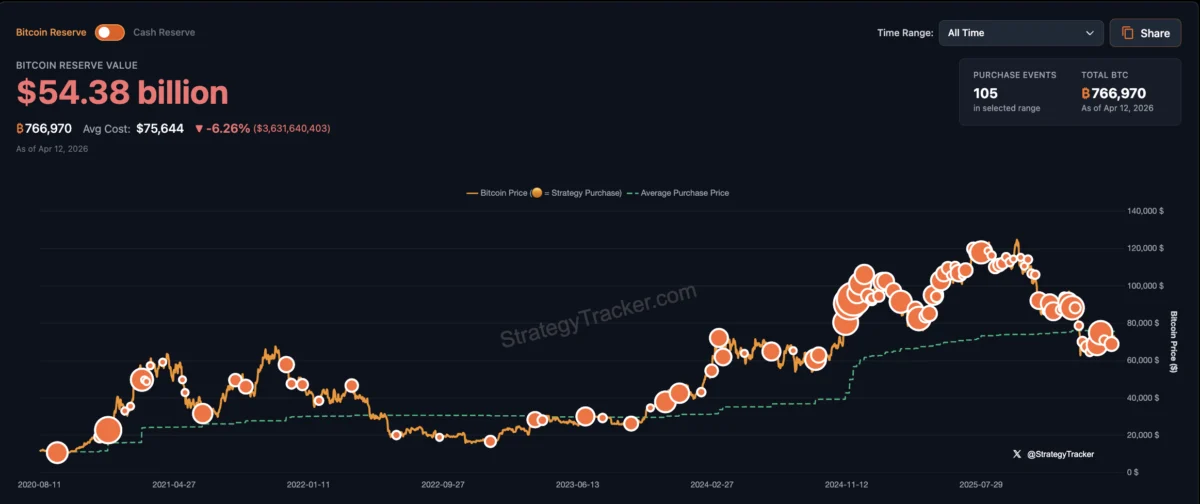
Michael Saylor, the co-founder and executive chairman of Strategy, a company renowned for its significant Bitcoin (BTC) treasury, has signaled the firm’s intention to acquire additional BTC. This announcement comes as the leading cryptocurrency experienced a retreat from its recent local high of over $73,000, reached earlier this week. Saylor’s succinct yet impactful message, "Think bigger," posted on Sunday, was accompanied by a chart illustrating Strategy’s historical BTC purchase pattern—a visual cue that has become widely interpreted by the crypto community as a precursor to imminent Bitcoin acquisitions by the company. This move underscores Strategy’s consistent and aggressive accumulation strategy, even as market dynamics fluctuate.
Strategy’s Unwavering Bitcoin Accumulation
Strategy’s latest reported Bitcoin acquisition occurred on April 6, when the company purchased 4,871 BTC for more than $329.8 million. This significant investment brought Strategy’s total holdings to an impressive 766,970 BTC, an amount valued at approximately $54.5 billion based on market prices at the time of publication, according to the company’s own data trackers. This continued accumulation highlights Strategy’s long-term conviction in Bitcoin as a primary treasury asset, a strategy that has differentiated it from many other corporate entities.
The Tysons Corners, Virginia-based business intelligence firm has steadfastly pursued its Bitcoin accumulation strategy, even navigating challenging market conditions. Notably, this included a prolonged bear market that saw Bitcoin’s price decline to two-year lows, temporarily placing a substantial portion of Strategy’s vast BTC treasury underwater. Despite these periods of unrealized losses, the company, under Saylor’s guidance, has maintained a resolute commitment to its digital asset focus, often utilizing various financing mechanisms, including convertible notes and stock offerings, to fund its purchases.
The Saylor Doctrine: A Bold Vision for Digital Capital
Michael Saylor’s philosophy regarding Bitcoin extends beyond mere investment; it represents a fundamental shift in corporate treasury management. Saylor views Bitcoin as a superior store of value and a hedge against inflation, positioning it as "digital gold" in the modern financial landscape. His conviction is rooted in Bitcoin’s decentralized nature, finite supply, and resistance to censorship, which he believes makes it the optimal long-term asset in an era of quantitative easing and depreciating fiat currencies.
This doctrine has driven Strategy’s transformation from a traditional business intelligence software company into what Saylor now describes as a "Bitcoin development company." This strategic pivot, initiated in August 2020 with an initial investment of $250 million, marked a watershed moment for corporate adoption of Bitcoin. Saylor’s public advocacy and transparent reporting of Strategy’s Bitcoin strategy have made him one of the most prominent figures in the cryptocurrency space, influencing numerous institutional and individual investors to consider Bitcoin as a viable asset class. He frequently articulates his belief that the four-year Bitcoin halving cycle, historically a key driver of price, is becoming less relevant, with capital flows and the increasing integration of Bitcoin into traditional banking and digital credit systems now dictating its growth trajectory. As he stated in April, "The global consensus is that BTC is digital capital. The four-year cycle is dead. Price is now driven by capital flows. Bank and digital credit will determine Bitcoin’s growth trajectory."
A Chronology of Aggressive Accumulation

Strategy’s journey into Bitcoin began in August 2020, when the company announced its initial purchase of 21,454 BTC. This was followed swiftly by another acquisition of 16,796 BTC in September 2020, bringing their total to 38,250 BTC. These early moves were groundbreaking, as no other publicly traded company of Strategy’s stature had committed such a significant portion of its treasury to Bitcoin.
Throughout 2021, as Bitcoin’s price surged to new all-time highs, Strategy continued its relentless accumulation, often acquiring BTC in tranches of hundreds or thousands, regularly announcing these purchases via press releases and SEC filings. Key milestones included crossing the 100,000 BTC mark in February 2021 and exceeding 200,000 BTC by the end of that year. Even during the severe crypto winter of 2022, when Bitcoin’s price plummeted from its peak, Strategy did not waver. Instead, it leveraged the downturn as an opportunity to buy at lower prices, steadfastly increasing its holdings. This period demonstrated the company’s long-term conviction, as many other institutional players either scaled back their crypto exposure or exited the market entirely. The most recent acquisition in April 2026, adding nearly 5,000 BTC, is a continuation of this well-established pattern, further solidifying their position as the preeminent corporate holder of Bitcoin.
Financial Landscape: Unrealized Losses and Long-Term Conviction
Despite Strategy’s significant accumulation, the volatile nature of cryptocurrency markets means the company frequently reports substantial unrealized gains or losses. At the time of this writing, Strategy’s average cost of acquisition per BTC stands at approximately $75,644. This figure is nearly $5,000 higher than the current market price, indicating that the company is presently sitting on a considerable amount of unrealized losses. Indeed, for the first quarter of 2026, Strategy reported an approximate loss of $14.5 billion on its Bitcoin holdings, as detailed in a filing with the US Securities and Exchange Commission (SEC).
These figures, while large, are typically viewed by Strategy and its proponents as temporary fluctuations within a long-term investment horizon. The company’s financial reporting treats Bitcoin as an intangible asset, meaning that impairment losses are recorded when the asset’s fair value falls below its carrying value, but gains are only recognized upon sale. This accounting standard often leads to significant reported losses during market downturns, even if the company has no intention of selling. Saylor and Strategy’s board have consistently communicated that their strategy is not predicated on short-term market movements but on Bitcoin’s long-term potential as a foundational digital asset. They view these periods of price retracement as opportunities to "buy the dip" and enhance their overall position at a more favorable average cost.
Supply Dynamics: Outpacing Miners and the Squeeze Narrative
Strategy’s aggressive accumulation strategy has profound implications for Bitcoin’s supply dynamics. The company has consistently acquired Bitcoin at a rate that significantly outpaces the production of new coins by miners. For instance, in March, while Bitcoin miners collectively produced approximately 16,200 BTC, Strategy alone accumulated a staggering 46,233 BTC during the same period. This means Strategy absorbed nearly three times the newly mined supply, a trend that has been observed multiple times over the past few years.
This disparity between demand from large institutional buyers like Strategy and the rate of new supply generation has led some analysts to forecast a potential "Bitcoin supply squeeze." The argument is that if a few large entities continue to absorb new supply at such a rapid pace, coupled with increasing demand from new spot Bitcoin Exchange-Traded Funds (ETFs) and other institutional investors, the available liquid supply of Bitcoin could shrink dramatically. This scarcity, in turn, could exert significant upward pressure on Bitcoin’s price, assuming demand remains constant or increases. The halving events, which reduce the supply of newly minted Bitcoin by half approximately every four years, further amplify this scarcity narrative, making Strategy’s persistent buying even more impactful on the overall market equilibrium.
Contrasting Corporate Strategies: Strategy vs. the Market

Strategy’s unwavering commitment to Bitcoin accumulation stands in stark contrast to the approaches taken by many other corporate treasury companies, particularly during periods of market volatility. While Strategy continues to "buy the dip," some other entities have shown signs of capitulation or strategic realignment, especially amid challenging business environments or the need for increased financial flexibility.
A notable example is MARA Holdings, a prominent Bitcoin mining company. In March, MARA Holdings announced the sale of 15,133 Bitcoin, generating roughly $1.1 billion. This significant divestment was undertaken to facilitate the repurchase of $1 billion of zero-coupon convertible notes at a discount. Fred Thiel, Chairman and CEO of MARA, explained that this transaction was designed to enhance the company’s "financial flexibility" and increase its "strategic optionality" as MARA looks to expand beyond pure-play Bitcoin mining into nascent sectors such as digital energy and AI/HPC (High-Performance Computing) infrastructure. This move by MARA highlights a different corporate philosophy: one that prioritizes capital management and diversification into new growth areas over the singular focus on Bitcoin accumulation adopted by Strategy.
Strategy’s total holding of 766,970 BTC makes it by far the largest Bitcoin treasury company globally, according to BitcoinTreasuries.net. To put this into perspective, the next largest corporate holder, Twenty One Capital, holds a comparatively modest 43,514 BTC. This vast difference underscores Strategy’s unique and aggressive positioning in the corporate Bitcoin landscape.
Broader Market Implications and the Future of Corporate Treasuries
Strategy’s continued Bitcoin accumulation, particularly during market retreats, sends a strong signal to the broader financial world. It reinforces the idea that Bitcoin is maturing as an asset class and that institutional players are increasingly viewing it as a long-term strategic holding rather than a speculative gamble. This sustained corporate adoption can contribute to increased market stability and legitimacy for Bitcoin.
The "Saylor Effect," wherein Strategy’s actions and Saylor’s pronouncements influence market sentiment, remains a significant factor. When Strategy signals a purchase, it often creates a ripple effect, encouraging other investors, both institutional and retail, to consider similar moves. This can contribute to upward price momentum or, at the very least, provide a floor during downturns, as market participants anticipate a large buyer entering the market.
Looking ahead, Strategy’s model could serve as a blueprint for other corporations contemplating Bitcoin integration into their treasury strategies. As the regulatory landscape evolves and more traditional financial products, like spot Bitcoin ETFs, become mainstream, the barriers to entry for corporate Bitcoin adoption may decrease. However, the path taken by Strategy also comes with inherent risks, primarily due to Bitcoin’s volatility and the potential for substantial unrealized losses, which can impact financial statements and investor perception. Nevertheless, Strategy’s continued commitment suggests a deeply entrenched belief in Bitcoin’s future, positioning the company as a vanguard in the ongoing financial revolution driven by digital assets. The firm’s actions will undoubtedly continue to be closely watched by investors, analysts, and companies worldwide, eager to understand the evolving role of cryptocurrency in modern corporate finance.