
 admin
admin
The European Union’s comprehensive Markets in Crypto-Assets (MiCA) regulation is significantly impacting the global cryptocurrency landscape, leading to a notable slowdown in new exchange listings. While the full implementation of MiCA is not expected until December, its early effects, particularly the legislation concerning stablecoins that went live at the end of June, are already reshaping how exchanges and crypto businesses operate within and serve the EU market. This intensified regulatory scrutiny, coupled with ongoing pressures in the United States, is fostering a more cautious environment for digital asset innovation and market expansion.
MiCA: A New Regulatory Paradigm for EU Digital Assets
The Markets in Crypto-Assets (MiCA) framework represents a landmark effort by the European Union to establish a standardized and supervised environment for the digital asset market across its member states. This regulation, the first of its kind to specifically address the burgeoning decentralized finance (DeFi) sector, aims to create a uniform approach to the issuance, trading, and custody of a wide array of digital assets, including stablecoins. MiCA’s reach is extensive, extending beyond the EU’s geographical borders due to its "extraterritorial scope." This means that any business, regardless of its headquarters, that offers services to customers within the EU or utilizes the Euro for its operations falls under its purview.
The introduction of MiCA marks a significant shift from previous, more fragmented regulatory attempts within the EU. Its ambition to create a harmonized rulebook is designed to foster investor confidence, promote market integrity, and facilitate the growth of a responsible digital asset ecosystem. By setting clear guidelines for crypto-asset service providers (CASPs) and token issuers, MiCA seeks to mitigate risks associated with market manipulation, illicit activities, and consumer protection. The regulation mandates stringent requirements for licensing, governance, capital, and transparency, compelling entities to adopt robust compliance frameworks.
Early Impact and Global Adjustments
Even before its full implementation, MiCA’s influence is being felt across the global cryptocurrency market. The early activation of stablecoin legislation has prompted businesses to reassess their operations and strategies for engaging with European customers. Companies and exchanges based outside the EU, which constitute a substantial portion of the international crypto market, are already making adjustments to ensure compliance. This proactive adaptation is a testament to the regulation’s far-reaching implications and the significant penalties associated with non-compliance.
For instance, major exchanges have been reportedly considering or implementing changes to their service offerings to align with MiCA’s requirements. Reports have surfaced indicating that some platforms are contemplating the delisting of certain stablecoins, such as Tether (USDT), in Europe due to the stringent regulatory demands, including robust reserve requirements and transparency obligations. This strategic recalibration reflects the significant operational and financial commitments necessary to meet the standards set forth by MiCA. The expectation is that this trend will continue as the full scope of MiCA’s provisions becomes more deeply integrated into market practices.

US Regulatory Pressure Adds to Global Uncertainty
Compounding the impact of MiCA, increased regulatory pressure in the United States has also contributed to a more cautious global market sentiment. The U.S. has been grappling with defining its approach to digital assets, leading to a complex and often uncertain regulatory environment. With the 2024 Presidential elections on the horizon, cryptocurrencies have emerged as a significant political talking point. This evolving political landscape, coupled with ongoing enforcement actions and the absence of clear, comprehensive federal legislation, has placed U.S.-based companies and exchanges in a state of heightened regulatory awareness.
The U.S. Securities and Exchange Commission (SEC) has been actively pursuing enforcement actions against various crypto entities, often classifying certain digital assets as securities. This approach has created significant legal challenges and operational hurdles for many firms. Furthermore, tax reporting rules, such as those recently finalized by the U.S. Treasury and IRS concerning crypto brokers, add another layer of complexity for businesses operating in or serving the U.S. market. The confluence of these factors—the EU’s proactive regulatory stance and the U.S.’s ongoing enforcement-driven approach—has created a challenging global environment for new crypto ventures and existing players alike.
Data Reveals a Slowdown in New Exchange Listings
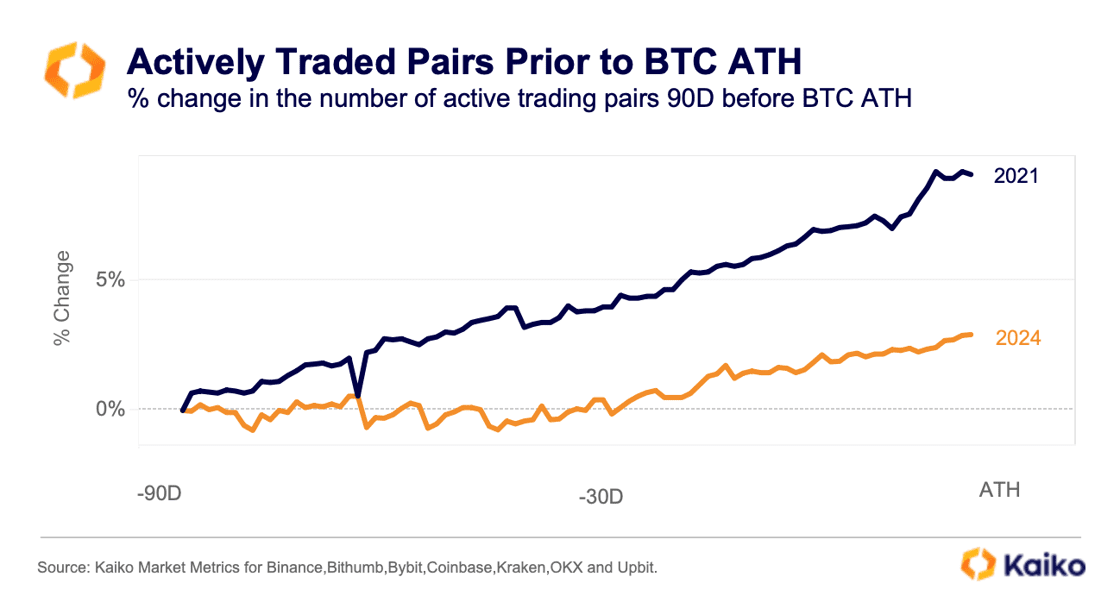
The cumulative effect of these regulatory pressures is demonstrably evident in the rate of new exchange listings. Data compiled by Kaiko, a cryptocurrency market data provider, reveals a significant slowdown in the introduction of new trading pairs across centralized exchanges. This trend indicates a growing caution among companies worldwide regarding the expansion of their listed assets, particularly for exchanges serving customers in the EU and the U.S.
Analysis of Kaiko’s data shows a marked deceleration in the growth of active trading pairs since the peak of the 2021 bull market. Before Bitcoin’s all-time high in 2021, the growth rate of new trading pairs stood at approximately 9%. However, leading up to the 2024 market peak, this growth rate had fallen to a mere 3%. This substantial reduction in the pace of new listings suggests that exchanges are becoming more selective and risk-averse, likely due to the increased compliance costs and regulatory uncertainties associated with listing new digital assets, especially those that might fall under stricter scrutiny by regulators.
Exchange-Specific Trends and Contributing Factors
Examining specific exchanges provides a more granular understanding of these trends. Binance, one of the world’s largest cryptocurrency exchanges, has experienced a slower pace of growth in active trading pairs compared to its peers. Its active trading pair count remains approximately 14% below its 2022 peak. While MiCA’s influence is a significant contributor to this slowdown in its European operations, Binance has also faced broader challenges.
The exchange has been under regulatory scrutiny in various jurisdictions globally. Furthermore, the legal troubles surrounding its founder and former CEO, Changpeng Zhao, including charges and a substantial fine, have undoubtedly impacted its operational trajectory and global standing. The legal battles faced by Binance.US in the past year have also played a role in diminishing its perceived dominance in certain markets. These multifaceted challenges have created an environment where expanding its offerings through new listings is likely a lower priority compared to navigating its existing regulatory and legal landscape.
In contrast, exchanges with customer bases primarily outside the EU appear to be less affected by MiCA. Bybit, for instance, has witnessed a surge in active trading pairs, reaching an all-time high during the market rally in May. The majority of Bybit’s clientele is located in regions where the regulatory environment is either less stringent or different from that of the EU. This suggests that while global regulatory trends are influential, regional regulatory frameworks play a critical role in shaping exchange listing strategies.
Similarly, exchanges in South Korea, particularly Bithumb, have experienced rapid growth in new listings, outpacing even Upbit. This surge has, in turn, drawn increased attention from South Korean authorities, who are still in the process of developing a comprehensive regulatory framework for the digital asset industry. This highlights a recurring theme: as markets grow and attract new assets, regulatory bodies often respond with increased oversight, which can then influence market dynamics, including listing trends.
Deceleration in Overall Market Growth and Emerging Market Resilience
The combined effect of a slower rate of new listings and a potential shift towards trading pairs involving stablecoins has contributed to a deceleration in the overall growth trajectory of the cryptocurrency market. This trend suggests a maturing market where innovation and expansion are increasingly intertwined with regulatory compliance and risk management.
However, it is important to note that emerging markets are demonstrating resilience and continued demand for cryptocurrencies. Factors such as high inflation, currency volatility, and the relative absence of strict regulatory oversight in some of these regions are driving local interest in digital assets as a store of value and a medium of exchange. This bifurcated market response—with developed economies experiencing regulatory-induced caution and emerging economies showing continued adoption—underscores the diverse and dynamic nature of the global crypto landscape.
The implications of this regulatory-driven slowdown in new listings are multifaceted. For nascent projects, securing a listing on a major exchange is often a crucial step for gaining visibility, liquidity, and investor access. A more restricted listing environment could pose significant hurdles for early-stage ventures, potentially slowing down the pace of innovation and the introduction of new use cases. For established exchanges, the focus may shift from rapid expansion to ensuring robust compliance and providing a secure, regulated trading environment, which could lead to increased operational costs but also enhanced long-term sustainability and investor trust.
The long-term impact of MiCA and similar regulatory initiatives globally will likely be a more consolidated and professionalized crypto industry. While the immediate effect may be a slowdown in certain market activities, such as new listings, the ultimate goal is to create a safer and more predictable environment for both investors and businesses. As the industry navigates this evolving regulatory terrain, the ability to adapt, comply, and innovate responsibly will be key determinants of success for exchanges and crypto projects alike. The data from Kaiko serves as a clear indicator that the era of unfettered listing growth may be giving way to a more measured and regulated phase in the evolution of digital asset markets.