
 admin
admin
The burgeoning digital asset landscape, once characterized by rapid innovation and unfettered growth, is now facing a significant recalibration driven by evolving regulatory frameworks. The European Union’s Markets in Crypto-Assets (MiCA) regulation, a comprehensive directive aimed at standardizing and supervising the digital asset market across its member states, is emerging as a pivotal force in this shift. While full implementation is not slated until December of this year, the preliminary stages and the recent activation of stablecoin legislation at the end of June have already begun to exert a palpable influence on global cryptocurrency exchange listings. This regulatory tightening, coupled with ongoing scrutiny in the United States, is contributing to a noticeable deceleration in the pace of new asset introductions on major trading platforms.
MiCA represents a landmark effort by the EU to establish a unified approach to crypto-asset regulation. It endeavors to bring clarity and oversight to a sector that has historically operated with a degree of autonomy. The regulation’s scope is broad, encompassing a wide array of digital assets, including stablecoins, and meticulously outlining rules for their issuance, trading, and custody. While the EU has seen various crypto-related regulatory initiatives prior to MiCA, this new framework is particularly noteworthy for its explicit targeting of the rapidly expanding Decentralized Finance (DeFi) sector within the region.
A key characteristic of MiCA is its "extraterritorial scope." This means its regulatory reach extends beyond the geographical confines of EU member states. It applies to any business, regardless of its headquarters, that offers services to customers within the EU, or that utilizes the Euro in its operations. This expansive jurisdiction means that global exchanges and service providers are compelled to adapt their operations to comply with EU standards if they wish to maintain a presence in this significant market. The implications of this are already being felt, with major players like Kraken reportedly considering the delisting of Tether (USDT) in Europe specifically due to the impending MiCA rules. This proactive adjustment by exchanges underscores the significant impact of the regulation even before its full enforcement.
Beyond the EU, the United States has also been intensifying its regulatory pressure on the crypto industry. With the 2024 Presidential elections on the horizon, digital assets, particularly Bitcoin, have become a prominent feature in political discourse. This evolving political landscape, marked by uncertainty and varying stances from candidates and agencies, has placed considerable pressure on companies and exchanges operating within the US. The US Treasury and the IRS, for instance, have finalized rules for crypto broker tax reporting, adding another layer of compliance for businesses. This dual regulatory environment, emanating from two of the world’s largest economic blocs, is creating a more cautious atmosphere for crypto innovation and expansion.

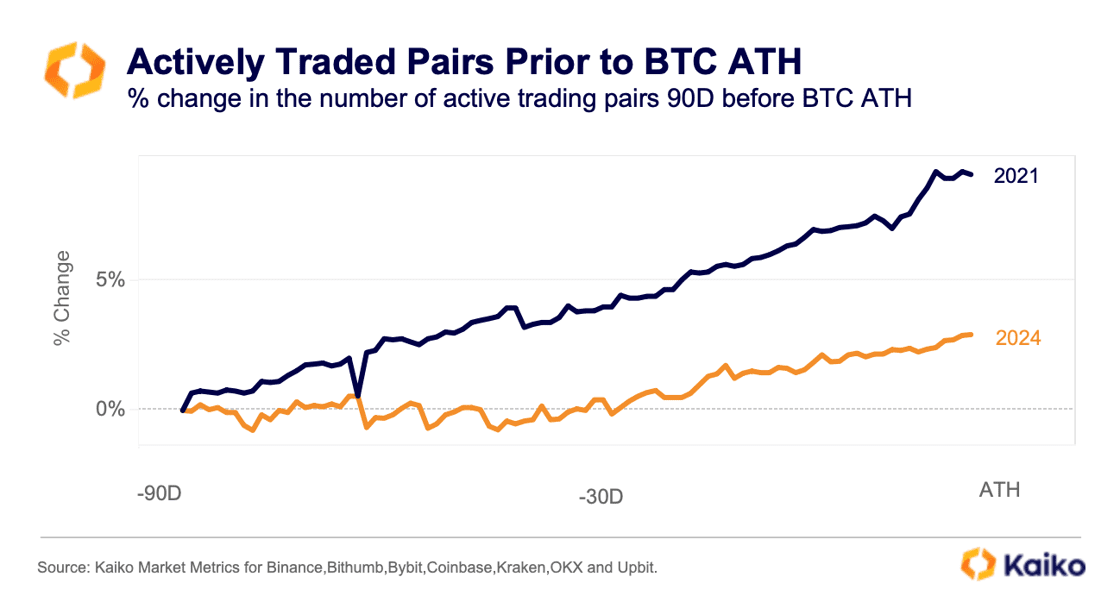
Data analysis from Kaiko, a leading cryptocurrency market data provider, offers compelling evidence of this trend. The rate at which new exchange listings are being introduced has seen a marked decline, particularly when compared to the frenetic pace observed during the 2021 bull run. Kaiko’s research indicates a significant slowdown in the growth of new trading pairs across major exchanges serving both EU and US customers. This growth rate, which peaked at approximately 9% prior to Bitcoin’s all-time high in 2021, has reportedly dwindled to a mere 3% leading up to the 2024 market highs. This deceleration suggests that exchanges are adopting a more discerning approach to listing new assets, likely influenced by the heightened regulatory scrutiny and the associated compliance burdens.
Exchange-Specific Trends and Regulatory Impact
Examining the data at an exchange level reveals nuanced trends. Binance, a global cryptocurrency exchange giant, has experienced a slower rate of new trading pair growth compared to some of its peers. Its active trading pair count currently stands 14% below its 2022 peak. While the broader impact of MiCA on its European operations is a contributing factor, Binance has also been navigating a complex web of global regulatory challenges. The exchange has faced scrutiny and legal troubles in various jurisdictions worldwide, including significant charges against its founder and former CEO, Changpeng Zhao. These legal entanglements, coupled with the previous regulatory battles faced by Binance.US, have undeniably impacted its global standing and, consequently, its listing strategy. The reduction in new listings can be seen as a consequence of these multifaceted pressures, forcing a more conservative approach to expansion.
In stark contrast to Binance’s more subdued listing activity, Bybit has witnessed a significant surge in its active trading pairs, reaching an all-time high during the market rally observed in May. This divergence in performance can be largely attributed to Bybit’s customer base, which predominantly originates from countries outside the EU. Consequently, Bybit appears to be largely insulated from the direct impact of MiCA. A similar pattern is observable in the South Korean crypto market, particularly with exchanges like Bithumb. These platforms have experienced rapid growth in new listings, with Bithumb even surpassing Upbit in this regard. This surge has, in turn, attracted increased attention from South Korean authorities, who are still in the process of developing a comprehensive regulatory framework for the industry. The rapid growth in these emerging markets, often characterized by less stringent regulations, highlights a potential shift in where new digital assets are first introduced and traded.
The Shifting Landscape of Trading Pairs
The data further indicates a subtle but significant shift in the type of trading pairs being introduced. While the overall rate of new listings has slowed, there appears to be a growing emphasis on stablecoin pairs. This trend could be a direct response to regulatory pressures, particularly concerning stablecoins, which are now subject to specific rules under MiCA. Exchanges may be prioritizing the listing of stablecoin pairs that are more likely to comply with existing and upcoming regulations, thereby reducing the risk of non-compliance.
The cumulative effect of this reduced pace of new listings and the potential shift towards more regulated asset types is a deceleration in the overall growth trajectory of the crypto market, at least in terms of the sheer volume of new assets becoming available on major exchanges. However, this narrative is not uniform across all markets. Emerging markets are demonstrating a notable resilience and an increasing demand for cryptocurrencies. This demand is being fueled by a confluence of factors, including high inflation rates, currency volatility, and, in some regions, a less restrictive regulatory environment compared to the EU and US. These markets are becoming increasingly vital as alternative hubs for crypto adoption and innovation, offering a different perspective on the future of digital asset integration.
Broader Implications and Future Outlook
The current regulatory climate signals a maturing phase for the cryptocurrency industry. What was once a largely unregulated frontier is now subject to increasing oversight, compelling participants to prioritize compliance and risk management. The impact of MiCA and the intensified scrutiny in the US suggest a future where exchanges will likely operate with greater caution, conducting more rigorous due diligence before listing new assets. This could lead to a more curated and potentially higher-quality selection of digital assets available to a broader audience.
For investors and traders, this regulatory evolution may translate into a more stable and predictable market environment, albeit one with potentially fewer speculative opportunities from new, unproven assets. The focus may shift from the rapid introduction of novel tokens to the established utility and regulatory compliance of existing ones.
The contrasting growth patterns observed between regions like the EU/US and emerging markets also highlight a global divergence in regulatory approaches and market dynamics. As regulatory frameworks continue to solidify, the crypto industry will likely see further stratification, with different regions offering distinct opportunities and challenges. The ability of exchanges and projects to navigate these diverse regulatory landscapes will be a critical determinant of their long-term success. The era of unchecked expansion is giving way to a period of structured growth, where regulatory adherence is not merely a suggestion but a fundamental requirement for participation in the global digital asset economy.