admin
admin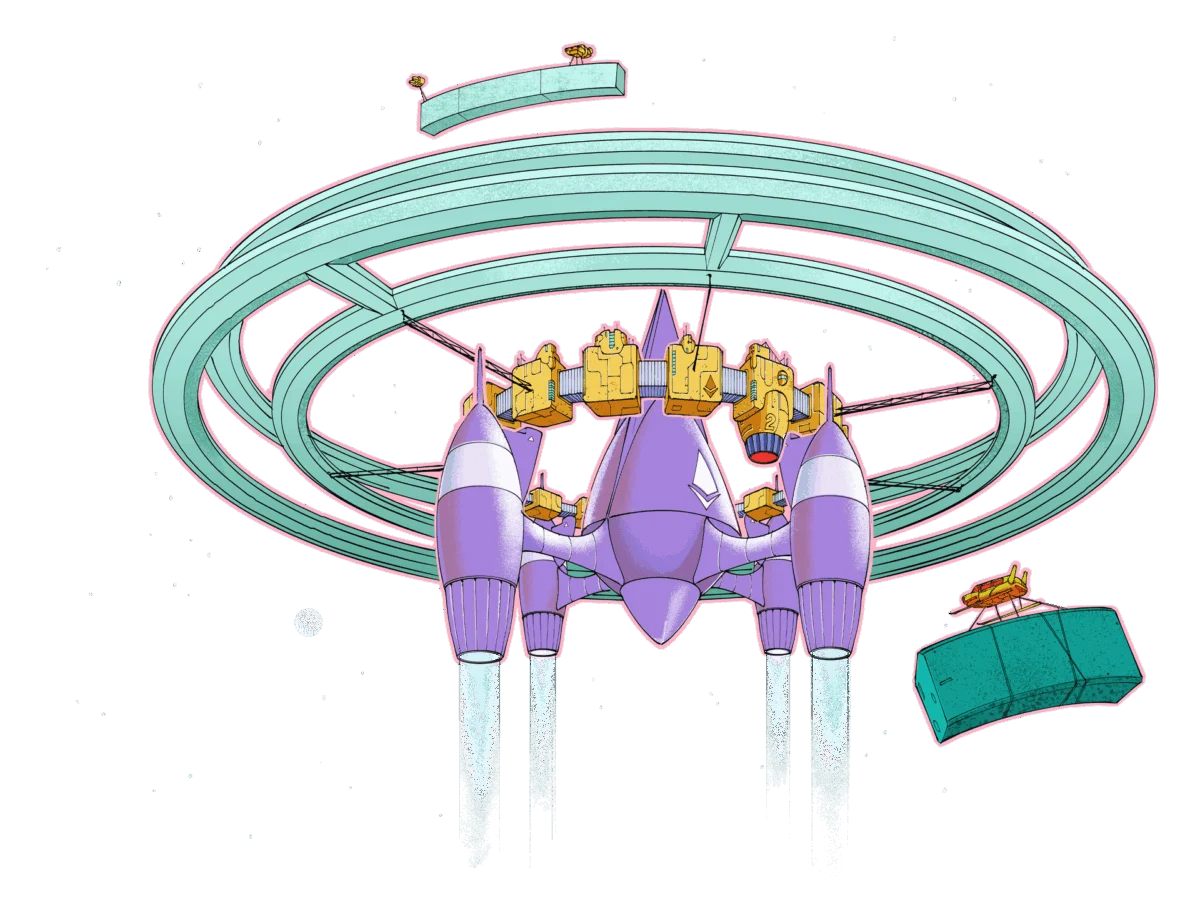
The Architecture of the Transition: Understanding the Merge
The Merge is frequently described by core developers as "changing the engine of an airplane while it is still in flight." This analogy underscores the necessity for the network to maintain 100% uptime while fundamentally altering how blocks are validated and secured. Unlike the Bitcoin network, which relies on a single dominant implementation of its protocol (Bitcoin Core), the Ethereum community has historically championed a multi-client approach. This philosophy is intended to prevent a single bug or vulnerability from compromising the entire ecosystem.

The transition is essentially a fusion of two independent layers. The first is the current "Execution Layer," which handles transactions and smart contract execution. The second is the "Consensus Layer," also known as the Beacon Chain, which has been running in parallel since December 2020 to test the Proof-of-Stake logic. Once the Merge occurs, the PoW mining process will be deprecated. Instead, validator nodes running consensus clients will take over the responsibility of proposing and attesting to new blocks based on the amount of Ether (ETH) they have staked.
A Chronology of Ethereum’s Evolution toward Proof-of-Stake
The journey to the Merge has been a multi-year endeavor, marked by several key phases:
- The Frontier and Homestead Eras (2015–2016): Ethereum launched with a PoW system similar to Bitcoin, but with the stated intention of eventually moving to PoS.
- The Introduction of the Difficulty Bomb: A mechanism designed to exponentially increase the difficulty of mining, effectively forcing the network to upgrade to PoS to avoid a "freeze."
- The Launch of the Beacon Chain (December 2020): This marked the beginning of "Phase 0," where users could begin staking 32 ETH to become validators on a parallel PoS chain that did not yet process transactions.
- The Altair Upgrade (October 2021): The first scheduled upgrade to the Beacon Chain, which refined the incentive and penalty structures for validators.
- The Merge (Estimated Mid-2022): The final step where the Execution Layer merges with the Consensus Layer, ending PoW mining forever.
The Critical Risk of Client Monoculture
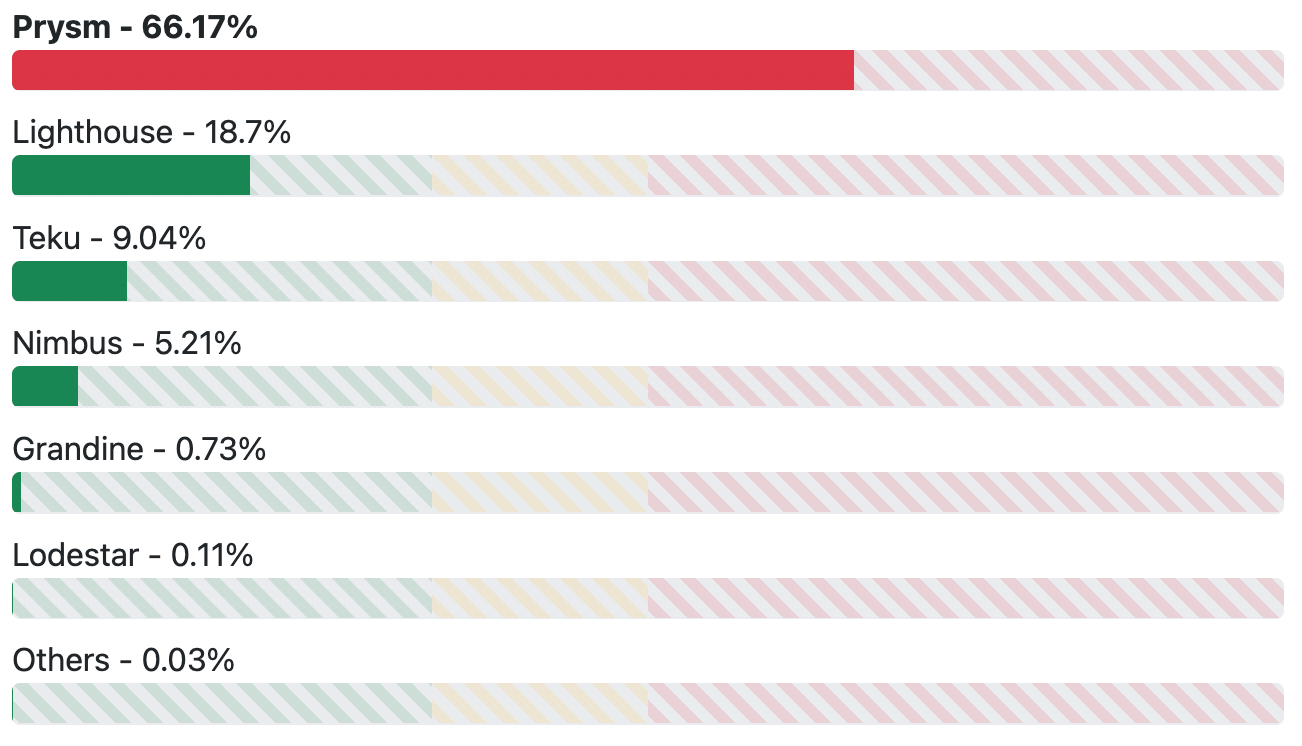
In a decentralized network, the software that participants run—known as the "client"—must be diverse. If 90% of the network runs Client A and Client A suffers a critical bug that causes it to produce invalid blocks, the entire network could come to a standstill or, worse, finalize an incorrect state. Ethereum developers have encouraged the creation of multiple client implementations, including Prysm, Lighthouse, Teku, Nimbus, and Lodestar. These are written in different programming languages, such as Go, Rust, Java, and TypeScript, to ensure that a flaw in one language’s compiler or a specific code implementation does not become a systemic failure.
However, current data suggests that the network is dangerously close to a "supermajority" situation. If a single client controls more than 66% (two-thirds) of the total staked ETH, it reaches a supermajority. In this scenario, if the client experiences a bug that leads to a consensus failure, the buggy chain could be "finalized." Once a chain is finalized, it cannot be reverted without a manual hard fork, which would effectively split the Ethereum community into two competing networks.
The thresholds of risk are categorized as follows:
- Less than 33%: If a client with less than one-third of the stake fails, the network continues to function normally, and the faulty nodes are simply penalized through "slashing" or inactivity leaks.
- Between 33% and 50%: A failure could prevent the network from reaching finality, leading to temporary disruptions until the issue is resolved.
- Between 50% and 66%: The client has the power to control the direction of the chain, though it cannot finalize it alone.
- Over 66%: A "game over" scenario where a bug can permanently corrupt the finalized state of the blockchain.
Current Market Share: The Dominance of Prysm and Geth
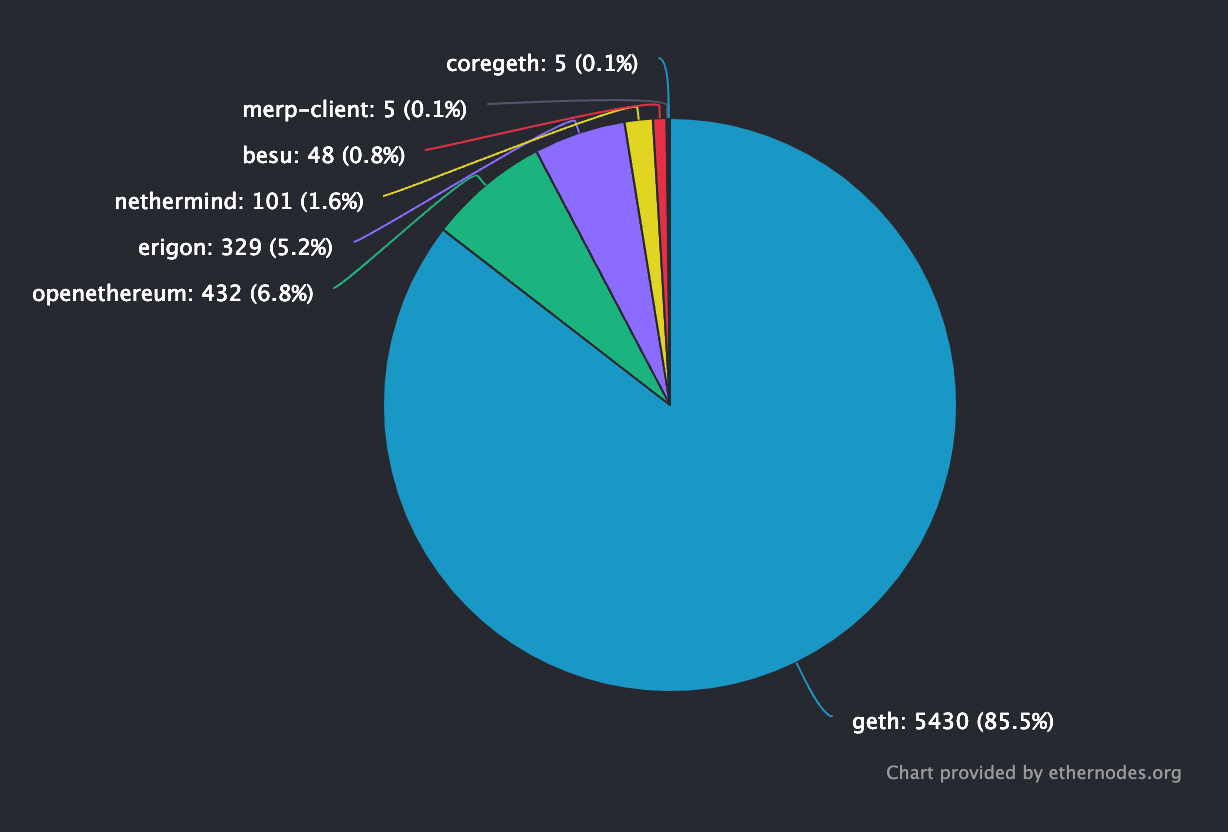
As of the latest reports, the Prysm client, developed by Prysmatic Labs, holds a commanding share of the consensus layer, hovering near the 66% danger zone. On the execution layer, Geth (Go-Ethereum) maintains an even more significant dominance, used by approximately 85% of all nodes.
Marius van der Wijden, an Ethereum core developer, attributes Prysm’s success to its "first-mover advantage." Prysm was the first implementation to offer a stable prototype and comprehensive documentation. Furthermore, its use of the Go programming language makes it accessible to developers already familiar with Geth. While Geth’s dominance on the execution layer is less of a security risk post-Merge (as it no longer dictates consensus), the consensus layer’s lack of diversity remains a primary concern for the Ethereum Foundation.
The Role of Major Exchanges and Staking Pools
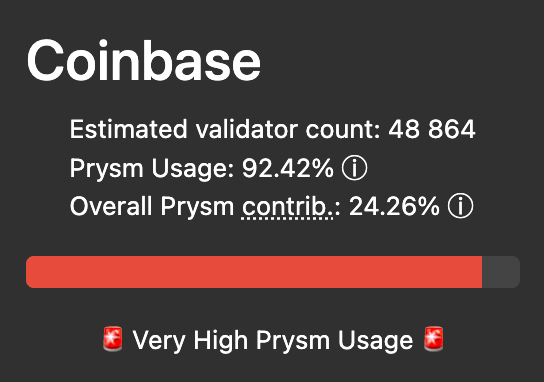
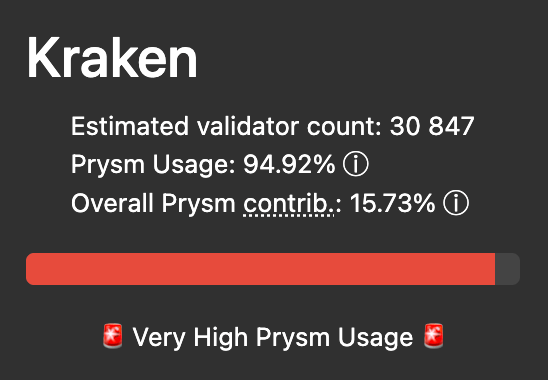
The centralization of ETH staking within a few large entities has exacerbated the client diversity issue. Major centralized exchanges, including Coinbase, Kraken, and Binance, along with decentralized liquid staking protocols like Lido, control a massive portion of the total staked ETH.
- Coinbase: With nearly 18% of the network’s validators, Coinbase has historically relied heavily on Prysm. The company noted that when they launched their staking service, Prysm was the only client that supported "remote signers"—a security feature that allows validator keys to be stored in isolated environments.
- Kraken: Holding roughly 11% of the validator count, Kraken has expressed a commitment to diversity. Following discussions with the Ethereum Foundation, Kraken has begun migrating some of its infrastructure to the Teku client.
- Lido Finance: As a decentralized protocol, Lido has a more distributed approach than centralized exchanges, but it still contributes significantly to Prysm’s market share. Lido has recently implemented incentives for its node operators to switch to minority clients.
- Rocket Pool: Often cited as the gold standard for decentralization, Rocket Pool has a very low reliance on Prysm (approximately 10%), instead encouraging its operators to use a variety of clients.
Official Responses and Mitigation Strategies
The Ethereum Foundation and core developers are actively campaigning for "client agility." The message to node operators is clear: running a majority client is not just a risk to the network; it is a financial risk to the operator. If a supermajority client fails, the "inactivity leak" mechanism would begin burning the ETH of the faulty nodes to eventually restore the minority chain to a two-thirds majority. This could result in the total loss of staked funds for those running the majority client.
Marius van der Wijden remains cautiously optimistic. He notes that the community has developed robust "fuzzing" infrastructure—automated systems that constantly bombard the different clients with random data to identify discrepancies in how they handle transactions. "The chances of a consensus failure happening are very small," van der Wijden stated, "but we have a strong consensus that we will not bail out stakers that run a majority client if their clients misbehave."
Broader Implications: Energy, Security, and Scalability
Beyond the technical risks of the Merge, the broader implications for the global economy and the environment are profound. By moving to Proof-of-Stake, Ethereum will eliminate the need for energy-intensive mining hardware (ASICs and GPUs), effectively silencing critics who have pointed to the network’s carbon footprint as a barrier to institutional adoption.
From a security perspective, PoS changes the "cost of attack." In a PoW system, an attacker must acquire more than 51% of the hardware and electricity. In PoS, an attacker must acquire more than 51% (or 66% for certain attacks) of the total ETH supply. If an attacker is caught, their stake can be destroyed (slashed), making an attack exponentially more expensive than in a PoW system where the hardware remains intact even after a failed attempt.
Finally, the Merge sets the stage for future scaling upgrades, such as sharding. While the Merge itself does not significantly lower gas fees, it provides the necessary consensus foundation for "Data Availability Sampling," which will eventually allow the network to process thousands of transactions per second through Layer 2 rollups.
The Path Forward
As the Ethereum network enters the final countdown to the Merge, the focus remains on education and infrastructure migration. The community’s ability to decentralize its client base in the coming months will determine whether Ethereum can truly claim to be a resilient, unstoppable "world computer." While the technical hurdles are steep, the coordination between developers, exchanges, and individual stakers represents one of the largest collaborative efforts in the history of computer science. The success of the Merge will not only redefine Ethereum but could serve as a blueprint for the future of all decentralized systems.