admin
admin
As Ethereum prepares for its historic transition from Proof-of-Work (PoW) to Proof-of-Stake (PoS), a critical security vulnerability has emerged within the network’s architecture. Known as "The Merge," this transition represents one of the most significant technical undertakings in the history of blockchain technology, often likened by developers to replacing an airplane’s engine in mid-flight. While the technical milestones for the upgrade are largely on track, a burgeoning consensus client monopoly—specifically the dominance of the Prysm client—has raised alarms within the developer community and among Ethereum Foundation (EF) researchers.
Ethereum’s design philosophy has long prioritized decentralization, not just in its node distribution but in its software implementation. Unlike Bitcoin, which primarily relies on a single dominant client (Bitcoin Core), Ethereum has actively encouraged the development of multiple, independent software implementations of its protocol. This strategy is intended to ensure that a bug or vulnerability in one codebase does not result in a catastrophic failure of the entire network. However, as the Beacon Chain—the PoS coordination layer—approaches its merger with the existing execution layer, data suggests that the network is currently far from achieving its diversity goals.

The Architecture of a Post-Merge Network
To understand the risks associated with client diversity, one must first grasp the dual-layer architecture that will define Ethereum following The Merge. Currently, Ethereum nodes handle both transaction execution and network validation. Post-Merge, these duties will be bifurcated into two distinct types of nodes.
Execution nodes will continue to run the Ethereum Virtual Machine (EVM), processing smart contracts and transactions. These nodes will essentially function as the "brains" of the network, but they will no longer be responsible for securing the chain through mining. Instead, they will pass processed data to consensus nodes. Consensus nodes, running on the Beacon Chain, will be responsible for validating the work of the execution nodes and reaching agreement on the state of the blockchain.
This separation of concerns is a robust security measure, but it introduces a new dependency: the consensus client. Currently, several consensus clients exist, including Prysm, Lighthouse, Teku, Nimbus, and Lodestar. Each is written in a different programming language—Prysm in Go, Lighthouse in Rust, and Teku in Java—to ensure that a language-specific exploit or a logic bug in one team’s code does not replicate across the others.

The Mathematical Thresholds of Risk
The security of a PoS network relies on specific mathematical thresholds. In Ethereum’s PoS implementation, a "supermajority" of two-thirds (approximately 66.6%) of the total staked Ether (ETH) is required to finalize blocks. Finalization is the point at which a transaction is considered irreversible.
The risks of client concentration are categorized by the percentage of the network they control:
- Below 33%: If a client with less than one-third of the stake experiences a bug or goes offline, the network continues to function normally. The faulty nodes are simply penalized through "inactivity leaks" until they are back online or their stake is depleted.
- Between 33% and 50%: If a client in this bracket fails, the network can no longer reach the two-thirds majority required for finalization. While the chain continues to grow, transactions are not finalized, leading to significant economic uncertainty until the issue is resolved.
- Between 50% and 66%: A client with a simple majority could theoretically control the chain’s direction, but it still cannot finalize blocks on its own.
- Above 66%: This is the "critical zone." If a client with a supermajority contains a critical bug that causes it to follow an invalid chain, it will finalize that invalid chain. In this scenario, the "buggy" chain becomes the official state of the network according to the majority of validators. Non-buggy clients would be forced to either follow the corrupted chain or split into a separate network, potentially resulting in a permanent and contentious hard fork.
As of recent audits, Prysm’s market share sits at approximately 66%. While technically just below the absolute supermajority threshold, the margin for error is razor-thin, leading many to question if the network is truly prepared for The Merge.

The Origins of Prysm’s Dominance
The dominance of Prysmatic Labs’ Prysm client is not a matter of chance but a result of early development success and accessibility. Marius van der Wijden, an Ethereum core developer, notes that Prysm benefited immensely from a "first-mover advantage."
"Prysm was the first prototype implementation of a beacon client," van der Wijden explained. This early start allowed the team to optimize their code and develop a comprehensive suite of tools, including a user-friendly Web UI and extensive documentation, which made it the default choice for early adopters and large-scale institutions.
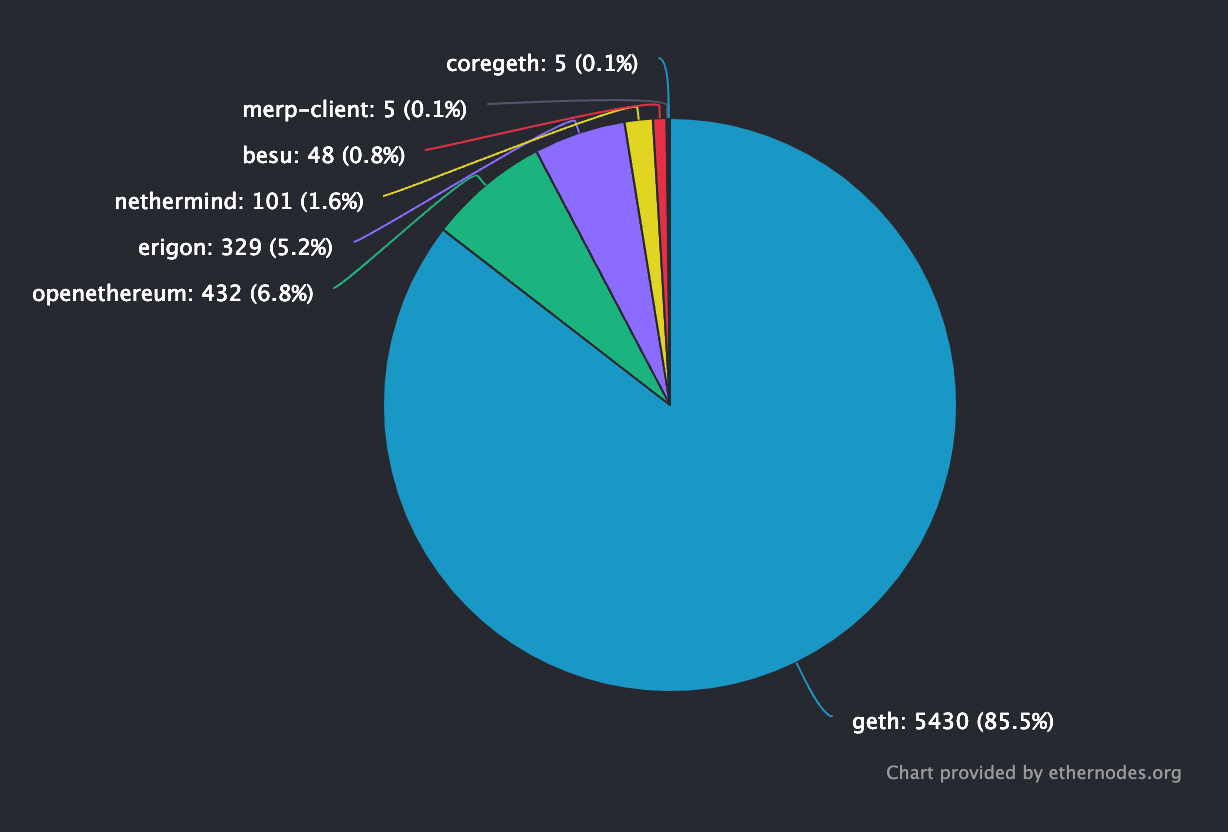
Furthermore, Prysm is written in Golang (Go), the same language used for Geth, the dominant execution client. This familiarity allowed developers and auditors already integrated into the Ethereum ecosystem to transition to the consensus layer with minimal friction. However, this same familiarity has led to a dangerous concentration of software risk.

Institutional Influence: The Role of Exchanges and Staking Pools
The client diversity issue is largely driven by institutional "whales"—major cryptocurrency exchanges and staking providers that control hundreds of thousands of validator nodes. Because these entities prioritize stability and security, they gravitated toward Prysm during its early, most stable phases.
Data indicates that a handful of players contribute disproportionately to the Prysm monopoly:
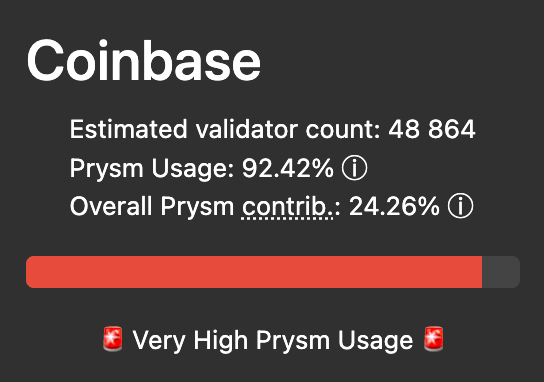
- Coinbase: Controls approximately 17.5% of the network’s validators. Recent reports show that over 92% of Coinbase’s validators run Prysm.
- Kraken: Manages roughly 11% of the network, with a Prysm usage rate of nearly 95%.
- Binance: Holds about 8.7% of the validator share, with approximately 76% running Prysm.
- Lido: As the largest liquid staking provider, Lido controls 18% of validators. While more diverse than the exchanges, 42.8% of its node operators still utilize Prysm.
When asked about this concentration, Coinbase Cloud pointed to the historical necessity of Prysm’s features. "When launching ETH2 staking, Coinbase evaluated existing clients and providers… starting with Prysm because it was the only viable client supporting remote signers," the company stated in a recent technical update. Remote signers allow for validator keys to be stored in isolated, secure environments, a non-negotiable requirement for an institution of Coinbase’s scale.
The Path to Mitigation
The Ethereum Foundation and independent developers are actively lobbying these large entities to diversify their infrastructure. The message is clear: the financial risk of a supermajority bug far outweighs the convenience of sticking with a single client. Under Ethereum’s "slashing" and "inactivity leak" rules, validators on a majority client that suffers a consensus failure could face the total loss of their staked ETH.
There are signs of progress. Kraken’s Senior Product Manager, Brian Hoffman, confirmed that the exchange has begun rolling out validators built on Teku. "We can increase diversity in our validator client software and offer clients an even more resilient on-chain staking service," Hoffman said, noting that migration of existing nodes is currently underway.
Similarly, Coinbase has integrated support for the Lighthouse client after working with the Sigma Prime team to ensure it met institutional security standards for remote signing.
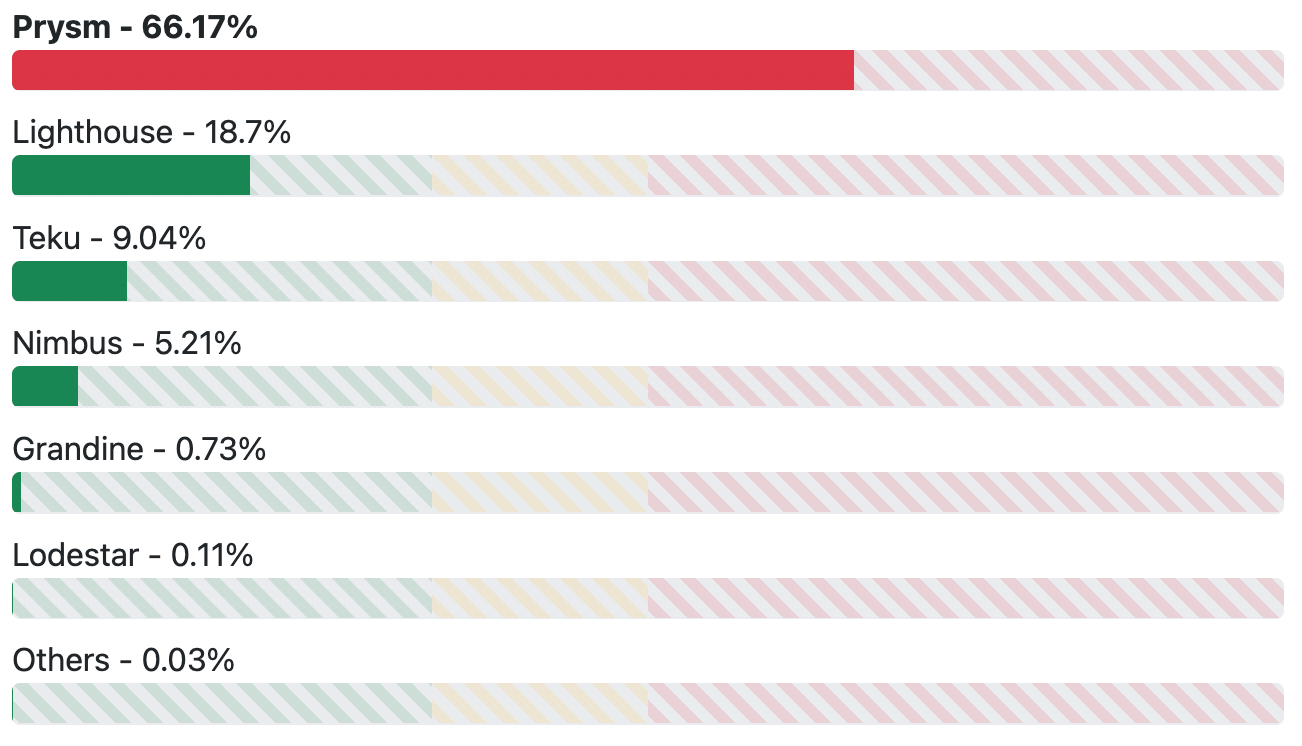
In contrast to the centralized giants, decentralized staking protocols like Rocket Pool have set a benchmark for diversity. Rocket Pool accounts for less than 1% of the network, but only 10.6% of its nodes run Prysm, with the remainder distributed across Lighthouse, Teku, and Nimbus.
Analysis of Implications: Is The Merge Safe?
Despite the alarming statistics, Ethereum core developers remain committed to the mid-2022 timeline for The Merge. The consensus among the dev community is that while the client distribution is not ideal, the risks are manageable through rigorous testing and social consensus.
The primary safeguard is "fuzzing"—a type of automated software testing that provides invalid, unexpected, or random data as inputs to the various clients to see if they reach different conclusions. This constant testing is designed to catch consensus bugs before they can reach the mainnet.
Furthermore, the Ethereum community has established a "social consensus" layer. If a supermajority client were to finalize an invalid chain, the community has signaled a willingness to perform a manual hard fork to restore the correct state of the network. This "nuclear option" serves as a deterrent for node operators; they know that if they run a majority client and it fails, the network will not bail them out.
"We have strong consensus that we will not bail out stakers that run a majority client if their clients misbehave," van der Wijden emphasized. This policy creates a powerful economic incentive for large stakers to diversify their clients before The Merge occurs.
Conclusion
The transition to Proof-of-Stake is a defining moment for Ethereum, promising to reduce the network’s energy consumption by over 99% and pave the way for future scaling upgrades like sharding. However, the Prysm supermajority remains a shadow over the proceedings.
While the technical foundation for The Merge is solid, the operational foundation—held up by exchanges and staking pools—requires a shift in priority from individual convenience to collective security. As the deadline approaches, the pressure on Coinbase, Binance, and Kraken to diversify will only intensify. The safety of The Merge may ultimately depend not on the code itself, but on the willingness of the network’s largest stakeholders to embrace the decentralized principles they represent.