
 admin
admin
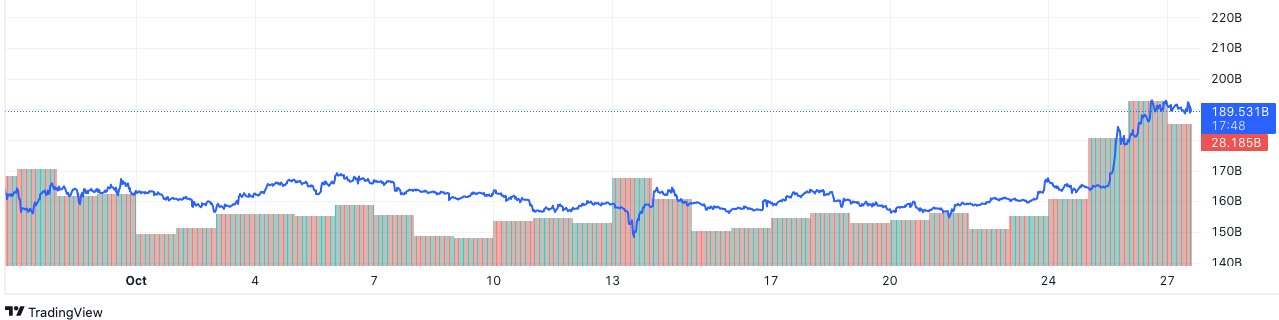
The global financial landscape witnessed a significant shift in late October 2022 as Ethereum (ETH), the world’s leading smart-contract platform, ascended to become the 50th most valuable asset globally by market capitalization. This milestone followed a period of intensive price action that saw the digital asset break out of a month-long consolidation phase, effectively surpassing several established multinational corporations and legacy industrial giants. By reaching a market valuation of approximately $190 billion, Ethereum moved ahead of household names such as Cisco Systems, the e-commerce titan Alibaba, pharmaceutical leader AstraZeneca, and telecommunications giant T-Mobile.
This transition marks a pivotal moment for the cryptocurrency sector, signaling a maturing market where digital assets are increasingly evaluated alongside traditional equities, precious metals, and commodities. The move into the top 50 global assets places Ethereum in direct competition for valuation with iconic entities like the Walt Disney Company and Toyota Motor Corporation, both of which maintained market caps in the vicinity of $195 billion during the same period.
The Mechanics of the October Rally
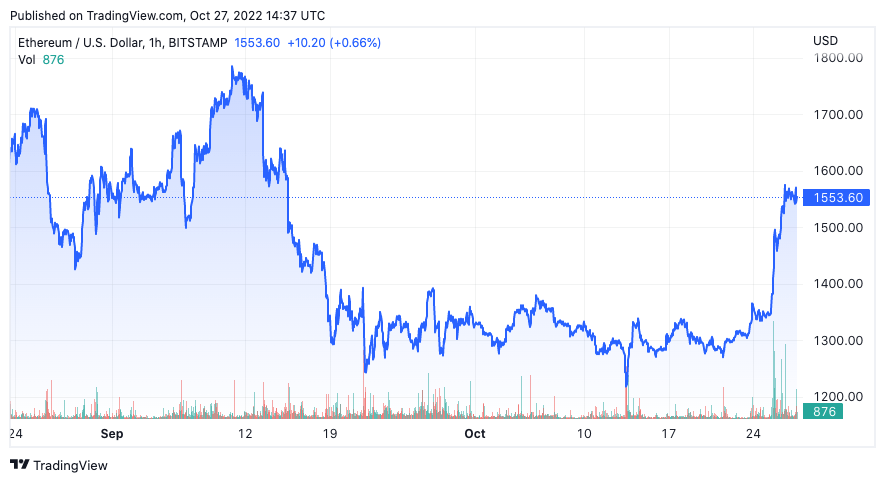
The surge in Ethereum’s market valuation was characterized by a sharp, high-volume breakout. After nearly thirty days of trading within a narrow horizontal range—often referred to by analysts as "flatlining"—Ethereum experienced a volatile upward trajectory. The price of ETH climbed from a baseline of approximately $1,300 to a peak of $1,560 within a window of less than 48 hours. This 20% appreciation was not merely a retail-driven phenomenon but was supported by a convergence of technical factors and shifts in market sentiment.
Market data suggests that the rally was accelerated by a "short squeeze." During the preceding month of price stagnation, a significant number of traders had entered short positions, betting on a further decline in the cryptocurrency market amidst broader macroeconomic uncertainty. When Ethereum’s price began its upward movement, these short positions were forcibly liquidated, creating a feedback loop of buying pressure that propelled the asset through key resistance levels.
Furthermore, the timing of the rally coincided with a brief period of stabilization in the U.S. Dollar Index (DXY) and a tentative recovery in the Nasdaq 100. As Ethereum maintains a historically high correlation with technology stocks, the broader relief rally in the equities market provided the necessary tailwinds for ETH to reclaim lost ground and expand its total market capitalization.
Surpassing Legacy Giants: A Comparative Analysis
Ethereum’s entry into the top 50 is best understood through the lens of the companies it has overtaken. The diversity of these entities underscores the breadth of Ethereum’s economic footprint.
- Alibaba Group: Once the crown jewel of the Chinese tech sector, Alibaba has faced significant regulatory headwinds and macroeconomic challenges in East Asia. Ethereum’s ability to surpass Alibaba’s market cap highlights the shifting investor preference toward decentralized, borderless protocols over centralized regional giants facing geopolitical risks.
- Cisco Systems: As a backbone of internet infrastructure, Cisco represents the hardware-centric era of the digital revolution. Ethereum, often described as a "world computer," represents the software-defined, decentralized future of that same infrastructure.
- AstraZeneca and T-Mobile: These companies represent the defensive sectors of healthcare and telecommunications. Ethereum’s valuation eclipsing these firms suggests that investors are increasingly viewing high-utility blockchain networks as essential infrastructure rather than speculative experiments.
The proximity of Ethereum to the Walt Disney Company and Toyota is also telling. While Disney dominates the global "attention economy" and Toyota leads the physical automotive industry, Ethereum’s value is derived from its utility as a settlement layer for decentralized finance (DeFi), non-fungible tokens (NFTs), and enterprise blockchain solutions.
The Broader Cryptocurrency Context: Bitcoin’s Dominance
While Ethereum’s achievement is historic, it remains the second cryptocurrency to reach such heights. Bitcoin (BTC), the original cryptocurrency, continues to hold a commanding lead in the global asset rankings. With a market capitalization exceeding $395 billion at the time of Ethereum’s breakout, Bitcoin occupied the 14th position globally, situated between the payment processor Visa and the retail behemoth Walmart.
The historical context of Bitcoin’s valuation provides a roadmap for what digital assets can achieve during periods of peak adoption. At its all-time high in mid-October 2021, Bitcoin’s market capitalization reached a staggering $1.23 trillion. At that valuation, Bitcoin was more valuable than Alphabet (Google’s parent company) is currently. Furthermore, during its peak, Bitcoin’s total value surpassed that of the world’s entire silver supply, which sat at approximately $1.10 trillion in late 2022.
The disparity between Bitcoin and Ethereum—often referred to as the "market cap gap"—remains a central theme for crypto-economists. However, Ethereum’s recent price action and its climb to the 50th spot suggest that the "Flippening" narrative (the hypothetical event where ETH’s market cap surpasses BTC’s) continues to be a topic of long-term speculation, particularly as Ethereum transitions into a more capital-efficient asset.
The "Merge" and the Shift to "Ultrasound Money"
To understand why Ethereum was able to sustain such a significant market cap, one must look back at the fundamental changes to its protocol. In September 2022, just weeks before this ranking milestone, Ethereum completed "The Merge." This upgrade transitioned the network from a Proof-of-Work (PoW) consensus mechanism to Proof-of-Stake (PoS).
The implications of The Merge were twofold. First, it reduced the network’s energy consumption by more than 99.9%, making it an attractive option for institutional investors with strict Environmental, Social, and Governance (ESG) mandates. Second, it fundamentally altered Ethereum’s issuance model. Under the new PoS system, the rate of new ETH creation was drastically reduced. Combined with a "burn mechanism" introduced in a previous upgrade (EIP-1559), Ethereum now possesses the potential to become deflationary during periods of high network activity.
This transition to what proponents call "ultrasound money" has changed the valuation models used by analysts. Rather than being viewed solely as a utility token, ETH is increasingly viewed as a yield-bearing asset, as stakers can earn rewards for securing the network. This "internet bond" characteristic provides a fundamental floor for the market cap that was absent in previous market cycles.
Institutional Reactions and Market Sentiment
While official statements from traditional firms like Toyota or Disney regarding Ethereum’s rise are rare, the reaction from the financial services sector has been notable. Large-scale asset managers have begun to integrate Ethereum into their broader market analysis.
Analysts from firms like Fidelity Digital Assets and Goldman Sachs have frequently noted that Ethereum’s market cap is a reflection of the "network effect." As more developers build on the Ethereum Virtual Machine (EVM), the value of the underlying token increases. The fact that Ethereum now sits in the top 50 assets is seen by many as a validation of this network effect.
Furthermore, the rise in market cap has implications for liquidity and institutional entry. As an asset grows in value, it becomes capable of absorbing larger trades without significant slippage, making it more viable for sovereign wealth funds, pension funds, and large-scale insurance companies to allocate capital toward it.
Economic Implications and Future Outlook
Ethereum’s ascent to the 50th spot is more than just a numerical milestone; it is a testament to the resilience of decentralized networks in a period of global economic tightening. As central banks around the world, led by the Federal Reserve, raised interest rates throughout 2022 to combat inflation, many "risk-on" assets saw their valuations slashed. Ethereum’s ability to rally and climb the global rankings in such a restrictive environment suggests a decoupling from the most speculative tiers of the market.
However, challenges remain. For Ethereum to move from the top 50 into the top 10—a territory currently occupied by Apple, Microsoft, and Saudi Aramco—it would need to see its market cap increase by a factor of five or more. This would require not only continued technical upgrades, such as "sharding" to improve scalability, but also a clearer regulatory framework in major economies like the United States.
The current ranking highlights a new era of "co-opetition" between crypto-assets and traditional corporations. As Ethereum-based solutions are integrated into supply chain management, insurance, and international settlements, the line between a "tech company" and a "blockchain protocol" continues to blur.
In conclusion, Ethereum’s achievement of becoming the 50th largest asset in the world underscores the permanence of blockchain technology in the global financial order. By surpassing legacy giants like Alibaba and Cisco, Ethereum has demonstrated that decentralized protocols can command valuations once reserved only for the world’s most successful centralized corporations. As the network continues to evolve post-Merge, its position in the top 50 may serve as a baseline for future growth rather than a ceiling. For investors and observers alike, the message is clear: digital assets are no longer on the fringes of the economy; they are at the very heart of the global asset hierarchy.