
 admin
admin
The broader cryptocurrency landscape witnessed a notable rally on Wednesday, February 25, as a renewed wave of buying interest swept across major digital assets, effectively reversing a portion of the losses incurred in recent trading sessions. This broad-based recovery propelled the total crypto market capitalization upward by approximately 6%, reaching an estimated $2.42 trillion by the end of the trading day. This marked a significant turnaround, signaling a potential shift in momentum after a period of consolidation and uncertainty.
The Resurgence: A Deeper Dive into Price Action
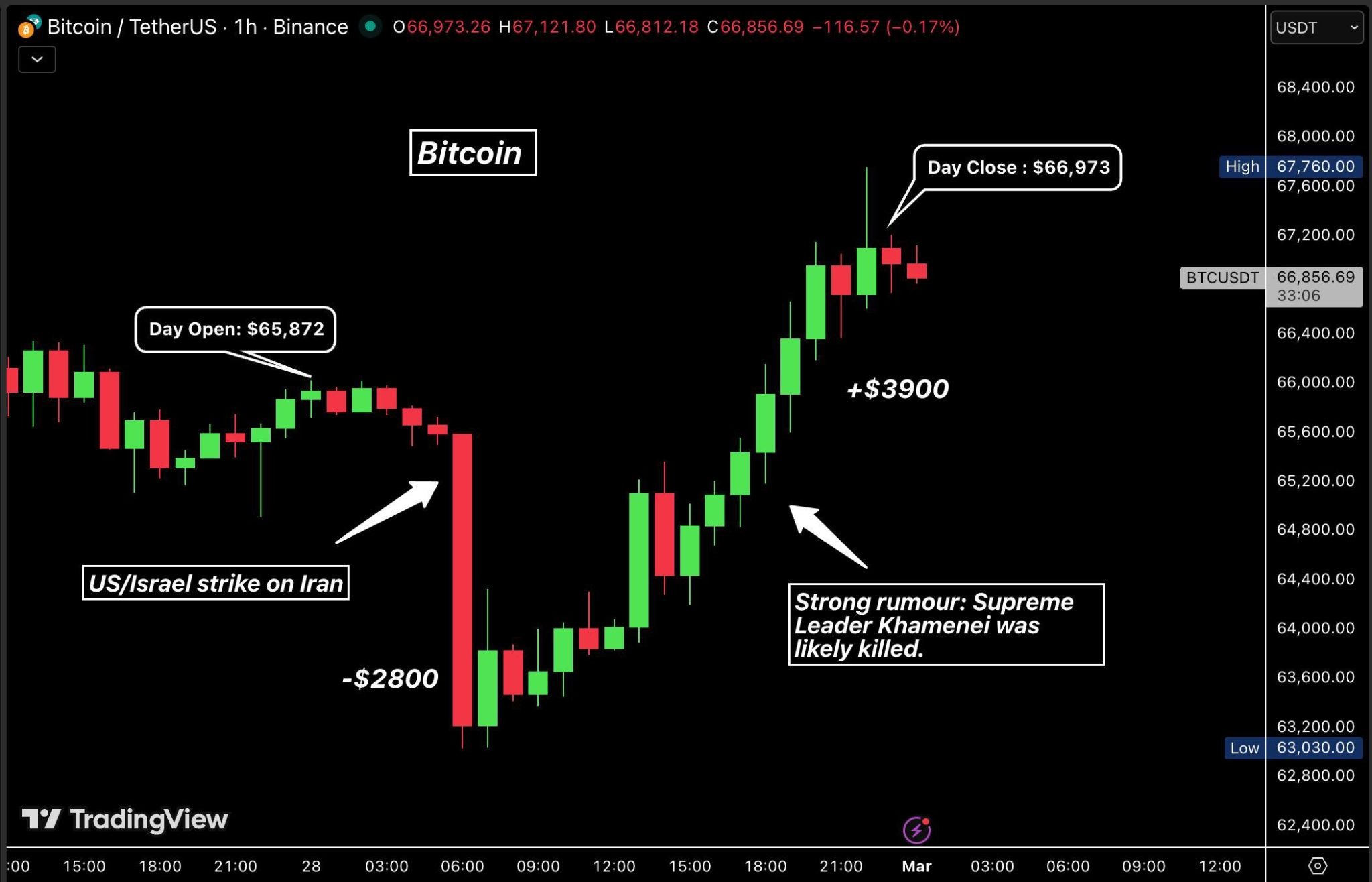
The morning’s trading saw Bitcoin (BTC), the world’s largest cryptocurrency by market capitalization, climb from an approximate low of $62,900 late Tuesday to register around $68,200 at the time of publication. This impressive ascent represented a daily gain of 6.2%, successfully nudging its weekly performance into positive territory. The move above $68,000 is particularly significant, as it positions Bitcoin within striking distance of its all-time highs and reaffirms its resilience after a brief dip. Market analysts had been closely watching the $60,000 to $63,000 range as a critical support zone, and the swift rebound from these levels provided a strong bullish signal. The sustained buying pressure indicates a robust demand foundation, particularly from institutional players leveraging the newly approved spot ETFs.
Ethereum (ETH), the second-largest cryptocurrency, demonstrated even greater strength, outperforming Bitcoin with a remarkable surge of over 10%. This propelled ETH back above the $2,060 mark, solidifying a commendable 4.6% gain for the week. Ethereum’s performance often serves as a barometer for the broader altcoin market, and its strong showing suggests a generalized return of investor confidence beyond just Bitcoin. The anticipation surrounding potential spot Ethereum ETFs in the future may also be contributing to this renewed interest, as investors look for opportunities in assets that could follow Bitcoin’s institutional adoption path.
Beyond the two market leaders, the top-10 crypto assets uniformly experienced upward movement. Solana (SOL) emerged as a standout performer among its peers, registering the most substantial daily gain with an increase exceeding 12%. Solana’s strong performance underscores the continued investor interest in high-throughput blockchain platforms with robust ecosystems. Other notable gainers included Filecoin (FIL), which led the top-100 assets with a surge of over 22%, Polkadot (DOT), climbing almost 22%, and Uniswap’s UNI token, which advanced by 17%. These significant moves across a diverse range of cryptocurrencies indicate that the rally was not confined to a few dominant assets but rather reflected a broader positive sentiment across the digital asset space. Losses, in contrast, were notably contained, with only minor dips recorded for MemeCore (M) and Midnight (NIGHT), indicating a strong buying bias throughout the market.
The Institutional Catalyst: Spot Bitcoin ETF Inflows
A primary driver behind Wednesday’s market uplift was the continued, robust performance of spot Bitcoin exchange-traded funds (ETFs). These financial instruments, which gained regulatory approval in the United States in January 2024, have become a crucial conduit for institutional capital to access Bitcoin without directly holding the underlying asset. On Tuesday, February 24, these spot Bitcoin ETFs collectively recorded an impressive net inflow exceeding $257 million. This substantial capital injection pushed the total net assets under management for these funds to approximately $81.3 billion, underscoring the growing appetite among traditional investors for exposure to digital assets.
The consistent inflows into spot Bitcoin ETFs since their launch have been a game-changer for the cryptocurrency market. They provide a regulated, accessible, and liquid investment vehicle, attracting both institutional funds and retail investors who prefer a traditional brokerage interface. This continuous demand pressure from institutional channels acts as a powerful fundamental tailwind for Bitcoin’s price, helping to absorb selling pressure and establish higher support levels. The sheer volume of assets now managed by these ETFs highlights the mainstreaming of Bitcoin as an investable asset class.
Adding to the positive sentiment, spot Ethereum ETFs also registered net inflows yesterday, totaling $9.23 million. While significantly smaller than Bitcoin ETF inflows, this development is noteworthy as it indicates a nascent institutional interest in Ethereum, potentially anticipating future regulatory clarity and product expansion similar to Bitcoin’s trajectory. The performance of these ETFs is now a key metric closely watched by market participants, as they increasingly dictate short-to-medium term market direction and reflect broader institutional adoption trends.
Navigating Treacherous Waters: Underlying Market Stress Indicators
Despite the impressive rebound in prices, a closer examination of certain on-chain indicators suggests that the market’s footing may still be somewhat unstable, and underlying stress has not fully dissipated. This dichotomy between price action and fundamental health metrics warrants caution from investors.
Analysts at Glassnode, a leading on-chain analytics firm, highlighted a significant development in Bitcoin’s Realized Profit/Loss Ratio (90-day Simple Moving Average). In a recent X post, they pointed out that this critical metric has fallen below 1. This particular threshold is highly significant because a value below 1 signals a shift into an "excess loss-realization regime." In simpler terms, it suggests that on average, investors are currently selling their Bitcoin at a loss, rather than realizing profits. This behavior is often indicative of capitulation or forced selling by weaker hands in the market.
Glassnode’s analysis further elaborated on the historical implications of such a development. "Historically, breaks below 1 have persisted for 6+ months before reclaiming it, a recovery that typically signals a constructive return of liquidity to the market," the analysts wrote. This historical precedent serves as a stark warning, implying that while the recent price bounce is encouraging, the underlying market structure might require a more prolonged period of healing and consolidation before a truly robust, sustained bull run can resume. A prolonged period below this ratio suggests that significant portions of the market are underwater, and it will take time for these positions to either recover or be flushed out entirely.

Further corroborating the sentiment of lingering apprehension, the Crypto Fear and Greed Index, a widely referenced sentiment gauge, although ticking up to 11 from 8 a day earlier, remains firmly entrenched in "extreme fear" territory. This index compiles data from various sources, including volatility, market momentum, social media sentiment, surveys, and dominance, to provide a composite score of overall market psychology. A score in the "extreme fear" range indicates that investors are highly risk-averse, prone to panic selling, and generally pessimistic about future price movements. While the slight increase from 8 to 11 suggests a marginal easing of the most intense fear, it is far from signaling a return to optimism or even neutrality. This persistent fear could cap potential upward movements and make the market vulnerable to sudden corrections if negative news emerges.
Volatility and Liquidations: The Mechanics of a Market Bounce
The recent market rally was accompanied by significant liquidation events, a common occurrence in highly leveraged cryptocurrency markets. Liquidations refer to the forced closing of a trader’s leveraged position by an exchange due to insufficient margin to cover potential losses. These events can cascade, amplifying price movements.
According to data compiled by CoinGlass, a platform specializing in crypto derivatives data, approximately 97,300 traders were liquidated across various exchanges over the past 24 hours. The total value of these liquidations reached a substantial $316.2 million. Crucially, the vast majority of these liquidations, accounting for $258.7 million, were short positions. A "short position" is a bet that the price of an asset will fall. When the price unexpectedly rises sharply, as it did on Wednesday, these short positions become unprofitable and are often automatically closed by the exchange, leading to a surge in buying pressure as traders are forced to buy back the asset to cover their positions. This phenomenon, known as a "short squeeze," can significantly amplify upward price movements, contributing to the speed and magnitude of rallies.
The specific breakdown of liquidations reveals the intensity across different assets. Bitcoin (BTC) liquidations totaled $8.6 million, while Ethereum (ETH) saw slightly over $6 million in liquidations. Solana (SOL) liquidations amounted to $1.6 million. These figures, particularly the dominance of short liquidations, highlight the volatile and often unpredictable nature of the cryptocurrency market, where leveraged trading can lead to rapid price swings. While these liquidations contributed to the immediate upward momentum, they also serve as a reminder of the inherent risks associated with high-leverage trading in a market still exhibiting signs of underlying stress.
Broader Economic Landscape and Geopolitical Crosscurrents
The cryptocurrency market does not operate in a vacuum; it is significantly influenced by the broader macroeconomic environment and geopolitical developments. On the macro side, U.S. Treasury yields experienced a slight uptick as investors processed the implications of former President Donald Trump’s State of the Union address. During his address, Trump heavily emphasized economic policy, floating various ideas ranging from a government-backed retirement plan to restrictions on institutional home buying, as reported by CNBC. While not directly crypto-related, such policy proposals can influence broader market sentiment, investor confidence, and inflation expectations, all of which indirectly affect risk assets like cryptocurrencies. Higher Treasury yields can sometimes divert capital away from riskier assets, as government bonds offer a relatively safe return.
Looking ahead, market attention is keenly focused on upcoming U.S. economic data releases, which could provide further clues about the Federal Reserve’s monetary policy trajectory and the overall health of the economy. Key reports include the weekly initial jobless claims, due on Thursday, which will offer insights into the labor market’s strength. Following this, the producer price index (PPI) report, scheduled for Friday, will be closely scrutinized for indications of inflationary pressures at the wholesale level. Both jobless claims and PPI are critical inputs for the Federal Reserve’s decision-making process regarding interest rates, which profoundly impact liquidity and investor appetite for risk assets.
Furthermore, traders and investors continue to monitor evolving geopolitical developments, particularly those involving the U.S. and Iran. Geopolitical tensions can introduce significant uncertainty into global financial markets, often leading investors to seek safe-haven assets or reduce exposure to volatile assets like cryptocurrencies. Any escalation or de-escalation in these tensions could have ripple effects across commodities, traditional equities, and consequently, the digital asset space. The interplay of these economic data points and geopolitical events will continue to shape investor sentiment and market dynamics in the coming weeks, adding layers of complexity to the cryptocurrency market’s short-term outlook.
Analyst Perspectives and Forward-Looking Implications
The current market rally presents a complex picture, one that analysts are carefully dissecting. On one hand, the strong price performance of Bitcoin and Ethereum, coupled with robust ETF inflows, clearly signals renewed institutional interest and a healthy demand side. The ability of major cryptocurrencies to reclaim key psychological levels after a brief downturn suggests underlying strength and resilience in the face of recent selling pressure. This could be interpreted as a bullish consolidation phase, where dips are quickly bought up, indicating conviction among market participants.
However, the persistent warnings from on-chain indicators, such as Glassnode’s Realized Profit/Loss Ratio falling below 1, and the Crypto Fear and Greed Index remaining in "extreme fear," temper much of the immediate optimism. These metrics suggest that while prices are rising, the market structure might still be fragile. The implication is that the current rally could be a relief bounce rather than the start of a sustained bull run, particularly if the fundamental indicators don’t improve over a longer period. Analysts would typically look for a recovery in the Realized Profit/Loss Ratio back above 1, coupled with a shift in the Fear and Greed Index towards "neutral" or "greed," to confirm a more robust and sustainable market uptrend.
The dual nature of the current rally—strong price action contrasted with cautionary underlying metrics—means that investors should approach the market with a degree of prudence. While the momentum is undeniably positive in the short term, the potential for prolonged periods of loss realization, as indicated by Glassnode, suggests that significant volatility could persist. The influence of macro factors, including inflation data, interest rate expectations, and geopolitical stability, will also continue to play a pivotal role in shaping the trajectory of the crypto market. The interplay of these factors will dictate whether the recent bounce evolves into a broader recovery or if the market experiences further consolidation before truly finding stable footing for its next major move. The coming weeks, with key economic data releases and ongoing geopolitical dynamics, will be crucial in determining the market’s path forward and providing clearer signals for investor sentiment and liquidity.