admin
admin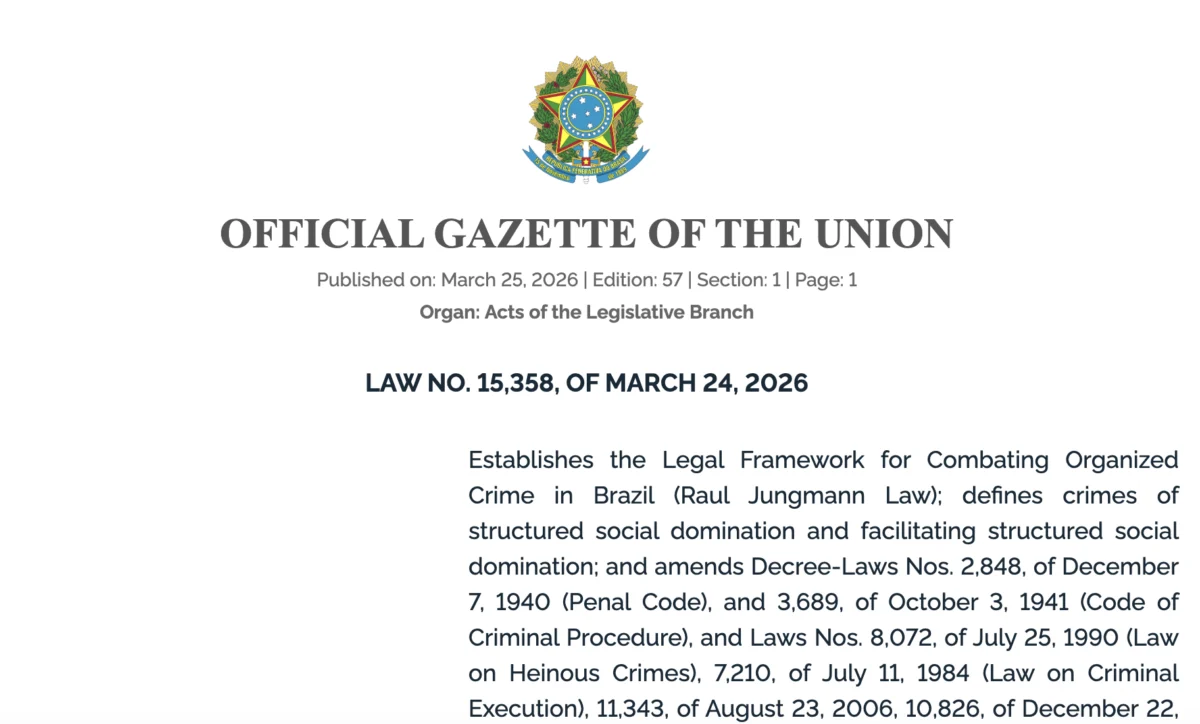
Brazil has enacted a pivotal legislative measure, Law No. 15.358, empowering its public security agencies with a novel and potent tool in the relentless fight against organized crime: the direct use of confiscated cryptocurrency. The law, officially published by Brazil’s legislative branch on Wednesday, March 24, 2026, establishes a comprehensive legal framework that not only permits authorities to prohibit transactions on crypto exchanges by classifying digital assets as instruments of crime but also allows for the direct appropriation of these assets to bolster public security initiatives. This development marks a significant escalation in the nation’s strategy to combat illicit activities in the digital realm, providing law enforcement with unprecedented resources drawn directly from the proceeds of criminal enterprises.
A New Era in Combating Digital Crime
The newly ratified Law No. 15.358 represents a bold step by Brazil to adapt its legal and operational capabilities to the evolving landscape of organized crime, which increasingly leverages the anonymity and global reach of cryptocurrencies. The core tenet of the legislation redefines "instruments of crime" to encompass any asset utilized in the commission of an offense, irrespective of whether its primary purpose was illicit. This broad interpretation explicitly includes digital assets, allowing for their forfeiture. Crucially, the law outlines a clear mechanism for the utilization of these forfeited assets, stating, "The forfeited assets and valuables may be used provisionally by public security agencies for police re-equipment, training, and special operations, subject to authorization from the judge overseeing the execution of the sentence." This provision signifies a direct and immediate impact on the operational capacity of Brazil’s law enforcement, moving beyond traditional asset forfeiture methods that often involve lengthy liquidation processes and bureaucratic hurdles.
The legislation reflects a growing global recognition among governments that cryptocurrencies, while offering innovative financial solutions, have also become a preferred medium for money laundering, drug trafficking, cybercrime, and other transnational criminal activities. By allowing confiscated crypto to be directly funneled into police budgets, Brazil aims to create a self-sustaining deterrent, where the very tools of crime are turned against their perpetrators to fund enhanced security measures. This innovative approach stands in contrast to some other nations, like the United States, where seized digital assets are often held in national stockpiles or liquidated through auctions, with proceeds sometimes entering general government funds rather than being directly earmarked for specific public security enhancements.
The Context: Brazil’s Battle Against Organized Crime and Crypto Illicit Flows
Brazil, a nation of over 213 million people, has long grappled with formidable challenges posed by organized crime, ranging from drug cartels to sophisticated financial fraud networks. The pervasive adoption of cryptocurrencies among its populace, while indicative of technological embracing, has also opened new avenues for criminal organizations to operate with greater impunity, facilitating faster, harder-to-trace transactions across borders. Estimates suggest a significant portion of the Brazilian population engages with cryptocurrencies, making the nation a fertile ground for both legitimate innovation and illicit exploitation of digital assets.
The urgency for such legislation has been underscored by high-profile cases illustrating the scale of crypto-enabled crime. A prime example is the Brazilian Federal Police’s "Operation Lusocoin" in 2025. This massive crackdown targeted an elaborate money laundering and foreign exchange evasion architecture that, according to reports from TRM Labs, moved tens of billions of Brazilian reais. The illicit network reportedly operated through a complex web of shell companies, over-the-counter (OTC) crypto brokers, and non-custodial wallets, showcasing the sophisticated methods employed by criminal groups to obfuscate their financial trails using digital assets. The sheer volume of funds involved in Operation Lusocoin highlighted the critical need for law enforcement to not only track and seize these digital assets but also to integrate them into their operational capabilities more effectively.
Before the formalization of Law No. 15.358, Brazilian authorities faced significant challenges in managing and utilizing seized digital assets. The absence of a clear legal framework often meant that the process of confiscation, valuation, and subsequent use of cryptocurrencies was cumbersome, lengthy, and not directly aligned with the immediate needs of public security agencies. This new law streamlines the process, ensuring that the resources generated from criminal activities are quickly repurposed to fight the very crimes they funded.
Chronology of Legislative and Policy Developments
The passage of Law No. 15.358 is not an isolated event but rather a culmination of ongoing efforts and discussions within Brazil’s legislative and executive branches concerning digital assets and their regulation.
- 2024: Initial discussions and legislative proposals began to emerge, recognizing the increasing role of cryptocurrencies in the national economy and, concurrently, in criminal activities. This period saw the first introduction of a bill proposing a national Bitcoin (BTC) reserve.
- August 2025: Brazil’s government engaged in significant debate, with the Lower House holding hearings on a proposal to create a national Bitcoin reserve. This initiative aimed to allocate up to 5% of the country’s treasury to purchase Bitcoin, signaling a potential shift towards sovereign digital asset holdings.
- February 2026: Lawmakers reintroduced the Bitcoin reserve legislation, notably expanding its scope to allow for the purchase of up to one million BTC. This reintroduction indicated sustained interest in exploring Bitcoin as a strategic national asset, though its passage remained uncertain as of March 2026.
- March 2026: The legislative branch officially published Law No. 15.358, establishing the legal framework for using confiscated cryptocurrency in public security operations. This marks a definitive step in Brazil’s approach to digital assets in the context of crime.
- Contemporaneous Discussions: The signing of Law No. 15.358 occurred amidst broader policy discussions regarding cryptocurrency. Brazil’s Finance Minister, Dario Durigan, had reportedly planned to delay talks on changing the country’s tax policy on crypto until after the presidential election in October. This strategic deferral aimed to avoid potentially divisive policy changes in an election year, highlighting the political sensitivities surrounding cryptocurrency regulation in Brazil. The focus on combating crime through asset forfeiture, therefore, emerged as a more immediate and politically viable legislative priority.
Defining "Instrument of Crime" and Legal Ramifications
The broad definition of "instrument of crime" within Law No. 15.358 is a critical aspect of its efficacy. By explicitly stating that "any asset that has been used to commit a crime shall be considered an instrument of the crime, even if it was not intended exclusively for that purpose," the law closes potential loopholes that criminals might exploit. This expansive interpretation ensures that even legitimate digital assets, if temporarily or incidentally used in a criminal scheme, can be subject to forfeiture. This aligns with modern legal principles in asset forfeiture, where the focus shifts from the intent behind acquiring an asset to its actual use in facilitating illicit activities.
The law mandates judicial oversight for the provisional use of forfeited assets. This means that while public security agencies can access these funds for re-equipment, training, and special operations, such use is contingent upon authorization from the judge overseeing the execution of the sentence. This judicial safeguard is crucial for maintaining due process, preventing arbitrary seizures, and ensuring accountability in how these significant resources are managed and deployed. It also underscores the complexity of integrating a volatile asset class like cryptocurrency into public finance, necessitating careful legal and financial stewardship.

International Cooperation: A Globalized Response to Global Crime
A particularly significant provision of Law No. 15.358 is its authorization for Brazil to coordinate and cooperate with international authorities for investigation and asset recovery, specifically including cases involving digital assets. This provision acknowledges the inherently transnational nature of cryptocurrency-related crime. Criminal networks often operate across borders, utilizing exchanges and wallets in multiple jurisdictions to obscure their activities. Effective prosecution and asset recovery in such cases demand robust international collaboration.
By formally sanctioning cooperation, Brazil positions itself as a proactive partner in the global fight against cybercrime and financial illicit flows. This could involve intelligence sharing, joint investigations, and coordinated asset freezing and forfeiture operations with law enforcement agencies in other countries. Given the global reach of major cryptocurrency exchanges and the decentralized nature of many digital assets, this international dimension is indispensable for the law’s long-term success. It enables Brazil to extend its investigative arm beyond national borders, pursuing criminal assets wherever they may reside in the digital landscape.
Implications for Brazil’s Public Security and Digital Asset Landscape
The immediate and profound implication of Law No. 15.358 is the direct enhancement of Brazil’s public security capabilities. The ability to fund police re-equipment, training, and special operations with confiscated crypto means a direct investment in the tools and expertise needed to combat sophisticated criminal organizations. This could translate into:
- Technological Upgrades: Acquisition of advanced forensic tools for blockchain analysis, secure communication systems, and modern surveillance technologies.
- Specialized Training: Development of highly skilled units focused on cybercrime investigation, digital asset tracing, and cryptocurrency seizure techniques.
- Operational Capacity: Funding for complex, long-term operations targeting major criminal networks, potentially reducing reliance on traditional budget allocations that might be subject to delays or limitations.
From a broader perspective, this legislation sends a clear message to both legitimate cryptocurrency users and criminal elements within Brazil. For legitimate users and businesses, it signals the government’s commitment to creating a more secure digital environment by cracking down on illicit activities. For criminals, it represents a significant escalation in the risks associated with using digital assets for illicit purposes, as their ill-gotten gains can now be directly repurposed to strengthen law enforcement.
However, the implementation of this law will not be without its challenges. The inherent volatility of cryptocurrencies presents a unique problem for asset management. The value of seized assets can fluctuate dramatically, impacting the actual resources available to public security agencies. Authorities will need robust protocols for the secure custody, valuation, and timely conversion or utilization of these assets to maximize their impact. Furthermore, the technical expertise required to manage and utilize diverse digital assets, from Bitcoin to various altcoins, will necessitate continuous investment in human capital and technological infrastructure.
A Comparative Look: Brazil vs. Global Approaches
Brazil’s approach, funneling confiscated crypto directly into public security measures, presents an interesting contrast to some other nations. In the United States, for instance, seized cryptocurrencies are often held by agencies like the Department of Justice or the Internal Revenue Service. While some proceeds might eventually fund law enforcement activities, there’s also a trend towards maintaining these assets as part of a national digital asset stockpile. The US government has, at times, become one of the largest holders of Bitcoin and other cryptocurrencies due to its extensive forfeiture operations. The decision on whether to liquidate these assets or hold them often depends on market conditions and strategic considerations.
Brazil’s direct-to-security funding model emphasizes immediate operational impact over potential long-term investment or market speculation. This could be seen as a pragmatic response to pressing domestic security concerns, prioritizing tangible improvements in law enforcement capabilities. Countries in the European Union are also developing diverse frameworks, with some nations focusing on immediate liquidation and others exploring more sophisticated management strategies for seized digital assets. Brazil’s model adds another distinct approach to the evolving global playbook for managing crypto-related crime.
The Future Outlook for Brazil’s Digital Asset Regulation
While Law No. 15.358 specifically addresses the criminal exploitation of digital assets, its passage is intricately linked to the broader regulatory trajectory of cryptocurrencies in Brazil. The ongoing discussions around a national Bitcoin reserve, despite its uncertain future, indicate a governmental willingness to engage with digital assets at a strategic level beyond just crime fighting. Should the Bitcoin reserve bill gain sufficient support, it could position Brazil as a pioneering nation in sovereign digital asset management, adding another layer of complexity and innovation to its financial policies.
The deferral of crypto tax policy discussions until after the October presidential election also suggests that the regulatory environment for digital assets is still very much in flux. The current law, focused on law enforcement, may lay foundational groundwork, but the comprehensive integration of cryptocurrencies into Brazil’s financial and legal systems will require further legislative and executive action. This includes clarifying regulatory frameworks for exchanges, defining investor protections, and establishing robust compliance standards for businesses operating in the crypto space.
In conclusion, Law No. 15.358 represents a significant milestone in Brazil’s efforts to modernize its approach to combating organized crime. By directly leveraging confiscated cryptocurrency to fund public security initiatives, Brazil is not only strengthening its law enforcement agencies but also sending a powerful message about its commitment to addressing the challenges posed by the digital frontier of crime. The success of this innovative legal framework will depend on its effective implementation, robust judicial oversight, and continued international collaboration, ultimately shaping Brazil’s position at the forefront of digital asset regulation and enforcement.