Dwi Wanna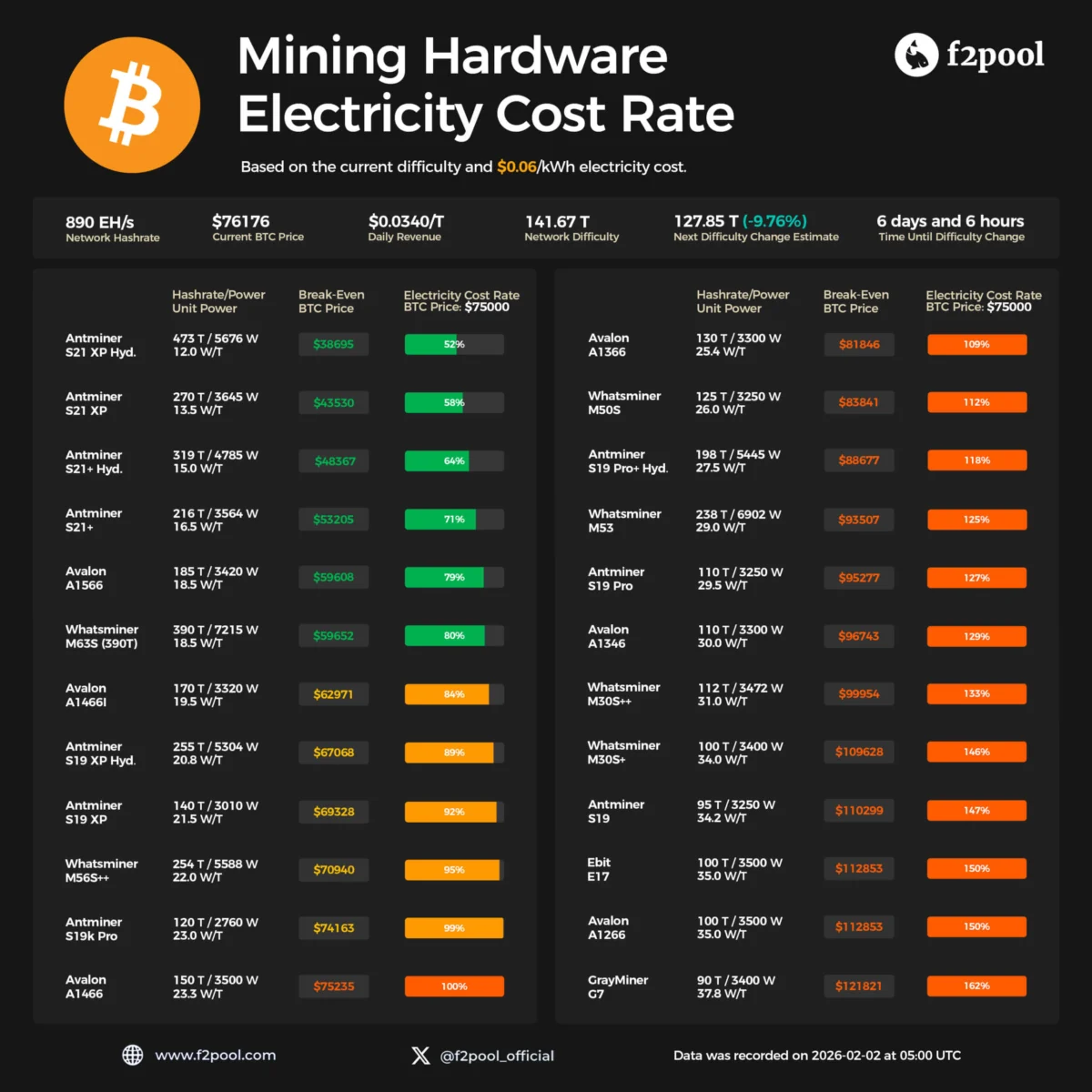
The industrial backbone of the Bitcoin network is currently navigating a period of intense financial turbulence as the market euphoria that defined the record highs of late 2024 gives way to a harsh economic reset. According to the latest market data, Bitcoin is trading in the vicinity of $78,000, marking a significant 38% decline from its all-time high of approximately $126,000 reached just four months ago. While retail investors often view such fluctuations through the lens of standard market volatility, the situation within the global mining sector suggests a more systemic crisis. The convergence of a plummeting asset price, stubbornly high network difficulty, and escalating global energy costs has created an environment described by analysts as a "perfect storm" for mining operators.
The financial strain is becoming increasingly visible in the network’s technical metrics. Analytics firm CryptoQuant recently characterized Bitcoin miners as being "extremely underpaid," noting that the profit-and-loss sustainability index has slumped to 21—the lowest reading recorded since the fourth quarter of 2024. This lack of profitability has forced a growing number of operators to disconnect less efficient hardware, leading to a 12% decline in total network hashrate since November. This represents the most significant drawdown in processing power since the 2021 mining ban in China, leaving the network at its lowest security level since September 2025.
The Chronology of a Market Correction
The current crisis did not emerge in a vacuum but is the result of a series of compounding factors that began in the fourth quarter of 2024. In October, Bitcoin reached a zenith of $126,000, a milestone that incentivized a massive influx of new mining hardware. This surge in participation drove network difficulty to record levels, as the protocol’s self-adjusting mechanism responded to the increased hashrate. However, the subsequent price correction caught many highly leveraged operators off guard.
By December 2024, as prices dipped below the $100,000 threshold, the "security budget"—the total value of block subsidies and transaction fees—began to contract. The situation was further exacerbated by seasonal energy demand and winter storms in the Northern Hemisphere, which forced several large-scale U.S. miners to curtail operations to stabilize local power grids. What was initially viewed as a temporary operational pause has, in many cases, turned into a permanent shutdown as the Bitcoin price failed to recover, eventually sliding toward the $75,000 mark by early February 2025.
Analyzing the Economics of Miner Capitulation
The current revenue compression is best illustrated by the "hashprice"—a metric that measures the expected value of 1 petahash per second (PH/s) of hashing power per day. Data from Luxor Technology’s Hashrate Index shows that the spot hashprice, which hovered near $39 per PH/s only months ago, has now fallen to an all-time low of approximately $34 per PH/s.
Figures provided by the mining pool f2pool on February 2 further highlight the severity of the situation. At a Bitcoin price of approximately $76,176 and a network hashrate of 890 exahashes per second (EH/s), a miner paying a mainstream industrial electricity rate of $0.06 per kilowatt-hour (kWh) earns only about $0.034 per terahash (TH) daily. When these figures are applied to specific hardware models, the results are stark:
- Antminer S21 XP Hydro: As the most efficient unit currently available, this machine draws 5,676 watts to produce 473 TH/s. At a $75,000 Bitcoin price, electricity costs consume roughly 52% of its revenue.
- Antminer S19 XP / Avalon A1466i: These mid-generation rigs see their electricity cost rates soar to between 92% and 100%, leaving virtually no margin for operational expenses or debt servicing.
- Legacy Hardware (S19 Pro, M50S, Avalon A1366): These models have become "underwater," with electricity costs ranging from 109% to 162% of the revenue they generate.
In practical terms, a vast majority of the global mining fleet is currently operating at a cash loss. For many publicly traded mining firms, the inability to cover even the basic cost of power has necessitated a radical shift in corporate strategy.
The Strategic Pivot to Artificial Intelligence
Unlike previous market cycles where distressed miners had few options other than to wait for a price recovery, the current landscape offers a lucrative alternative. The infrastructure required for Bitcoin mining—high-voltage power connections, advanced cooling systems, and large-scale data centers—is remarkably similar to the requirements for high-performance computing (HPC) and Artificial Intelligence (AI) workloads.

This has led to the emergence of an "AI escape hatch." As Bitcoin mining profitability wanes, operators are increasingly repurposing their facilities to host GPUs for AI training and inference. CoreWeave, a firm that transitioned from mining to "neocloud" services, has become the blueprint for this evolution. Recently, CoreWeave secured a $2 billion investment from Nvidia to expand its data center footprint, emphasizing the value of power contracts over Bitcoin ASICs.
Other major players are following suit. Hut 8, a prominent Canadian operator, recently finalized a 15-year lease for a 245-megawatt AI data center at its River Bend campus. The deal is valued at approximately $7 billion, providing the company with stable, long-term cash flows that are decoupled from the volatility of the cryptocurrency markets. For shareholders, this pivot represents a rational hedge against Bitcoin’s cyclicality, as AI infrastructure currently commands a significant valuation premium.
Implications for Bitcoin Network Security
The migration of hashrate from Bitcoin to AI compute raises critical questions regarding the long-term security model of the network. Jeff Feng, co-founder of Sei Labs, has described this period as "the biggest bitcoin miner capitulation since 2021," noting that the permanent reallocation of power to AI data centers could hinder future hashrate growth. Once a facility is re-equipped with GPUs and locked into long-term AI contracts, that energy capacity is effectively removed from the Bitcoin ecosystem.
While the Bitcoin network remains the most secure decentralized computer system in the world, a sustained decline in hashrate theoretically lowers the cost of a "51% attack." Furthermore, the exit of smaller, less efficient operators tends to centralize block production among a handful of ultra-efficient, well-capitalized firms. This concentration of power could potentially introduce new fragilities into a system designed for maximum decentralization.
Industry experts suggest that if the "security budget" remains under pressure, the network may need to accelerate its transition to a fee-based revenue model. This would require a significant increase in on-chain transaction volume or the adoption of higher-value settlement use cases to compensate for the diminishing real-world value of the block subsidy.
Future Outlook and Industry Responses
The path forward for Bitcoin miners likely involves a combination of consolidation and technological adaptation. Market observers expect to see a wave of mergers and acquisitions, as larger firms with healthier balance sheets acquire the distressed assets of failing competitors. This "quiet consolidation" would allow the most efficient operators to capture a larger share of the remaining rewards.
Institutional responses are also beginning to take shape. Some investment funds that hold spot Bitcoin ETFs are reportedly monitoring the hashrate decline with concern, viewing network security as a fundamental component of the asset’s value proposition. There is growing speculation that the industry may eventually develop formal mechanisms to support the security budget, such as tiered transaction fees or incentive programs for miners who provide grid-stabilization services.
Ultimately, the f2pool dashboard and the Hashrate Index serve as real-time barometers of a global negotiation between energy producers and the digital economy. At a rate of 3.5 cents per terahash per day, the Bitcoin network is currently testing the limits of how much its participants are willing to pay for decentralized security in an increasingly competitive market for electricity. Whether the network can retain its industrial base or will be forced to cede ground to the burgeoning AI sector will be the defining narrative of the mining industry in 2025 and beyond.