Dwi Wanna
The Anatomy of Miner Stress and the AISC Threshold
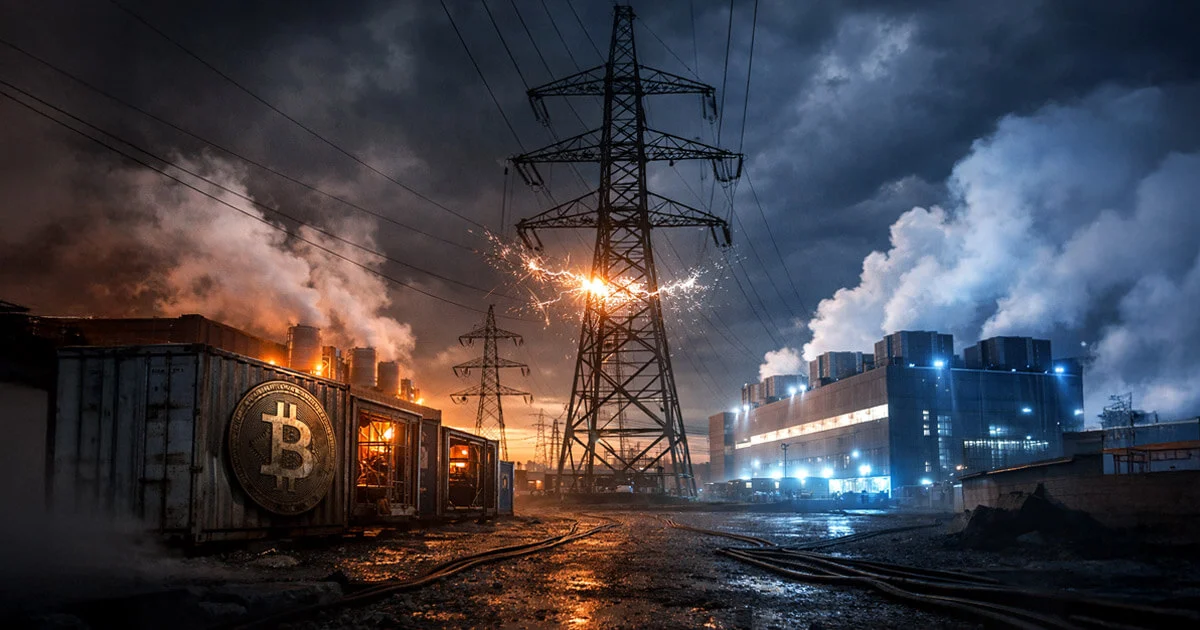
In the current market environment, the Bitcoin hashrate ribbon—a metric that tracks the moving averages of the network’s computational power—has entered a state of inversion. This technical signal historically indicates that miners are taking hardware offline because the cost of operation exceeds the rewards generated. With Bitcoin trading in a range that frequently dips below the estimated average AISC of $90,000, the industry is navigating a period of significant "capitulation."
The term All-In Sustaining Cost is borrowed from the traditional gold mining industry and serves as a comprehensive benchmark for survival. It is not merely a measure of the electricity required to keep a machine humming; rather, it is the total cost required to keep a mining operation viable over the long term.
To understand why the $90,000 level is so critical, one must examine the three distinct layers of AISC:
- Direct Operating Cash Costs: This is the base layer, dominated by electricity expenses. For many industrial-scale miners, power contracts are fixed, but for those exposed to spot pricing or hosting fees, the margins are razor-thin. This layer also includes the "boots on the ground"—the technicians, security, and facility managers required to maintain massive data centers.
- Sustaining Capital Expenditure (CAPEX): Mining is often described as a "Red Queen’s Race," where one must run as fast as possible just to stay in the same place. Sustaining CAPEX covers the replacement of failing fans, the repair of degraded hashboards, and the necessary upgrades to more efficient hardware as the network difficulty rises. If a miner cannot afford to upgrade their fleet, their share of the global hashrate—and thus their revenue—slowly evaporates.
- Corporate and Financing Costs: This final layer is particularly relevant for the growing cohort of publicly traded mining firms. Interest payments on debt, liquidity requirements for loan covenants, and the overhead of maintaining a listed company add a significant burden that smaller, private operators may not face.
When the price of Bitcoin falls below this multi-layered $90,000 threshold, the "center of mass" for the mining industry becomes uncomfortable. However, because every miner operates under a different cost structure, the response is rarely a uniform "dump" of assets.
A Chronology of the 2024 Post-Halving Landscape
The current stress is the direct result of a sequence of events that began with the fourth Bitcoin halving in April 2024. This event cut the block subsidy from 6.25 BTC to 3.125 BTC, effectively doubling the production cost for every coin mined overnight.
- Q2 2024: Following the halving, the network saw an initial dip in hashrate as older, less efficient machines (such as the Antminer S19 series) became unprofitable. Miners relied on high transaction fees driven by new protocols like Ordinals and Runes to bridge the revenue gap.
- Q3 2024: As transaction fees normalized, the focus shifted entirely to operational efficiency. Large public miners began aggressive fleet upgrades, moving toward the Bitmain S21 and T21 models, which offer significantly better joules-per-terahash efficiency.
- Q4 2024 – Q1 2025: The network hashrate reached new all-time highs as the "big players" consolidated their positions. However, this increased competition drove the mining difficulty to record levels. When the price of Bitcoin failed to maintain a comfortable margin above the $90,000 AISC, the industry entered the current phase of capitulation.
This timeline demonstrates that miner stress is not a sudden accident but a structural phase of the Bitcoin cycle. The "bleeding" at $90,000 is the market’s way of purging the least efficient operators.

The Mathematical Limits of a "Death Spiral"
The fear of a miner-led market crash often ignores the hard numbers governing how much Bitcoin miners actually control. According to data from Glassnode, total miner holdings currently sit at approximately 50,000 BTC. While this represents billions of dollars in value, it is not an infinite supply.
The "dump math" can be broken down into two primary sources: new issuance and existing inventory.
New Issuance: The Daily Flow
Post-halving, the Bitcoin network produces approximately 450 new BTC per day. This amounts to roughly 13,500 BTC per month. If every single miner were forced to sell 100% of their daily production just to keep the lights on, the market would need to absorb 450 BTC of selling pressure daily.
Inventory: The Stockpile
The 50,000 BTC held in miner treasuries represents the "buffer" that companies use to survive lean times. In a severe stress scenario, miners might tap into these reserves. If miners were to liquidate 30% of their total inventory over a 90-day period of extreme duress, that would add approximately 167 BTC to the daily selling pressure.
When combined, even in a "severe stress" case where 100% of new issuance is sold alongside a significant portion of the treasury, the total daily selling pressure would be roughly 617 BTC.
To put this number into perspective, it is useful to compare it to the flows seen in Bitcoin Exchange-Traded Funds (ETFs). A $100 million inflow or outflow day for a major ETF like BlackRock’s IBIT is common. At a price of $90,000, $100 million represents approximately 1,111 BTC. Thus, the maximum possible "forced" selling from the entire mining industry is only about half of what the market frequently absorbs from a single day of ETF volatility.
Institutional and Strategic Responses
The mining industry of today is vastly different from the hobbyist or small-scale operations of 2018 or 2020. Modern miners have developed sophisticated tools to manage financial stress, which prevents them from having to "market dump" their coins during price dips.

1. The AI and HPC Pivot:
A significant trend among public miners, such as Core Scientific and Iris Energy (IREN), is the diversification into High-Performance Computing (HPC) and Artificial Intelligence data centers. By leveraging their existing power infrastructure for AI workloads, these companies create a non-volatile revenue stream that can subsidize their Bitcoin mining operations during periods of low profitability.
2. Grid Curtailment and Energy Arbitrage:
Miners in regions like Texas have become integral to the energy grid. By participating in demand-response programs, they receive payments from grid operators to turn off their machines during peak demand. In many cases, these "curtailment credits" can be more profitable than the mining itself, allowing companies to maintain cash flow without selling their Bitcoin.
3. Over-the-Counter (OTC) and Forward Sales:
Sophisticated miners rarely sell their holdings on public exchanges. Instead, they use OTC desks or enter into forward-sale contracts. These methods allow for the liquidation of large amounts of Bitcoin without directly impacting the spot price on retail exchanges.
Broader Impact and Market Implications
The "death spiral" theory suggests that as miners shut down, the network becomes less secure, leading to a loss of confidence and a further price drop. However, the Bitcoin protocol includes a self-correcting mechanism: the Difficulty Adjustment.
Every 2,016 blocks (roughly every two weeks), the network evaluates how fast blocks are being found. If miners have shut down and blocks are arriving too slowly, the difficulty automatically drops. This makes it easier and cheaper for the remaining miners to find blocks, instantly lowering their AISC and restoring profitability. This "hard ceiling" on the death spiral is one of the most elegant features of the Bitcoin whitepaper.
In the current context, if Bitcoin remains below $90,000 for an extended period, we should expect:
- Hashrate Consolidation: A migration of hashrate from inefficient, high-cost operators to well-capitalized, low-cost industrial miners.
- Mergers and Acquisitions: Larger public miners with access to capital markets may acquire struggling private mines at a discount.
- Increased Network Stability: As the least efficient hardware is purged, the remaining network is composed of the most resilient and modern machines, creating a more stable floor for the next market cycle.
Ultimately, while miners are indeed feeling the heat at $90,000, the narrative of a catastrophic industry collapse is not supported by the data. The combined pressure of daily issuance and treasury liquidations remains a manageable fraction of total market liquidity. The "death spiral" is not a terminal event, but a periodic rebalancing that ensures only the most efficient and strategically diverse operators survive to secure the network. The math, rather than the mood of the market, remains the final arbiter of Bitcoin’s industrial health.