
 admin
admin
The journey into the burgeoning world of digital assets demands careful consideration of one’s chosen trading partner. For beginners, an intuitive interface and strong educational resources are often key, while advanced traders prioritize sophisticated tools, deep liquidity, and competitive fee structures. Beyond these user-centric preferences, the overarching shadow of U.S. regulatory oversight dictates much of what is accessible. Federal bodies like the Securities and Exchange Commission (SEC), the Commodity Futures Trading Commission (CFTC), and the Financial Crimes Enforcement Network (FinCEN) each play a role in shaping the operational parameters for crypto exchanges, leading to a fragmented and evolving regulatory environment. This guide aims to demystify these complexities, offering a detailed breakdown of the leading U.S. crypto trading platforms to empower investors with the knowledge needed for informed decision-making.
The Evolving Regulatory Tapestry of U.S. Crypto Markets
The United States has long grappled with how to classify and regulate cryptocurrencies, resulting in a patchwork of federal and state laws that can be bewildering. Initially, many cryptocurrencies operated in a grey area, but over the past decade, various agencies have asserted jurisdiction. The SEC, for instance, has often viewed many digital assets as unregistered securities, leading to enforcement actions against platforms and token issuers. Conversely, the CFTC has categorized Bitcoin and Ethereum as commodities, overseeing their futures markets. FinCEN, under the Treasury Department, primarily focuses on anti-money laundering (AML) and know-your-customer (KYC) compliance, treating exchanges as money service businesses (MSBs).

This multi-pronged regulatory approach means that exchanges operating in the U.S. must navigate a complex compliance matrix. They often require specific state-level money transmitter licenses in addition to federal registrations, which can be costly and time-consuming to acquire and maintain. This stringent environment explains why many international exchanges either entirely avoid the U.S. market or operate through highly restricted U.S.-specific subsidiaries. The implication for American investors is a reduced selection of platforms compared to global markets, but with the trade-off of potentially enhanced consumer protections and greater operational stability from regulated entities. The recent history, marked by high-profile collapses of unregulated or loosely regulated entities, has only amplified the call for robust oversight, reinforcing the value of choosing a fully compliant exchange.
Best Crypto Exchanges in the US at a Glance
| Exchanges | Available Coins | Trading Fee | US License | Best For |
|---|---|---|---|---|
| Coinbase | 200+ | 0.00% – 0.05% maker, 0.01% to 0.60% taker fee | Yes | Beginners and secure trading |
| Kraken | 120+ | 0.16-0.26% Pro; 1% instant | Yes | Advanced traders and margin trading |
| Gemini | 100+ | 0.50% basic fee | Yes | Regulatory compliance |
| Binance.US | 130+ | 0% / 0.01% maker fees/taker fees | Yes | Low-fee trading and high liquidity |
| Uphold | 300+ | 0.8%–1.2% | Yes | Multi-asset trading and cross-asset transfers |
| Robinhood | 20+ | 0% commission (spread) | Yes | Stock and crypto investors |
| Crypto.com | 400+ | 0.075% maker/taker | Yes | Staking rewards and mobile-first users |
| eToro | 100+ | 1% | Yes | Social and copy trading |
| Bitstamp | 70+ | 0.30%/0.40% maker/taker | Yes | Simple and reliable trading |
| OKX | 350+ | 0.08-0.10% | Yes | Advanced cryptocurrency trading and derivatives |
10 Best Crypto Platforms in the US: Top Picks Review
1. Coinbase – Best for beginners and secure trading
Coinbase stands as one of the most widely recognized and utilized cryptocurrency trading platforms in the U.S., particularly favored by beginners due to its user-friendly interface and robust focus on regulatory compliance and security. Established in 2012, Coinbase has played a pivotal role in mainstream crypto adoption, growing into a publicly traded company on Nasdaq (COIN). Its reputation for security, including extensive cold storage for customer assets and FDIC insurance for USD balances, appeals strongly to security-conscious investors.
Key Features:
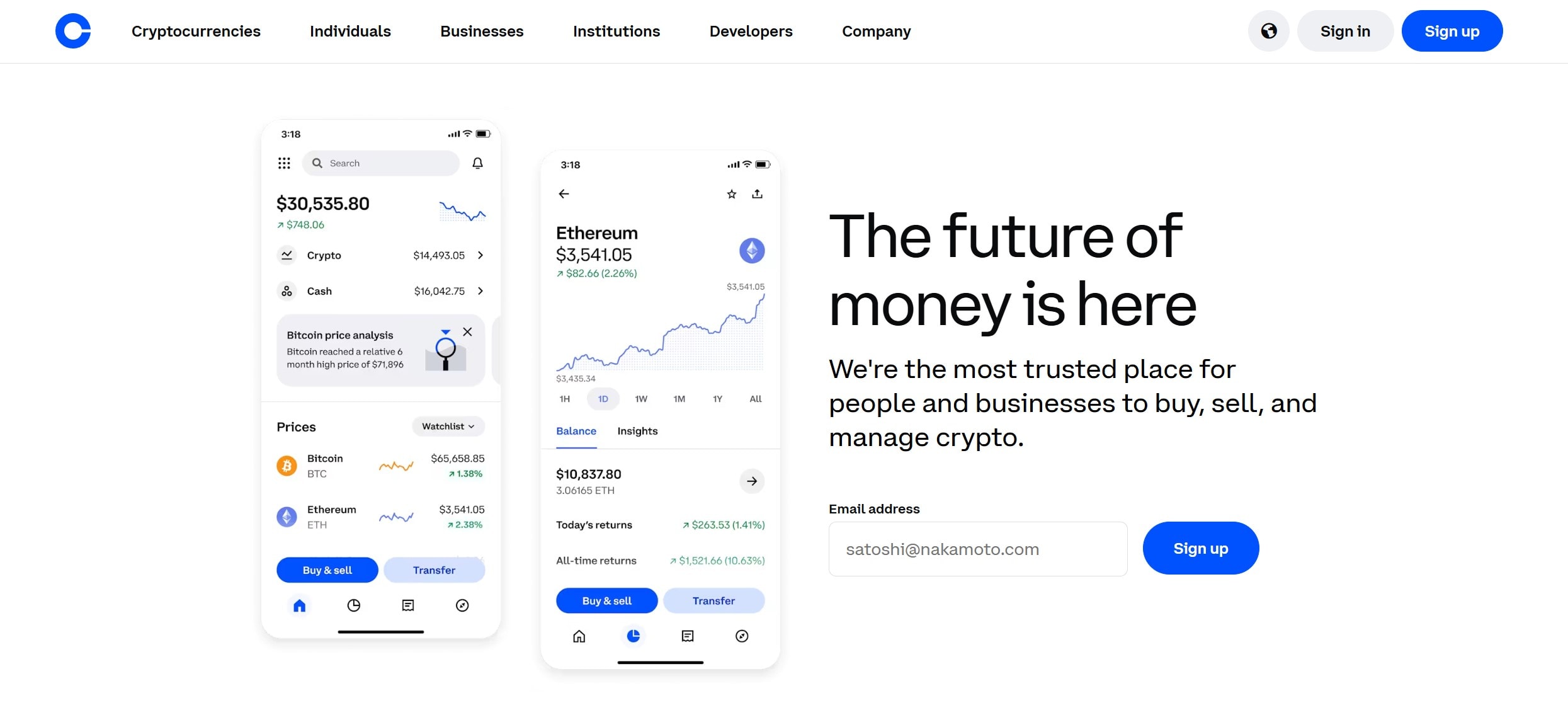
- Intuitive User Interface: Designed for ease of use, making crypto purchases straightforward for novices.
- Coinbase Advanced Trade: Offers a more sophisticated trading platform with lower fees and advanced charting tools for experienced users.
- Broad Asset Support: Provides access to over 200 cryptocurrencies, including major assets like Bitcoin (BTC) and Ethereum (ETH), and a growing selection of altcoins.
- Educational Resources: Features extensive learning materials, including "Learn & Earn" programs, to help users understand cryptocurrencies.
- Strong Security Measures: Implements 2FA, biometric logins, cold storage for a majority of assets, and crime insurance.
- Regulatory Adherence: Fully compliant with U.S. federal and state regulations, holding licenses across multiple jurisdictions.
Fee Structure: Coinbase employs a dual fee structure. Simple buy/sell orders through its standard interface typically include a spread (around 0.50%) plus a flat or percentage fee, which can range from 1.49% for bank transfers to 3.99% for debit/credit card purchases. This makes basic transactions relatively more expensive. For active traders, Advanced Trade utilizes a volume-based maker-taker model, with significantly lower fees ranging from 0.00%–0.05% for makers and 0.01%–0.60% for takers, decreasing with higher 30-day trading volumes. ACH deposits are free, while wire transfers incur small fees.
| Pros and Cons: | Pros | Cons |
|---|---|---|
| Strong liquidity on major assets | The basic interface can be expensive for casual users | |
| Solid compliance and security reputation | Fewer small-cap cryptocurrencies compared to global platforms | |
| Better tools for experienced users (Advanced Trade) | Customer support can be slow during market spikes | |
| Extensive educational resources | Higher fees for instant/fiat purchases |
2. Kraken – Best for advanced traders and margin trading
Founded in 2011, Kraken is one of the oldest and most respected cryptocurrency exchanges globally, with a strong presence in the U.S. It caters primarily to intermediate and advanced traders, offering a comprehensive suite of trading products beyond simple spot trading. Kraken supports over 120 crypto assets, including a mix of major digital assets, stablecoins, and even some meme coins, alongside support for seven fiat currencies (USD, EUR, GBP, CAD, JPY, CHF, and AUD). Its emphasis on security, advanced trading features, and competitive fees for high-volume traders makes it a formidable choice.
Key Features:

- Advanced Trading Options: Offers spot trading, margin trading, futures, indices, and OTC services.
- Staking Services: Provides attractive staking rewards for a variety of proof-of-stake cryptocurrencies.
- Deep Liquidity: High trading volumes ensure efficient execution for major crypto pairs.
- Professional Interface (Kraken Pro): Features advanced charting, order types, and analytical tools.
- Robust Security: Employs cold storage, 2FA, and an experienced security team.
- Regulatory Compliance: Maintains a strong record of compliance with U.S. regulations.
Fee Structure: Kraken’s basic Instant Buy fees are 0.9% for stablecoins and 1.5% for other crypto assets, in addition to payment method costs (e.g., 0.5% for ACH, 3.75% + €0.25 for credit/debit cards). Kraken Pro offers a more competitive, volume-based maker-taker fee schedule, with maker fees ranging from 0.00% to 0.16% and taker fees from 0.10% to 0.26%, decreasing significantly with higher 30-day trading volumes. This structure heavily favors active traders.
| Pros and Cons: | Pros | Cons |
|---|---|---|
| Low fees for high-volume trades via maker-taker model | The Pro interface can be complex for absolute beginners | |
| Deep liquidity on major crypto pairs | Certain U.S. states and products are restricted | |
| Supports spot, margin, futures, staking, and OTC | Customer support can be slow during market volatility | |
| Strong regulatory compliance and security | Instant Buy fees are relatively high |
3. Gemini – Best for regulatory compliance
Founded in 2014 by Cameron and Tyler Winklevoss, Gemini has carved out a niche as a premium cryptocurrency exchange known for its unwavering commitment to regulatory compliance and institutional-grade security. Operating under the stringent oversight of the New York State Department of Financial Services (NYDFS), Gemini positions itself as a trustworthy gateway to digital assets. It supports over 100 cryptocurrencies, including major players like Bitcoin (BTC), Ethereum (ETH), Bitcoin Cash (BCH), and Litecoin (LTC), and offers various services from spot trading to staking.
Key Features:
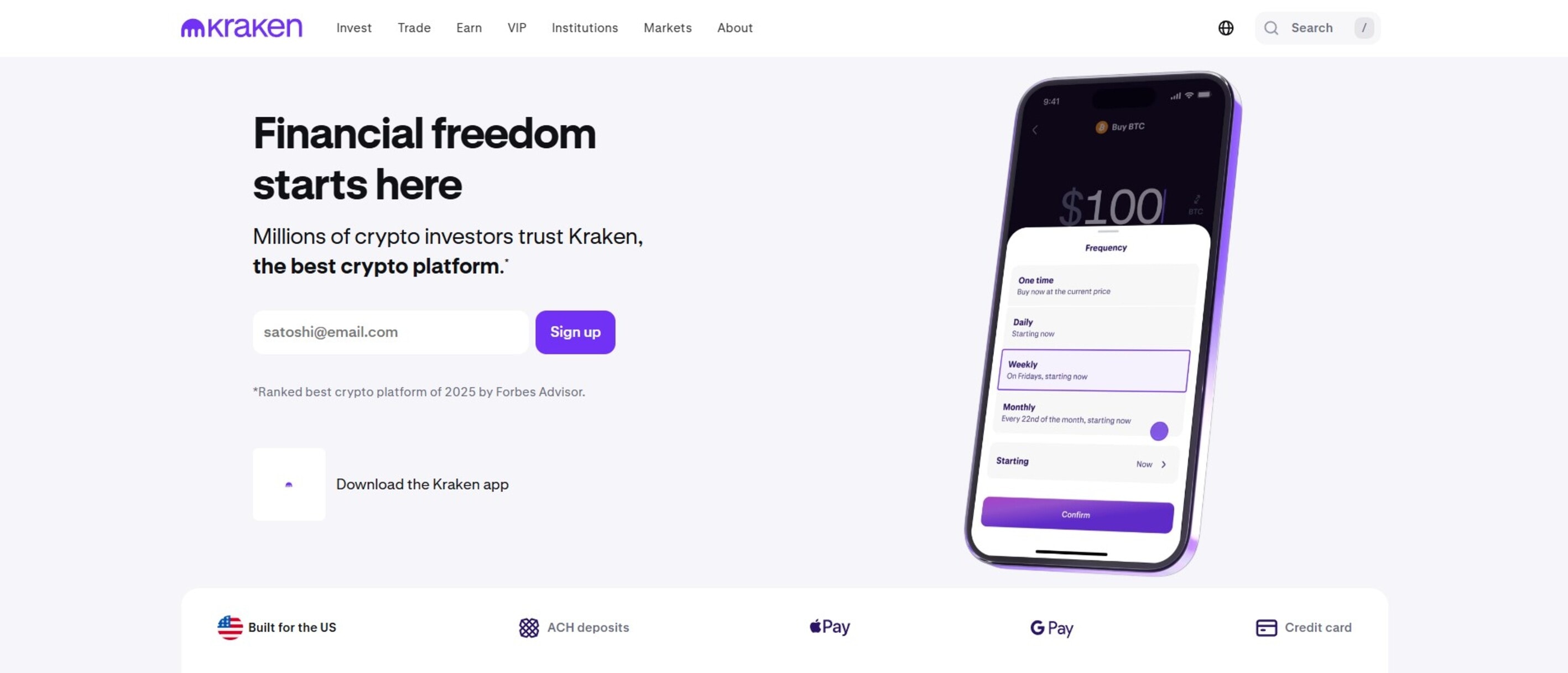
- "Security First" Approach: Emphasizes advanced security measures, including offline cold storage, 2FA, and regular third-party security audits.
- Regulatory Prowess: Among the most regulated exchanges in the U.S., holding numerous licenses and complying with rigorous financial standards.
- Gemini ActiveTrader: A professional trading platform offering advanced charting tools, multiple order types, and a more competitive fee structure.
- Earn Program: Allows users to earn interest on their crypto holdings (subject to regulatory availability).
- NFT Marketplace (Nifty Gateway): Offers an integrated platform for buying and selling NFTs.
- Insurance Coverage: Provides insurance against certain types of losses from security breaches.
Fee Structure: Gemini’s fee structure can be perceived as higher for casual users. Basic trades on the website or mobile app include a 0.50% convenience fee plus a transaction fee that varies based on order size (e.g., $0.99 for orders under $10, up to 1.49% for trades over $200). The ActiveTrader platform significantly reduces fees, charging maker fees from 0.20%–0.00% and taker fees from 0.40%–0.10%, with stablecoin pairs often enjoying 0.00% maker / 0.01% taker fees. ACH deposits are free, while wire transfers incur small fees.
| Pros and Cons: | Pros | Cons |
|---|---|---|
| Strong regulatory compliance and security | Higher fees for casual or small trades | |
| Supports spot trading, advanced trading, and staking | ActiveTrader platform can be complex for beginners | |
| Free ACH deposits and crypto withdrawals | Limited derivatives compared to some competitors | |
| Institutional-grade security measures | Fewer supported assets than some competitors |
4. Binance.US – Low-Fee trading and high liquidity
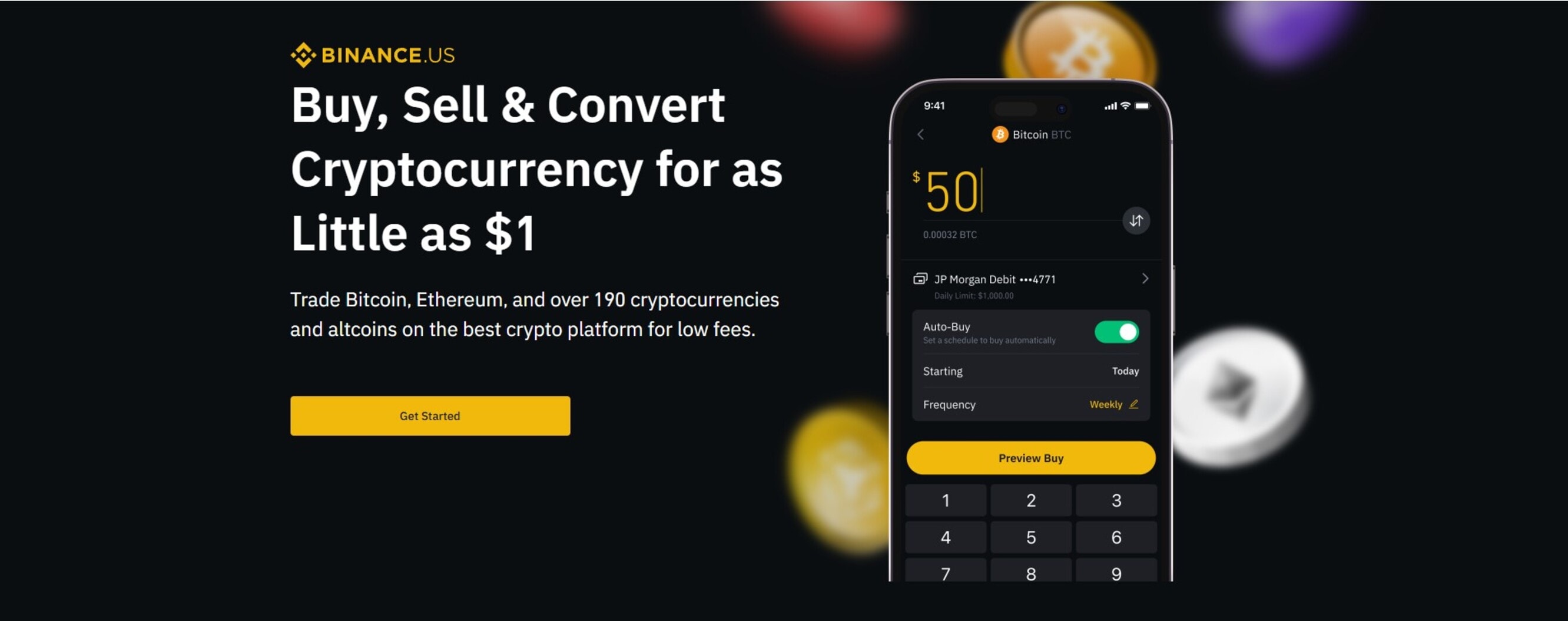
Binance.US serves as the U.S. counterpart to Binance, the world’s largest cryptocurrency exchange by trading volume. Launched in 2019 to comply with U.S. regulations, Binance.US operates as an independent entity, providing a tailored experience for American traders. While it supports fewer assets than its global parent platform (over 130 cryptocurrencies), it prioritizes regulatory adherence and offers a robust trading environment with high liquidity, especially for major assets. It provides both web and mobile platforms designed for traders of all experience levels.
Key Features:

- Competitive Fee Structure: Known for some of the lowest trading fees in the U.S. market, particularly for active traders.
- High Liquidity: Benefits from the Binance ecosystem’s vast liquidity, ensuring efficient trade execution.
- Advanced Trading Interface: Offers comprehensive charting tools, various order types, and APIs for algorithmic trading.
- Spot Trading & Staking: Provides options for direct crypto purchases and earning rewards through staking.
- BNB Discounts: Users holding Binance Coin (BNB) can receive additional fee discounts.
- Strong Security: Implements industry-standard security measures including 2FA, cold storage, and regular audits.
Fee Structure: Binance.US utilizes a tiered, volume-based maker-taker fee model. Most spot trading pairs feature highly competitive fees, often at 0% for makers and 0.01% for takers. These fees can be further reduced for high-volume traders or when paid in BNB. Simple buy/sell transactions may include a spread between the market and executed prices. ACH deposits are typically free, while crypto withdrawal fees vary by network congestion and asset.
| Pros and Cons: | Pros | Cons |
|---|---|---|
| Low fees for Advanced Trading, especially with BNB | U.S. restrictions limit access to some global Binance features | |
| Advanced trading tools, charting, and APIs | Staking fees can be high (up to ~40% revenue share) | |
| Spot trading, staking, and rewards options | The platform can feel complex for beginners | |
| High liquidity for major trading pairs | Limited fiat withdrawal options compared to some rivals |
5. Uphold – Best for multi-asset trading and cross-asset transfers
Uphold distinguishes itself in the U.S. market by offering a unique multi-asset trading platform where users can seamlessly trade cryptocurrencies, fiat currencies, and even precious metals. Launched in 2014, Uphold provides a versatile environment for managing diverse portfolios. It supports a broad range of major digital assets, stablecoins, and allows users to hold and transfer traditional currencies like USD, EUR, GBP, alongside gold-backed assets. This "Anything-to-Anything" trading model makes it highly flexible for users looking to diversify beyond just crypto.
Key Features:
- Multi-Asset Capabilities: Trade directly between cryptocurrencies, fiat currencies, and precious metals on a single platform.
- "Anything-to-Anything" Trading: Enables direct conversions between any supported asset without needing to convert to fiat first.
- Broad Crypto Support: Offers access to over 300 cryptocurrencies, including many altcoins not found on more restricted platforms.
- Debit Card: The Uphold Card allows users to spend their crypto, fiat, or precious metals at merchants worldwide.
- Staking Rewards: Provides opportunities to earn rewards on selected crypto assets.
- Strong Security Protocols: Utilizes 2FA, encryption, and regular security audits.
Fee Structure: Uphold primarily uses a spread-based fee model, which can be less transparent than a direct commission. Spreads for major cryptocurrencies typically range from 0.8%–1.2%, while altcoins can see spreads from 1.4%–2.95%. Stablecoin spreads are generally lower, around 0.25%. Small trades under $500 may incur an additional $0.99 fee. Card or Apple/Google Pay deposits cost 3.99%, and instant withdrawals carry a 1.75% fee. ACH/SEPA bank transfers are generally free. Fees are embedded in the quoted price, which might lead to higher costs for frequent or precise traders.
| Pros and Cons: | Pros | Cons |
|---|---|---|
| Multi-asset trading on one platform | Higher spreads for casual crypto trades | |
| Supports crypto, fiat, and precious metals | Limited advanced trading tools compared to Kraken or Binance.US | |
| Easy transfers between assets | Fees for debit/credit card purchases can be high | |
| Web and mobile access for portfolio management | Spread-based fees can be less transparent |
6. Robinhood – Best for stock and crypto investors
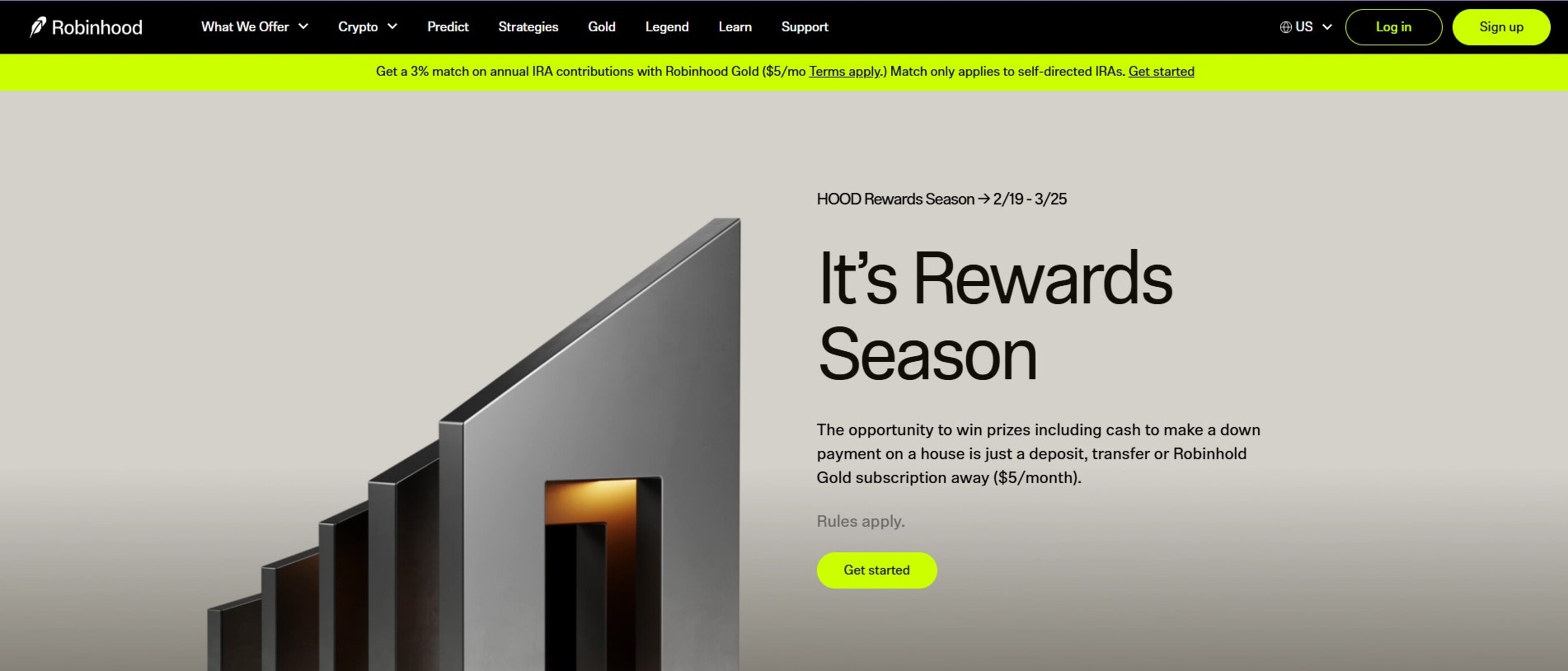
Robinhood, a pioneer in commission-free stock trading, extended its offerings to cryptocurrencies in 2018, making it an attractive platform for investors who want to manage both traditional and digital assets in one place. Headquartered in the U.S., Robinhood supports major cryptocurrencies such as Bitcoin (BTC), Ethereum (ETH), Litecoin (LTC), and several stablecoins, albeit with a more limited selection (around 20+ coins) compared to dedicated crypto exchanges. Its appeal lies in its extremely simple interface and zero-commission trading model, which has resonated with a new generation of investors.
Key Features:
- Commission-Free Trading: Offers 0% commission on both crypto and stock trades, appealing to cost-conscious investors.
- Unified Portfolio: Allows users to manage their crypto, stock, and ETF investments from a single, integrated account.
- User-Friendly Interface: Known for its minimalist design and ease of use, ideal for beginners.
- Instant Deposits: Provides instant access to funds after deposits, up to certain limits for Robinhood Gold members.
- Crypto Wallet Functionality: Offers basic wallet features for sending and receiving supported cryptocurrencies.
- Recurring Investments: Allows users to set up automated crypto purchases.
Fee Structure: Robinhood charges no explicit commission for crypto trades. Instead, its fees are embedded within the spread, meaning the price you buy or sell at is slightly different from the true market price. While typically small, this spread can widen during periods of high market volatility. Deposits via ACH are free. Instant deposits and debit card funding may incur small fees or are limited to Robinhood Gold subscribers. Cryptocurrency withdrawals are available but may incur blockchain network fees depending on the asset and network congestion.
| Pros and Cons: | Pros | Cons |
|---|---|---|
| Commission-free crypto and stock trading | Limited advanced trading tools compared to Kraken or Binance.US | |
| Beginner-friendly and simple interface | Fewer supported coins than major exchanges | |
| Integrated crypto and stock portfolios | Limited support for staking and derivative trading | |
| Free ACH deposits | Spread-based pricing can be less transparent |
7. Crypto.com – Best for staking rewards and mobile-first users
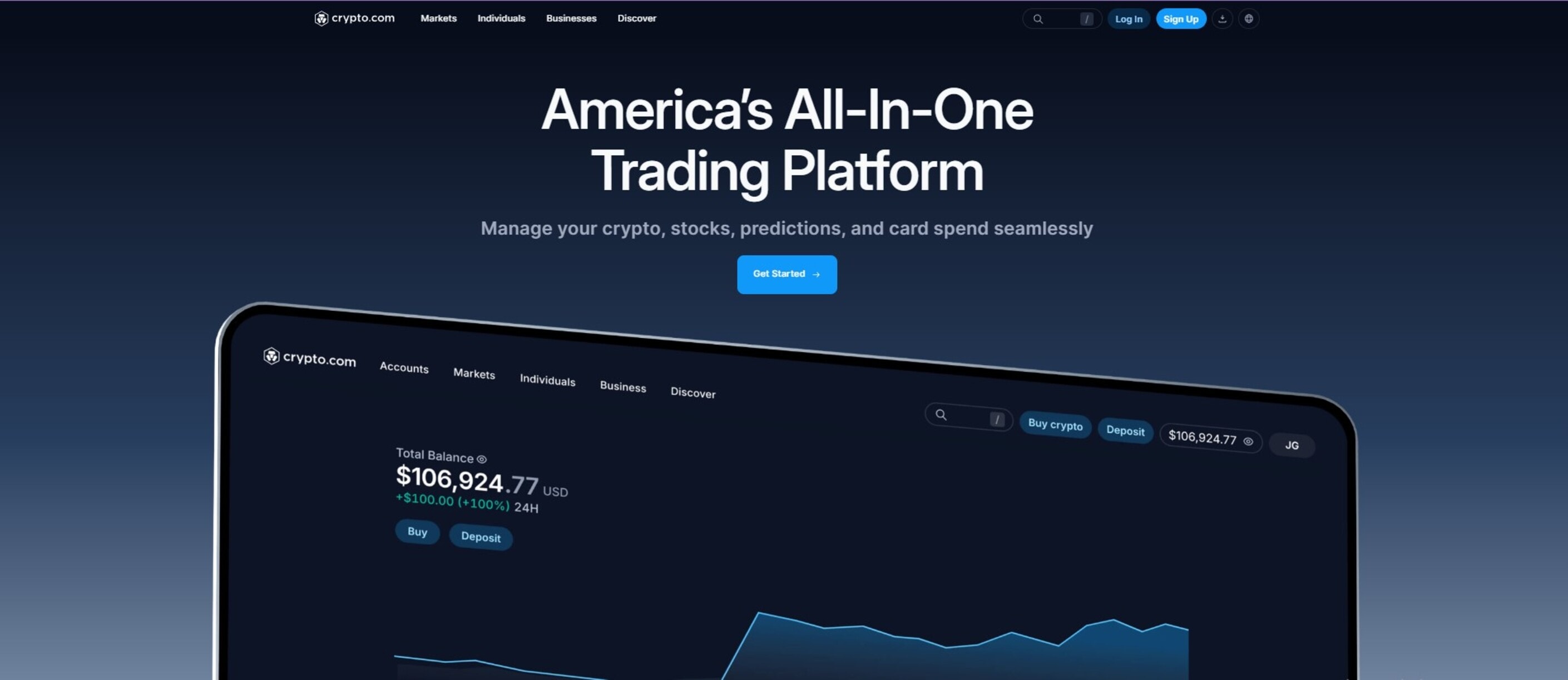
Crypto.com has rapidly expanded its global footprint, offering a comprehensive ecosystem that includes a mobile app, a separate exchange platform, a DeFi wallet, and a popular Visa debit card. Available in 49 U.S. states, it supports an impressive range of over 400 cryptocurrencies for spot trading, making it one of the most diverse platforms in terms of asset offerings. Its mobile-first approach, coupled with attractive staking rewards and cashback incentives through its Visa card, appeals strongly to users looking for an all-encompassing crypto experience.
Key Features:

- Extensive Crypto Selection: Offers trading for over 400 cryptocurrencies, providing broad market access.
- Crypto.com Visa Card: Provides up to 5% cashback in CRO tokens on eligible spending, with various tier benefits.
- Staking and Earn Programs: Allows users to earn passive income on their crypto holdings with competitive APYs.
- Mobile-First Design: A highly intuitive and feature-rich mobile application for easy management and trading.
- DeFi Wallet: Offers a separate, self-custodial wallet for greater control over digital assets.
- Robust Security: Employs multi-factor authentication, cold storage, and a $750 million insurance fund.
Fee Structure: Crypto.com’s fee structure is bifurcated between its main app and its web-based Exchange. The app typically uses a spread-based model, which can result in higher costs for instant purchases. The Crypto.com Exchange (available to U.S. users for spot trading) uses a maker-taker model, with base fees of 0.075% for both makers and takers, decreasing significantly with higher 30-day trading volumes or by staking CRO tokens. High-volume traders or substantial CRO stakers can achieve 0% maker and as low as 0.04% taker fees. USD deposits via ACH are generally free, while crypto withdrawals incur blockchain network fees.
| Pros and Cons: | Pros | Cons |
|---|---|---|
| Supports 400+ cryptocurrencies and many trading pairs | App spreads are higher than exchange trading fees | |
| Visa card offers up to 5% rewards | The fee structure is split between app and exchange, which can be confusing | |
| Bank transfer and card funding options | U.S. users have limited access to derivatives | |
| Strong liquidity on major assets like Bitcoin (BTC) and Ethereum (ETH) | Customer support response times can be inconsistent |
8. eToro – Best for social and copy trading
eToro has gained significant traction as a social trading platform, allowing users not only to trade cryptocurrencies but also to mirror the strategies of successful investors. Accessible to U.S. users since 2018, eToro provides access to over 100 cryptocurrencies, alongside commission-free stocks and ETFs. Its distinctive "CopyTrader" feature is particularly appealing to beginners who wish to learn from experienced traders or those who prefer a hands-off approach to managing their portfolios.
Key Features:
- Social Trading & CopyTrader: Enables users to automatically copy the trades of top-performing investors.
- Diverse Asset Portfolio: Offers access to cryptocurrencies, stocks, ETFs, and other assets on a single platform.
- User-Friendly Interface: Designed for ease of navigation, especially for new investors.
- Smart Portfolios: Thematic investment portfolios managed by eToro, focusing on specific market trends.
- Educational Resources: Provides learning materials and a vibrant community forum.
- Regulatory Compliance: Regulated in multiple jurisdictions, including the U.S.
Fee Structure: eToro U.S. offers commission-free trading on stocks and ETFs, but crypto transactions incur a 1% fee on both purchases and sales, which is embedded in the spread. Withdrawals carry a flat $5 fee, and transfers of crypto to the external eToro Money wallet incur a 2% fee. An inactivity fee of $10/month applies after 12 months of no login activity. Small regulatory fees may also apply to sell orders for stocks due to SEC and FINRA requirements. While seemingly straightforward, the 1% crypto fee can add up for frequent traders.
| Pros and Cons: | Pros | Cons |
|---|---|---|
| Access to 100+ cryptocurrencies and commission-free stocks/ETFs | Spread-based fees can be higher than dedicated exchanges | |
| Social and copy trading for learning strategies | Inactivity fees after 12 months | |
| Easy funding via bank transfer and card | Limited crypto derivatives access for U.S. users | |
| Intuitive and beginner-friendly platform | Fees for crypto transfers to external wallets |
9. Bitstamp – Best for simple and reliable trading
Bitstamp, founded in 2011, holds the distinction of being one of the longest-running cryptocurrency exchanges globally, and it maintains a strong, compliant presence in the U.S. Known for its reliability and straightforward approach, Bitstamp supports major crypto assets such as BTC, ETH, and Bitcoin Cash (BCH), along with over 70 additional cryptocurrencies. The platform offers both a web-based and mobile interface, designed for both beginners seeking simplicity and experienced users looking for essential trading functionalities without excessive complexity. Its long operational history contributes to its strong reputation for security and trustworthiness.
Key Features:
- Long-Standing Reputation: One of the oldest and most respected crypto exchanges, emphasizing reliability and stability.
- Simple & Reliable Interface: Offers a clean, intuitive design for easy navigation and trading.
- Fiat Funding Options: Supports various fiat deposit methods, including bank transfers (ACH/wire) and card purchases.
- Tiered Fee Structure: Rewards higher trading volumes with reduced fees.
- Robust Security Measures: Implements cold storage, 2FA, and robust cybersecurity protocols.
- Institutional Services: Provides services tailored for institutional clients, including OTC desk.
Fee Structure: Bitstamp U.S. employs a tiered maker-taker fee model designed to reward higher trading volumes. For advanced trading, fees start at 0.30% for makers and 0.40% for takers for 30-day volumes under $10,000. These fees progressively decrease, reaching as low as 0.00% for makers and 0.06% for takers for volumes exceeding $100 million. Instant Buy/Sell transactions incur a higher 4% service fee for credit/debit cards, Apple Pay, Google Pay, or PayPal. USD deposits via ACH are generally free, while international wire deposits and withdrawals carry small fees (e.g., 0.05% for deposits, 0.1% for withdrawals).
| Pros and Cons: | Pros | Cons |
|---|---|---|
| Simple, reliable platform with strong security | Limited number of cryptocurrencies compared to major exchanges | |
| Supports fiat funding via bank transfers and cards | Higher fees for low-volume traders | |
| Tiered fee structure rewards high-volume traders | Advanced trading features are limited compared to Kraken or Binance.US | |
| Established reputation and long operational history | High fees for instant card purchases |
10. OKX – Best U.S. exchange for derivative trading (limited availability)
OKX is a global cryptocurrency platform with a limited but significant presence for U.S. users, primarily through its OKX US operations, which may have state-specific restrictions. Known for its extensive range of digital assets and advanced derivative trading options (where permitted), OKX caters to professional traders seeking sophisticated tools. The platform provides spot trading, futures, options, and margin trading, positioning itself as a comprehensive solution for experienced market participants looking for diverse trading instruments.
Key Features:
- Wide Range of Cryptocurrencies: Supports over 350 digital assets, offering extensive trading opportunities.
- Advanced Derivative Trading: Provides futures, options, and perpetual swaps for experienced traders (subject to U.S. regulatory limitations).
- Robust Trading Engine: High performance and reliability for executing complex trades.
- Earn Products: Offers various ways to earn passive income, including staking and savings.
- MetaX Wallet Integration: Connects to OKX’s self-custody Web3 wallet for enhanced asset control.
- Tiered Fee Structure: Rewards active traders and OKB token holders with reduced fees.
Fee Structure: OKX U.S. employs a tiered maker-taker fee model based on 30-day trading volume and holdings of its native token, OKB. Spot trading fees typically start at 0.08% for makers and 0.10% for takers, with rates decreasing as trading volume or OKB holdings increase. Notably, some trading pairs on OKX, particularly stablecoin pairs, may incur zero fees, placing it among the select few platforms offering such benefits. Deposits are generally free, while withdrawals incur blockchain network fees that vary by cryptocurrency and network congestion.
| Pros and Cons: | Pros | Cons |
|---|---|---|
| Supports a wide range of cryptocurrencies and derivatives | An advanced trading interface may be complex for beginners | |
| Tiered fees reward high-volume traders | Not all U.S. states have full access to all features | |
| Strong security with cold storage and 2FA | Derivatives carry additional risk for inexperienced users | |
| Some zero-fee stablecoin trading pairs | Customer support can be challenging to access |
Key Factors to Consider When Choosing the Best Crypto Exchange in the USA
Selecting the right cryptocurrency exchange in the U.S. is a critical decision that can significantly impact your trading experience, security, and financial outcomes. The inherent volatility of the crypto market, coupled with evolving regulatory landscapes, necessitates a diligent evaluation process. Here are the paramount factors prospective investors should scrutinize:
Regulatory Compliance
Regulatory compliance is not merely a checkbox; it is the bedrock of trust and operational longevity for any cryptocurrency exchange in the U.S. Platforms that adhere strictly to federal and state regulations, encompassing mandates from the SEC, CFTC, and FinCEN, offer a more secure and predictable trading environment. This adherence often translates into robust anti-money laundering (AML) and know-your-customer (KYC) procedures, which, while sometimes perceived as cumbersome, are vital in preventing illicit activities and protecting user funds. Choosing a fully licensed exchange mitigates the risk of sudden