Dwi Wanna

The Bitcoin network underwent a significant recalibration on October 29, with mining difficulty jumping by 5.54% to reach a staggering 148.36 trillion. This adjustment, the second major increase in a single month, follows a 5.92% rise on October 16, signaling an intense period of competition among global mining operations. As the network’s total computing power—known as the hashrate—stages a robust recovery, the financial landscape for miners is becoming increasingly precarious. Daily revenue per unit of computing power has plummeted toward $33 per petahash per second (PH/s), marking some of the lowest levels recorded since August. This convergence of rising operational difficulty and shrinking profit margins is forcing a strategic reckoning within the industry, as firms balance the need for more efficient hardware against the growing temptation to pivot toward artificial intelligence (AI) infrastructure.
Understanding the October Difficulty Adjustments
Bitcoin’s mining difficulty is a self-regulating mechanism designed to ensure that the average time between blocks remains approximately 10 minutes. Every 2,016 blocks, or roughly every two weeks, the network evaluates how quickly miners have been solving the cryptographic puzzles required to secure the ledger. If the hashrate increases and blocks are found too quickly, the difficulty rises. Conversely, if miners drop off the network, the difficulty decreases.
The recent 5.54% jump indicates that miners have been deploying vast amounts of new hardware or reactivating older machines at an accelerated pace. According to data from Nodewitness, the difficulty moved from 140.58 trillion to 148.36 trillion in the latest cycle. When combined with the mid-October adjustment, the total increase for the month exceeds 11%, creating a significantly higher barrier to entry for rewards. For individual operators, this means that the same amount of electricity and computing power now yields roughly 10.5% less Bitcoin than it did at the start of the month, assuming transaction fees remain stable.
A Turbulent Timeline: From Contraction to Recovery
The current surge in hashrate is a remarkable reversal of a trend that saw the network experience one of its steepest contractions in recent years. Jamie Coutts, chief crypto analyst at Real Vision, noted that the network’s 14-day average hashrate declined by 23% between its peak in October 2025 and February 2026. This decline was the most severe since the 2021 Chinese mining ban, which forced nearly half of the world’s mining capacity offline overnight.
Several factors contributed to this earlier slump. Severe winter weather in key mining hubs, particularly in Texas, forced many large-scale operations to power down to stabilize the energy grid. Simultaneously, a growing narrative emerged that mining companies were abandoning Bitcoin production in favor of more lucrative opportunities in AI and high-performance computing (HPC). While the network showed signs of life in early 2026, it remained volatile through July, leading to skepticism regarding the industry’s long-term commitment to the Bitcoin protocol.
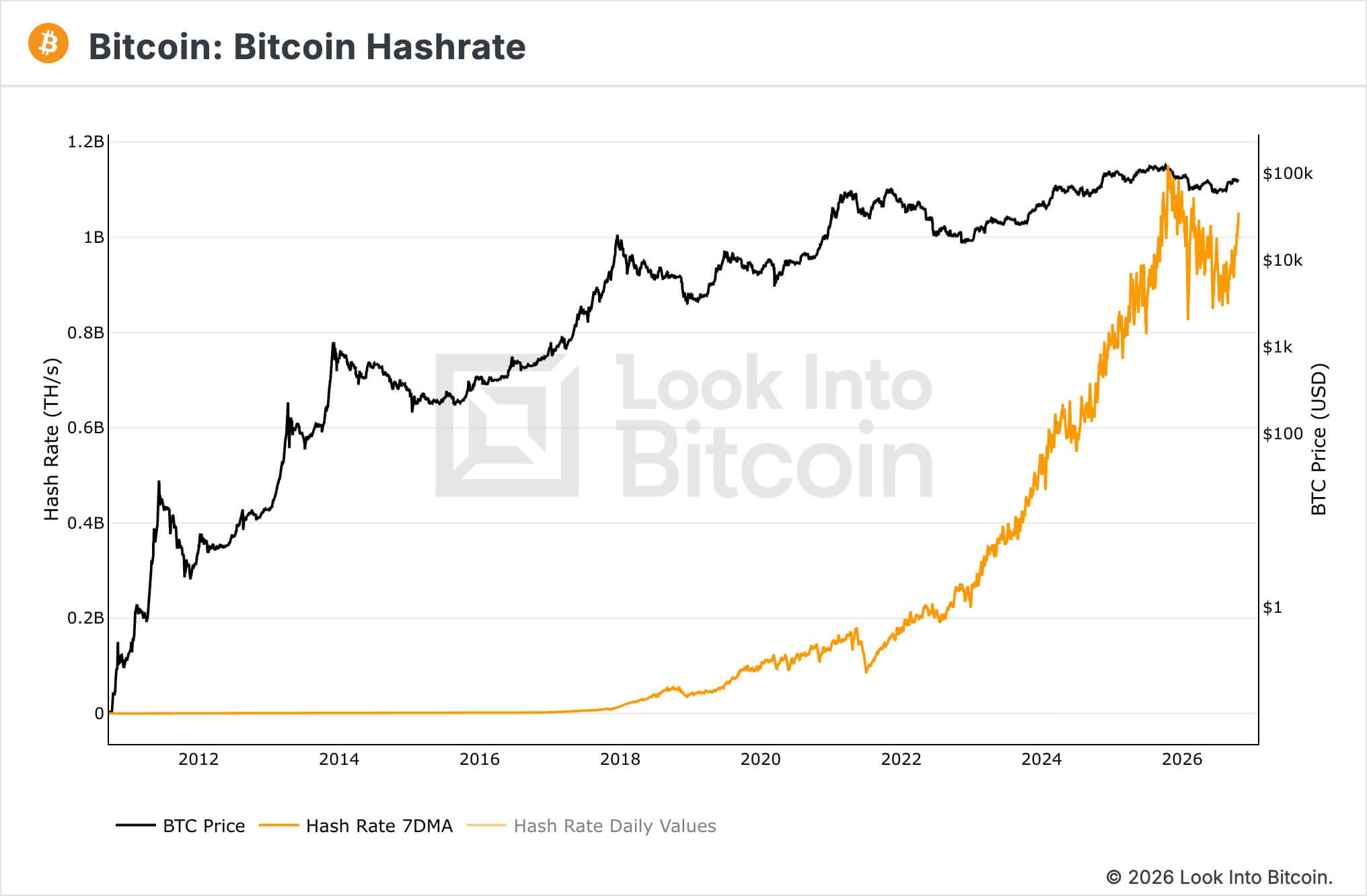
However, since July 17, the trajectory has shifted dramatically. Analysis shows that Bitcoin’s hashrate has climbed by 21% over the subsequent 102 days. This recovery added approximately 185 exahashes per second (EH/s) to the network—the largest absolute amount of computing power added during a recovery phase since 2018. Data from Look Into Bitcoin confirms that the network’s total computing power is now hovering at its highest level in seven months, illustrating a renewed, if financially strained, commitment to the network.

The Financial Squeeze: Revenue Hits August Lows
While the rising hashrate is a testament to the network’s security and the resilience of its operators, it has come at a steep financial cost. The "hashprice"—a metric used to measure the expected daily revenue for each petahash per second of computing power—is currently under immense pressure. Data from Startmining indicates that the hashprice has dropped to approximately $33 per PH/s per day.
To put this in perspective, the hashprice averaged $40 in September when difficulty was lower. The current $33 level represents a critical threshold for many operators. This revenue figure must cover electricity costs, hardware maintenance, facility hosting, and the interest on debt used to finance these massive operations. For many, the math no longer adds up.
The impact is most visible when comparing hardware efficiency. Mining machines are rated by their energy efficiency in joules per terahash (J/TH).
- Older Equipment (25 J/TH): At a gross hashprice of $33.35, a machine operating at 25 J/TH generates roughly $32.68 daily per PH/s after a standard 2% mining pool fee. If the operator pays 6 cents per kilowatt-hour (kWh) for electricity, the daily power bill alone is $36. This results in a $3.32 daily loss per petahash before even considering labor or rent.
- Modern Equipment (20 J/TH): Under the same conditions, a more efficient 20 J/TH machine spends $28.80 on electricity, leaving a razor-thin surplus of approximately $3.88 per day.
This economic reality is widening the gap between "mega-miners" with access to ultra-cheap power (sub-5 cents/kWh) and smaller or less efficient players. For an operator using 25 J/TH equipment to simply break even on power alone, their electricity tariff must be 5.45 cents/kWh or lower.
The Strategic Shift to AI and High-Performance Computing
The tightening margins in Bitcoin mining have accelerated a trend among publicly traded firms to diversify their revenue streams. Companies that once identified solely as Bitcoin miners are increasingly rebranding as data center providers for AI and high-performance computing.
The rationale is rooted in revenue stability. Bitcoin mining is a volatile, "winner-take-all" competition where revenue is subject to the fluctuating price of BTC and the unpredictable growth of the network hashrate. In contrast, AI infrastructure contracts often involve long-term leases with blue-chip technology companies, providing predictable, dollar-denominated cash flows.
However, the latest hashrate data suggests that as some firms redirect their power capacity toward AI, others are stepping in to fill the void. The massive 185 EH/s addition since July indicates that new, high-efficiency machines are being deployed, likely by private entities or international players in regions with stranded energy assets. This suggests that while the "public miner" profile is changing, the global appetite for securing the Bitcoin network remains undeterred.
Implications for Network Security and Market Stability
From a technical standpoint, the increase in difficulty and hashrate is a positive indicator for the Bitcoin network. A higher hashrate increases the "cost of attack," making it exponentially more expensive for any single entity to attempt a 51% attack. For Jamie Coutts, this recovery signals a deepening of the network’s moat and continued confidence among capital-intensive operators.
However, the "security-profitability paradox" remains a concern. If difficulty continues to rise while the price of Bitcoin remains stagnant or the hashprice drops further, the industry may see a wave of consolidation. Smaller miners may be forced to sell their holdings or liquidate their equipment, which could lead to a temporary increase in BTC sell pressure on the open market.
Furthermore, the reliance on highly efficient hardware means that the industry is becoming more centralized around manufacturers capable of producing the latest generation of 3-nanometer chips. This creates a secondary layer of competition where the ability to secure a supply chain is just as important as the ability to secure cheap electricity.
Conclusion: A New Era of Industrial-Scale Mining
The October difficulty adjustments serve as a stark reminder that Bitcoin mining has evolved into a high-stakes, industrial-scale competition. The 5.54% jump on October 29 reflects a network that is more robust and secure than it has been in months, but it also highlights the "survival of the fittest" nature of the current market.
As miners navigate the dual pressures of record-high difficulty and near-record-low revenue, the industry is bifurcating. On one side are the diversified giants moving toward AI to stabilize their balance sheets; on the other are the pure-play miners who are doubling down on efficiency and scale. For the latter, the path forward requires navigating a narrow corridor of profitability where every fraction of a cent in energy costs and every joule of hardware efficiency can mean the difference between expansion and insolvency. The coming months will likely determine which of these strategies will define the next era of the Bitcoin network.