Dwi Wanna
The high-performance computing and Bitcoin mining firm IREN, formerly known as Iris Energy, has revised the timeline for its landmark AI operating-revenue milestone, shifting the target for achieving a $4 billion annualized run rate (ARR) from December 31, 2026, to January 31, 2027. According to the company’s November 5 quarterly results and accompanying investor presentation, this window could potentially extend through the end of February 2027. This adjustment comes as the company navigates a massive $15 billion capital expenditure plan designed to transition its operations from a primary focus on cryptocurrency mining to a dominant position in the artificial intelligence infrastructure sector.
The $4 billion figure represents an annualized operating measure based on projected hourly pricing and utilization of its Graphics Processing Units (GPUs) and data center capacity, rather than GAAP-recognized annual revenue. To support this trajectory, IREN has outlined a complex financing roadmap that includes a separate $6 billion funding target for broader expansion beyond its initially funded programs. This strategic pivot reflects a broader trend within the digital asset industry, where established miners are leveraging their access to power and specialized cooling infrastructure to meet the insatiable global demand for AI compute power.
Strategic Realignment of Financial and Operational Milestones
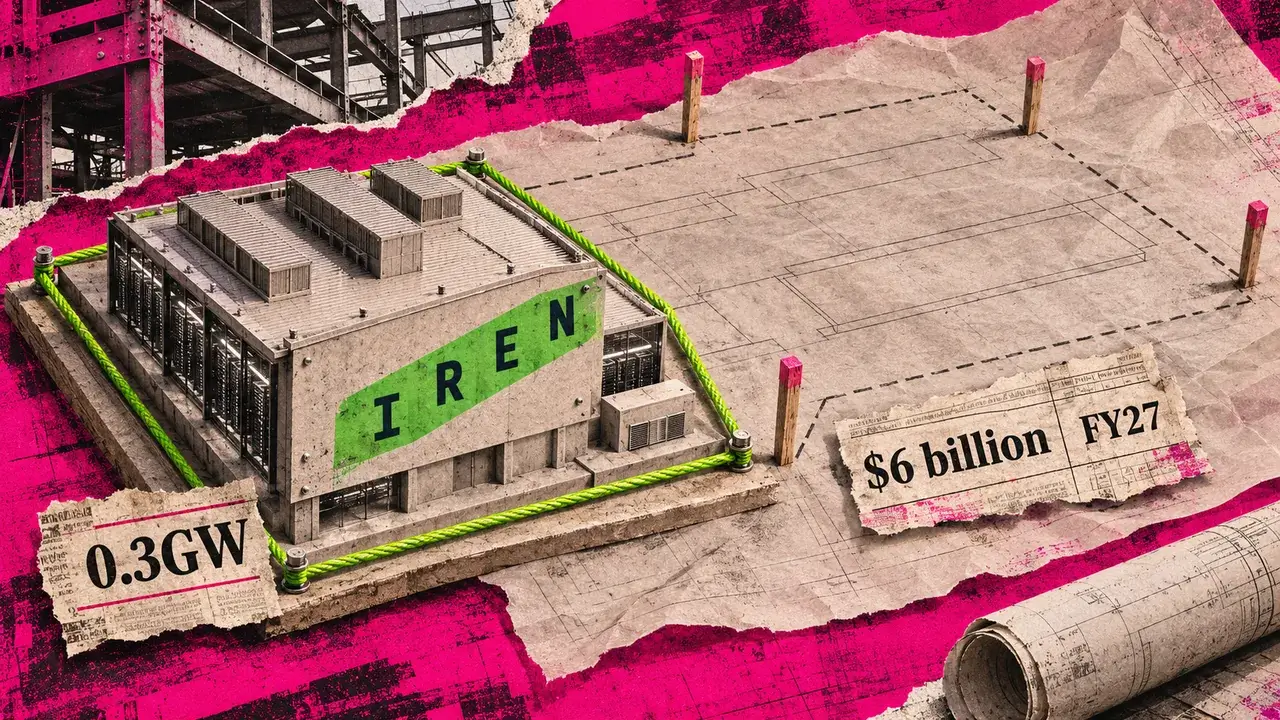
Management has defined its current funding coverage around an initial 0.3 gigawatt (GW) of IT capacity. This initial phase is described as “fully funded” regarding the remaining data center and GPU costs required to reach the stated revenue targets. However, the company’s ambitions extend far beyond this baseline. IREN’s broader fiscal year 2027 (FY27) plan involves $15 billion in total remaining spending for data center construction and GPU procurement, measured from a September 30 baseline.
The company’s internal accounting divides this $15 billion expenditure into three distinct buckets. The first $9 billion, which IREN categorizes as "funded" or "committed," consists of $5.8 billion in cash (including restricted cash) and $3.2 billion in committed funding. The remaining $6 billion represents the financing target IREN intends to secure to fuel expansion through the end of the fiscal year. These funds are expected to come from a variety of sources, including GPU-specific financing, customer prepayments, traditional data center debt, and corporate equity or debt markets.
The shift in the January-to-February operating timetable for the $4 billion ARR milestone has been attributed to two primary factors: a specific customer-requested design change and adjustments in supplier delivery timing. Such shifts are becoming common in the high-performance computing (HPC) industry as data center specifications evolve to accommodate the next generation of power-hungry AI chips, such as NVIDIA’s Blackwell architecture.
A Deep Dive into the Revenue Transformation
The transformation of IREN’s business model is perhaps most visible in its revenue mix for the September quarter. The company reported total revenue of $228 million, a significant portion of which now stems from AI-related services. Specifically, $135 million was generated from AI Cloud Services, while $65 million came from AI Cloud Lease agreements. In contrast, the company’s legacy Bitcoin mining operations contributed $28 million to the quarterly total.
This represents a staggering shift from the June quarter, where total AI revenue stood at approximately $71 million, consisting entirely of AI Cloud Services with no revenue recorded from leasing. The jump to $200 million in combined AI revenue in just one quarter underscores the speed at which IREN is scaling its HPC operations. However, management has cautioned that recognized revenue can be materially lower than ARR projections, as the latter assumes full utilization and specific pricing models. The actual revenue ramp is dependent on the successful commissioning, testing, and customer acceptance of new hardware deployments.
The Mechanics of GPU and Data Center Financing
IREN’s ability to reach its 0.8GW capacity target by the end of the 2027 calendar year depends heavily on its sophisticated financing strategy. The company has demonstrated a preference for hardware-backed financing, where debt is secured against the very GPUs and servers being deployed.
A notable example of this occurred in August when Blue Owl Capital announced a $2.4 billion financing facility for IREN’s Mackenzie "AI Factory." This facility was structured as $1.2 billion in senior secured loans and $1.2 billion in senior secured notes. Crucially, these funds are released in tranches that coincide with the physical delivery and commissioning of hardware, ensuring that the company’s debt load scales in tandem with its revenue-generating assets.
The cost of this capital varies significantly depending on the partner and the assets involved. Historical disclosures show that IREN secured Microsoft-related GPU financing at a weighted-average rate of 6% (excluding fees), while the more general Mackenzie facility carried a fixed rate of 9%. These rates reflect the market’s assessment of the risk associated with different types of HPC contracts and hardware.
Furthermore, customer prepayments are playing an increasingly vital role in reducing the company’s reliance on external debt. After the September 30 reporting period, IREN signed a five-year contract estimated to generate $22 million in annual revenue per IT megawatt. This deal included contracted prepayments covering 90% of the associated GPU capital expenditure. While such terms vary across the customer base, they provide a significant buffer for IREN’s balance sheet by offloading the upfront cost of hardware to the end-user.
Capacity Targets and Infrastructure Development
The roadmap to 0.8GW is a phased approach that balances rapid growth with operational flexibility. While the initial 0.3GW program is the current focus for the $4 billion ARR milestone, procurement is already advancing for the next phase. IREN has confirmed that GPUs have been ordered for an additional 0.3GW of capacity.
The company’s management maintains that they retain the flexibility to pace this expansion based on market conditions and the availability of financing. This flexibility is critical given that the $6 billion financing target remains subject to prevailing market conditions and the terms of existing debt covenants.
The physical infrastructure required for these targets is immense. Transitioning from Bitcoin mining to AI requires a total redesign of power distribution and cooling systems. Bitcoin mining typically utilizes "air-cooled" environments with higher tolerances for temperature fluctuations. AI training and inference, particularly using high-end GPUs, require much more stable environments, often utilizing liquid cooling technologies and significantly higher power density per rack. IREN’s investment in these "AI Factories" represents a long-term bet on the permanence of the AI revolution.
Industry Context and Competitive Landscape
IREN is not alone in its pivot toward AI. The entire Bitcoin mining sector is undergoing a period of soul-searching following the most recent "halving" event, which reduced the rewards for mining Bitcoin by 50%. This has compressed margins for miners with high electricity costs, leading many to seek higher-margin alternatives.
Companies like Core Scientific and TerraWulf have also announced major pivots toward AI data center hosting. However, IREN’s strategy is distinct in its dual approach: providing both "Cloud Services" (where IREN manages the software stack and compute) and "Cloud Leases" (where customers lease the raw hardware). This diversification allows the company to capture different segments of the market, from startups needing immediate compute to large enterprises seeking long-term infrastructure stability.
Analysts note that IREN’s success will likely be measured by its ability to execute on its "fully funded" 0.3GW program without further delays. While the one-to-two-month shift in the revenue milestone is relatively minor in the context of a multi-year build-out, it highlights the logistical complexities of the global GPU supply chain and the bespoke nature of large-scale AI data center design.
Implications for Investors and the Market
The move to push the $4 billion ARR milestone into early 2027 suggests a conservative approach to guidance, allowing for the inevitable "teething issues" that come with large-scale industrial deployments. For investors, the focus remains on the $6 billion "gap" in the $15 billion FY27 plan. How IREN bridges this gap—whether through further equity dilution, high-interest debt, or more favorable customer prepayments—will determine the company’s long-term profitability.
The distinction between ARR and recognized revenue is also a key point for market observers. While ARR provides a "north star" for the company’s potential scale, the GAAP revenue reported in quarterly filings will be the ultimate arbiter of the company’s financial health. With AI revenue already eclipsing Bitcoin mining revenue by a ratio of more than 7-to-1, IREN is no longer a "crypto company" in the traditional sense; it is an infrastructure provider for the digital age.
As the company moves toward its 0.8GW goal, the broader implications for the AI industry are clear. The bottleneck for AI development is no longer just the availability of chips, but the availability of power and data centers capable of housing them. IREN’s aggressive expansion plan is a direct response to this bottleneck, positioning the company as a gatekeeper to the compute power required for the next generation of artificial intelligence.