admin
admin
The Ethereum network, the world’s most commercially significant blockchain housing hundreds of billions of dollars in decentralized finance (DeFi) assets and non-fungible tokens (NFTs), is approaching a pivotal transformation. Around the middle of 2022, the protocol is scheduled to undergo "The Merge," a high-stakes transition from its current Proof-of-Work (PoW) consensus mechanism to a Proof-of-Stake (PoS) system. This technical overhaul is frequently compared by engineers to the feat of replacing an airplane’s engine mid-flight. Because the Ethereum ecosystem serves as the foundational layer for a vast global economy, the network cannot afford even a momentary cessation of block production or a lapse in security during this migration.

Unlike the Bitcoin network, which relies primarily on a single dominant software implementation (Bitcoin Core), the Ethereum developer community—supported by the Ethereum Foundation (EF)—has intentionally fostered an ecosystem of multiple client softwares. These clients are independent implementations of the Ethereum protocol, written in various programming languages by distinct development teams. This strategic plurality is intended to ensure that a critical bug in one piece of software does not result in the total failure of the entire network. However, as the date of The Merge draws closer, a significant imbalance in client adoption has emerged, posing a potential "black swan" risk to the network’s finality and security.
The Architecture of the Merge: A Two-Layered System
The Merge represents the formal joining of the existing Ethereum execution layer—the chain we use today—with the Beacon Chain, a PoS consensus layer that has been running in parallel since December 2020. Post-merge, the duties of a network node will be bifurcated into two distinct roles. Currently, an Ethereum node handles both the execution of transactions and the validation of those transactions under a PoW mining model. After the transition, these responsibilities will be separated into the Execution Layer and the Consensus Layer.
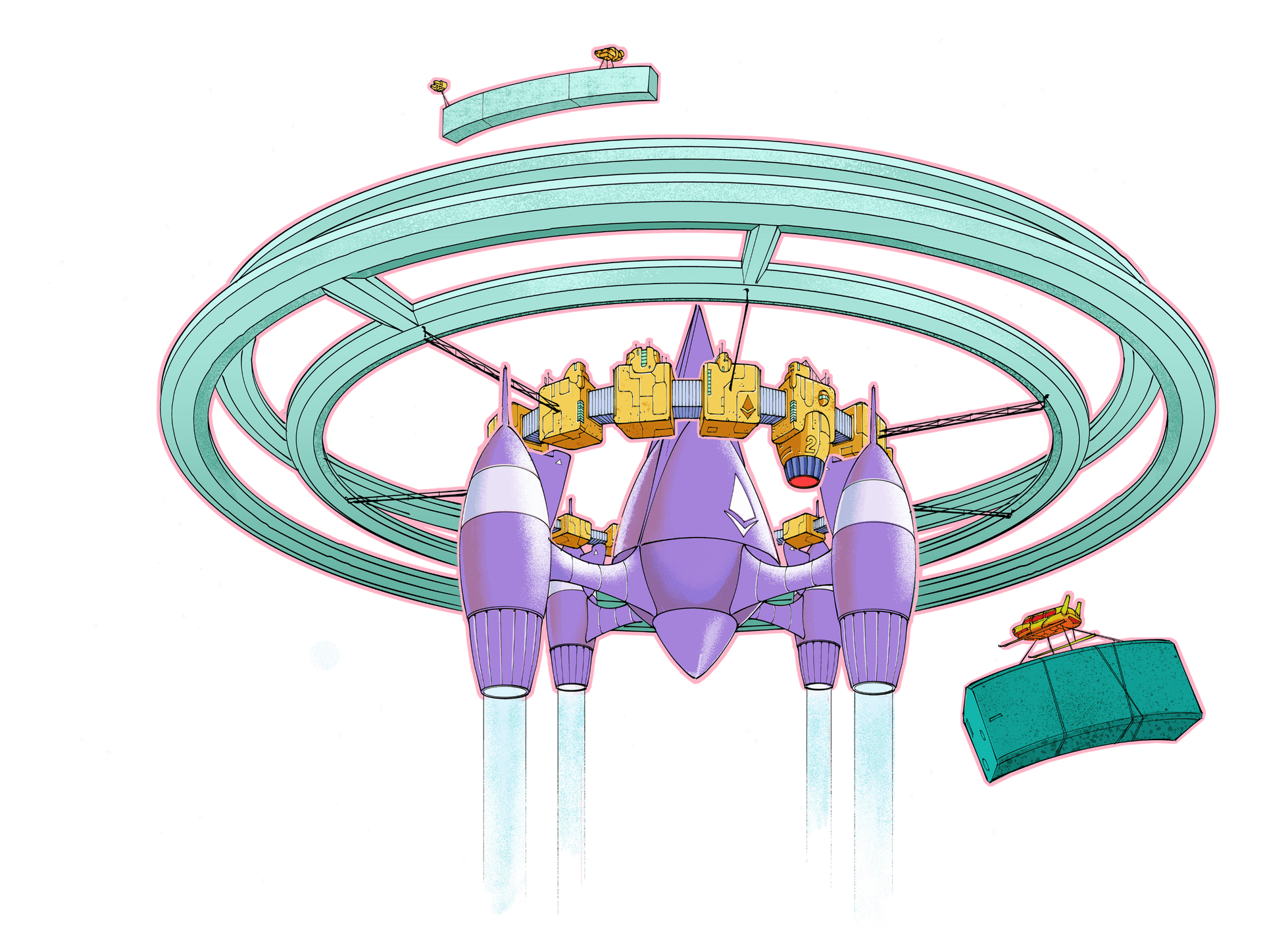
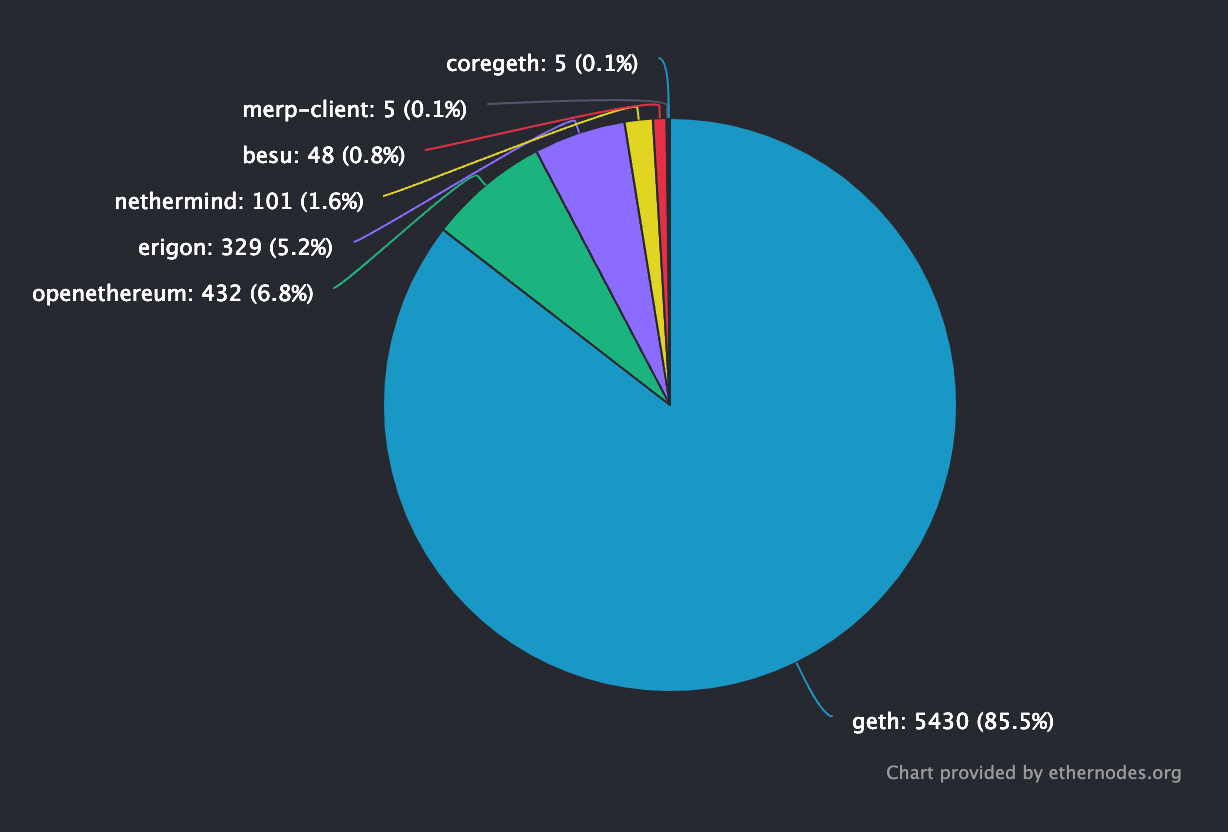
The Execution Layer will continue to host the Ethereum Virtual Machine (EVM), the environment where smart contracts reside and transactions are processed. Execution nodes will manage the mempool, execute transactions, and then pass the resulting data to validator nodes. The Consensus Layer, populated by validator nodes running PoS software, will be responsible for agreeing on the order of blocks and finalizing them on the blockchain. This separation of duties is a classic architectural strategy designed to enhance the robustness of the system through logical layering. While execution clients like Geth (Go-Ethereum) will remain largely the same, they will no longer handle the security of the chain; that responsibility shifts entirely to consensus clients such as Prysm, Lighthouse, Teku, and Nimbus.
The Critical Thresholds of Client Diversity
The primary motivation for maintaining multiple software clients is "client diversity." In a decentralized network, if every node runs the same software, a single coding error or vulnerability could crash the entire system or allow an attacker to seize control. By distributing the network across different codebases, the community ensures that if one client fails, the others can continue to produce and validate blocks.
The risks associated with client concentration are categorized by specific mathematical thresholds regarding the "staking power" or the percentage of total validators running a specific client:
- Below 33%: If a client used by less than one-third of the network experiences a bug, the network remains functional. The buggy nodes may go offline or be penalized, but the remaining two-thirds can still reach consensus and finalize blocks.
- Between 33% and 50%: A bug in a client of this size would prevent the network from reaching "finality"—the point at which a block cannot be changed. While the network might continue to produce blocks, the lack of finality would disrupt exchanges and high-value transactions.
- Above 50%: If a client with a simple majority has a bug, the network could split into two different versions of history (a fork). While automatic mechanisms eventually attempt to reconcile this, the disruption would be severe, affecting all users and potentially leading to significant financial loss.
- Above 66% (The Supermajority): This is the "game over" scenario. If a client with more than two-thirds of the staking power has a bug that causes it to follow an invalid chain, that invalid chain will be "finalized." In this situation, the non-buggy minority clients cannot easily fix the state. The network would either have to undergo a manual hard fork—effectively splitting Ethereum into two different coins—or the minority would be forced to adopt the buggy chain, compromising the integrity of the protocol.
The Dominance of the Prysm Client
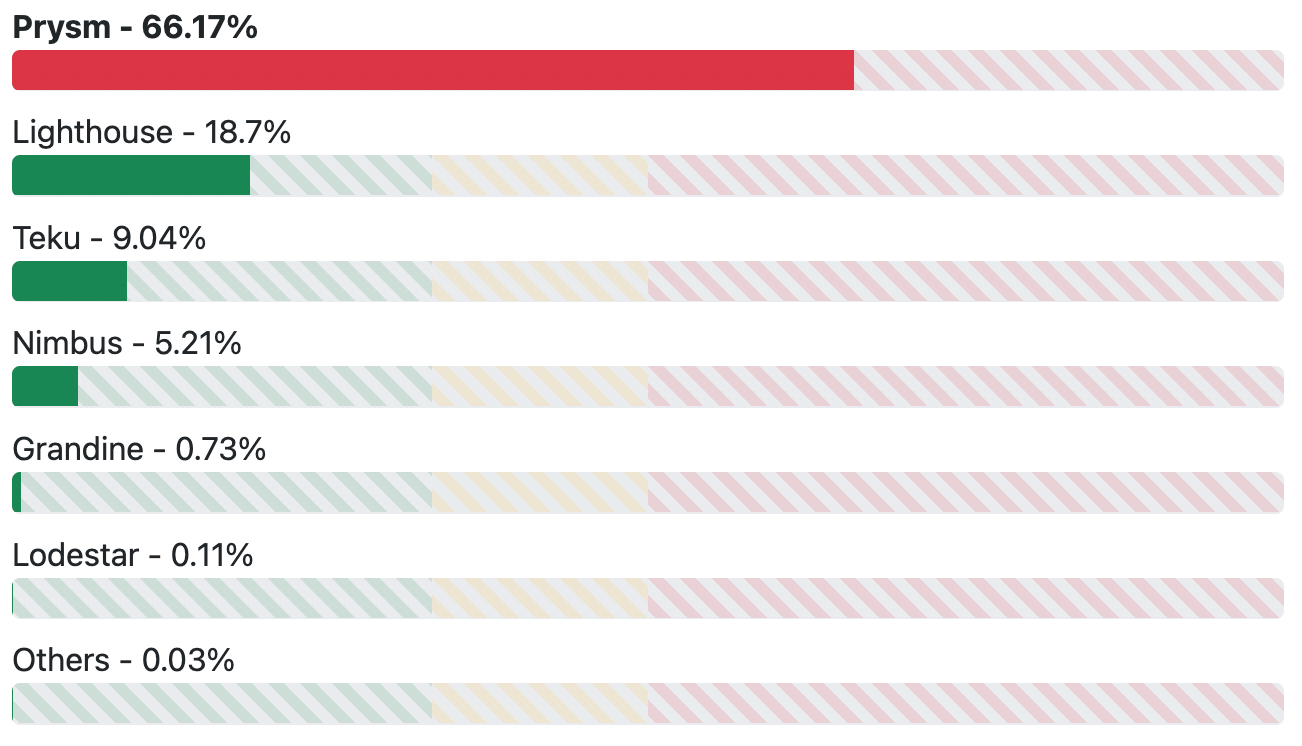
As of the first quarter of 2022, the Ethereum network faces a precarious situation: the Prysm client, developed by Prysmatic Labs, commands a supermajority of approximately 66% of the consensus layer’s staking power. While Prysm is widely regarded as a high-quality, stable implementation, its sheer dominance nullifies the safety benefits of having multiple clients. If a consensus-breaking bug were discovered in Prysm today, the entire Ethereum PoS chain would finalize that error.
Industry experts and core developers point to several factors for Prysm’s market lead. Marius van der Wijden, an Ethereum core developer, notes that Prysm benefited significantly from a "first-mover advantage." It was the first client to provide a functional prototype for the Beacon Chain, allowing it to build a robust suite of documentation, tooling, and a user-friendly Web UI long before its competitors. Furthermore, Prysm is written in Go (Golang), the same language as Geth, the dominant execution client. This familiarity makes it the natural choice for developers and auditors who are already comfortable with the Ethereum codebase.
Institutional Staking and the Concentration of Power
The client diversity issue is exacerbated by the centralization of staking through major exchanges and service providers. Because running a validator requires 32 ETH—a significant capital barrier for many—users often turn to staking pools or "staking-as-a-service" platforms. These entities manage thousands of validators on behalf of their customers, and their choice of software has a disproportionate impact on network health.
Data reveals that the largest contributors to the Prysm supermajority are major centralized exchanges:
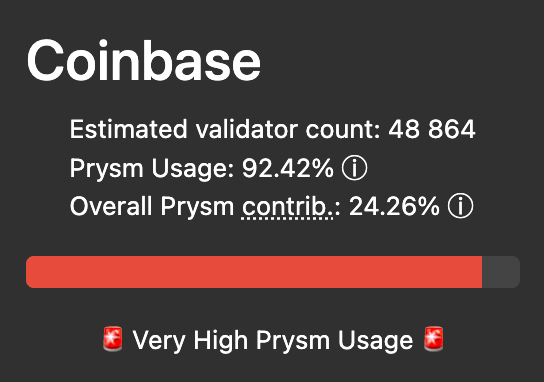
- Coinbase: Managing over 48,000 validators (approx. 17.5% of the network), Coinbase runs roughly 92% of its infrastructure on Prysm.
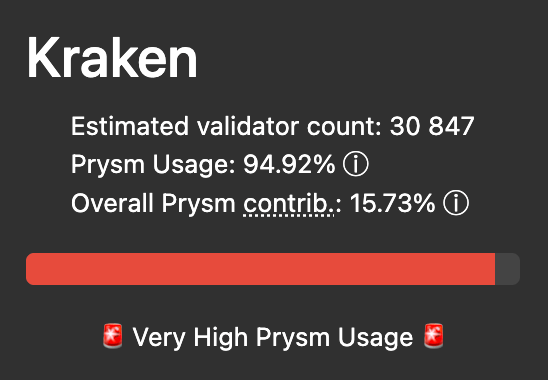
- Kraken: With over 30,000 validators (approx. 11% of the network), Kraken’s Prysm usage stands at nearly 95%.
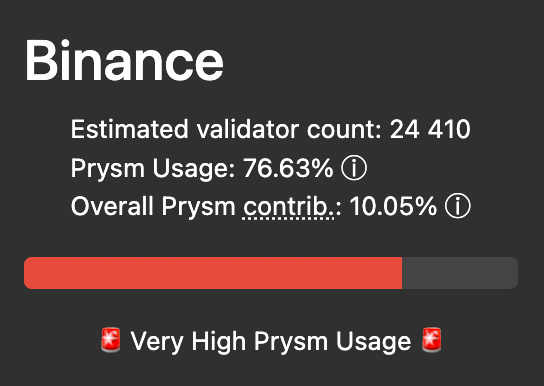
- Binance: Holding a 10% share of the consensus power, Binance also leans heavily on Prysm.
When questioned about these choices, institutional providers often cite security and stability. Coinbase, for instance, noted that when it launched its staking services, Prysm was the only client that supported "remote signers." This feature allows validator keys to be stored in isolated, secure environments rather than on the validator server itself, a requirement for institutional-grade security. Similarly, Kraken representatives stated that Prysm’s maturity made it the most viable solution during the early stages of the Beacon Chain.
Efforts Toward Mitigation and Rebalancing
The Ethereum Foundation and core developers are actively working with these large-scale stakers to diversify their infrastructure. There are signs of progress; Kraken has confirmed it is beginning to migrate a portion of its validators to the Teku client. Coinbase has also indicated it is working to integrate the Lighthouse client into its stack now that Lighthouse supports remote signing.
In the decentralized sector, Rocket Pool has emerged as a leader in diversity. Unlike its centralized counterparts, Rocket Pool’s node operators are highly distributed, with only about 10% utilizing Prysm. This demonstrates that while Prysm is the easiest "out-of-the-box" solution, a more balanced distribution is possible with intentional effort.
Marius van der Wijden has emphasized that switching clients is a relatively safe procedure for node operators. By ensuring a "slashing protection" database is migrated or by waiting for a short period (at least seven minutes) between shutting down one client and starting another, operators can avoid the risk of "double-signing," which results in financial penalties.
Chronology of the Transition
To understand the urgency of the client diversity issue, one must look at the timeline leading toward The Merge:
- December 201, 2020: The Beacon Chain launches, marking the beginning of the PoS era in a "test" capacity without handling actual transaction data.
- October 2021: The Altair upgrade is successfully implemented on the Beacon Chain, proving the network can undergo seamless hard forks under PoS.
- December 2021 – March 2022: Developers launch various testnets, such as Kintsugi and Kiln, to simulate The Merge environment. These tests help identify bugs in the interaction between execution and consensus clients.
- Mid-2022 (Target): The official Merge on the Ethereum mainnet. At a specific "Total Difficulty" threshold, PoW mining will cease, and the Beacon Chain will take over the production of blocks.
Long-term Implications and Risk Assessment
Despite the current imbalance, the Ethereum core development team remains committed to the mid-2022 timeline. The consensus among developers is that while the risk of a Prysm-related failure is non-zero, it is statistically low. The community relies on extensive "fuzzing"—a type of automated testing that searches for edge cases—to ensure all clients behave identically under various conditions.
However, a stern warning has been issued to the staking community: there will be no "bailouts." If a supermajority client experiences a consensus failure and causes stakers to lose funds or be slashed, the Ethereum protocol will not be rolled back to save them. This "social consensus" serves as a powerful economic incentive for large stakers to diversify their software before The Merge occurs.
The successful execution of The Merge will be a landmark achievement in computer science, reducing Ethereum’s energy consumption by more than 99.9% and setting the stage for future scalability upgrades like sharding. Yet, the road to this sustainable future is paved with technical complexities. The challenge of client diversity highlights a fundamental truth of decentralized systems: true security is not just a matter of robust code, but of a balanced and distributed ecosystem where no single entity or software implementation holds the power to break the whole. As the "engine swap" approaches, the pressure is on the industry’s largest players to move away from the convenience of the majority and toward a more resilient, multi-client future.