admin
admin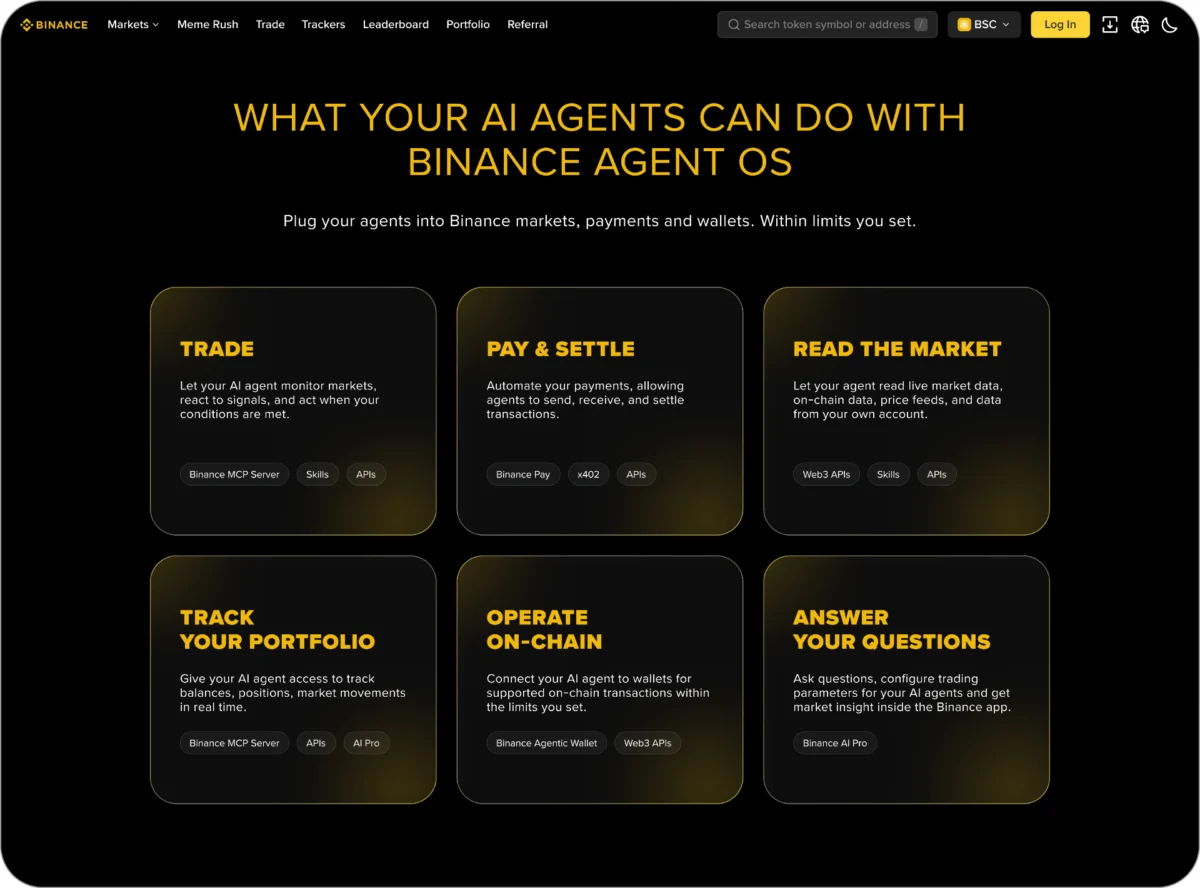
The global landscape of cryptocurrency trading underwent a significant transformation this week as Binance, the world’s largest digital asset exchange by trading volume and user base, announced the official launch of Agent OS. This new platform is designed to allow artificial intelligence agents to analyze market trends, manage portfolios, and execute complex trading strategies autonomously on behalf of users. By integrating autonomous AI directly into its financial infrastructure, Binance is signaling a shift from human-centric trading interfaces toward a future where "agentic" workflows handle the heavy lifting of wealth management.
With a registered user base exceeding 300 million, Binance’s move represents the most significant mainstream adoption of AI agents in the financial sector to date. Agent OS is not merely a trading bot; it is a comprehensive development environment that allows third-party AI applications—ranging from OpenAI’s ChatGPT and Codex to Anthropic’s Claude Code and the coding assistant Cursor—to interact directly with the exchange’s liquidity and backend services.
The Architecture of Agent OS: Bridging AI and Finance
At its core, Agent OS serves as a middleware layer that translates the reasoning capabilities of Large Language Models (LLMs) into actionable financial commands. The platform brings together several existing and new Binance services into a unified ecosystem. Key components include the Binance Wallet Agentic Hub, the Binance Skill Hub, and the recently introduced support for the Model Context Protocol (MCP).
The inclusion of the Model Context Protocol is particularly noteworthy. MCP is an open standard that allows AI models to seamlessly connect to data sources and tools without the need for custom, one-off integrations for every new application. By adopting this protocol, Binance ensures that developers can build agents that are "platform-agnostic," capable of pulling data from diverse sources while executing trades on the Binance infrastructure.
Furthermore, the platform utilizes the Binance x402 transaction verification and payment facilitator API. This component is essential for agents that need to perform micro-payments or settle transactions across different blockchain networks. Through these tools, an AI agent can be programmed to monitor a specific set of decentralized finance (DeFi) protocols, identify arbitrage opportunities, and execute the necessary swaps and transfers without human intervention.
User Control and the "Sandbox" Security Model
As the industry moves away from simple chatbots that provide information toward agents that take physical action in financial markets, the risks associated with AI errors or "hallucinations" have become a central concern. Binance has addressed these risks by placing the burden of governance and limit-setting squarely on the user.
Jeff Li, Vice President of Product at Binance, emphasized in a recent technical briefing that the platform was built with "granular access control" as a priority. Rather than granting an AI agent full access to a user’s primary account, Binance utilizes a "subaccount" system. This architecture creates a logical "sandbox" around the agent’s activities.
"Instead of total freedom, we put the power in users’ hands to give them the granular access control of what they can do through the agent," Li stated. "We put [the control] at the account level to protect the users’ funds."
Under this model, users must manually transfer funds into a dedicated subaccount before an agent can begin trading. Withdrawals from these subaccounts are blocked by default, preventing a compromised or malfunctioning agent from draining assets to external wallets. Additionally, users can toggle settings to require manual approval for every trade or allow the agent to operate autonomously within the confines of the subaccount’s balance.
The Evolution of Algorithmic Trading: A Chronology
The launch of Agent OS is the latest milestone in a decades-long evolution of automated trading. To understand the significance of Binance’s new platform, it is necessary to look at the chronology of how technology has reshaped market participation:
- The 1980s and 90s: The rise of quantitative trading and early algorithmic "program trading" on Wall Street. These systems were rule-based and lacked any form of predictive "intelligence."
- 2010–2020: High-frequency trading (HFT) becomes dominant. Algorithms begin using machine learning to identify patterns in micro-second intervals, but they remain highly specialized and narrow in scope.
- 2022: The public release of ChatGPT and other LLMs changes the paradigm. For the first time, non-programmers can use natural language to describe complex strategies.
- Early 2024: Rival exchanges begin testing the waters. Kraken launches its open-source command-line tool with a built-in MCP server in March. Coinbase follows in June with "Coinbase for Agents," focusing on on-chain payments and financial workflows.
- Late 2024: Binance enters the fray with Agent OS, leveraging its massive liquidity and global reach to provide a more integrated "operating system" for AI-driven finance.
Technical Limitations and the "Black Box" Challenge
Despite the sophistication of Agent OS, Binance admits there are significant visibility gaps. Because the AI’s "reasoning"—the logical steps it takes to decide on a trade—occurs on the user’s local machine or within a third-party AI provider’s cloud (like OpenAI or Anthropic), Binance cannot see why a trade was made.
"We really cannot see the reasoning of what the user’s action is," Jeff Li noted. This creates a "black box" scenario where the exchange can monitor the output (the trade) but not the input (the data or prompt that triggered it).
This lack of visibility poses a unique challenge for risk management. If an agent is manipulated via a "prompt injection" attack—where a malicious actor tricks the AI into executing a harmful command through clever phrasing—the exchange’s primary defense remains the subaccount limit. Binance has confirmed that its standard anti-money laundering (AML) and security protocols will apply to all Agent OS transactions, but the responsibility for "logical" security rests with the user and the agent developer.
Supporting Data: The Growing Market for AI in Crypto
The intersection of AI and crypto is one of the fastest-growing sectors in the technology world. According to market data, AI-related crypto tokens and projects saw their total market capitalization surge from under $2 billion in early 2023 to over $25 billion by mid-2024.
While traditional algorithmic trading accounts for roughly 70% to 80% of volume in the U.S. equities market, the crypto market has historically been more driven by retail sentiment. However, the introduction of tools like Agent OS is expected to shift the crypto market toward a similar "algo-dominant" structure.
Binance’s internal projections suggest that by offering a platform that reduces the barrier to entry for building trading bots, they can capture a larger share of the "pro-sumer" market—users who are not institutional hedge funds but have the technical savvy to deploy AI-driven strategies.
Transactional Boundaries and Daily Limits
To mitigate the systemic risk of automated trading, Binance has implemented strict daily transaction limits for its Agentic Wallet, which handles on-chain activities. These limits differ from the exchange-based trading limits, which are only restricted by the amount of capital in the subaccount.

| Transaction Type | Daily Limit (USD) |
|---|---|
| Regular Token Swaps | $50,000 |
| DeFi Protocol Transactions | $100,000 |
| x402 Payments (Micro-payments) | $20 |
These caps are designed to prevent "flash crashes" or mass liquidations that could be triggered by poorly programmed agents interacting with decentralized protocols. The $20 limit on x402 payments is particularly interesting, suggesting that Binance views agent-to-agent micro-payments as a high-frequency but low-value activity, likely used for paying for data API calls or small service fees.
Competitive Landscape: The Race for the "AI Exchange"
Binance is far from alone in this pursuit. The "agentic" race has become the new frontline for crypto exchanges seeking to retain their most active users.
- Kraken: Their March launch of a command-line interface (CLI) with MCP support targeted the most technical segment of the developer community, focusing on speed and open-source transparency.
- Coinbase: With "Coinbase for Agents," the San Francisco-based exchange focused heavily on the "on-chain" economy, allowing agents to hold their own keys and interact with the Base Layer-2 network.
- OKX: The exchange introduced an "Agent Trade Kit" earlier this year, focusing on providing an open-source toolkit for developers to build bespoke trading interfaces.
Binance’s advantage lies in its "Skill Hub" and "Agentic Hub," which function almost like an app store for trading behaviors. This could allow less technical users to "plug and play" pre-built skills into their agents, potentially democratizing access to high-level trading strategies that were previously reserved for elite quantitative firms.
Broader Implications and Future Outlook
The launch of Agent OS raises fundamental questions about the future of financial regulation and market stability. If a significant portion of a 300-million-user platform begins delegating decisions to AI, the speed of market reactions could accelerate beyond human comprehension.
From a regulatory perspective, the "black box" nature of AI reasoning may complicate efforts to monitor for market manipulation. If an agent decides to "pump" a low-liquidity token based on a misunderstood social media post, determining intent—a key factor in legal cases—becomes nearly impossible.
However, the potential benefits are equally significant. AI agents can monitor markets 24/7, react to news in milliseconds, and execute complex hedging strategies that protect retail investors from sudden volatility. By automating the "boring" parts of portfolio management—such as rebalancing and tax-loss harvesting—Agent OS could provide a level of financial sophistication previously unavailable to the average user.
Jeff Li described Agent OS as Binance’s "first step" in a much larger journey. As AI models become more capable and less prone to error, the boundaries of what these agents can do will likely expand. For now, the platform represents a high-stakes experiment in the fusion of silicon and silver, placing the world’s largest liquidity pool into the hands of autonomous code. The success of this initiative will depend not just on the brilliance of the AI, but on the ability of human users to set the right boundaries for their digital proxies.