admin
admin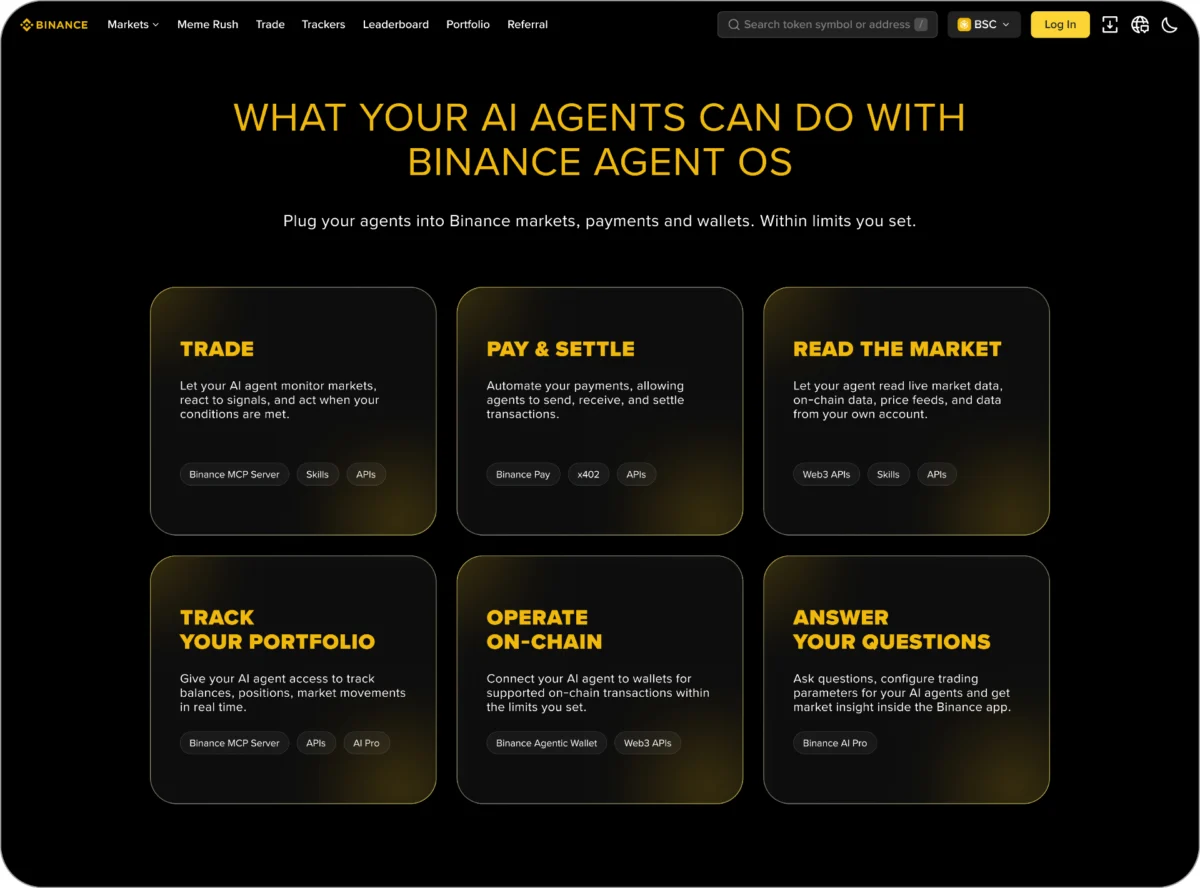
Binance, the global leader in the cryptocurrency exchange sector with a user base exceeding 300 million, has officially entered the frontier of autonomous finance with the launch of Agent OS. This new platform is designed to bridge the gap between large language models (LLMs) and active financial markets, allowing artificial intelligence agents to analyze real-time data, manage portfolios, and execute complex trades on behalf of users. The move signals a pivotal shift in the industry, transitioning from passive AI chatbots to active "agentic" systems capable of managing real-world capital within the world’s most liquid crypto ecosystem.
The launch of Agent OS marks a significant milestone for Binance, as it integrates its existing financial infrastructure with cutting-edge AI development protocols. By providing a unified environment for developers, Binance is positioning itself as the foundational layer for a new era of AI-driven decentralized and centralized finance.
The Technical Architecture of Agent OS
At its core, Agent OS is a comprehensive development environment that allows AI applications to interact directly with Binance’s extensive suite of financial tools. The platform leverages several key components to ensure seamless integration between silicon-based logic and financial execution.
One of the most notable technical inclusions is the support for the Model Context Protocol (MCP). Developed as an open standard, MCP allows AI models to easily access data sources and tools across different platforms without requiring bespoke integrations for every new application. By adopting MCP, Binance enables its platform to communicate fluently with the industry’s leading AI models, including OpenAI’s ChatGPT and Codex, Anthropic’s Claude Code, and the developer-centric tool Cursor.
Beyond MCP, Agent OS provides developers with access to:
- Binance APIs: High-speed interfaces for market data and order execution.
- Binance Wallet Agentic Hub: A specialized interface for managing digital assets through AI logic.
- Binance x402 Integration: A transaction verification and payment facilitator API that allows agents to handle settlement processes.
- Binance Skill Hub: A repository of pre-defined functions that agents can "learn" to perform specific financial tasks.
By combining these tools, developers can build agents that do not merely provide investment advice but actually log into authorized environments, monitor price fluctuations, and pull the trigger on trades based on pre-set parameters or autonomous reasoning.
Security and the "Sandbox" Philosophy
The introduction of autonomous agents into a high-stakes financial environment naturally raises questions regarding security, volatility, and the risk of catastrophic loss. Binance’s leadership has emphasized that while the agents are autonomous, they operate within a strictly defined "sandbox" controlled by the human user.
Jeff Li, Vice President of Product at Binance, noted in a recent briefing that the platform was built with "granular access control" as a priority. Rather than granting an AI agent full access to a user’s primary account, Binance utilizes a "subaccount" model. This structure serves as a primary line of defense.
"We put the power in users’ hands to give them the granular access control of what they can do through the agent," Li stated. "We put the control at the account level to protect the users’ funds."
Under this model, users transfer a specific amount of capital into a dedicated subaccount. The AI agent’s permissions are restricted to that specific environment. Crucially, Binance has disabled withdrawals from these subaccounts by default. This ensures that even if an agent is compromised or suffers from a logic error—commonly referred to in the AI industry as a "hallucination"—it cannot drain the user’s entire holdings or transfer funds to external wallets without explicit human intervention.
Furthermore, users can toggle between two modes of operation:
- Approval Mode: The agent analyzes the market and prepares an order, but a human must manually click "confirm" before the trade is executed.
- Autonomous Mode: The agent executes trades instantly based on its programmed logic, provided the transaction stays within the limits of the subaccount.
Transaction Limits and Financial Guardrails
While Binance does not impose a universal cap on the total volume of trades an AI agent can execute within the exchange (the limit is effectively the balance of the subaccount), it has established strict daily limits for on-chain activities and payments to mitigate systemic risk.
According to company documentation, the Agentic Wallet—which allows agents to interact with decentralized finance (DeFi) protocols and on-chain tokens—carries the following default daily restrictions:
- Standard Token Swaps: Capped at $50,000 per day.
- DeFi Protocol Transactions: Capped at $100,000 per day.
- x402 Payments and Settlements: Limited to $20 per day.
These tiered limits reflect the different risk profiles of exchange-based trading versus on-chain payments. The low $20 limit on x402 payments suggests that Binance is currently treating automated AI payments with extreme caution, likely to prevent the platform from being used for large-scale automated fraud or money laundering during this early adoption phase.
The "Black Box" Challenge: Visibility and Logic
One of the more complex aspects of Agent OS is the lack of visibility Binance has into the AI’s decision-making process. Because the "reasoning" behind a trade happens either on the user’s local hardware or within the servers of AI providers like OpenAI or Anthropic, Binance only sees the end result: the trade request.

"We really cannot see the reasoning of what the user’s action is," Jeff Li explained. This creates a "black box" scenario where the exchange can monitor what is happening, but not why.
This lack of visibility poses unique challenges for risk management. If an AI agent is manipulated via a "prompt injection" attack—where a malicious actor tricks the AI into following harmful instructions—Binance’s systems would perceive the resulting trade as a legitimate request from an authorized subaccount. Consequently, the responsibility for prompt security and the integrity of the AI’s logic rests almost entirely on the developer and the end-user.
A Chronology of the Agentic Shift in Crypto
The launch of Agent OS is not an isolated event but rather the latest move in an accelerating arms race among major crypto exchanges to capture the AI developer market.
- March 2024: Kraken launched an open-source command-line tool equipped with a built-in MCP server. This allowed early-adopter developers to begin scripting AI agents capable of spot and futures trading.
- June 2024: Coinbase introduced "Coinbase for Agents." This initiative focused on connecting AI to financial "workflows," allowing agents to create crypto wallets, trade assets, and even "earn" money through micro-tasks.
- Late 2024: OKX released its "Agent Trade Kit," an open-source toolkit designed to simplify the integration of LLMs with OKX’s trading engine.
- Present Day: Binance enters the fray with Agent OS, leveraging its massive 300-million-user base to bring these tools to a mainstream audience.
This timeline demonstrates that the industry has moved past the experimental phase. Exchanges are now competing to provide the most robust "operating system" for the next generation of traders: algorithms driven by natural language processing rather than traditional code.
Market Implications and Future Outlook
The broader implications of Agent OS are profound. For retail investors, this technology could democratize high-frequency and quantitative trading strategies that were previously the exclusive domain of hedge funds and institutional desks. An AI agent can monitor global news, social media sentiment, and technical indicators 24/7, reacting to market-moving events in milliseconds.
However, the proliferation of AI agents also introduces new market dynamics. If a significant portion of trading volume becomes driven by similar LLM logics, the market could see "flash crashes" or sudden bouts of extreme volatility if multiple agents react to the same signal simultaneously.
From a regulatory perspective, the rise of agentic trading remains a gray area. Regulatory bodies such as the SEC in the United States and ESMA in Europe have yet to issue specific guidelines on "autonomous financial agents." Binance’s strategy of using subaccounts and default withdrawal blocks appears to be a proactive attempt to self-regulate and minimize the potential for financial contagion or consumer harm.
As Agent OS matures, Binance intends to expand its capabilities. Jeff Li described the current launch as a "first step" toward a platform where AI-powered applications can act across both crypto and traditional financial markets. In the coming months, the industry will be watching closely to see if AI agents become the new standard for portfolio management or if the risks of autonomous reasoning prove too volatile for the high-stakes world of digital assets.