Dwi Wanna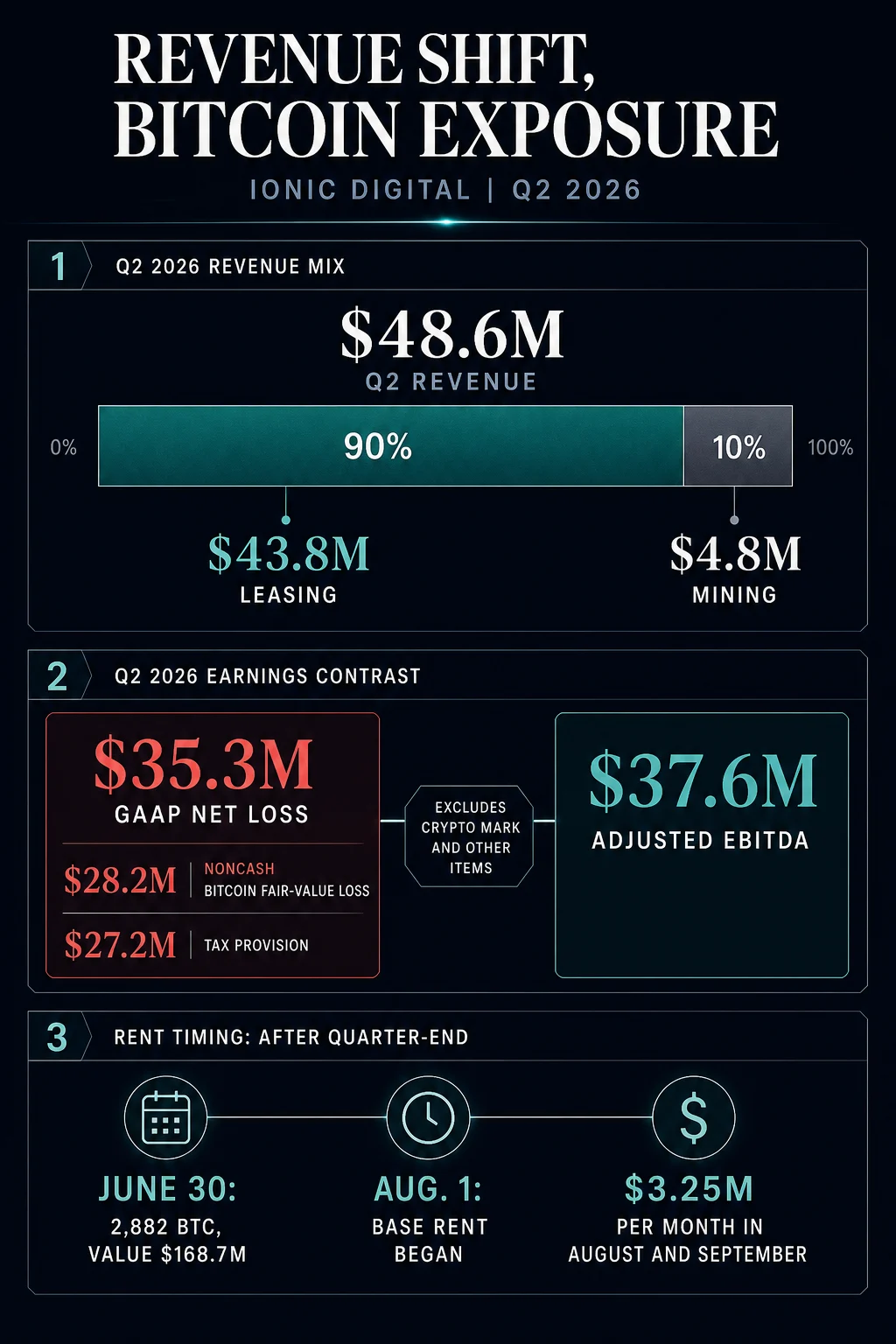
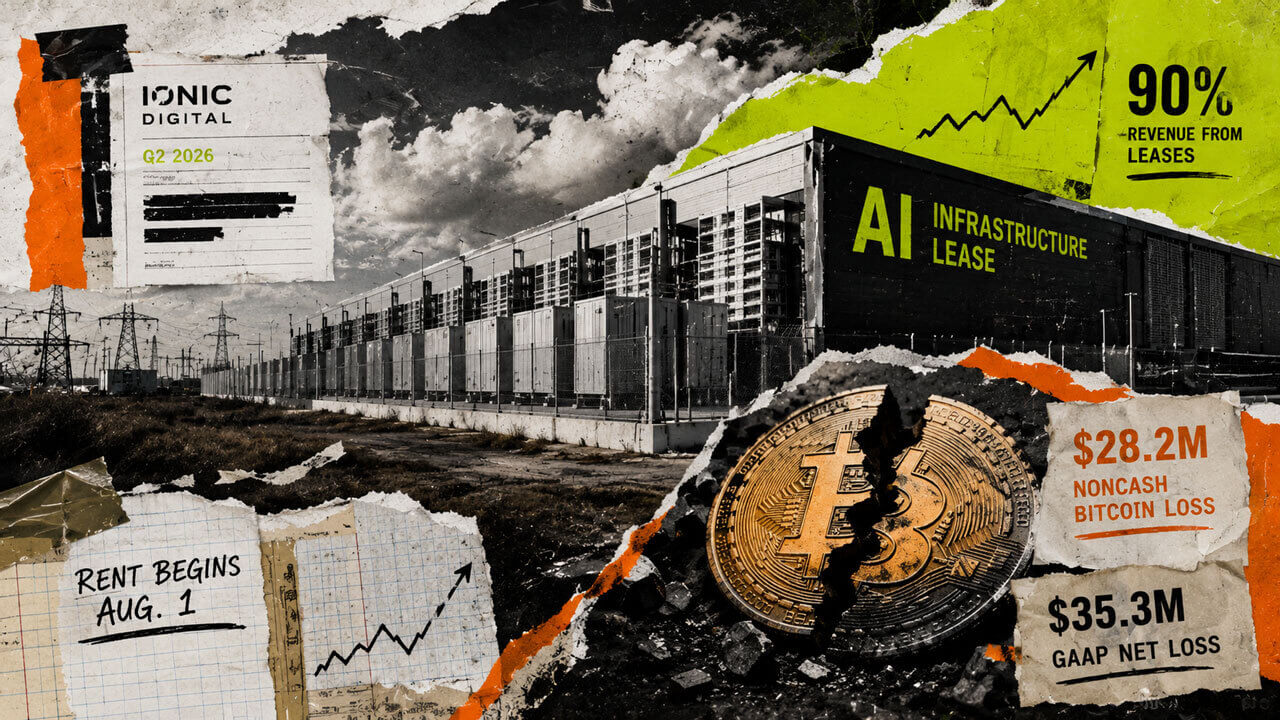
Ionic Digital has undergone a fundamental transformation in its business model, transitioning from a pure-play Bitcoin mining entity to a major provider of artificial intelligence (AI) infrastructure. According to the company’s second-quarter financial results for 2026, this strategic pivot is now clearly reflected in its balance sheet, with 90% of its operating revenue derived from leasing power-rich sites to AI infrastructure providers. However, despite the robust growth in its leasing segment, the company remains heavily exposed to the volatility of the cryptocurrency market. A $28.2 million non-cash fair value loss on its Bitcoin holdings significantly weighed on its bottom line, resulting in a GAAP net loss of $35.3 million for the quarter.
The shift in revenue composition marks a milestone for Ionic Digital as it seeks to capitalize on the global surge in demand for high-performance computing (HPC) and AI data centers. By repositioning its Ward County facilities, the company has effectively decoupled its primary revenue stream from the fluctuations of Bitcoin mining difficulty and the four-year halving cycle, moving toward a more predictable, contract-based income model.
Financial Performance and the AI Revenue Surge
In the second quarter of 2026, Ionic Digital reported total revenue of $48.6 million. Of this total, a staggering $43.8 million was generated through its leasing agreement with Nscale, an AI infrastructure provider. In contrast, traditional Bitcoin mining activities contributed only $4.8 million to the quarterly revenue. This 9:1 ratio underscores the speed at which Ionic has pivoted its operations toward the AI sector.
The lease revenue from the Ward County site was recognized on a straight-line basis, a standard accounting practice that spreads the total value of a lease over its duration. However, the company noted that recurring base rent payments from Nscale only officially commenced on August 1, 2026, which falls outside the second-quarter reporting period. This means that while the revenue was recognized in the accounts, the actual cash collection cycle for the recurring rent is just beginning.
Despite the strong top-line performance in the leasing sector, the company’s GAAP (Generally Accepted Accounting Principles) earnings were dragged into the red by its Bitcoin treasury. Ionic Digital held 2,882 BTC as of June 30, 2026, valued at approximately $168.7 million. A remeasurement of these assets led to a $28.2 million non-cash fair value loss. When combined with a $27.2 million tax provision, depreciation, and stock-based compensation, the company ended the quarter with a net loss of $35.3 million.
To provide investors with a clearer view of its operational health, Ionic reported an Adjusted EBITDA of $37.6 million. This non-GAAP measure excludes the impact of crypto price volatility, taxes, and other non-cash charges. Management indicated that this adjusted figure better reflects the core performance of the leasing and mining operations, independent of the market price of Bitcoin.
The Nscale Partnership and Lease Structure
The cornerstone of Ionic Digital’s current strategy is its relationship with Nscale. The Ward County operating lease, which officially began on December 19, 2025, involves providing 234 megawatts (MW) of power capacity for AI infrastructure.
The financial structure of this deal is complex, involving significant upfront payments and a tiered rent schedule:
- Initial Payment: Nscale provided a $45.6 million advance payment in November 2025 to secure the capacity.
- Ramp-up Phase: Recurring base rent began on August 1, 2026. For August and September, the payments are set at $3.25 million per month.
- Expansion Phase: Payments are scheduled to increase to $6.5 million per month in October and November, eventually reaching $9.75 million per month by December 2026 and January 2027.
- Future Capacity: A separate 89-megawatt expansion is currently in development. Once Ionic provides this additional capacity, it will trigger an additional $5.8 million in monthly rent.
This structured escalation reflects the time required to build out the specialized cooling and power distribution systems necessary for AI chips, which have significantly higher power density requirements than standard Bitcoin mining rigs.
Chronology of the Transition
The transition from a Bitcoin-centric operation to an AI infrastructure powerhouse has followed a rapid timeline over the past year:
- November 2025: Ionic Digital secures a $45.6 million advance from Nscale, signaling the start of its infrastructure pivot.
- December 19, 2025: The Ward County operating lease officially commences, and the company begins the process of retrofitting its power sites.
- Q1 2026: The company begins recognizing lease revenue on a straight-line basis while continuing to scale back its own proprietary mining operations.
- June 30, 2026: Ionic closes its Q2 books with 90% of revenue coming from AI leasing. The company reports holding 2,882 BTC.
- August 1, 2026: Recurring monthly rent payments from Nscale begin, marking the start of consistent cash inflows from the AI segment.
- Late 2026 (Projected): Rent payments are scheduled to triple as the full 234 MW capacity is utilized by Nscale’s high-performance computing hardware.
Liquidity and Capital Resources
Ionic Digital entered the second half of 2026 in a strong liquidity position, largely due to successful financing activities rather than operational cash flow. The company began the year with $43.5 million in cash and equivalents. During the first six months, it secured $400 million in financing proceeds, which significantly bolstered its reserves.
As of June 30, 2026, the company reported:
- Total Cash: $415.7 million.
- Bitcoin Holdings: $168.7 million (2,882 BTC).
- Debt: No outstanding borrowings.
The company utilized $25.9 million in cash for operations during the first half of the year and $1.8 million for investing activities. The substantial cash balance provides a buffer as the company waits for the tiered lease payments to reach their full $9.75 million monthly rate. It also provides the capital necessary to complete the 89-MW expansion, which is critical for future revenue growth.

Broader Industry Implications: The "Power Prize"
Ionic Digital’s shift is part of a broader trend within the cryptocurrency mining industry. Following the 2024 Bitcoin halving, which slashed the block reward for miners by 50%, many firms have found that their most valuable asset is not their fleet of mining rigs, but their long-term power purchase agreements (PPAs) and grid connections.
AI companies and cloud service providers are currently facing a massive shortage of data center space and electrical capacity. Bitcoin miners, who have spent years securing hundreds of megawatts of power in energy-friendly jurisdictions like Texas, are uniquely positioned to meet this demand.
By leasing their power capacity to AI firms, miners can achieve:
- Margin Stability: AI leasing typically offers fixed or predictable margins, whereas mining margins fluctuate with Bitcoin prices and global hashrate changes.
- Higher Valuation Multiples: Public markets often value "Compute-as-a-Service" and data center infrastructure companies at higher multiples than Bitcoin miners due to the perceived lower risk and recurring nature of the revenue.
- Diversification: Maintaining a Bitcoin treasury while earning USD-denominated rent allows companies to benefit from crypto upside while covering operational costs with stable cash flow.
Other major players in the space, such as CleanSpark and Core Scientific, have recently announced similar multi-billion dollar agreements to host high-performance computing infrastructure. Ionic Digital’s Q2 results serve as a "proof of concept" for this transition, demonstrating that a former miner can successfully convert the majority of its revenue to the AI sector within a single fiscal year.
Strategic Outlook and Risk Factors
While the Q2 report highlights a successful pivot, Ionic Digital faces several ongoing challenges. The most prominent is the "earnings sensitivity" created by its Bitcoin treasury. Even as the company’s operations move toward AI, its reported net income will remain at the mercy of the crypto market until it either sells its holdings or moves toward a different accounting treatment for digital assets.
Furthermore, the "straight-line" accounting method used for the lease revenue can sometimes mask the timing of actual cash receipts. Analysts will be closely watching the Q3 and Q4 reports to ensure that the transition from "recognized revenue" to "collected cash" proceeds as scheduled. The delivery of the additional 89-MW expansion also remains a key execution risk; any delays in providing that capacity could postpone the associated $5.8 million monthly rent.
Management remains optimistic, stating that the company’s focus is on maximizing the value of its power assets. By aligning with the AI infrastructure boom, Ionic Digital has positioned itself as a critical link in the global supply chain for artificial intelligence, leveraging the infrastructure originally built for the digital gold rush to power the next generation of computing.