admin
admin
The European Union’s comprehensive Markets in Crypto-Assets (MiCA) regulation, designed to harmonize and oversee the burgeoning digital asset market, is already exerting a significant influence on global cryptocurrency exchange operations, leading to a marked slowdown in new asset listings. While full implementation is slated for December, the initial phase concerning stablecoins, which went live at the end of June, has prompted exchanges worldwide to re-evaluate their strategies for engaging with the EU market. This regulatory tightening, coupled with persistent pressure in the United States, is creating a more cautious environment for crypto innovation and market expansion.
MiCA: A Unified Regulatory Front in the EU
MiCA represents a landmark effort by the European Union to establish a clear and consistent regulatory framework for crypto-assets. Unlike previous, more fragmented approaches, MiCA aims to provide a single set of rules applicable across all 27 member states. This ambitious regulation casts a wide net, encompassing various digital assets, including stablecoins, and dictating stringent requirements for their issuance, trading, and custody.
The regulation’s scope is notably broad, extending beyond the geographical confines of the EU. It imposes obligations on any entity offering crypto-asset services to EU customers, irrespective of their physical location. Furthermore, businesses utilizing the Euro in their operations are also subject to MiCA’s purview. This "extraterritorial scope" means that global exchanges and crypto service providers must comply with EU standards if they wish to serve European clients, significantly shaping international market dynamics.

The recent activation of stablecoin provisions under MiCA at the close of June has been a primary catalyst for immediate adjustments. Exchanges that previously listed stablecoins or intended to do so in the EU are now facing a more complex compliance landscape. This has led to proactive measures, such as Kraken’s reported consideration of delisting Tether (USDT) in Europe, a move that underscores the tangible impact of MiCA even before its full enforcement.
The Dual Impact of Regulatory Scrutiny: EU and US Pressures
The regulatory climate in the United States has also been a significant factor contributing to the global slowdown in crypto exchange listings. The increasing politicization of digital assets, particularly Bitcoin, as the 2024 US Presidential elections loom, has amplified uncertainty. This heightened political focus has translated into intensified scrutiny from regulatory bodies, leaving companies and exchanges operating in the US in a state of heightened caution.
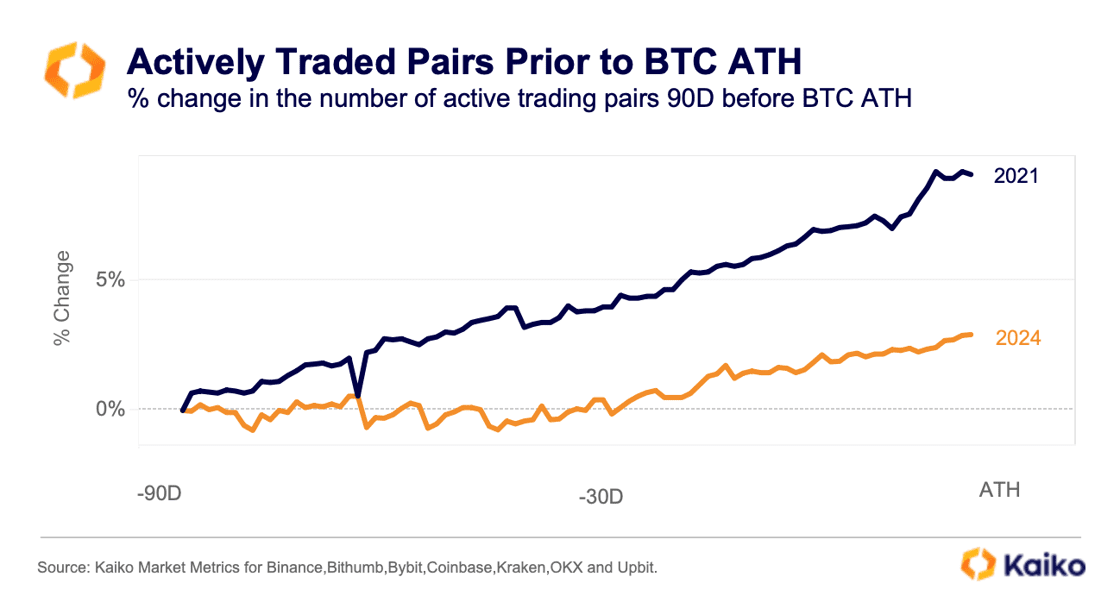
Data compiled by Kaiko, a cryptocurrency market data provider, illustrates a distinct trend: a noticeable deceleration in the rate at which new trading pairs are being listed on exchanges. This indicates a global sentiment of increased prudence among market participants.
A Shrinking Pipeline of New Listings: Data Insights
The peak of the 2021 bull run saw a rapid expansion of crypto exchange listings, with new trading pairs proliferating across major platforms. However, this growth trajectory has significantly flattened. Kaiko’s analysis reveals a substantial decline in the growth rate of new trading pairs. Before Bitcoin’s all-time high in 2021, the growth rate for new listings stood at approximately 9%. By contrast, in the lead-up to its 2024 peak, this rate had dwindled to a mere 3%.

This marked reduction in the pace of new listings suggests a more selective and risk-averse approach by exchanges. The stringent regulatory environments in key markets like the EU and the US are undoubtedly contributing factors, compelling exchanges to conduct more thorough due diligence and risk assessments before introducing new assets to their platforms.
Exchange-Specific Trends: Binance’s Slowdown and Bybit’s Resilience
Examining the data at an exchange level reveals nuanced trends. Binance, historically a dominant player in the market, has experienced a slower rate of growth in active trading pairs compared to its peers. The exchange’s active trading pairs are currently 14% below their 2022 peak. While MiCA is a contributing factor to this slowdown, Binance has also faced a confluence of global challenges.
The exchange has been navigating regulatory headwinds in various jurisdictions worldwide. Furthermore, the legal proceedings against its founder and former CEO, Changpeng Zhao, including charges and subsequent sentencing, have cast a long shadow. The legal battles faced by Binance.US in the past year have also played a substantial role in diminishing its perceived global dominance and, consequently, its capacity for rapid expansion.
In stark contrast, Bybit has demonstrated remarkable resilience and growth. The exchange has witnessed a surge in its active trading pairs, reaching an all-time high during the market rally observed in May. A key factor contributing to Bybit’s continued expansion appears to be its customer base, which is predominantly located in countries outside the EU. This geographical distribution means Bybit is less directly impacted by MiCA’s immediate effects.

A similar pattern is evident in Korean exchanges, notably Bithumb. These platforms have experienced rapid growth in new listings, with Bithumb’s new listings even outpacing Upbit. This surge has drawn the attention of South Korean authorities, who are still in the process of developing a comprehensive regulatory framework for the cryptocurrency industry. The rapid influx of new digital assets necessitates a robust oversight mechanism to ensure market integrity and investor protection.
Broader Market Implications and Emerging Market Dynamics
The aggregate effect of the slowed rate of new listings and a discernible shift towards stablecoin trading pairs is a deceleration in the overall growth momentum of the cryptocurrency market. Exchanges are becoming more cautious, prioritizing established assets and compliance over rapid, broad-based token introductions.
However, the narrative is not uniform across all markets. Emerging markets are exhibiting a different dynamic, demonstrating resilience and even increased demand for cryptocurrencies. This trend is often fueled by factors such as high inflation rates, currency volatility, and a relative absence of strict regulatory oversight, which can make cryptocurrencies an attractive alternative for value preservation and as a medium of exchange.
In these regions, the barriers to entry for new digital assets may be lower, and the appetite for alternative financial instruments higher. This creates a bifurcated global crypto landscape, with mature, heavily regulated markets experiencing a slowdown in listings, while emerging markets may continue to see innovation and expansion, albeit with their own set of risks and challenges.
The implications of this regulatory shift are far-reaching. For nascent crypto projects, securing exchange listings is becoming a more arduous and time-consuming process. This could potentially stifle innovation and slow down the adoption of new technologies and use cases. Investors, on the other hand, may benefit from increased security and transparency on major exchanges, but could also face a narrower selection of assets to trade.
The long-term impact of MiCA and similar regulatory initiatives in other major economies will likely shape the future trajectory of the crypto industry. The move towards greater regulatory clarity, while potentially creating short-term friction, is widely seen by industry analysts as a necessary step for the maturation and mainstream adoption of digital assets. The challenge for regulators and industry participants alike will be to strike a balance that fosters innovation while safeguarding market integrity and consumer protection. The current slowdown in new exchange listings serves as a clear indicator that this balancing act is well underway, with significant consequences for the global crypto ecosystem.