admin
admin
The European Union’s ambitious Markets in Crypto-Assets (MiCA) regulation is casting a long shadow over the global cryptocurrency landscape, significantly impacting the pace of new exchange listings. While designed to foster a more standardized and secure digital asset market across the EU, MiCA, alongside increasing regulatory scrutiny in other major economies like the United States, is prompting a more cautious approach from exchanges and token issuers worldwide. Data from leading crypto market intelligence firm Kaiko reveals a marked deceleration in the introduction of new trading pairs, signaling a global recalibration in response to evolving regulatory frameworks.
The comprehensive MiCA regulation, which aims to harmonize rules for crypto-asset issuers, service providers, and trading platforms within the EU, represents a significant step towards establishing a clear and consistent regulatory environment. Its scope extends beyond the 27 EU member states, encompassing any entity offering services to EU customers or utilizing the Euro, regardless of their physical location. While the full implementation of MiCA is not expected until December of this year, its initial phases, particularly the stablecoin legislation that took effect at the end of June, have already begun to influence market dynamics. This forward-looking legislation is not merely a regional adjustment; its "extraterritorial scope" means that global companies serving European clients must now align their operations with EU standards, leading to proactive adjustments even among non-EU headquartered entities.
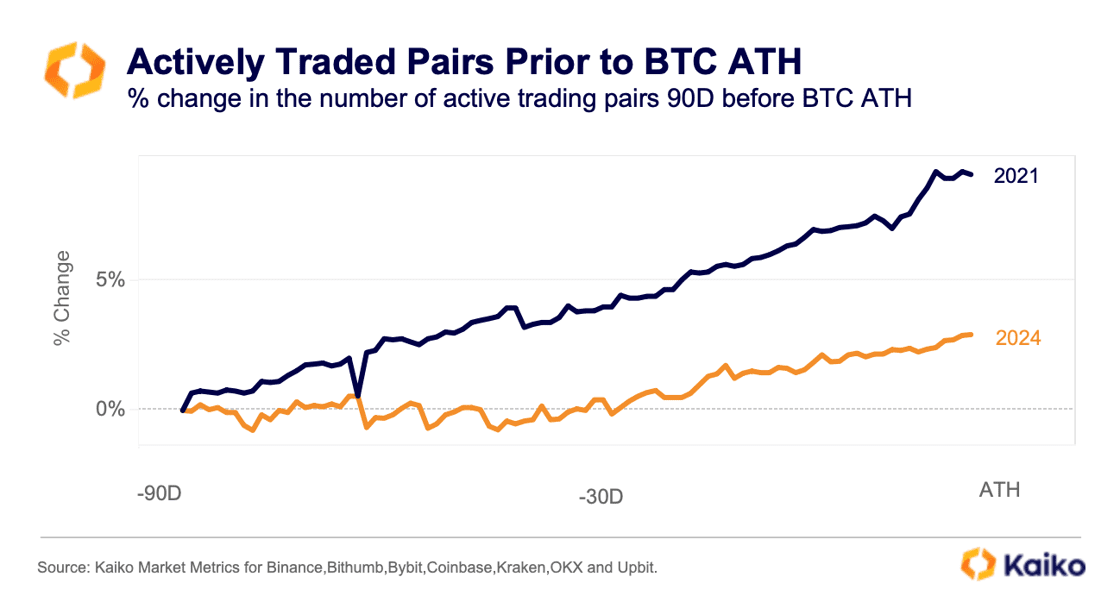
The impact of this heightened regulatory pressure is vividly illustrated by shifts in the rate of new exchange listings. Data compiled by Kaiko indicates a significant slowdown, particularly when compared to the frenetic activity seen during the 2021 bull run. Prior to Bitcoin’s all-time high in 2021, the growth rate of new trading pairs across major exchanges serving EU and US customers was approximately 9%. However, in the lead-up to the 2024 market peak, this growth rate has dwindled to a mere 3%. This dramatic reduction suggests a global trend of increased caution among market participants, driven by the need to navigate complex and evolving regulatory landscapes.
The MiCA Effect: Standardizing and Straining the Market
MiCA’s objective is to create a unified regulatory approach across the EU, providing clarity and consumer protection. The regulation addresses a wide spectrum of digital assets, including stablecoins, and establishes guidelines for their issuance, trading, and custody. While previous EU initiatives have touched upon crypto-assets, MiCA stands out as the first broad framework specifically targeting the burgeoning Decentralized Finance (DeFi) sector.
The extraterritorial reach of MiCA means that companies operating outside the EU but engaging with EU customers or the Euro are compelled to comply. This has already prompted significant strategic decisions. For instance, Kraken, a prominent global cryptocurrency exchange, has publicly acknowledged considering the delisting of Tether’s USDT stablecoin in Europe due to the anticipated compliance burdens and risks associated with MiCA’s stablecoin provisions. This move, if enacted, would represent a tangible consequence of the regulation, potentially impacting liquidity and trading options for a widely used stablecoin within the European market. Such considerations underscore the proactive measures companies are taking to align with the new regulatory reality, even before full implementation.
US Regulatory Landscape Fuels Global Caution
Simultaneously, the United States has been experiencing its own wave of intensified regulatory pressure on the crypto industry. The ongoing evolution of digital asset policy in the US, particularly in the lead-up to the 2024 Presidential elections, has created an environment of significant political and regulatory uncertainty. With cryptocurrencies, especially Bitcoin, increasingly becoming a focal point in political discourse, companies and exchanges operating within the US have found themselves on edge, anticipating potential shifts in policy and enforcement actions.

The US regulatory environment has been characterized by a series of enforcement actions and proposed rules from bodies such as the Securities and Exchange Commission (SEC) and the Treasury Department. These actions, often aimed at clarifying the classification of digital assets and the responsibilities of market participants, have instilled a sense of caution. The finalization of crypto broker tax reporting rules by the US Treasury and IRS, for example, adds another layer of compliance responsibility for exchanges and investors. This complex and often unpredictable US regulatory landscape, coupled with the EU’s proactive MiCA framework, contributes to a global environment where new listings are scrutinized more rigorously.
Analyzing the Data: A Shift in Listing Trends
Kaiko’s analysis of exchange listing trends provides a granular view of this market recalibration. The data illustrates a clear divergence in listing activity, with exchanges primarily serving the EU and US markets showing a marked slowdown.
Exchange-Specific Trends and Regulatory Impact:
-
Binance: The world’s largest cryptocurrency exchange, Binance, has experienced a slower pace of new trading pair introductions compared to its historical performance. The number of active trading pairs on Binance remains approximately 14% below its peak in 2022. While MiCA is a significant factor influencing this trend, Binance has also been navigating a series of global regulatory challenges. Legal troubles, including charges against its founder and former CEO, Changpeng Zhao, and the US Department of Justice’s pursuit of a substantial prison sentence and fine, have undoubtedly impacted its operational capacity and strategic decisions. Furthermore, the legal battles faced by Binance.US last year have contributed to a perceived reduction in its global dominance, indirectly affecting its listing strategies. The exchange’s efforts to comply with various international regulations, including MiCA, likely necessitate a more deliberate and selective approach to listing new assets.
-
Bybit: In stark contrast to exchanges facing direct regulatory headwinds in the EU and US, Bybit has demonstrated remarkable resilience and growth. The exchange has witnessed a surge in active trading pairs, reaching an all-time high during the market rally in May. This performance is largely attributed to Bybit’s customer base, which is predominantly located in regions outside the direct purview of MiCA. This geographical distribution allows Bybit to operate with less direct impact from the EU regulation, showcasing how regulatory frameworks can create market advantages for exchanges with different geographic focuses.
-
Korean Exchanges: Similar trends of rapid growth in new listings are observable in South Korean exchanges, most notably Bithumb. Bithumb has outpaced its domestic competitor, Upbit, in the introduction of new trading pairs. This surge in activity has, in turn, attracted increased regulatory attention within South Korea, highlighting that while some regions are establishing comprehensive frameworks like MiCA, others are still grappling with developing their own approaches to regulating the crypto industry. The rapid expansion on Bithumb suggests a strong demand for new digital assets in this market, even as authorities work to catch up on regulatory oversight.
The Broader Implications: Market Growth and Emerging Markets
The deceleration in new exchange listings, coupled with a noticeable shift towards stablecoin pairs, has contributed to an overall slowdown in the growth rate of the global crypto market. This suggests a maturing market where the focus is shifting from sheer volume of listings to quality, regulatory compliance, and stability.
However, the narrative is not uniform across all geographies. Emerging markets are demonstrating notable resilience and an increasing demand for cryptocurrencies. This demand is often fueled by macroeconomic factors such as high inflation, currency volatility, and a perceived lack of robust traditional financial infrastructure. In these regions, cryptocurrencies can offer an alternative store of value, a medium of exchange, or a hedge against economic instability. The less stringent regulatory environments in some of these emerging markets may also contribute to a more dynamic listing environment compared to highly regulated jurisdictions.
The Kaiko data, particularly the visual representation of active trading pairs, underscores the cyclical nature of the crypto market, with peaks coinciding with bull runs and troughs during periods of consolidation or regulatory uncertainty. The current trend indicates a move towards a more regulated and potentially more sustainable growth trajectory, albeit at a slower pace. The emphasis on stablecoin pairs, a trend partly driven by regulatory considerations and the desire for more predictable trading environments, further reflects this maturation.
The Future Outlook: Navigating a Complex Regulatory Terrain
As MiCA fully integrates into the EU’s financial landscape and regulatory bodies in other key jurisdictions continue to refine their approaches, the landscape for new exchange listings is likely to remain challenging. Companies seeking to list new tokens or expand their services will need to demonstrate a clear understanding of and commitment to regulatory compliance. This could lead to a more concentrated market, where established exchanges with robust compliance frameworks are better positioned to list new assets.
The long-term implications of this regulatory tightening are multifaceted. On one hand, it promises greater investor protection and market integrity, potentially attracting institutional capital and fostering broader adoption. On the other hand, it could stifle innovation and make it more difficult for nascent projects to gain traction. The differential impact on exchanges based on their geographic focus also highlights the potential for regulatory arbitrage, where companies may strategically choose to operate in jurisdictions with more favorable regulatory environments.
Ultimately, the current slowdown in new exchange listings is a direct consequence of the global cryptocurrency industry navigating an increasingly complex and demanding regulatory environment. While the path forward may be less about rapid expansion and more about measured growth and compliance, the underlying demand for digital assets, particularly in emerging markets, suggests that the industry will continue to evolve, albeit under stricter oversight. The strategic decisions made by exchanges and token issuers in response to MiCA and other regulatory pressures will shape the future trajectory of the digital asset market for years to come.