admin
admin
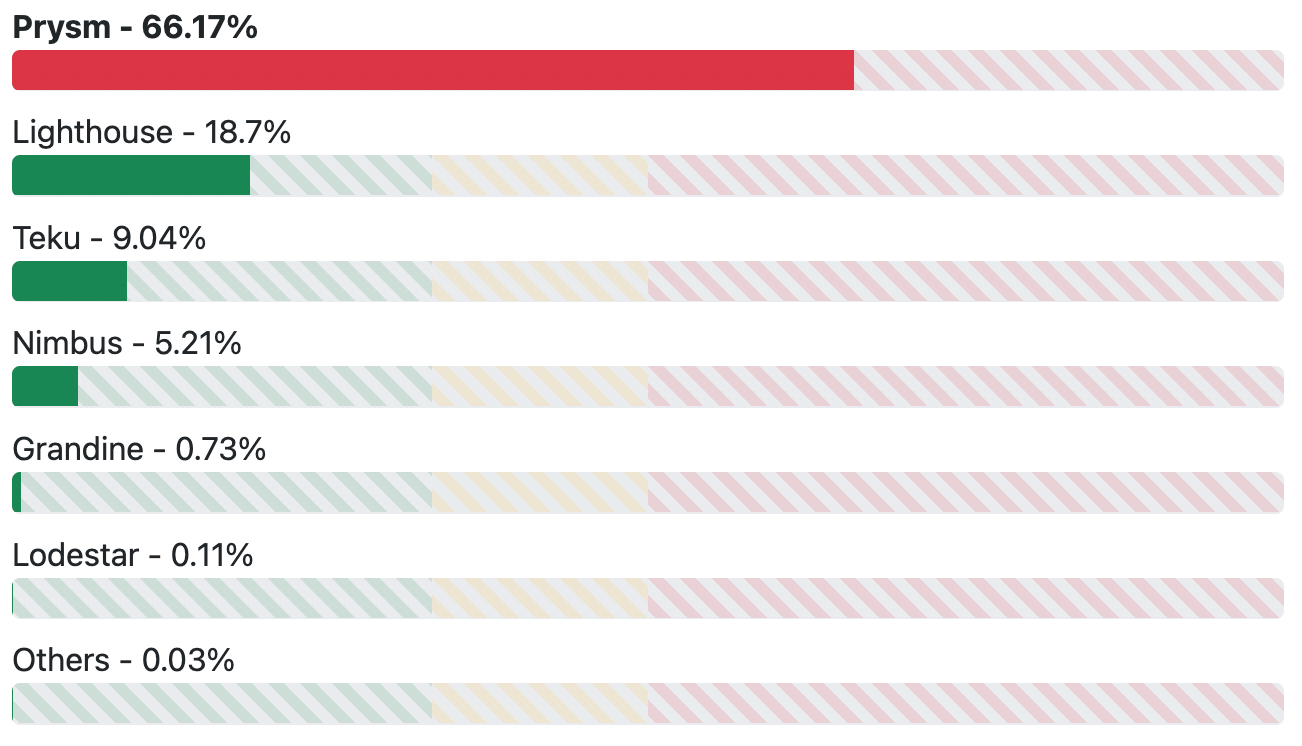
Central to the success of this transition is the concept of client diversity. Unlike many other blockchain protocols, such as Bitcoin, which largely rely on a single dominant software implementation (Bitcoin Core), Ethereum has deliberately fostered a multi-client ecosystem. This strategy is designed to ensure that a single software bug or vulnerability cannot take down the entire network. However, recent data has raised alarms within the developer community. As of early 2022, the Prysm client, developed by Prysmatic Labs, accounts for approximately 66% of the Ethereum Beacon Chain’s staking power. This supermajority creates a potential single point of failure that challenges the very resilience the Ethereum Foundation has sought to build.
The Architectural Shift: Execution and Consensus Layers
To understand the risks associated with client dominance, it is necessary to examine how Ethereum’s architecture will change post-Merge. Currently, Ethereum nodes handle both the execution of smart contracts and the validation of transactions within a single framework. After the transition, the node’s responsibilities will be bifurcated into two distinct layers: the Execution Layer and the Consensus Layer.

The Execution Layer will continue to host the Ethereum Virtual Machine (EVM), where transactions are processed and smart contracts are run. This layer will essentially use modified versions of existing software, such as Geth (Go-Ethereum). The Consensus Layer, represented by the Beacon Chain, will be responsible for the Proof-of-Stake logic, including the selection of block proposers and the management of the validator set. Every full node will need to run both an execution client and a consensus client. While these two components communicate with one another, they operate as separate logical layers. This separation is intended to enhance the robustness of the network, but it also means that the health of the blockchain is now dependent on the diversity of software used in both layers.
A Chronology of the Transition to Proof-of-Stake
The journey toward Proof-of-Stake has been years in the making, involving a series of meticulously planned phases designed to minimize risk.
- The Research Phase (2015–2018): Early Ethereum research, led by Vitalik Buterin and the Ethereum Foundation, focused on "Casper," a consensus protocol designed to bring PoS to the network.
- The Beacon Chain Launch (December 2020): The Beacon Chain was launched as a standalone PoS blockchain running in parallel with the main Ethereum PoW chain. This allowed the community to begin staking Ether (ETH) and testing the consensus logic without affecting live transactions.
- The Testnet Merges (Early 2022): Developers launched various testnets, such as Kintsugi and Kiln, to simulate the actual merging of the PoW and PoS chains. These environments were critical for identifying bugs in how execution and consensus clients interacted.
- The Mainnet Merge (Estimated Mid-2022): The final step involves a "Total Difficulty" trigger on the PoW chain, after which all subsequent blocks are produced by PoS validators.
Throughout this timeline, the Ethereum Foundation has advocated for the use of diverse clients including Lighthouse (written in Rust), Teku (Java), Nimbus (Nim), and Prysm (Go). Despite these options, the market has gravitated toward a single provider.
The Mathematical Risk of Client Supermajority
The danger of a single client controlling more than 66% of the network is rooted in the mathematical requirements for "finality" in the Ethereum PoS protocol. For a block to be considered finalized—meaning it cannot be reverted without a massive penalty to the validators—it must receive attestations from two-thirds (66.6%) of the active staking power.
If a consensus client has less than 33% market share and suffers a critical bug, the rest of the network can continue to function. The faulty nodes would simply go offline, and the network would continue to finalize blocks. The affected validators would face minor "inactivity leak" penalties, but the integrity of the blockchain would remain intact.
If a client controls between 33% and 50% of the network and fails, the blockchain stops finalising blocks because the remaining 66% threshold cannot be met. While the network continues to produce blocks, they are not "final," leading to uncertainty for exchanges and users.
However, if a client controls more than 66% of the network—as Prysm currently does—a bug that causes the client to follow an invalid chain would lead to that invalid chain being "finalized." In this scenario, the non-buggy clients would be on a separate, minority chain that cannot reach finality. This would essentially result in a permanent chain split. The community would be forced to choose between following a "buggy" chain or performing a manual hard fork to recover, a process that would be chaotic and potentially result in massive financial contagion.
Analyzing Prysm’s Dominance: The First-Mover Advantage
The reasons for Prysm’s overwhelming popularity are multifaceted. Marius van der Wijden, an Ethereum core developer, points to a "first-mover advantage." Prysm was the first implementation to provide a functional prototype of a Beacon client, allowing it to capture the early market of stakers. Because it had more time to mature, the team at Prysmatic Labs was able to develop superior documentation, a user-friendly Web UI, and robust tooling.
Furthermore, Prysm is written in the Go programming language (Golang), which is also the language used for Geth, the most popular execution client. For developers and system administrators already familiar with Geth, transitioning to Prysm felt natural. This familiarity lowered the barrier to entry for large-scale operations.
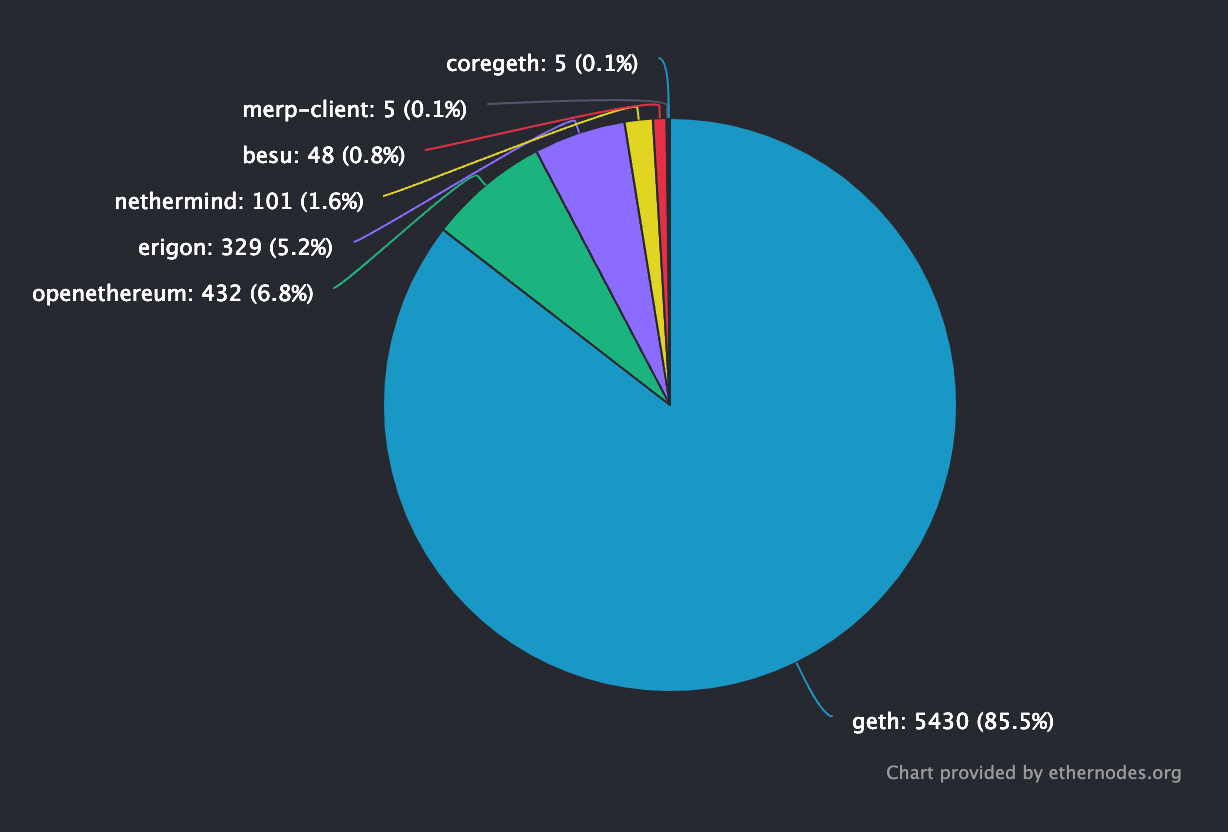
While Geth itself maintains a supermajority (roughly 85%) on the execution layer, developers argue this is less of a risk than a consensus supermajority. Post-merge, execution nodes primarily execute transactions, but they do not define the "truth" of the chain’s state in the same way consensus clients do. Nevertheless, the lack of diversity across both layers remains a point of contention for decentralization purists.
Institutional Contributors to the Diversity Crisis
The concentration of staking power is largely a result of the rise of centralized staking services. Because running a validator requires 32 ETH and technical expertise, many users turn to exchanges like Coinbase, Kraken, and Binance, or liquid staking protocols like Lido.
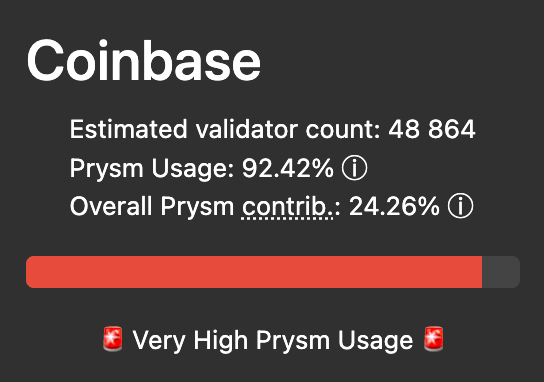
- Coinbase: With nearly 18% of all validators on the Beacon Chain, Coinbase is a massive player. Data suggests that over 92% of Coinbase’s validators run the Prysm client.
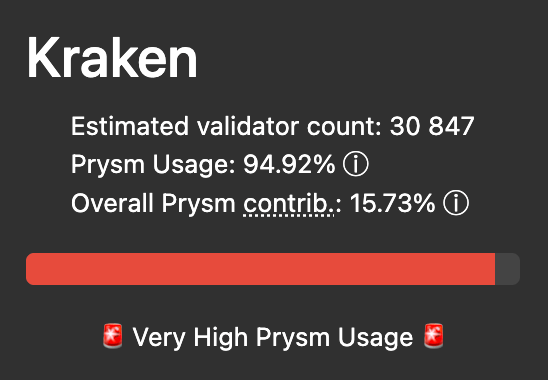
- Kraken: Holding roughly 11% of the validator set, Kraken reports a Prysm usage rate of approximately 95%.
- Binance: Accounting for nearly 9% of validators, Binance uses Prysm for roughly 76% of its operations.
- Lido: As the largest liquid staking provider with 18% of validators, Lido has a more diverse profile but still relies on Prysm for 42% of its infrastructure.
When questioned about this reliance, institutions often cite security and stability. Coinbase Cloud noted in a public statement that when they launched their staking services, Prysm was the only viable client that supported "remote signers." This feature allows validator keys to be stored in isolated, secure environments rather than on the validator server itself, which is a prerequisite for institutional-grade security.
Kraken’s Senior Product Manager, Brian Hoffman, echoed these sentiments, stating that Prysm was chosen for its maturity. However, he confirmed that Kraken has begun migrating some validators to the Teku client following discussions with the Ethereum Foundation.
The Counter-Example: Rocket Pool and Decentralized Staking
In contrast to the centralized exchanges, Rocket Pool—a decentralized staking protocol—demonstrates that diversity is possible. Rocket Pool accounts for a smaller fraction of the network (under 1%), but only about 10% of its node operators use Prysm. This is largely because Rocket Pool encourages its community of independent node operators to choose from a variety of clients, providing documentation and support for Lighthouse, Nimbus, and Teku alongside Prysm.
The success of Rocket Pool in achieving client diversity suggests that the issue is not a lack of viable alternatives, but rather a lack of urgency or technical inertia among the largest holders of ETH.
Expert Analysis: Is The Merge Safe to Pursue?
Despite the clear risks associated with the 66% supermajority, Ethereum’s core developers remain committed to the mid-2022 timeline. Marius van der Wijden expressed confidence that the transition is safe to pursue, noting that the community has "great testing and fuzzing infrastructure" that runs continuously to find discrepancies between clients.
However, the developer community has issued a stern warning to stakers: there will be no "bailouts." If a supermajority client suffers a consensus failure and causes a chain split, validators on the buggy chain will face significant financial penalties through the "slashing" mechanism. This protocol-level punishment is designed to make it prohibitively expensive to participate in a faulty consensus. The message is clear: the risk of running a majority client is not just a theoretical concern for the network; it is a direct financial risk to the stakers themselves.
Broader Implications for the Blockchain Industry
The resolution of the client diversity issue will have long-lasting implications for the blockchain industry. If Ethereum successfully navigates The Merge despite the Prysm supermajority, it will prove that a complex, multi-client ecosystem can survive a major upgrade. If, however, a bug occurs, it could serve as a cautionary tale about the dangers of software monocultures in decentralized systems.
The move to Proof-of-Stake is expected to reduce Ethereum’s energy consumption by more than 99.9%, addressing one of the primary criticisms of blockchain technology. It also introduces a "deflationary" aspect to the tokenomics of Ether, as the issuance of new coins will drop significantly. While these benefits are highly anticipated by investors, they are secondary to the fundamental requirement of network stability.
As the industry moves closer to the transition date, the pressure on exchanges and staking pools to diversify their infrastructure is mounting. The Ethereum Foundation continues to provide grants and support to minority clients like Lighthouse and Teku to ensure they are "Merge-ready." Ultimately, the safety of The Merge may depend less on the code itself and more on the willingness of the network’s largest stakeholders to prioritize long-term decentralization over short-term technical convenience.